
A New 'Computing-in-Memory' Chip Breaks the AI Bottleneck for 3D Vision
By performing calculations directly inside resistive memory, a new hardware-software system reconstructs 3D scenes with 47 times the energy efficiency of state-of-the-art GPUs.
By Factlen Editorial Team

- Hardware Architects
- Focus on breaking the von Neumann bottleneck and the massive energy efficiency gains of analog computing-in-memory.
- Medical Imaging Specialists
- Value the ability to reconstruct high-fidelity 3D medical images from sparse data without cloud processing.
- AI Algorithm Developers
- Emphasize the software-hardware co-design, specifically how neural fields and pruning techniques were adapted for physical memristors.
- Manufacturing Skeptics
- Point out the historical difficulties in scaling analog resistive memory reliably due to noise and cycle-to-cycle variability.
What's not represented
- · Cloud Computing Providers
- · Consumer Electronics Manufacturers
Why this matters
Modern AI relies on power-hungry GPUs that drain batteries by constantly shuttling data back and forth. This breakthrough allows complex 3D vision and medical imaging to run locally on low-power devices like AR glasses and portable scanners, without needing a cloud connection.
Key points
- A new AI system uses resistive memory to perform calculations directly where data is stored.
- The hardware-software co-design bypasses the energy-draining 'von Neumann bottleneck'.
- The prototype achieved up to 47.2 times greater energy efficiency than state-of-the-art GPUs.
- The technology could enable real-time 3D medical imaging and AR on low-power, portable devices.
Reconstructing 3D spaces from limited two-dimensional data is a foundational challenge for modern technology, underpinning everything from medical CT scans to augmented reality headsets.[6]
On the software side, "neural fields" have recently emerged as a powerful solution. Instead of storing a bulky, memory-intensive grid of 3D voxels, a neural network is trained to learn a continuous mathematical function that can generate the scene from any angle.[6][7]
However, rendering these complex neural fields on conventional computers is painfully slow and power-hungry. This inefficiency stems from the "von Neumann bottleneck"—a fundamental architectural flaw in modern processors where data must be constantly shuttled back and forth between memory chips and the CPU or GPU.[5]
The energy cost of this constant data movement now dominates the execution time for machine learning workloads. For portable devices like AR glasses or mobile medical scanners, the resulting battery drain makes real-time 3D reconstruction nearly impossible.[2][5]

A breakthrough study published in the journal Nature demonstrates a hardware-software co-design that completely bypasses this bottleneck. Researchers have developed an AI system that performs complex calculations directly inside the memory itself.[1][3]
The core technology driving this system is "resistive memory" (ReRAM). Unlike traditional RAM, which stores data as electrical charges that must be refreshed, ReRAM stores information as physical resistance levels within a solid material.[4][5]
This enables a paradigm called Computing-in-Memory (CIM). By exploiting basic physics—specifically Ohm's law and Kirchhoff's current law—a grid of resistive memory cells can perform massive matrix-vector multiplications in analog, right where the data lives.[1][5]
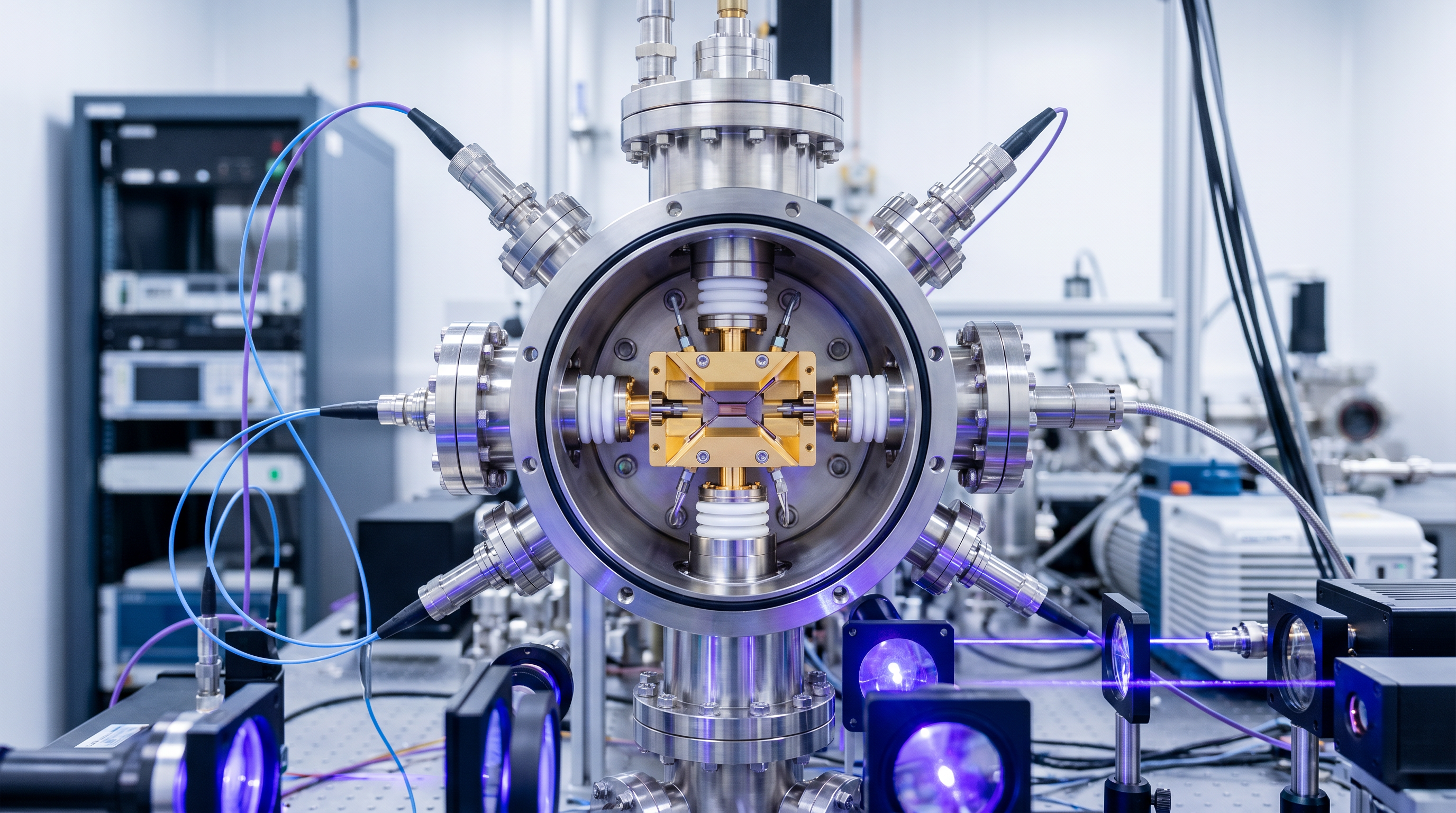
To prove the concept, the research team built a 40-nanometer, 256-kilobit in-memory computing macro chip specifically engineered to process neural fields.[1][4]
To prove the concept, the research team built a 40-nanometer, 256-kilobit in-memory computing macro chip specifically engineered to process neural fields.
Because physical memory arrays have strict size limits, the team had to adapt the software to fit the hardware. They compressed the neural field algorithms using low-rank decomposition and structured pruning, ensuring the model was small enough to reside entirely within the resistive memory array.[1][4]
The system also features a "Gaussian Encoder" that takes advantage of a unique quirk of analog hardware: its inherent randomness. The encoder harnesses the natural stochasticity of resistive memory formation to efficiently encode the sparse input data without requiring extra processing power.[1][4]
The performance gains achieved by this co-design are staggering. When tested on tasks like synthesizing new viewpoints of a 3D scene, the resistive memory system achieved up to a 47.2-fold improvement in energy efficiency compared to state-of-the-art GPUs.[1][4]

Speed also saw a massive boost. The architecture delivered up to a 38.8-fold increase in computational parallelism, meaning it can process vast amounts of spatial data simultaneously rather than sequentially.[1][4]
Crucially, these extreme efficiency gains did not come at the cost of accuracy. In 3D Computed Tomography (CT) sparse reconstruction tasks, the hardware achieved an average Peak Signal-to-Noise Ratio (PSNR) of 31.68 decibels, matching the visual fidelity of power-hungry software baselines.[1][4]
The implications for healthcare are profound. This technology could allow CT scanners to generate high-resolution 3D images from far fewer X-ray slices, drastically reducing radiation exposure for patients. Furthermore, the reconstruction could happen instantly on the machine itself, without needing to transmit sensitive data to a cloud server.[2][6][7]

Beyond medicine, the chip offers a clear path forward for "embodied AI." Robots and autonomous vehicles could map and understand their 3D environments in real-time using tiny, low-power chips, freeing them from heavy battery packs and tethered computing rigs.[2][3]
Despite the breakthrough, scaling this technology from a 256-kilobit prototype to the gigabyte capacities required for massive commercial AI models remains a significant manufacturing challenge. Analog components are inherently prone to "noise" and device-to-device variability that digital silicon avoids.[4][5]
To mitigate this analog noise, the researchers implemented a Hardware-Aware Quantization circuit that ensures precise weight mapping, proving that these physical quirks can be managed at a small scale.[1][4]
By proving that algorithms and physical memory structures can be co-optimized, this research signals a fundamental shift in AI hardware. The future of artificial intelligence may not rely solely on shrinking silicon transistors, but on reimagining the physical architecture of computation itself.[1][2][7]
How we got here
1945
John von Neumann outlines the computer architecture that separates processing and memory, creating the foundation for modern computing.
2007
Researchers propose nanoionics-based resistive switching memories as a highly scalable alternative to traditional RAM.
2020
Neural Radiance Fields (NeRFs) are introduced, revolutionizing 3D scene reconstruction but requiring massive GPU compute power.
April 2024
Researchers publish a preprint detailing a software-hardware co-design using resistive memory for neural field reconstruction.
June 2026
The peer-reviewed study is published in Nature, demonstrating a 47x energy efficiency boost over state-of-the-art GPUs.
Viewpoints in depth
Hardware architecture view
Focuses on the physical limitations of current processors and the necessity of in-memory computing.
For decades, processor speeds have vastly outpaced memory bandwidth, creating the 'von Neumann bottleneck.' Hardware architects argue that simply shrinking silicon transistors is no longer yielding proportional performance gains for AI workloads. By moving the computation directly into the memory array using resistive materials, this approach eliminates the energy-intensive data shuttling that currently throttles deep learning accelerators.
Medical imaging view
Prioritizes patient safety and the deployment of portable, high-fidelity diagnostic tools.
Medical researchers view this technology as a critical step toward low-dose diagnostics. Traditional 3D CT reconstructions require dense data, meaning higher radiation exposure for the patient. Neural fields can reconstruct accurate 3D models from sparse, low-dose inputs, but currently require massive cloud GPUs. A low-power, edge-computing chip would allow these advanced reconstructions to happen instantly at the patient's bedside or in mobile clinics.
Algorithm design view
Highlights the importance of co-optimizing software models to fit physical hardware constraints.
AI developers note that standard neural networks are designed for the precise, digital math of GPUs. Moving to analog resistive memory introduces physical noise and strict size limitations. This perspective emphasizes the ingenuity of using low-rank decomposition and structured pruning to shrink the neural fields, and leveraging the natural stochasticity of the hardware itself to encode data, proving that software must adapt to the physics of the chip.
Manufacturing and scaling view
Cautions that building a prototype is vastly different from mass-producing commercial chips.
While the 256-kilobit prototype is a remarkable proof-of-concept, manufacturing analysts point out that resistive memory has historically struggled with cycle-to-cycle variability and defect rates at scale. Ensuring that billions of analog memory cells behave uniformly across a massive commercial wafer remains a formidable engineering challenge. Until these yield issues are solved, standard digital GPUs will continue to dominate the market.
What we don't know
- How reliably the 40-nanometer resistive memory manufacturing process can scale from a 256-kilobit prototype to multi-gigabyte commercial chips.
- Whether the analog noise and device-to-device variability of resistive memory will degrade accuracy when applied to vastly larger, generalized AI models.
- How quickly consumer electronics manufacturers will adopt Computing-in-Memory architectures over entrenched, standardized GPU pipelines.
Key terms
- Computing-in-Memory (CIM)
- An architecture that performs calculations directly inside the memory array, eliminating the need to move data to a separate processor.
- Resistive Memory (ReRAM)
- A type of computer memory that stores data by altering the electrical resistance of a solid dielectric material.
- Neural Fields
- An AI technique that uses neural networks to represent continuous 3D scenes or objects, rather than storing them as discrete pixels or voxels.
- Von Neumann Bottleneck
- The performance limitation in traditional computers caused by the time and energy required to shuttle data between the CPU and memory.
- Peak Signal-to-Noise Ratio (PSNR)
- A mathematical metric used to measure the quality of a reconstructed image compared to the original; higher decibel values indicate better quality.
- Stochasticity
- The quality of lacking a predictable order or plan; inherent randomness, which this system uses to its advantage for data encoding.
Frequently asked
What is the 'von Neumann bottleneck'?
It is the delay and energy drain caused by constantly moving data back and forth between a computer's memory and its processor. It is a major limitation for modern AI.
How does resistive memory (ReRAM) work?
Instead of storing data as electrical charges like traditional RAM, ReRAM stores information by changing the physical electrical resistance of a material. This allows it to perform calculations directly where the data is stored.
What are 'neural fields' in AI?
Neural fields are a way for AI to represent 3D spaces. Instead of using a grid of 3D pixels (voxels), a neural network learns a continuous mathematical function to generate the scene from any angle.
Will this replace standard GPUs?
Not immediately. While highly efficient for specific tasks like 3D reconstruction, scaling analog resistive memory to handle massive, generalized AI models still faces manufacturing and reliability challenges.
Sources
Source coverage
7 outlets
4 viewpoints surfaced







[1]NatureAI Algorithm Developers
Efficient and accurate neural-field reconstruction using resistive memory
Read on Nature →[2]Bioengineer.orgMedical Imaging Specialists
Groundbreaking advance poised to transform medical imaging and embodied AI
Read on Bioengineer.org →[3]Upbeat BytesManufacturing Skeptics
Efficient and accurate neural-field reconstruction using resistive memory
Read on Upbeat Bytes →[4]arXivAI Algorithm Developers
Efficient and accurate neural field reconstruction using resistive memory
Read on arXiv →[5]Springer NatureHardware Architects
Non-volatile computing-in-memory based on memristive devices
Read on Springer Nature →[6]NIH National Library of MedicineMedical Imaging Specialists
Neural fields in biological image processing
Read on NIH National Library of Medicine →[7]Factlen Editorial TeamHardware Architects
Synthesis by Factlen editorial team
Read on Factlen Editorial Team →

More in science
See all 42 stories →Carbon Budget
Global Carbon Budget for 1.5°C Will Be Exhausted in Three Years, Major Climate Assessment Warns
7 sources

Longevity Science
How Sleep and Exercise Reprogram Aging Blood Cells to Prevent Heart Disease
4 sources

Cellular Aging
Sleep and Exercise Can Reprogram Mutant Blood Cells to Prevent Heart Disease
7 sources

Quantum Computing
Microsoft and Quantinuum Achieve 800-Fold Reduction in Quantum Error Rates
6 sources
Every angle. Every day.
Get science stories with full source coverage and perspective breakdowns delivered to your inbox.