
Microsoft and Quantinuum Achieve 800-Fold Reduction in Quantum Error Rates
A new Nature paper demonstrates a breakthrough in quantum error correction on a trapped-ion processor, bringing fault-tolerant quantum computing significantly closer to reality.
By Factlen Editorial Team
- Quantum Hardware Developers
- Focuses on the engineering milestones and the path to commercial utility.
- Theoretical Physicists
- Focuses on the rigorous demonstration of error correction mathematics on physical hardware.
- Industry Analysts
- Focuses on the competitive landscape and the scalability of different quantum architectures.
What's not represented
- · Classical Supercomputing Industry
- · Cryptographers preparing for post-quantum security
Why this matters
Quantum computers promise to solve problems in drug discovery and materials science that would take classical supercomputers millennia, but their extreme fragility to noise has held them back. This 800-fold reduction in error rates proves that the math of quantum error correction works on physical hardware, bringing the era of commercially useful quantum computing significantly closer.
Key points
- Researchers from Microsoft and Quantinuum achieved up to an 800-fold reduction in logical error rates on a trapped-ion quantum processor.
- The breakthrough relies on quantum low-density parity-check (qLDPC) codes combined with error detection and post-selection.
- Post-selection discards experimental runs with potential errors, dramatically increasing the fidelity of the remaining data.
- While a major milestone, the industry must still transition from post-selection to real-time error correction to achieve true fault tolerance.
In a landmark achievement for the field of quantum information science, researchers from Microsoft and Quantinuum have successfully demonstrated a massive reduction in quantum computing error rates. Published in the journal Nature, the study details how the team implemented highly optimized error-correcting codes on a programmable trapped-ion processor. By combining advanced quantum codes with a technique known as error detection and post-selection, the researchers achieved improvements in logical error rates ranging from 11-fold to a staggering 800-fold compared to the baseline physical error rates of the hardware. This milestone provides concrete experimental evidence that the theoretical frameworks designed to protect fragile quantum information can be successfully executed on physical machines, marking a pivotal leap toward fault-tolerant quantum computing.[1][2][3]
The core obstacle preventing quantum computers from fulfilling their transformative potential is their inherent susceptibility to noise. Unlike classical bits, which exist in a binary state of 0 or 1 and are remarkably stable, quantum bits—or qubits—exist in delicate superpositions that are easily disrupted by minute environmental fluctuations, such as changes in temperature or electromagnetic radiation. This phenomenon, known as quantum decoherence, causes the qubits to lose their quantum state, leading to computational errors. Furthermore, the physical operations used to manipulate qubits, known as quantum gates, also introduce a small but non-zero probability of error during every calculation.[5][6]
To overcome this fragility, theoretical physicists developed the concept of quantum error correction (QEC). Because the laws of quantum mechanics prohibit the direct copying of an unknown quantum state—a principle known as the no-cloning theorem—researchers cannot simply back up quantum data the way classical computers do. Instead, QEC works by encoding the information of a single, highly reliable "logical qubit" across an entangled array of many "physical qubits." By measuring the parity of the physical qubits without directly observing the encoded data, the system can detect and identify errors as they occur, preserving the integrity of the logical qubit even when individual physical qubits fail.[5]

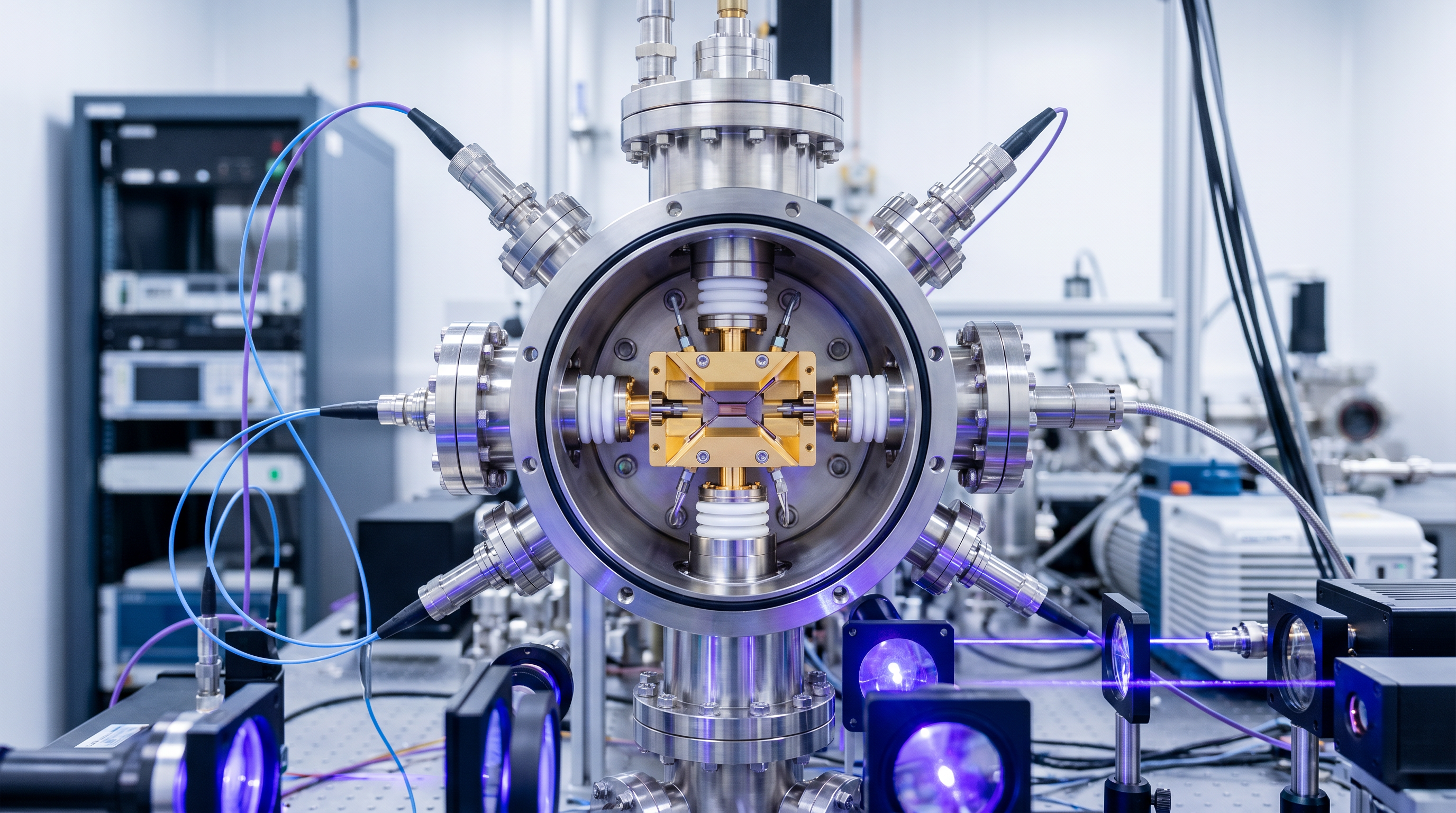
The recent Nature demonstration was executed on Quantinuum's cutting-edge trapped-ion quantum charge-coupled device (QCCD) architecture. In this specific modality, the physical qubits are individual charged atoms—ions—suspended in a vacuum using electromagnetic fields. These ions are manipulated with exquisite precision using targeted laser pulses to perform quantum gate operations. The QCCD architecture is particularly well-suited for advanced error correction because it boasts exceptionally long qubit coherence times and highly reliable two-qubit gate fidelities, which currently hover around 99.99% in state-of-the-art systems.[2][3][5]
A defining feature of the trapped-ion QCCD system is its ability to physically shuttle the ions across a grid of specialized zones within the processor. This mobility allows for arbitrary connectivity between qubits, meaning any qubit can interact with any other qubit in the system. This is a significant advantage over superconducting quantum processors, which are typically constrained to nearest-neighbor connectivity on a fixed two-dimensional grid. The flexible connectivity of the trapped-ion system enabled the researchers to implement complex quantum low-density parity-check (qLDPC) codes, which require long-range interactions between qubits that are difficult to achieve on rigid architectures.[3][4]
A defining feature of the trapped-ion QCCD system is its ability to physically shuttle the ions across a grid of specialized zones within the processor.
While the hardware provided a pristine foundation, the dramatic 800-fold reduction in error rates was achieved through a specific operational technique known as post-selection. In a fully fault-tolerant quantum computer, errors would be detected and actively corrected in real-time while the algorithm continues to run. However, real-time correction requires immense classical computing overhead and incredibly fast feedback loops that remain technologically challenging. Instead of attempting to correct every detected error on the fly, the Microsoft and Quantinuum team used their error-correcting codes to flag experimental runs where an uncorrectable error likely occurred.[1][3]
Once these corrupted runs were flagged, the researchers simply discarded them from the final dataset—this is the essence of post-selection. By selectively filtering out the outcomes tainted by potential errors, the fidelity of the remaining, unflagged data skyrocketed. This post-selection process, working in tandem with the inherent protective properties of the quantum codes, pushed the effective logical error rates down by orders of magnitude. The results dwarf previous benchmarks, proving that the underlying error-correction mathematics function exactly as theorized when applied to high-quality physical qubits.[1][3]

Despite the impressive top-line numbers, industry analysts and physicists are careful to contextualize the role of post-selection in the broader roadmap to quantum utility. Post-selection is widely viewed as a crucial stepping stone, but it is not a viable long-term solution for running deep, complex quantum algorithms. The fundamental limitation of post-selection is scalability. If a system discards a small percentage of its experimental runs at every step of a calculation, the compounding effect means that a sufficiently long algorithm will eventually discard 100% of its runs, yielding no usable output.[4][5]
Consequently, the next major frontier for quantum hardware developers is transitioning from error detection with post-selection to true, real-time error correction. This will require integrating the quantum processor with highly advanced classical control systems capable of decoding error syndromes and applying corrective microwave or laser pulses in a fraction of a microsecond. Extending the demonstrated codes to support more complex logical operations, such as magic state distillation, without relying on post-selection will be the ultimate test of a platform's ability to achieve commercial fault tolerance.[3][4][5]
The success of this trapped-ion experiment also reshapes the competitive landscape of quantum computing architectures. For years, superconducting circuits—championed by tech giants like Google and IBM—have dominated the conversation around quantum error correction, culminating in impressive demonstrations of the surface code. However, the surface code is highly resource-intensive, requiring hundreds or thousands of physical qubits to create a single logical qubit. The trapped-ion demonstration of qLDPC codes, which boast a much more efficient ratio of physical to logical qubits, provides strong experimental backing for alternative architectures that could scale to commercial utility with significantly fewer total qubits.[4][5]

As the race to build a useful quantum computer accelerates, the focus has definitively shifted from proving that quantum error correction is theoretically possible to determining which hardware modality and code family can scale the fastest. The implications of reaching this goal resonate deeply across multiple scientific disciplines. A fault-tolerant quantum computer could simulate complex chemical systems at an atomic level, unlocking breakthroughs in materials science, battery technology, and drug discovery that are currently intractable for even the most powerful classical supercomputers.[2][5][6]
While the era of ubiquitous quantum computing remains years away, the Microsoft and Quantinuum milestone represents a tangible acceleration of the timeline. By successfully merging highly optimized error-correcting codes with the pristine control of trapped-ion hardware, researchers have transformed a daunting theoretical obstacle into an engineering challenge. As hardware fidelities continue to improve and real-time feedback mechanisms mature, the extraordinary promise of quantum advantage moves steadily closer to reality.[2][3][6]
How we got here
1996
Theoretical physicist Peter Shor authors one of the first fault-tolerant quantum error correction schemes.
2024
Early demonstrations of logical qubits across various hardware modalities, including superconducting and neutral-atom systems, begin to emerge.
June 2026
Microsoft and Quantinuum publish a Nature paper detailing an 800-fold reduction in logical error rates using a trapped-ion processor.
Viewpoints in depth
Quantum Hardware Developers
Focuses on the engineering milestones and the path to commercial utility.
For companies like Quantinuum and Microsoft, this milestone is a validation of the trapped-ion architecture and their specific approach to quantum low-density parity-check (qLDPC) codes. They argue that the high baseline fidelity and all-to-all connectivity of trapped ions make them the most viable near-term path to fault tolerance. Their focus is now on engineering the classical control systems required to transition from post-selection to real-time error correction, viewing the remaining hurdles as engineering challenges rather than fundamental physics roadblocks.
Theoretical Physicists
Focuses on the rigorous demonstration of error correction mathematics on physical hardware.
The academic physics community views this result as a critical proof-of-concept for the mathematics of quantum error correction. While acknowledging the limitations of post-selection, theorists emphasize that achieving an 800-fold reduction in error rates proves that complex qLDPC codes behave in reality exactly as they do in simulation. This camp is particularly interested in how these results will inform the design of future, more efficient codes that require even fewer physical qubits to protect a logical qubit.
Industry Analysts
Focuses on the competitive landscape and the scalability of different quantum architectures.
Analysts tracking the quantum sector view this development through the lens of the architectural race between trapped ions, superconducting circuits, and neutral atoms. They note that while Google's superconducting surface code demonstrations have been impressive, the resource efficiency of the trapped-ion qLDPC approach demonstrated here presents a compelling alternative. However, analysts caution that until true real-time error correction is achieved without discarding data via post-selection, the timeline for commercially useful quantum advantage remains uncertain.
What we don't know
- It remains unclear exactly when researchers will successfully transition from post-selection to real-time error correction at scale.
- The ultimate winner in the architectural race between trapped-ion, superconducting, and neutral-atom quantum computers is still undecided.
Key terms
- Qubit
- The fundamental unit of quantum information, capable of existing in a superposition of multiple states simultaneously, unlike classical binary bits.
- Quantum Error Correction (QEC)
- A set of mathematical techniques used to protect fragile quantum information from environmental noise by encoding it across multiple physical qubits.
- Decoherence
- The process by which a quantum system loses its delicate quantum state due to interactions with its surrounding environment, resulting in computational errors.
- Trapped-Ion Architecture
- A type of quantum computer that uses individual charged atoms, suspended in a vacuum by electromagnetic fields and manipulated by lasers, to act as qubits.
- Fault Tolerance
- The ability of a quantum computer to continue operating reliably even when individual physical components experience errors.
Frequently asked
What is a logical qubit?
A logical qubit is a highly reliable unit of quantum information created by grouping together many fragile 'physical qubits' using error-correcting codes. This redundancy allows the system to detect and fix errors without losing the underlying data.
What does post-selection mean in this context?
Post-selection is a technique where the quantum computer flags experimental runs that likely contain uncorrectable errors and discards them. While it drastically improves the accuracy of the remaining data, it is a stepping stone toward true real-time error correction.
Why use trapped ions for quantum computing?
Trapped-ion systems use individual charged atoms suspended in a vacuum. They are highly valued for their long coherence times (how long they hold a quantum state) and their ability to physically move ions around, allowing any qubit to interact with any other.
Is quantum computing ready for commercial use?
Not yet. While this 800-fold reduction in error rates is a massive breakthrough, researchers still need to implement real-time error correction and scale up the number of logical qubits before these machines can solve commercially relevant problems.
Sources
Source coverage
6 outlets
3 viewpoints surfaced






[1]NatureTheoretical Physicists
Improved quantum processor logical error rates via correction and detection
Read on Nature →[2]QuantinuumQuantum Hardware Developers
Quantinuum's Fault-Tolerance Advantage: Turning Quantum Reliability into Commercial Usefulness
Read on Quantinuum →[3]Bioengineer.orgTheoretical Physicists
Enhanced Quantum Processor Error Rates Through Correction
Read on Bioengineer.org →[4]PostQuantumIndustry Analysts
The Post-Selection Problem; Competitive Landscape: Where This Sits
Read on PostQuantum →[5]QuantumZeitgeistIndustry Analysts
Physical qubits versus logical qubits
Read on QuantumZeitgeist →[6]SymbioseiQuantum Hardware Developers
In the relentless pursuit of practical quantum computing
Read on Symbiosei →
More in science
See all 42 stories →Carbon Budget
Global Carbon Budget for 1.5°C Will Be Exhausted in Three Years, Major Climate Assessment Warns
7 sources

Longevity Science
How Sleep and Exercise Reprogram Aging Blood Cells to Prevent Heart Disease
4 sources

Cellular Aging
Sleep and Exercise Can Reprogram Mutant Blood Cells to Prevent Heart Disease
7 sources
AI Hardware
A New 'Computing-in-Memory' Chip Breaks the AI Bottleneck for 3D Vision
7 sources
Every angle. Every day.
Get science stories with full source coverage and perspective breakdowns delivered to your inbox.