
Why 'Solarpunk' and 'Hopepunk' Are Dominating 2026 Reading Lists
As readers experience fatigue with dystopian narratives, a surge of optimistic, climate-resilient fiction is reshaping the publishing industry.
By Factlen Editorial Team
- Solarpunk & Hopepunk Advocates
- Argue that optimistic fiction is a necessary tool for survival and climate action, not just escapism.
- Publishing Industry Analysts
- View the trend as a direct market response to reader fatigue with dystopia and real-world anxiety.
- Factlen Editorial Team
- Synthesizes the cultural shift from cautionary tales to constructive blueprints.
What's not represented
- · Traditional speculative fiction critics who argue that utopian settings risk sacrificing narrative tension and the urgent warning power of dystopia.
- · Climate scientists evaluating the actual feasibility of the green technologies depicted in solarpunk fiction.
- · Urban planners working to implement solarpunk aesthetics in real-world infrastructure.
Why this matters
As real-world anxieties mount, the stories we consume shape our collective ability to imagine solutions. The shift toward solarpunk and hopepunk proves that audiences are no longer satisfied with warnings of doom—they are actively seeking blueprints for a sustainable, equitable future.
Key points
- Readers in 2026 are actively turning away from dystopian fiction in favor of optimistic, solution-oriented narratives.
- Solarpunk envisions a sustainable future where advanced technology and ecological restoration exist in harmony.
- Hopepunk treats optimism, radical kindness, and community building as forms of political resistance against cynicism.
- The publishing industry is seeing massive growth in 'cozy' subgenres that prioritize emotional safety and low-stakes conflict.
- Advocates view these genres not as naive escapism, but as necessary blueprints for navigating the real-world climate crisis.
For the better part of two decades, the speculative fiction landscape has been dominated by the apocalypse. From the bleak, resource-starved arenas of massive young-adult franchises to the corporate-owned wastelands of modern cyberpunk, readers have been conditioned to expect the future to be a nightmare. But in 2026, a profound shift has taken hold of the publishing industry. Exhausted by real-world anxieties and a relentless news cycle, readers are actively turning away from dystopian despair. In its place, a vibrant, radically optimistic literary movement has surged to the top of bestseller lists and library queues.[6][8]
At the forefront of this shift is "solarpunk," a subgenre of speculative fiction that imagines a sustainable, equitable future where humanity has successfully harmonized advanced technology with the natural world. Unlike narratives that treat climate change as an inevitable death sentence, solarpunk treats it as a challenge that was met and overcome. The genre envisions societies rooted in communal self-reliance, renewable energy, and ecological restoration.[2][4]
Solarpunk is frequently described as the direct antithesis of cyberpunk. Where cyberpunk relies on the trope of "high tech, low life"—featuring neon-soaked, hyper-capitalist dystopias where corporations rule and the environment is dead—solarpunk offers "high tech, high harmony." In these narratives, technological advancement does not come at the expense of the earth; rather, the two sustain each other.[1]
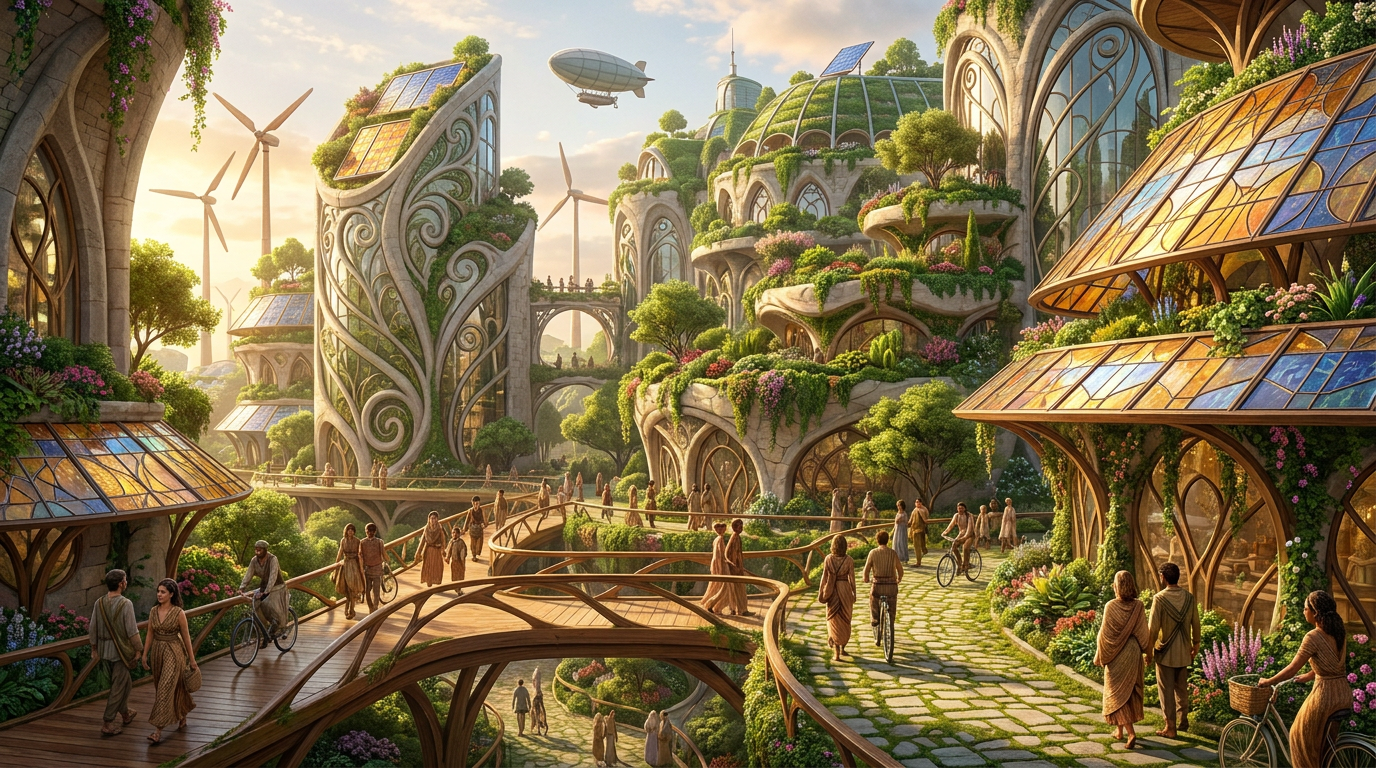
The aesthetic of solarpunk is as distinct as its philosophy. It replaces the chrome and smog of traditional sci-fi with stained-glass solar panels, vertical forests, decentralized community gardens, and pedestrian-first urban design. But advocates stress that the movement is not merely greenwashing or an architectural mood board. At its core, solarpunk literature explores post-capitalist structures, asking what human life looks like when labor is organized around community need rather than corporate profit.[4][8]

Running parallel to solarpunk is the rise of "hopepunk," a broader narrative framework that extends beyond science fiction. Coined in 2017 by author Alexandra Rowland, hopepunk is defined by the belief that in a world leaning toward cynicism, optimism is a political choice. It weaponizes hope as a form of active resistance against despair.[7]
Crucially, hopepunk is not synonymous with toxic positivity or naive escapism. These stories do not pretend that the world is perfect or that systemic injustices do not exist. Instead, they acknowledge the darkness but focus entirely on characters who fight for positive change through radical kindness, empathy, and collective action. The narrative tension comes not from surviving the end of the world, but from the hard, unglamorous work of making it better.[6][7]
The publishing industry has rapidly adapted to this shift in reader appetite. Industry analysts note that heading into 2026, readers are increasingly demanding stories that balance real-world challenges with constructive outcomes. While escapism remains a core driver of fiction sales, modern audiences want narratives that speak to contemporary struggles in ways that leave them feeling empowered rather than depleted.[5]
The publishing industry has rapidly adapted to this shift in reader appetite.
This demand has also fueled the explosive growth of "cozy fantasy" and "cozy sci-fi," genres that lower the stakes entirely to focus on character relationships and community building. Becky Chambers’ Monk and Robot series is frequently cited as the quintessential bridge between solarpunk and cozy fiction. The novellas follow a tea monk and a robot traveling through a lush, post-industrial moon where humanity voluntarily stepped back to let nature heal. The series offers a calm, comforting world that has resonated deeply with anxious readers.[1][3]

For many readers, solarpunk serves as a vital psychological tool in the face of the climate crisis. Environmental advocates argue that the constant barrage of apocalyptic climate narratives can lead to paralysis and "climate despair." By offering a concrete, imaginative blueprint of what a successful transition to a green economy might actually look like, solarpunk provides a manual for hope. It proves that it is impossible to build a better future if we cannot first imagine it.[2][8]
While the term solarpunk only gained widespread traction online around 2014, the genre's literary lineage stretches back decades. Ursula K. Le Guin’s 1974 masterpiece The Dispossessed is widely considered a foundational text. Though set on a harsh, arid moon rather than a lush green utopia, the novel's exploration of an anarchist society that manages resources with utmost care and prioritizes collective well-being perfectly embodies the solarpunk ethos.[3][4]
Similarly, Octavia E. Butler’s Parable of the Sower is often viewed as the necessary precursor to solarpunk. While Butler’s novel is undeniably grim—depicting the collapse of American society amid environmental and economic ruin—it centers on the creation of "Earthseed," a community built on mutual aid, adaptability, and the explicit goal of taking root among the stars. It represents the painful but necessary first step toward the utopian visions that modern solarpunk authors explore.[2][3]
One of the primary criticisms leveled against utopian fiction is the perceived lack of narrative tension. If society has solved its major problems, where does the plot come from? Solarpunk authors have answered this by shifting the nature of conflict. The drama in these novels rarely stems from a singular, world-ending villain. Instead, it arises from the friction of maintaining a delicate ecological balance, the political negotiations required to sustain decentralized communities, or the deeply personal, human conflicts that persist no matter how perfect the society.[8]
In Kim Stanley Robinson’s New York 2140, for example, the tension comes from the sheer logistical effort of survival. The novel does not start in a perfected solarpunk world; rather, it shows a flooded, post-sea-level-rise New York where residents must cooperate in co-op housing to navigate the slow destruction of their environment. The plot is driven by the mechanics of building a better system from the wreckage of the old.[3]

This focus on community has bled off the page and into the real world. Libraries and book clubs across the country report a massive surge in solarpunk and hopepunk selections for 2026. Readers are using these novels not just for solitary entertainment, but as springboards for complex discussions about local environmental policy, urban planning, and community resilience. The books are fostering the exact kind of real-world connection they depict.[5][8]
Ultimately, the rise of solarpunk and hopepunk represents a maturation of speculative fiction. For decades, the genre excelled at showing humanity exactly what not to do, serving as a bleak mirror to our worst impulses. Now, authors and readers alike are demanding more from their fiction. They are asking literature to do the heavy lifting of charting a path forward.[1][6]
As 2026 unfolds, the dominance of these optimistic genres proves that hope is not a passive state, but an active discipline. By choosing to read and write stories where humanity gets it right, the literary world is making a profound statement: the future is not a lost cause, and a better world is still entirely within our grasp.[7][8]
How we got here
1974
Ursula K. Le Guin publishes The Dispossessed, laying the philosophical groundwork for resource-conscious, post-capitalist sci-fi.
2014
The solarpunk aesthetic first gains widespread traction on social media platforms, focusing on stained-glass solar panels and green architecture.
2017
Author Alexandra Rowland coins the term 'hopepunk' to describe narratives that use optimism and kindness as political resistance.
2021
Becky Chambers publishes A Psalm for the Wild-Built, cementing the crossover between solarpunk and the booming 'cozy fantasy' market.
2026
Optimistic speculative fiction dominates mainstream publishing trends as readers actively reject dystopian fatigue.
Viewpoints in depth
Solarpunk & Hopepunk Advocates
Optimistic fiction is a necessary tool for survival and climate action, not just escapism.
Advocates argue that apocalyptic narratives induce 'climate despair' and political paralysis. By providing concrete, imaginative blueprints of a sustainable future, solarpunk acts as a manual for hope. They view the genre as a radical political act that proves a better world must be imagined before it can be built.
Publishing Industry Analysts
The trend is a direct market response to reader fatigue with dystopia and real-world anxiety.
Market analysts track the rise of solarpunk and cozy fantasy to a broader consumer shift toward emotional safety. After years of pandemic stress and political polarization, readers are voting with their wallets for narratives that offer comfort, low-stakes conflict, and characters who successfully overcome adversity through community support.
Traditional Speculative Fiction Critics
Utopian settings risk sacrificing narrative tension and the urgent warning power of dystopia.
While acknowledging the appeal of hopepunk, some literary critics argue that traditional dystopian fiction remains vital. They caution that overly perfected solarpunk worlds can struggle to generate compelling plots, and worry that abandoning cautionary tales might soften the perceived urgency of the real-world climate crisis.
What we don't know
- Whether solarpunk will eventually cross over into blockbuster film and television adaptations with the same success as cyberpunk.
- How long the current reader preference for 'cozy' and low-stakes fiction will last before the market cycles back to darker narratives.
- If the specific green technologies imagined in solarpunk literature will influence real-world urban planning and engineering.
Key terms
- Solarpunk
- A speculative fiction subgenre imagining a sustainable future where humanity harmonizes advanced technology with ecological restoration.
- Hopepunk
- A narrative movement that treats optimism, radical kindness, and community building as acts of political resistance against despair.
- Cyberpunk
- A classic sci-fi subgenre characterized by dystopian, hyper-capitalist futures and environmental decay.
- Cli-Fi
- Climate fiction; literature that explores the effects of climate change and human society's response to ecological shifts.
- Cozy Fantasy
- A low-stakes subgenre of fantasy that focuses on character relationships, comfort, and everyday life rather than world-ending conflicts.
Frequently asked
What is the difference between solarpunk and cyberpunk?
Cyberpunk focuses on 'high tech, low life' with dystopian, corporate-controlled futures. Solarpunk envisions 'high tech, high harmony,' where advanced technology is used to restore the environment and support equitable communities.
Is hopepunk just about happy endings?
No. Hopepunk acknowledges systemic injustice and hardship, but focuses on characters who actively fight for positive change through radical kindness and collective action, rather than giving in to cynicism.
Where did the term solarpunk come from?
The term and its associated aesthetic first emerged in online communities around 2014, blending Art Nouveau design with renewable energy concepts and decentralized community structures.
Why are these genres becoming so popular now?
Publishing analysts attribute the rise to reader fatigue with real-world anxieties and apocalyptic news cycles. Audiences are seeking 'manuals for hope' that offer constructive blueprints for the future.
Sources
Source coverage
8 outlets
3 viewpoints surfaced








[1]Ooligan PressSolarpunk & Hopepunk Advocates
Solarpunk: A Bright Future in 2025
Read on Ooligan Press →[2]Edge EffectsSolarpunk & Hopepunk Advocates
Solarpunk Narrates Futures Beyond Climate Despair
Read on Edge Effects →[3]Toledo LibrarySolarpunk & Hopepunk Advocates
Imagining a Brighter Tomorrow: The Best Solarpunk Fiction to Read Now
Read on Toledo Library →[4]Feminist Book ClubSolarpunk & Hopepunk Advocates
Solarpunk: An Introduction
Read on Feminist Book Club →[5]BooksShelfPublishing Industry Analysts
What's Going to Be Hot in 2026 – Predictions for Fiction
Read on BooksShelf →[6]Kirkus ReviewsPublishing Industry Analysts
Book Trends for 2025
Read on Kirkus Reviews →[7]The Bookish ElfPublishing Industry Analysts
The Evolution of Contemporary Literature: Trends Defining 2025
Read on The Bookish Elf →[8]Factlen Editorial TeamFactlen Editorial Team
Synthesis by Factlen editorial team
Read on Factlen Editorial Team →

More in culture
See all 25 stories →Everyday Awe
The Science of Everyday Awe: How Moments of Wonder Rewire the Brain and Improve Health
6 sources

Intergenerational Living
How Intergenerational Housing is Solving the Loneliness Epidemic
7 sources

Nonprofit Funding
The Rise of Trust-Based Philanthropy: How Unrestricted Giving is Reshaping the Nonprofit Sector
6 sources

Digital Gardens
The Rise of Digital Gardens and the Return of the Cozy Web
11 sources

Every angle. Every day.
Get culture stories with full source coverage and perspective breakdowns delivered to your inbox.