
The Rise of Digital Gardens and the Return of the Cozy Web
As users grow exhausted with algorithmic feeds and corporate walled gardens, a quiet rebellion is reviving the personal internet through interconnected digital gardens and decentralized networks.
By Factlen Editorial Team
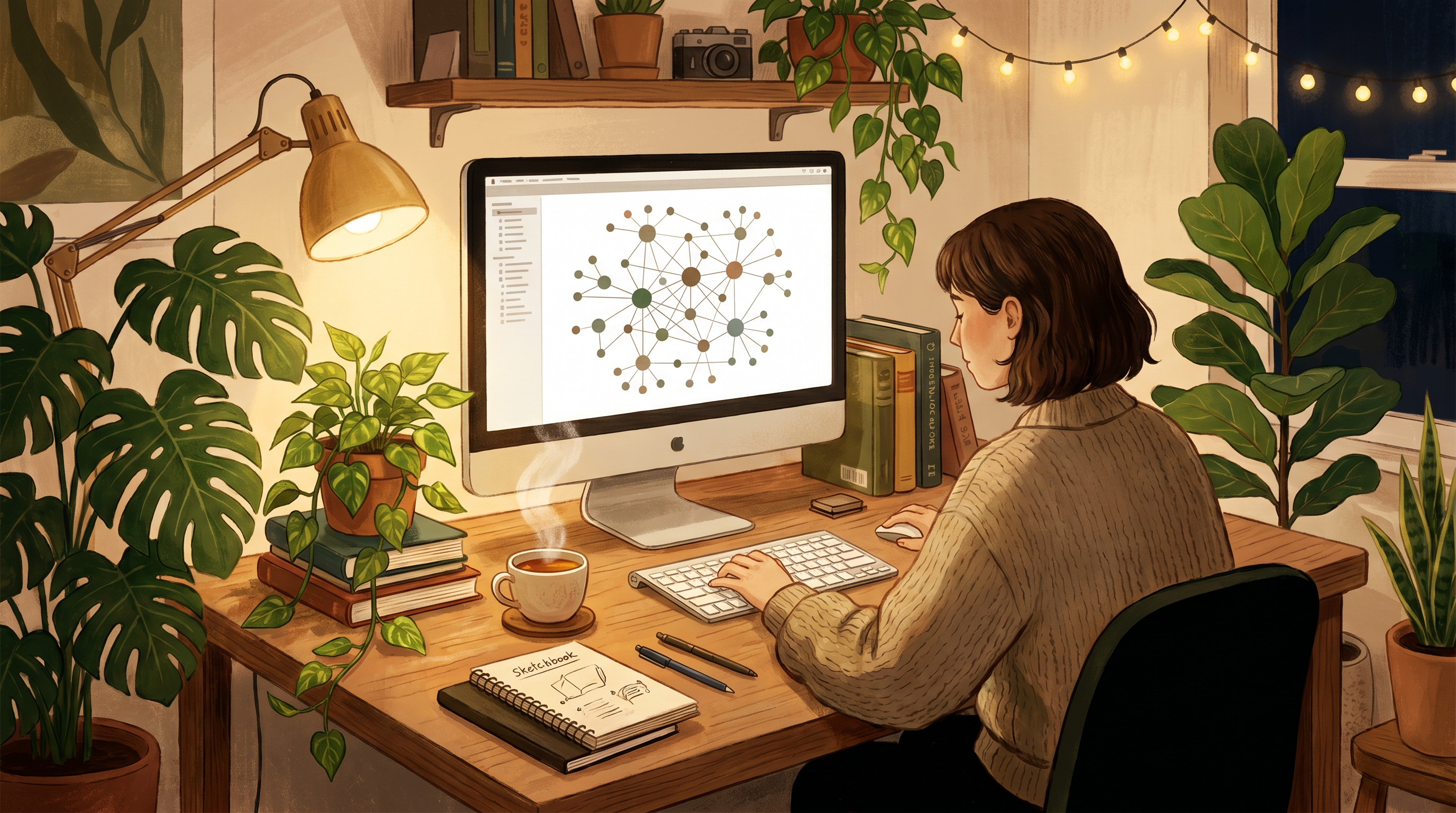
- IndieWeb Advocates
- Focus on data ownership, decentralization, and escaping corporate walled gardens.
- Digital Gardeners
- Focus on the creative process, slow thinking, and contextual knowledge building.
- Boring Web Traditionalists
- Focus on nostalgia, simplicity, and human-scale community without optimization.
What's not represented
- · Corporate platform executives
- · Algorithmic discovery engineers
Why this matters
The shift toward digital gardens and the IndieWeb represents a fundamental reclamation of digital sovereignty. By owning their data and escaping algorithmic manipulation, users are building a healthier, more resilient internet that prioritizes deep thought over viral engagement.
Key points
- Internet users are increasingly exhausted by algorithmic feeds, outrage cycles, and corporate walled gardens.
- A movement toward the "Cozy Web" is reviving personal websites and independent digital spaces.
- "Digital gardens" replace chronological blogs with interconnected, continuously evolving knowledge graphs.
- Decentralized protocols like ActivityPub allow these independent sites to communicate, forming the Fediverse.
- The IndieWeb movement champions data ownership, encouraging creators to publish on their own domains first.
- While discovery remains a challenge without algorithms, community-driven tools like web rings are making a comeback.
For the better part of a decade, the internet has been defined by the "stream"—a relentless, algorithmically sorted feed of content designed to maximize engagement and keep users scrolling within corporate walled gardens. But a growing exhaustion with attention capitalism, outrage cycles, and platform instability is driving a quiet rebellion. Across the internet, creators, professionals, and everyday users are retreating from the noise to cultivate the "Cozy Web."[1][6]
This movement is characterized by a return to human-scale, interconnected personal websites, often referred to as the IndieWeb. Rather than renting space on centralized platforms, users are reclaiming their digital sovereignty by building their own infrastructure. It is a rejection of the hyper-optimized "personal branding" era of the 2010s in favor of authenticity, slowness, and depth.[5][6][7][9]
At the heart of this renaissance is the concept of the "digital garden." Unlike a traditional blog, which presents polished articles in reverse-chronological order, a digital garden is a non-linear, continuously evolving space where ideas grow organically. It is a networked collection of notes and essays that are linked through contextual associations rather than publication dates.[1][3][4]
The language of digital gardening reflects its philosophy. Creators use terms like "seedling" for raw, unformed thoughts, "budding" for developing concepts, and "evergreen" for mature, comprehensive essays. This framework lowers the pressure for perfectionism, allowing writers to publish half-finished thoughts and iterate on them publicly over time. The garden helps users move away from time-bound streams and into contextual knowledge spaces.[2][3][4]
The contrast between feeds and gardens is stark. Feeds reward speed, demand performance, and quickly erase context as content is pushed down the timeline. Gardens, conversely, reward depth, invite reflection, and build meaning through hyperlinking. The topology of a digital garden resembles a personal Wikipedia, where readers follow their curiosity down interconnected paths rather than defaulting to an algorithm's suggestions.[2][3]

The technical barriers that once restricted personal websites to seasoned developers have largely collapsed. The rise of no-code website builders, alongside powerful networked note-taking applications like Obsidian, Roam Research, and Notion, has made it effortless to create and publish interconnected knowledge graphs. Furthermore, platforms like WordPress have integrated digital gardening plugins, bringing the philosophy to a massive scale.[1][2][6][7]
But the Cozy Web is not a collection of isolated islands. The IndieWeb movement relies heavily on the "Fediverse"—a decentralized digital ecosystem of autonomous servers that can communicate with one another. If a digital garden is a user's private home, the Fediverse is the public square where they interact with the neighborhood.[5][10]
The IndieWeb movement relies heavily on the "Fediverse"—a decentralized digital ecosystem of autonomous servers that can communicate with one another.
The backbone of the Fediverse is ActivityPub, an open, decentralized social networking protocol launched by the World Wide Web Consortium (W3C) in 2018. ActivityPub allows users on entirely different platforms to follow, share, and comment on each other's content. For example, a user on Mastodon can seamlessly interact with someone on a personal WordPress site or a PeerTube video instance, without either party having to create an account on a centralized platform.[5][11]
This interoperability enables a practice known as POSSE: Publish (on your) Own Site, Syndicate Elsewhere. Under the POSSE model, a creator's personal website serves as the ultimate source of truth and the primary home for their data. Content is then automatically pushed out to various social media networks and aggregators to reach a broader audience, ensuring that the creator retains total ownership even if a third-party platform shuts down or changes its rules.[7][9]

Alongside the IndieWeb is the emergence of the "Boring Web," a cultural reaction against the hyper-optimized internet. The Boring Web champions websites that exist simply to be useful or expressive—hobby sites, gardening journals, local history archives, and photography portfolios. These spaces are devoid of engagement metrics, pop-up funnels, and "smash that like button" pleas, offering a refreshing return to the quirky, human-centric internet of the late 1990s.[8][9]
To navigate this decentralized landscape, early internet concepts like "Web Rings" are experiencing a revival. Before the dominance of search engines, web rings connected related sites—such as a network of science fiction blogs or homesteading journals—allowing visitors to travel from one site to the next. Today, these trust networks are being rebuilt to foster discovery and community identity without relying on algorithmic curation.[9]

Despite its appeal, the digital garden model faces significant challenges, primarily regarding discovery. Because these spaces are decentralized and non-chronological, they lack the viral distribution mechanisms built into corporate social media. Finding a high-quality digital garden often relies on serendipity, word-of-mouth, or manual curation, which can limit their reach.[1][4]
Furthermore, maintaining a digital garden requires sustained effort and intentionality. Nurturing a thriving ecosystem of interconnected ideas is an ongoing process, and the experience can be jarring for readers accustomed to the passive consumption of a feed. If a garden is poorly structured or filled with empty "seedling" pages, visitors may leave feeling unsatisfied.[1][4]
Yet, for the creators and communities embracing this shift, the trade-offs are entirely worth it. The Fediverse and the IndieWeb represent a fundamental reassertion of internet principles: that power should be distributed, and individuals should control their digital presence. It is a move away from profit-driven attention harvesting toward horizontal, self-governing models of social interaction.[6][10]
The internet is currently undergoing a profound transition. As users increasingly recognize the vulnerabilities of renting space in corporate walled gardens, the appeal of owning a permanent, evolving digital home will only grow. The renaissance of the personal website and the cultivation of the Cozy Web prove that the future of the internet can be slower, more intentional, and deeply human.[2][6][8]
How we got here
Late 1990s
The early personal web thrives with quirky, hand-coded sites connected by community-curated web rings.
2010s
The rise of centralized social media platforms consolidates internet traffic into algorithmic, chronological feeds.
2018
The World Wide Web Consortium (W3C) launches the ActivityPub protocol, laying the technical foundation for the Fediverse.
2020
The concept of the 'digital garden' gains mainstream traction as users seek alternative ways to organize personal knowledge during the pandemic.
2022–2024
Major shifts in corporate platform ownership accelerate the 'Twitter Migration,' driving millions to decentralized alternatives like Mastodon.
2025–2026
The 'Cozy Web' solidifies as a mainstream cultural movement, with creators prioritizing data ownership and slow, contextual publishing.
Viewpoints in depth
IndieWeb Advocates
Argue that the primary issue with the modern internet is centralized corporate control.
This camp advocates for protocols like ActivityPub and practices like POSSE to ensure users own their data and distribution channels. By building their own infrastructure, they argue that users can insulate themselves from platform decay, algorithmic manipulation, and the sudden policy changes that plague corporate walled gardens.
Digital Gardeners
Focus on the cognitive benefits of topological, non-linear publishing.
Gardeners argue that chronological feeds destroy context and encourage reactive, performative thinking. By contrast, topological gardens foster deep, interconnected knowledge and relieve the pressure of publishing polished pieces. They view the internet as a space for slow cultivation rather than rapid consumption.
Boring Web Traditionalists
Emphasize a return to the quirky, unoptimized internet of the late 1990s.
This perspective rejects the professionalization of the web—including SEO, personal branding, and engagement metrics—in favor of authentic, human-scale expression. They champion community-curated discovery mechanisms like web rings, arguing that the internet is healthier when it is less optimized and more personal.
What we don't know
- Whether decentralized networks can ever achieve the mainstream scale and seamless user experience of corporate platforms like Meta or X.
- How the economics of the IndieWeb will evolve, as independent creators currently lack the built-in monetization tools provided by centralized feeds.
- If new, non-algorithmic discovery mechanisms can effectively surface high-quality digital gardens without recreating the biases of traditional search engines.
Key terms
- Cozy Web
- The private, gatekeeper-bounded spaces of the internet, such as personal websites, group chats, and digital gardens, that offer refuge from public algorithmic feeds.
- ActivityPub
- An open, decentralized social networking protocol developed by the W3C that allows different platforms to interoperate.
- Walled Garden
- A closed digital ecosystem controlled by a single corporation that restricts access to its data and attempts to keep users entirely within its platform.
- IndieWeb
- A community and movement focused on individuals building and controlling their own digital presence on their own infrastructure.
Frequently asked
What is a digital garden?
A digital garden is a personal website structured as a networked collection of evolving notes and essays, rather than a chronological blog. Ideas are linked contextually and updated over time.
What is the Fediverse?
The Fediverse is a decentralized network of independent social media servers that can communicate with each other using shared protocols, allowing users to interact across different platforms.
What does POSSE stand for?
POSSE stands for Publish (on your) Own Site, Syndicate Elsewhere. It is a content strategy where creators publish first on their own domain and then push links to social media, ensuring they retain ownership of their work.
How do I start a digital garden?
Many creators use networked note-taking tools like Obsidian, Roam Research, or Notion, which can be published to the web. Others use no-code website builders or WordPress plugins designed specifically for digital gardening.
Sources
Source coverage
11 outlets
3 viewpoints surfaced









[1]The ClarionDigital Gardeners
Digital gardens: The internet's new personal renaissance
Read on The Clarion →[2]Wilde on ArtDigital Gardeners
Digital Gardening – A Return to Personal Creativity on the Web
Read on Wilde on Art →[3]Maggie AppletonDigital Gardeners
A Brief History & Ethos of the Digital Garden
Read on Maggie Appleton →[4]Vivian QuDigital Gardeners
Deconstructing digital gardens
Read on Vivian Qu →[5]nss magazineIndieWeb Advocates
What is the “fediverse” and how is it growing?
Read on nss magazine →[6]The Return of Personal WebsitesIndieWeb Advocates
The Return of Personal Websites: Why Everyone's Building One Again
Read on The Return of Personal Websites →[7]Daniel PrindiiIndieWeb Advocates
Miscellanea no 3: About walled gardens, digital gardens and the Web
Read on Daniel Prindii →The Indie Web is leading a quiet rebellion against big tech
Read on Nathan Lindahl →The Indie Web, The Boring Web, Web Rings
Read on KommunityKoin →[10]Cultural StudiesIndieWeb Advocates
A Decentralized Internet is Possible
Read on Cultural Studies →[11]arXivIndieWeb Advocates
Fediverse Sharing: Cross-Platform Interaction Dynamics between Threads and Mastodon Users
Read on arXiv →
More in culture
See all 23 stories →Intergenerational Living
How Intergenerational Housing is Solving the Loneliness Epidemic
7 sources
Nonprofit Funding
The Rise of Trust-Based Philanthropy: How Unrestricted Giving is Reshaping the Nonprofit Sector
6 sources

Cozy Web
The Splinternet of Trust: How the 'Cozy Web' is Reshaping Internet Culture
7 sources

Digital Culture
The Analog Renaissance: Why Gen Z is Trading Smartphones for Dumbphones and Third Places
8 sources

Every angle. Every day.
Get culture stories with full source coverage and perspective breakdowns delivered to your inbox.