
How Intergenerational Housing is Solving the Loneliness Epidemic
Intentional living communities that mix seniors, students, and young families are emerging as a powerful antidote to both social isolation and the housing crisis.
By Factlen Editorial Team
- Urban Planners & Architects
- Advocates for redesigning the built environment to force organic social interaction.
- Public Health Advocates
- Views shared living as a critical preventative healthcare measure against the physical toll of loneliness.
- Housing Equity Advocates
- Focuses on the financial relief these models provide to vulnerable demographics like students and low-income seniors.
What's not represented
- · Traditional elder-care facility operators
- · Single-family zoning proponents
Why this matters
With one in six people globally experiencing loneliness and younger demographics facing an acute housing affordability crisis, breaking down age-segregated living could simultaneously solve two of society's most pressing challenges.
Key points
- Loneliness is recognized by the WHO as a global public health crisis, severely impacting older adults.
- Intergenerational housing intentionally mixes age groups to foster daily interaction and mutual support.
- Homesharing programs match students with seniors, trading reduced rent for companionship and chores.
- European data shows these living models can reduce reported loneliness by up to 45 percent.
- Restrictive zoning laws and cultural preferences for extreme privacy remain the primary barriers to expansion.
The modern built environment has engineered a paradox: humans live closer together than ever before, yet social isolation has reached epidemic proportions. The World Health Organization now recognizes social disconnection as a global public health crisis, noting that one in six people worldwide experiences profound loneliness. For older adults, the statistics are particularly stark, with many spending an average of seven hours alone each day.[5][6]
Simultaneously, younger generations are navigating a parallel crisis of housing affordability. Students and young families are increasingly priced out of urban centers, while older adults often find themselves over-housed in aging properties they can no longer maintain, yet unable to afford specialized elder care.[1][4]
In response to these intersecting crises, a quiet revolution in urban planning and community design is gaining momentum. Intergenerational living—the intentional integration of different age groups within shared housing models—is emerging as a powerful antidote to both the loneliness epidemic and the housing crunch.[2][5]

The concept fundamentally challenges the age-segregated models that have dominated housing since the late 20th century. Instead of isolating seniors in retirement villages and younger people in student housing or starter-home suburbs, intergenerational models weave them together. This is not merely about placing different demographics in the same zip code; it requires intentional architectural and programmatic design to foster daily interaction.[2][4]
At the micro-level, homesharing programs are scaling rapidly. Initiatives like Canada HomeShare match post-secondary students with older adults who have spare bedrooms. In exchange for significantly reduced rent, the students provide light household assistance and, crucially, companionship.[3]
The results of these one-to-one matches have been striking. Research into the Toronto-based program, which the WHO recognized as an age-friendly best practice, found that 95 percent of participants believed the arrangement directly addressed their risk for social isolation. Beyond financial security, participants reported enhanced general well-being and a renewed sense of safety.[3]
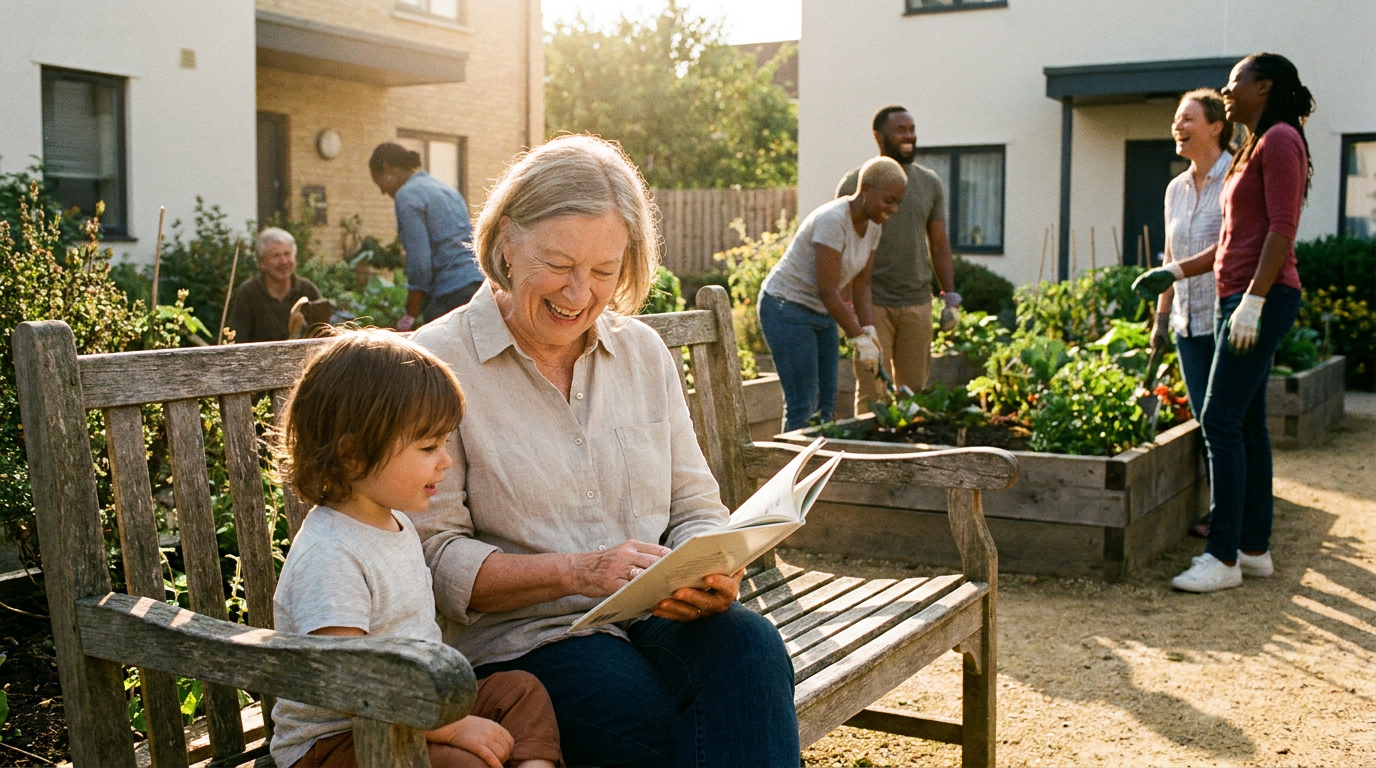
On a macro-level, purpose-built cohousing communities are demonstrating how architecture can engineer social cohesion. In Oregon, the Bridge Meadows communities provide subsidized housing to both seniors and families adopting children from the foster care system. The physical layout—featuring shared courtyards and a central multipurpose room—forces organic collisions between neighbors.[4]

On a macro-level, purpose-built cohousing communities are demonstrating how architecture can engineer social cohesion.
In these environments, the generational exchange becomes a daily rhythm. Older residents find a renewed sense of purpose by reading to children or watching over them in the courtyard, while foster parents receive an informal, built-in support network of surrogate grandparents. Social workers on staff help facilitate these relationships, ensuring that the community remains resilient as residents' needs evolve.[4]
Similar models are taking root globally. Singapore's Kampung Admiralty, often described as a "vertical village," integrates senior apartments with childcare facilities, medical centers, and community gardens in a single complex. In Northern Europe, particularly in Denmark and the Netherlands, intergenerational cohousing has been an established practice for decades, providing a robust dataset on its long-term efficacy.[2][5]
The public health data emerging from these European models is compelling. Evidence indicates that intergenerational housing can reduce loneliness by up to 45 percent while significantly boosting informal care networks. Because loneliness correlates strongly with physical decline, hypertension, and dementia, these living arrangements function as a preventative healthcare measure.[5][6]
The benefits flow in both directions. Children raised in intergenerational environments demonstrate increased emotional resilience, stronger social skills, and a marked reduction in ageist stereotypes. By interacting daily with older adults, younger residents develop a more nuanced understanding of the aging process and a greater capacity for empathy.[2]

Economically, the model offers a pressure release valve for overstretched social systems. By allowing older adults to age in place with the informal support of younger neighbors, the reliance on expensive, state-funded elder care facilities is reduced. Furthermore, shared resources—from communal kitchens to tool libraries—lower the overall carbon footprint and financial burden of the community.[4][6]
Despite the clear benefits, scaling intergenerational living faces significant structural headwinds. In many North American municipalities, restrictive zoning laws prohibit the construction of accessory dwelling units or multi-family cohousing in neighborhoods zoned exclusively for single-family homes.[2]
There is also a cultural barrier to overcome. The deep-seated societal preference for extreme independence and privacy can make the transition to shared living spaces daunting. Misperceptions about the loss of autonomy or potential intergenerational conflict require careful community engagement and education before ground is even broken.[1]

Yet, public sentiment appears to be shifting rapidly as the dual pressures of isolation and inflation mount. Recent polling in the United Kingdom revealed that 81 percent of adults believe mixing age groups reduces loneliness, and 76 percent agree it improves mental health.[1][5]
As urban planners and policymakers look toward the future, the consensus is clear: the nuclear family housing model of the past is insufficient for the demographic realities of an aging, increasingly isolated population. By designing spaces that intentionally connect the generations, communities are discovering that the most effective solutions to modern crises are often found in each other.[2][7]
How we got here
Late 20th Century
Housing models become increasingly age-segregated, separating seniors into retirement communities and youth into starter suburbs.
2006
The Treehouse Community opens in Massachusetts, pioneering a model that mixes seniors with families adopting children from foster care.
2020
The World Health Organization recognizes the Toronto HomeShare program as an age-friendly best practice for combating isolation.
2025
Polling reveals overwhelming public support for intergenerational living as a solution to the dual crises of loneliness and housing costs.
Viewpoints in depth
Urban Planners & Architects
Advocates for redesigning the built environment to force organic social interaction.
This camp argues that the loneliness epidemic is largely a design failure, born from decades of prioritizing single-family zoning and age-segregated facilities. They push for zoning reforms that allow for multi-family cohousing and accessory dwelling units (ADUs). Their focus is on the physical infrastructure—shared kitchens, central courtyards, and communal gardens—that makes isolation difficult and daily interaction inevitable.
Public Health Advocates
Views shared living as a critical preventative healthcare measure.
Medical professionals and researchers in this camp point to the severe physical toll of loneliness, which correlates with hypertension, dementia, and early mortality. They view intergenerational housing not just as a real estate trend, but as a non-medical intervention. By boosting informal care networks and providing seniors with a sense of purpose, they argue these communities can significantly reduce the burden on state-funded elder care systems.
Housing Equity Advocates
Focuses on the financial relief these models provide to vulnerable demographics.
For this group, the primary draw of intergenerational living is economic survival. They highlight how homesharing programs prevent students from taking on crushing debt to afford urban rent, while simultaneously allowing low-income seniors to afford the property taxes and maintenance required to age in place. They advocate for public subsidies to expand these models to marginalized communities.
What we don't know
- How effectively these models can scale in suburban areas dominated by strict single-family zoning laws.
- The long-term mechanisms needed to resolve interpersonal conflicts that naturally arise in shared living spaces.
- Whether public funding will shift significantly from traditional elder-care facilities to subsidize intergenerational cohousing.
Key terms
- Cohousing
- An intentional community of private homes clustered around shared space, designed to encourage social interaction.
- Homesharing
- A living arrangement where two or more unrelated people share a dwelling, often involving an exchange of reduced rent for household assistance.
- Aging in Place
- The ability of an older adult to live in their own home and community safely, independently, and comfortably, regardless of age or income.
- Accessory Dwelling Unit (ADU)
- A smaller, independent residential dwelling unit located on the same lot as a stand-alone single-family home, often used to house aging relatives.
Frequently asked
What is intergenerational housing?
It is an intentional living arrangement that brings together different age groups—such as seniors, students, and young families—into shared spaces to foster community and mutual support.
How does homesharing work?
Programs match older adults who have spare bedrooms with younger people, often students. The student receives reduced rent in exchange for providing companionship and helping with light household chores.
Does this actually improve health?
Yes. Studies show that intergenerational living can reduce loneliness by up to 45 percent, which in turn lowers the risk of hypertension, depression, and cognitive decline.
What are the main barriers to building these communities?
Restrictive zoning laws that favor single-family homes, combined with cultural hesitations about sharing space and losing privacy, are the primary hurdles to scaling these models.
Sources
Source coverage
7 outlets
3 viewpoints surfaced







[1]Housing LINUrban Planners & Architects
Intergenerational Housing: A Solution for the Future
Read on Housing LIN →[2]Harvard Joint Center for Housing StudiesUrban Planners & Architects
Living Together by Design: Housing to Connect Generations
Read on Harvard Joint Center for Housing Studies →[3]National Institutes of HealthPublic Health Advocates
Thriving-in-Place: Examining the impact of intergenerational living in the Toronto HomeShare Program
Read on National Institutes of Health →[4]Boston College Center for Retirement ResearchHousing Equity Advocates
Intergenerational Living Could Address the Affordable Housing and Care Gaps
Read on Boston College Center for Retirement Research →[5]Intergenerational EnglandPublic Health Advocates
The Case for Intergenerational Housing
Read on Intergenerational England →[6]ElderLawAnswersHousing Equity Advocates
Multigenerational Housing: Options and Benefits for Seniors
Read on ElderLawAnswers →[7]Factlen Editorial Team
Synthesis by Factlen editorial team
Read on Factlen Editorial Team →

More in culture
See all 23 stories →Nonprofit Funding
The Rise of Trust-Based Philanthropy: How Unrestricted Giving is Reshaping the Nonprofit Sector
6 sources

Digital Gardens
The Rise of Digital Gardens and the Return of the Cozy Web
11 sources

Cozy Web
The Splinternet of Trust: How the 'Cozy Web' is Reshaping Internet Culture
7 sources

Digital Culture
The Analog Renaissance: Why Gen Z is Trading Smartphones for Dumbphones and Third Places
8 sources

Every angle. Every day.
Get culture stories with full source coverage and perspective breakdowns delivered to your inbox.