
Why Astronomers Are Using 'Earthshine' to Track Climate Change and Hunt for Exoplanets
The faint light reflected from Earth onto the dark side of the Moon is revealing critical data about our planet's warming climate and providing a blueprint for detecting habitable exoplanets.
By Factlen Editorial Team
- Climate Researchers
- Focus on Earth's energy imbalance and how dropping albedo accelerates global warming.
- Astrobiologists
- View earthshine as a crucial training ground for detecting biosignatures on distant exoplanets.
- Observational Astronomers
- Emphasize the technical challenge of measuring faint reflected light and separating it from direct lunar illumination.
What's not represented
- · Satellite Remote Sensing Engineers
- · Climate Modellers
Why this matters
By studying the faint light bouncing off the Moon, scientists are not only measuring how much extra solar heat Earth is absorbing, but also perfecting the exact techniques needed to find biological life on other planets.
Key points
- Earthshine is sunlight that reflects off Earth, bounces off the dark side of the Moon, and returns to our eyes.
- By measuring this faint glow, scientists have determined that Earth's albedo (reflectance) has dropped by 0.5 percent over 20 years.
- Warming oceans in the eastern Pacific are reducing highly reflective low-lying clouds, causing Earth to absorb more solar heat.
- Astrobiologists use earthshine as a proxy for exoplanets, studying how Earth's light blends into a single pixel.
- Spectrometers analyzing earthshine can successfully detect the 'vegetation red edge,' proving we can spot plant life from space.
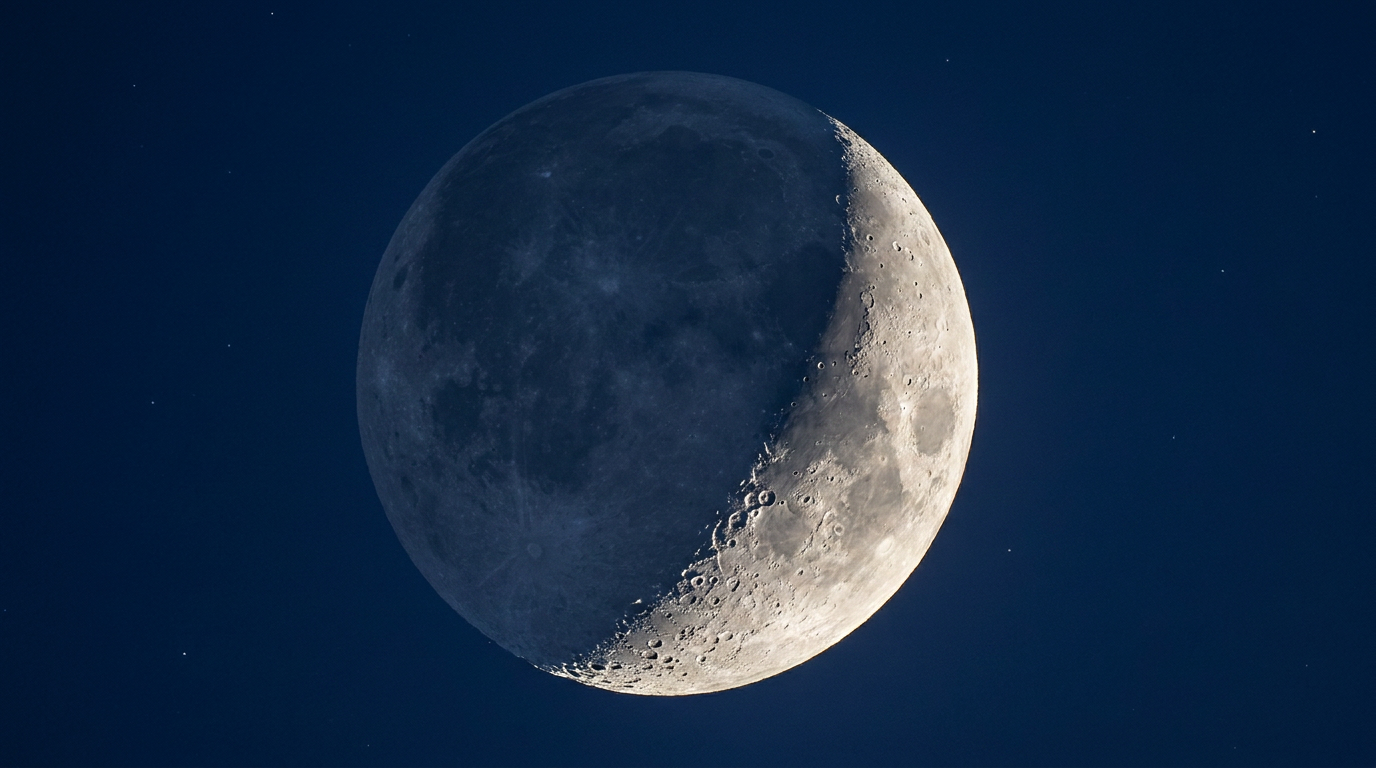
If you step outside on a clear evening just after a new moon, you can witness one of the solar system's most elegant optical illusions. Look closely at the thin, brightly lit lunar crescent, and you will likely notice the rest of the moon's disk glowing in a faint, ghostly gray. This phenomenon is known as 'earthshine.' It is a subtle, beautiful sight that has captivated skywatchers for millennia, appearing as a dim sphere nestled within the bright arms of the crescent. But beyond its aesthetic appeal, this faint glow carries an immense amount of scientific information.[2]
The mechanics behind this ashen glow are essentially a cosmic game of billiards. Sunlight strikes the daytime side of Earth, bounces across the vacuum of space to the dark side of the Moon, and then reflects back to our eyes on the night side of the planet. In essence, when you look at the dark portion of a crescent moon, you are looking at a massive mirror reflecting the collective light of our own world. Because the Moon's surface is rough and covered in dust, it scatters this incoming light, blending the reflections of Earth's oceans, continents, and cloud systems into a single, unified beam of information.[2][6]
The fundamental physics of earthshine were first correctly deduced by Leonardo da Vinci in the early 16th century, who realized that the 'ashen light' was caused by sunlight reflecting off Earth's oceans. Yet today, this 500-year-old observation has evolved into a cutting-edge diagnostic tool for modern astrophysicists. By analyzing the exact brightness, polarization, and chemical signature of this reflected light, scientists are unlocking critical data about Earth's shifting climate. Simultaneously, they are developing the exact spectroscopic techniques needed to hunt for biological life on planets orbiting distant stars.[4][6]

For climate researchers, the Moon acts as a giant, natural satellite measuring Earth's 'albedo'—the fraction of solar energy our planet reflects back into space. Historically, Earth has reflected about 30 percent of incoming sunlight, primarily off bright white surfaces like sea ice, snow, and low-lying cloud decks. The remaining 70 percent of that solar radiation is absorbed by the planet's oceans and landmasses, driving the global climate system and warming the atmosphere. Maintaining this delicate balance of reflection and absorption is what keeps Earth's temperature relatively stable over long periods.[1][5]
Measuring global albedo from low-Earth orbit is notoriously difficult because satellites can only see narrow strips of the planet at any given moment, and their instruments degrade over time in the harsh environment of space. Earthshine, however, provides an instantaneous, integrated snapshot of an entire hemisphere's reflectance. To capture this macro view, researchers at the Big Bear Solar Observatory in California spent two decades meticulously photographing the Moon night after night. By comparing the brightness of the sunlit crescent to the earthshine-illuminated dark side, they created a highly accurate, long-term record of Earth's reflectivity.[1][5]
Their findings, published in the journal Geophysical Research Letters, revealed a startling and climatologically significant trend: Earth is losing its shine. Over a 20-year period from 1998 to 2017, the planet's albedo dropped by 0.5 percent. In practical terms, this means Earth is now reflecting about half a watt less light per square meter than it did in the late 1990s. While that fraction sounds small, spread across the entire surface area of the globe, it represents a massive increase in the amount of solar energy being absorbed by the climate system.[1][5]

Their findings, published in the journal Geophysical Research Letters, revealed a startling and climatologically significant trend: Earth is losing its shine.
This dimming is not caused by changes in the Sun's output, but by shifting dynamics within Earth's own atmosphere. Warming ocean temperatures in the eastern Pacific have disrupted the formation of highly reflective, low-lying stratocumulus clouds. As this natural, bright-white mirror dissipates, more dark ocean water is exposed to direct sunlight. Because water is highly absorbent—reflecting only about 10 percent of the light that hits it—the loss of these cloud decks causes the ocean to absorb heat that would have otherwise been bounced safely back into the void of space.[1][5]
This creates a concerning feedback loop for climate models: a warming ocean burns off the clouds that protect it from the Sun, which in turn causes the ocean to warm even faster. However, the precision of the earthshine data has given meteorologists a much clearer understanding of Earth's overall energy budget. By tracking the Moon's glow, scientists can now calibrate their complex climate simulations with a level of hemispheric accuracy that was previously impossible, ensuring that future climate projections account for these subtle shifts in planetary reflectivity.[1][6]
But earthshine is not just a tool for looking inward at our own environmental challenges; it is increasingly being used by astrobiologists to look outward. As astronomers discover thousands of exoplanets orbiting distant stars, the next great frontier in space exploration is determining if any of those rocky worlds harbor life. The challenge is that exoplanets are too far away to resolve visually. Even to the most powerful next-generation telescopes, a distant Earth-like world will appear as nothing more than a single, featureless pixel of light drowning in the glare of its host star.[3]

To know what to look for in that single pixel, astronomers desperately need a baseline. They need to know exactly what a living, breathing planet looks like when its light is compressed into a single point. Earthshine provides the perfect proxy for this exact scenario. When Earth's light bounces off the rough, scattering surface of the Moon, it blends the distinct spectral signatures of our oceans, continents, and clouds into a single, unified beam. By pointing telescopes at the Moon, astronomers can study Earth exactly as an alien civilization would see it from light-years away.[3][4]
In a landmark 2002 study published in The Astrophysical Journal, researchers analyzed the spectrum of earthshine and successfully identified the chemical fingerprints of ozone, molecular oxygen, and water vapor. Even more remarkably, the data revealed the subtle optical signature of Earth's oceans, proving that surface water could be detected from afar. Because oxygen and methane are highly reactive and should quickly disappear from an atmosphere unless they are constantly replenished by biological processes, detecting them together in a planetary spectrum is considered a strong 'biosignature.'[3]
Perhaps the most profound discovery hidden in earthshine is the phenomenon known as the 'vegetation red edge.' Plant life on Earth absorbs visible light for photosynthesis, but it strongly reflects near-infrared light to avoid overheating and tissue damage. When you look at the spectrum of light reflected by a forest, there is a sharp, distinct spike in reflectance at a wavelength of around 700 nanometers. When astrobiologists run earthshine through a spectrometer, that exact infrared spike is clearly visible, surviving the round-trip journey to the Moon and back.[4]

This red edge is the undeniable optical signature of global biology. If a future space telescope detects that exact same near-infrared spike in the light of an exoplanet, it would be one of the strongest possible indicators of extraterrestrial plant life. Recent advancements have pushed this technique even further using spectropolarimetry—the study of how light waves are polarized, or oriented, when they bounce off different surfaces. A 2012 study in Nature demonstrated that polarized earthshine could reveal the fractional coverage of clouds versus oceans, and could detect vegetation even when it covered as little as 10 percent of the visible landmass.[4][6]
These lunar observations are currently writing the instruction manual for the Habitable Worlds Observatory, NASA's planned multi-billion-dollar flagship mission designed specifically to image Earth-like exoplanets. Before that telescope ever opens its shutters to the deep universe, its software, algorithms, and analytical models will have been rigorously trained on the faint light bouncing off our own Moon. It is a poetic symmetry: for millennia, humanity has looked up at the Moon and projected our myths onto its surface. Today, the Moon is returning the favor, acting as a cosmic mirror that teaches us how to find another home in the dark.[6]
How we got here
Early 1500s
Leonardo da Vinci correctly hypothesizes that the 'ashen light' of the Moon is caused by sunlight reflecting off Earth's oceans.
1928
French astronomer André Danjon begins the first systematic, long-term measurements of earthshine to estimate Earth's albedo.
1998
The Big Bear Solar Observatory launches a modern, two-decade photometric study to track changes in Earth's reflectance.
2002
Astronomers successfully identify the chemical signatures of water, ozone, and oceans in earthshine, proving its value for exoplanet research.
2021
Researchers publish 20 years of earthshine data revealing a climatologically significant 0.5 percent drop in Earth's albedo.
Viewpoints in depth
Climate Researchers
Focus on Earth's energy imbalance and how dropping albedo accelerates global warming.
For climatologists, earthshine is a critical diagnostic tool for the planet's energy budget. While satellites provide high-resolution data on specific regions, earthshine offers an instantaneous, integrated measurement of an entire hemisphere's reflectance. The recent discovery that Earth's albedo has dropped by 0.5 watts per square meter over two decades is a major concern for this camp. It indicates that the loss of highly reflective low-lying clouds over the Pacific is causing the planet to absorb more solar radiation, creating a feedback loop that could accelerate oceanic warming beyond what greenhouse gas emissions alone would cause.
Astrobiologists
View earthshine as a crucial training ground for detecting biosignatures on distant exoplanets.
Astrobiologists look at earthshine not to understand Earth, but to understand what Earth looks like from light-years away. Because next-generation telescopes will only see distant exoplanets as single, unresolved pixels of light, scientists need to know how the signatures of life—like oceans, ozone, and vegetation—blend together in a global spectrum. By analyzing the light bouncing off the Moon, this camp can test and refine the exact spectroscopic techniques they will use to hunt for extraterrestrial biology, ensuring they know exactly what a 'living planet' looks like before they point their multi-billion-dollar instruments at the stars.
What we don't know
- Whether the recent drop in Earth's albedo is a permanent shift or part of a longer, multi-decadal oscillation in Pacific cloud cover.
- How accurately the 'vegetation red edge' can be detected on exoplanets that have different atmospheric compositions or host stars than Earth.
- Whether future space telescopes will have the precise sensitivity required to isolate these faint biosignatures from the overwhelming glare of alien suns.
Key terms
- Earthshine
- Sunlight that reflects off Earth, travels to the Moon, and bounces back to our eyes, illuminating the dark portion of the lunar disk.
- Albedo
- The proportion of incoming solar radiation that a planet or surface reflects back into space.
- Biosignature
- A chemical or optical footprint—such as oxygen, ozone, or specific light reflections—that provides scientific evidence of past or present life.
- Spectropolarimetry
- An advanced observational technique that measures both the spectrum (color) and the polarization (wave orientation) of light to determine surface compositions.
- Stratocumulus clouds
- Low-lying, highly reflective cloud decks that play a major role in bouncing solar energy away from Earth.
Frequently asked
Can I see earthshine with the naked eye?
Yes. It is most visible in the days immediately before or after a new moon, when the moon appears as a thin crescent in the twilight sky.
Why is Earth's albedo decreasing?
Warming ocean temperatures in the eastern Pacific have reduced the formation of highly reflective, low-lying stratocumulus clouds, causing Earth to absorb more sunlight.
What is the vegetation red edge?
It is a sharp spike in near-infrared light reflected by plant life. Detecting this signature in earthshine proves we could spot forests on other planets.
How does the Moon help us find aliens?
By reflecting Earth's blended light back to us, the Moon provides a perfect proxy for what a living, breathing exoplanet would look like through a distant telescope.
Sources
Source coverage
6 outlets
3 viewpoints surfaced






[1]Geophysical Research LettersClimate Researchers
Earth's Albedo 1998–2017 as Measured From Earthshine
Read on Geophysical Research Letters →[2]NASA ScienceObservational Astronomers
Earthshine
Read on NASA Science →[3]The Astrophysical JournalAstrobiologists
The Spectrum of Earthshine: A Pale Blue Dot Observed from the Ground
Read on The Astrophysical Journal →[4]NatureAstrobiologists
Biosignatures as revealed by spectropolarimetry of Earthshine
Read on Nature →[5]World Economic ForumClimate Researchers
The earth is dimming. What 'earthshine' means for our climate system
Read on World Economic Forum →[6]Factlen Editorial TeamObservational Astronomers
Synthesis by Factlen editorial team
Read on Factlen Editorial Team →

Every angle. Every day.
Get science stories with full source coverage and perspective breakdowns delivered to your inbox.