
U.S. Military Strike in Venezuela Kills Tren de Aragua Leader Niño Guerrero
President Trump announced that a coordinated U.S. missile strike in Venezuela killed Héctor Rusthenford Guerrero Flores, the head of the transnational Tren de Aragua gang. The operation, conducted with the cooperation of the post-Maduro Venezuelan government, marks a major escalation in the U.S. campaign against Latin American criminal organizations.
By Factlen Editorial Team
- U.S. National Security Advocates
- Argue that transnational gangs must be treated as insurgent terrorist threats requiring kinetic military force.
- Regional Diplomacy Observers
- Focus on the historic intelligence and military cooperation between the U.S. and the post-Maduro Venezuelan government.
- Human Rights & Legal Monitors
- Warn that using military missiles and summary deportations against criminal suspects bypasses due process and international law.
What's not represented
- · Venezuelan Civilians in Bolívar
- · Migrant Advocacy Groups
Why this matters
This strike represents an unprecedented use of U.S. military force against a criminal organization on South American soil. It also highlights a dramatic geopolitical realignment, showcasing deep military and intelligence cooperation between Washington and Caracas following the removal of Nicolás Maduro earlier this year.
Key points
- U.S. forces killed Tren de Aragua leader Héctor "Niño" Guerrero in a missile strike in Bolívar, Venezuela.
- The operation was conducted by the Joint Special Operations Command with intelligence from the CIA.
- Venezuelan security forces actively collaborated in the strike, highlighting a major geopolitical shift since the removal of Nicolás Maduro.
- Guerrero Flores had a $5 million U.S. bounty and was indicted in New York on terrorism and racketeering charges.
- The strike is part of a broader U.S. military campaign against the gang, which includes lethal maritime operations and mass deportations.
The U.S. military has killed Héctor Rusthenford Guerrero Flores, the notorious leader of the Venezuelan transnational gang Tren de Aragua, in a targeted missile strike. President Donald Trump announced the assassination on Friday, describing the operation as a "swift and lethal kinetic strike" that eliminated one of the hemisphere's most wanted fugitives. The strike marks a dramatic escalation in the administration's aggressive campaign against Latin American criminal syndicates.[1][2][4]
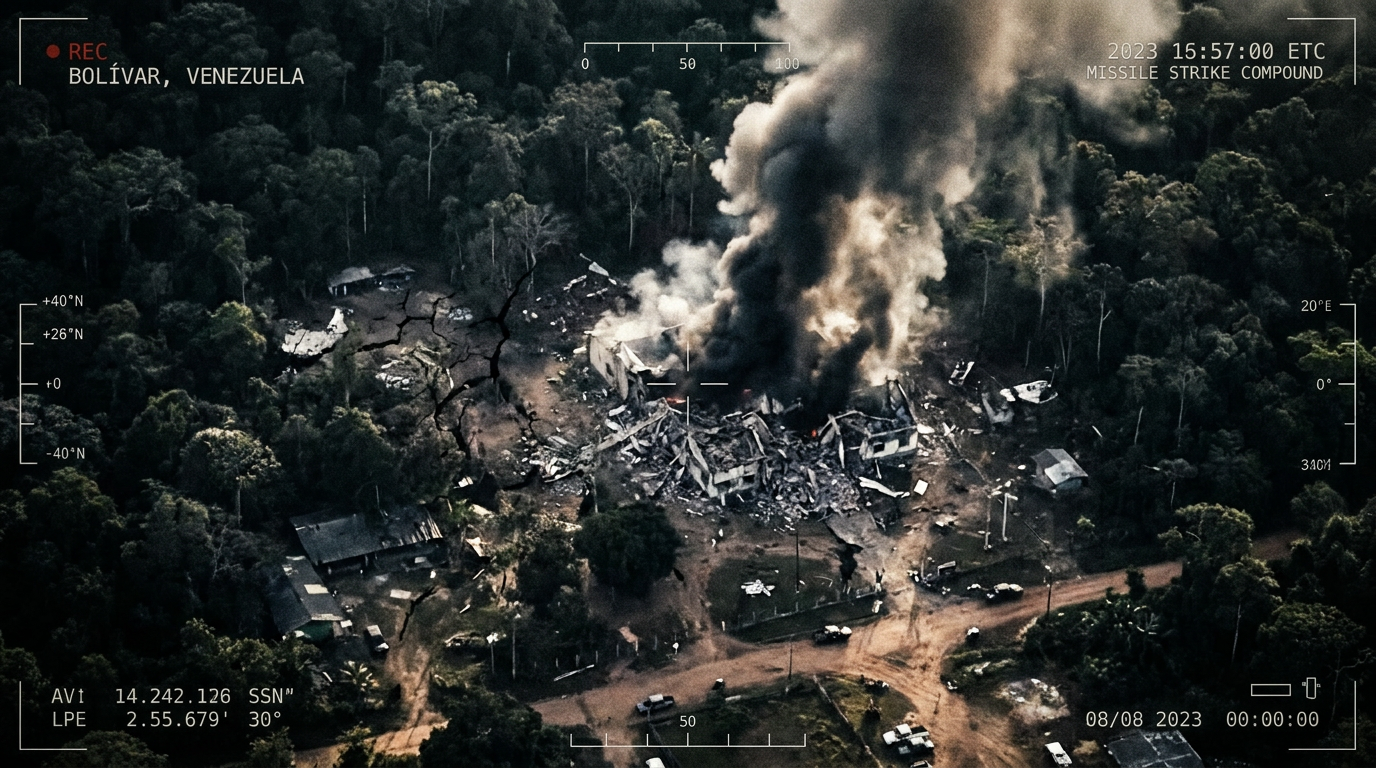
The operation took place earlier in the week at a Tren de Aragua compound located in the southeastern Venezuelan state of Bolívar. According to Defense Secretary Pete Hegseth, the strike was carried out by the United States Southern Command. Trump shared an aerial, unclassified video on social media showing a small, green-roofed building erupting in a massive explosion as the projectile hit.[1][3][6]
In a significant departure from traditional U.S. counter-narcotics operations, the strike was executed by the Joint Special Operations Command (JSOC) using a missile, rather than relying on local law enforcement extradition. A senior administration official confirmed that the CIA provided the critical intelligence that pinpointed Guerrero Flores's location, guiding the military's targeting systems.[3]

Perhaps the most striking element of the operation was the unprecedented level of cooperation from Caracas. Hegseth confirmed the strike was conducted in "full collaboration with Venezuelan security forces," and the Venezuelan Ministry of Communications issued a statement confirming their participation in the joint operation.[1][3][6]
This military partnership highlights a profound geopolitical realignment following the U.S. capture and removal of former Venezuelan President Nicolás Maduro in January 2026. For years, U.S. intelligence accused the Maduro regime of harboring Tren de Aragua and allowing the gang to operate with impunity. With a new government in place, Washington and Caracas are now actively sharing intelligence and coordinating lethal force on Venezuelan soil.[2][3][6]
This military partnership highlights a profound geopolitical realignment following the U.S.
The target of the strike, widely known by his alias "Niño Guerrero," was the architect of Tren de Aragua's explosive growth. Originally a localized prison gang operating out of Venezuela's Tocorón Penitentiary, Guerrero Flores transformed the group into a multinational crime syndicate. Under his leadership, the gang expanded its reach into Colombia, Peru, Chile, and the United States, capitalizing on the mass exodus of Venezuelan migrants.[4][6][7]

Guerrero Flores had been a top priority for U.S. law enforcement. In December 2025, federal prosecutors in New York unsealed an indictment charging him with terrorism, racketeering, and drug trafficking. The U.S. State Department subsequently offered a $5 million reward for information leading to his capture, accusing him of directing murders, kidnappings, and the smuggling of tons of cocaine while laundering money through cryptocurrency.[2][6][7]
The assassination is the culmination of the Trump administration's strategy to treat transnational gangs as military adversaries rather than criminal defendants. Early in 2025, the State Department officially designated Tren de Aragua as a Foreign Terrorist Organization. This legal reclassification allowed the administration to deploy the U.S. military against the gang's infrastructure, arguing that traditional policing is insufficient against heavily armed "narco-terrorists."[1][2][5]
The Bolívar strike is part of a broader, highly controversial kinetic campaign. Since September 2025, the U.S. military has conducted dozens of missile strikes against alleged drug-smuggling speedboats in the Caribbean Sea and the Eastern Pacific. Those maritime operations have resulted in the deaths of at least 207 people, drawing intense scrutiny from international legal monitors who question the use of preemptive lethal force in international waters.[2][4][6]

Domestically, the administration has mirrored this aggressive posture. Citing the gang's expansion into American cities, the White House invoked the Alien Enemies Act of 1798 to bypass standard immigration courts. This has led to the summary deportation of hundreds of Venezuelan men accused of gang affiliations, many of whom were flown directly to a maximum-security prison in El Salvador—a move that has sparked ongoing civil rights lawsuits.[1][3][5]
The death of Niño Guerrero leaves a massive power vacuum at the top of Tren de Aragua. While U.S. officials celebrate the decapitation of the syndicate, regional security analysts warn of the immediate aftermath. The elimination of a central mastermind often fractures cartels into smaller, highly violent splinter groups that battle for control of lucrative trafficking routes, potentially sparking a new wave of bloodshed across the Andean corridor.[3][5]
How we got here
2013
Héctor Guerrero Flores returns to Tocorón prison, where he begins expanding Tren de Aragua into a transnational syndicate.
September 2023
Guerrero Flores escapes Tocorón just before a massive Venezuelan military raid on the facility.
Early 2025
The U.S. designates Tren de Aragua as a Foreign Terrorist Organization.
September 2025
The U.S. military begins a campaign of lethal strikes against alleged drug-smuggling boats in the Caribbean.
December 2025
Federal prosecutors in New York indict Guerrero Flores on terrorism and racketeering charges.
January 2026
The U.S. captures and removes Venezuelan President Nicolás Maduro, leading to a new government in Caracas.
June 2026
A U.S. missile strike in Bolívar, Venezuela, kills Guerrero Flores.
Viewpoints in depth
U.S. National Security Advocates
Viewing transnational gangs as insurgent threats requiring military force.
Proponents of the administration's approach argue that traditional law enforcement is insufficient against multinational syndicates like Tren de Aragua, which operate with the wealth and firepower of small armies. By designating them as Foreign Terrorist Organizations, the U.S. can leverage Joint Special Operations Command and kinetic strikes to neutralize leadership directly, arguing this is the only language narco-terrorists understand.
Regional Sovereignty & Diplomacy Observers
Focusing on the historic realignment between Washington and Caracas.
Diplomatic analysts point to the strike as the ultimate proof of a reshaped Western Hemisphere following the January 2026 removal of Nicolás Maduro. The fact that Venezuelan security forces actively collaborated with the CIA and allowed U.S. missiles to strike within their borders demonstrates a profound shift, turning a former adversary into a direct partner in the war on organized crime.
Human Rights & Legal Monitors
Raising alarms over the expansion of military war powers and summary justice.
Legal scholars and human rights organizations express deep concern over the normalization of military strikes against criminal suspects. Critics argue that using missiles and summary deportations under the Alien Enemies Act bypasses the judicial system and due process. They warn that the campaign—which has already killed over 200 people in maritime strikes—sets a dangerous precedent for international law and the use of lethal force outside traditional war zones.
What we don't know
- Who will assume control of Tren de Aragua's vast criminal empire following Guerrero Flores's death.
- Whether the strike will lead to violent retaliation or fragmentation among the gang's factions across the Americas.
- The specific terms of the intelligence-sharing agreement between the U.S. and the post-Maduro Venezuelan government.
Key terms
- Tren de Aragua
- A transnational criminal organization that originated in a Venezuelan prison and expanded across the Americas, involved in drug trafficking, extortion, and human smuggling.
- Joint Special Operations Command (JSOC)
- A component of the U.S. military responsible for studying special operations requirements and conducting covert strikes and counter-terrorism missions.
- Foreign Terrorist Organization (FTO)
- A designation by the U.S. State Department that allows the government to apply severe financial sanctions and military measures against a group.
- Alien Enemies Act of 1798
- A U.S. law invoked by the Trump administration to summarily deport individuals accused of belonging to Tren de Aragua without standard immigration hearings.
Frequently asked
Who was Héctor Guerrero Flores?
Known as 'Niño Guerrero,' he was the mastermind who transformed Tren de Aragua from a local Venezuelan prison gang into a massive transnational crime syndicate.
Where did the strike take place?
The missile strike hit a Tren de Aragua compound in the southeastern Venezuelan state of Bolívar.
Did Venezuela approve of the U.S. strike?
Yes. Following the removal of Nicolás Maduro in January 2026, the new Venezuelan government actively collaborated with the CIA and U.S. forces to execute the operation.
Why is the U.S. military involved instead of police?
The U.S. designated Tren de Aragua a Foreign Terrorist Organization in 2025, allowing the administration to use military force and kinetic strikes against the group, treating them as narco-terrorists.
Sources
Source coverage
7 outlets
3 viewpoints surfaced







[1]CBS NewsRegional Diplomacy Observers
Trump says U.S. killed Tren de Aragua leader in airstrike in Venezuela
Read on CBS News →[2]The GuardianHuman Rights & Legal Monitors
Trump says leader of Venezuelan Tren de Aragua gang killed in US strike
Read on The Guardian →[3]The Washington PostRegional Diplomacy Observers
U.S. forces kill Venezuelan Tren de Aragua gang leader, Trump says
Read on The Washington Post →[4]Los Angeles TimesHuman Rights & Legal Monitors
Trump says U.S. military strike killed leader of Tren de Aragua gang
Read on Los Angeles Times →[5]CBCRegional Diplomacy Observers
Trump says Tren de Aragua gang leader killed via U.S. military strike
Read on CBC →[6]Associated PressU.S. National Security Advocates
Trump says US military strike killed leader of Tren de Aragua gang with help from Venezuela
Read on Associated Press →[7]Courthouse NewsU.S. National Security Advocates
Feds charge Tren de Aragua leader on terrorism, drug, gun offenses
Read on Courthouse News →

More in news politics
See all 5 stories →Middle East Diplomacy
US and Iran Near Interim Agreement to Halt Hostilities: What the Deal Contains
0 sources
Union Contracts
House Passes Sweeping Labor Bill Mandating Strict Timelines for First Union Contracts
0 sources
US-Iran Deal
US and Iran on the Brink of Historic Interim Peace Agreement to End War
0 sources

Every angle. Every day.
Get news politics stories with full source coverage and perspective breakdowns delivered to your inbox.