
The Science of Umami: How Glutamates and Synergy Engineer Flavor
Understanding the biochemistry of the fifth taste reveals how combining specific ingredients can multiply savory flavors by up to 15 times.
By Factlen Editorial Team
- Culinary Scientists
- Researchers focused on mapping the biochemical pathways of human taste and flavor perception.
- Gastronomic Traditionalists
- Chefs and historians who revere the intuitive wisdom of ancient cooking techniques.
- Public Health & Regulatory Bodies
- Dietitians and regulatory experts focused on food safety and nutritional optimization.
- Plant-Based Innovators
- Cooks using umami synergy to replicate the satisfying depth of meat in sustainable cooking.
What's not represented
- · Home Cooks
- · Commercial Flavor Manufacturers
Why this matters
Mastering the science of umami transforms home cooking from guesswork into a predictable chemical process. By understanding how glutamates and nucleotides interact, anyone can engineer restaurant-quality depth, reduce sodium intake, and make plant-based meals deeply satisfying.
Key points
- Umami is the fifth basic taste, triggered by free glutamates found in foods like tomatoes, cheese, and soy sauce.
- Combining glutamates with nucleotides (found in meat and mushrooms) creates 'umami synergy,' amplifying flavor up to 15 times.
- Traditional dishes like Japanese dashi, cheeseburgers, and pasta Bolognese all rely on this chemical synergy.
- The FDA and global health organizations universally recognize MSG as a safe ingredient.
- The human body metabolizes MSG exactly the same way it processes naturally occurring glutamates.
- Chefs use umami synergy to reduce sodium and create deeply satisfying plant-based meals.
It is the mouth-coating richness of a long-simmered Bolognese, the savory depth of aged Parmesan cheese, and the irresistible pull of a perfectly seared steak. For decades, Western cooks struggled to articulate exactly what made these foods so deeply satisfying, often relying on vague terms like 'savory' or 'meaty.' In Japan, however, the concept has had a name since 1908: umami. Coined by chemist Kikunae Ikeda after he isolated the flavor compound in kombu seaweed broth, umami translates roughly to 'pleasant savory taste.' Yet, for nearly a century, Western food science dismissed Ikeda’s discovery as a cultural quirk rather than a biological reality. It was not until the early 2000s that researchers definitively proved Ikeda right by identifying specific taste receptors on the human tongue—known as T1R1 and T1R3—that are hardwired to detect umami. Today, umami is universally recognized as the fifth basic taste, alongside sweet, sour, salty, and bitter, fundamentally reshaping how chefs and scientists understand flavor.[5][7][8]
At a molecular level, umami is the taste of glutamic acid, one of the most abundant amino acids in nature and a crucial building block of protein. In its bound form within a protein chain, glutamic acid has no taste. However, when proteins are broken down—whether through the heat of cooking, the slow enzymatic breakdown of aging, or the microbial action of fermentation—the amino acid is released as 'free glutamate.' This free glutamate is what binds to our taste receptors, signaling to the brain that we are consuming nutrient-dense, protein-rich food. Evolutionary biologists suggest this receptor developed to help early humans identify vital caloric resources, triggering a dopamine release that makes umami-rich foods inherently craveable. This biological imperative explains why humans are universally drawn to ingredients like ripe tomatoes, cured meats, and fermented sauces, all of which are bursting with free glutamates.[2][4]
While adding a splash of soy sauce or a sprinkle of Parmesan can elevate a dish, the true secret to restaurant-quality flavor lies in a phenomenon known as 'umami synergy.' Food scientists have discovered that glutamates do not work alone. They interact powerfully with a second group of compounds called nucleotides—specifically inosinate, which is found primarily in meats and fish, and guanylate, which is highly concentrated in dried mushrooms and seaweed. On their own, these nucleotides produce virtually no umami flavor. But when they are combined with free glutamates in the same mouthful, a profound chemical reaction occurs on the palate. The nucleotides bind to the umami taste receptor alongside the glutamate, acting as an allosteric modulator that locks the glutamate in place for longer.[1][6]

The result of this molecular lock-in is a multiplier effect that exponentially amplifies the perception of savoriness. Studies have shown that combining glutamates and nucleotides does not simply double the flavor; it can amplify the umami sensation by up to fifteen times. This synergy creates a prolonged, mouth-watering depth that lingers long after the food has been swallowed, providing a sensation of fullness and satisfaction. Long before scientists could map these receptors or measure amino acid concentrations, traditional culinary cultures around the world intuitively mastered this chemical equation. They built their foundational recipes around the precise combination of glutamate-rich plants and nucleotide-rich proteins or fungi, unknowingly engineering the ultimate sensory experience through trial and error over centuries.[5][7]
The result of this molecular lock-in is a multiplier effect that exponentially amplifies the perception of savoriness.
The most elegant and deliberate example of umami synergy is Japanese dashi, the foundational broth of the country's cuisine. A classic dashi is made by briefly simmering kombu—a kelp that is exceptionally high in glutamates—with katsuobushi, which are dried, fermented skipjack tuna flakes packed with inosinate. The resulting broth is a pure, unadulterated umami bomb that requires virtually no fat to feel rich and satisfying. Western cuisines rely heavily on the exact same chemical synergy, even if the ingredients look entirely different. A classic American cheeseburger pairs the glutamates of aged cheddar with the inosinate of ground beef. A traditional Caesar salad dressing combines the glutamates of Parmesan cheese with the inosinate of cured anchovies. Even a humble bowl of pasta Bolognese achieves its comforting depth by marrying the glutamates of slow-cooked tomatoes with the inosinate of minced beef and pork.[5][7]

Understanding this synergy also explains some of the culinary world's most luxurious and enduring pairings. A 2020 study published in the journal Scientific Reports analyzed the chemical composition of champagne and oysters to understand exactly why they are considered a classic gastronomic match. Researchers at the University of Copenhagen discovered that aged champagnes, which spend years resting on their yeast lees during the fermentation process, develop remarkably high levels of free glutamates. European oysters, meanwhile, contain substantial amounts of both free glutamates and umami-boosting nucleotides. When consumed together, the champagne and the oyster trigger a powerful umami synergy on the palate, proving that the legendary pairing is rooted in hard biochemistry and receptor activation rather than mere cultural sophistication or luxury marketing.[1]
Despite the universal love for umami, its most concentrated form—monosodium glutamate, or MSG—remains deeply misunderstood. After discovering umami, Kikunae Ikeda patented a method to stabilize free glutamate with a simple sodium molecule, creating a crystalline seasoning that could bring savory depth to any meal. For decades, MSG was a beloved staple in global kitchens. However, in the late 1960s, a wave of xenophobic panic surrounding 'Chinese Restaurant Syndrome' vilified the ingredient, blaming it for a litany of unverified health issues ranging from headaches to palpitations. The stigma stuck, leading to decades of 'No MSG' signs in restaurant windows and a lingering public distrust of the seasoning.[3][4]

Modern science, however, has thoroughly vindicated MSG. Decades of rigorous, double-blind testing by the U.S. Food and Drug Administration, the World Health Organization, and the Federation of American Societies for Experimental Biology have repeatedly confirmed that MSG is safe for the general population. The human digestive system cannot distinguish between the free glutamate found naturally in a wedge of Roquefort cheese and the glutamate in a pinch of MSG powder; they are metabolically identical. Today, food scientists and progressive chefs are actively reclaiming MSG, utilizing it not just as a flavor enhancer, but as a public health tool. Because MSG contains roughly one-third the sodium of table salt, it can significantly reduce the overall sodium content of a dish while simultaneously making it taste more robust and satisfying.[3][4]
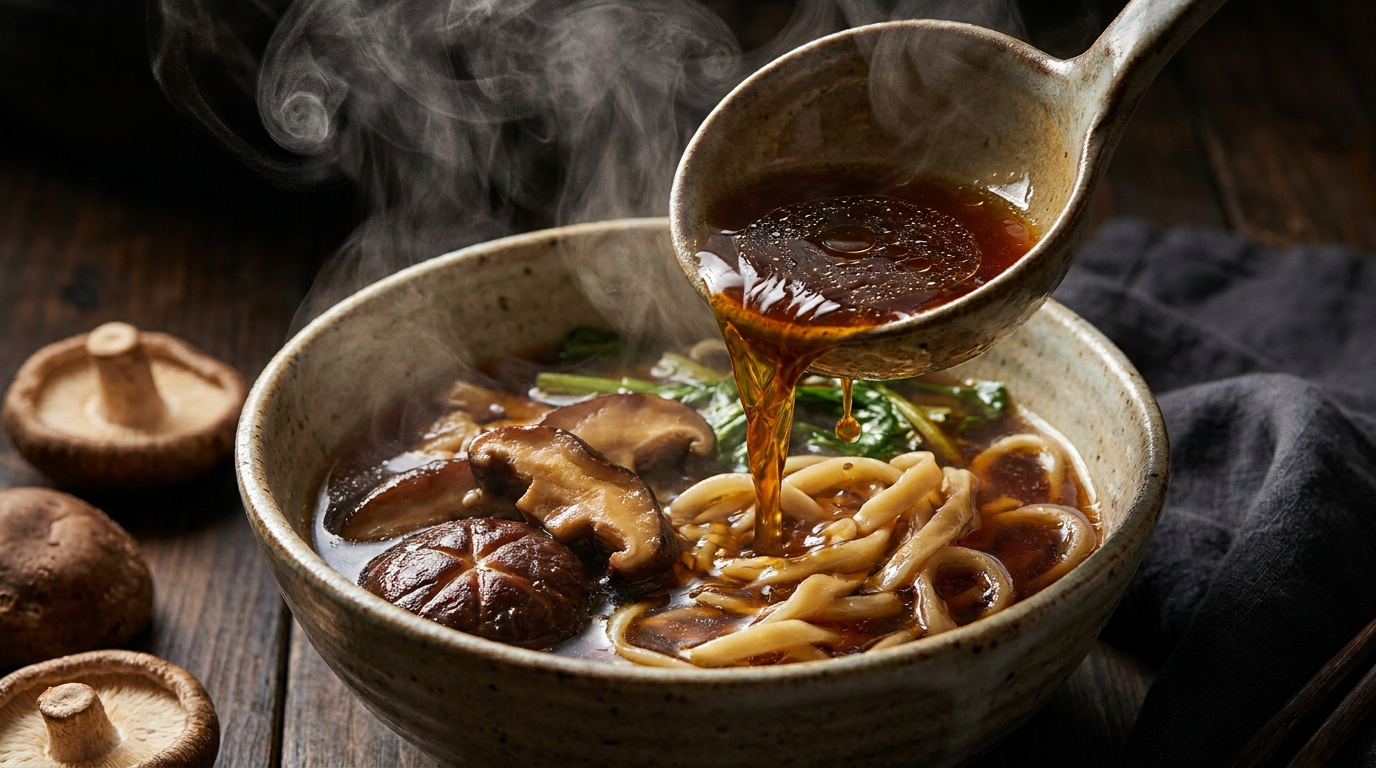
The principles of umami synergy are also proving crucial in the modern shift toward plant-based eating. Replicating the deep, satisfying savoriness of meat without using animal products is one of the greatest challenges in vegan cooking. By consciously pairing plant-based glutamates—such as miso, soy sauce, or tomato paste—with plant-based nucleotides like dried shiitake mushrooms or nutritional yeast, cooks can engineer the same mouth-coating richness found in a beef stew. Food engineers note that applying high-heat cooking techniques like roasting or searing to these ingredients further triggers the Maillard reaction, creating additional aromatic compounds that trick the brain into perceiving a meaty depth. By treating flavor as an applied science, home cooks can unlock a new dimension of culinary potential, proving that the most powerful tool in the kitchen is an understanding of how we taste.[6][8]
How we got here
1908
Japanese chemist Kikunae Ikeda isolates glutamic acid from kombu broth and coins the term 'umami'.
1909
Ikeda patents the process for producing monosodium glutamate (MSG) to commercialize the umami flavor.
1968
A letter to the New England Journal of Medicine sparks a decades-long, scientifically unfounded panic over 'Chinese Restaurant Syndrome'.
2002
Scientists definitively identify the T1R1 and T1R3 taste receptors on the human tongue, validating umami as a biological reality.
2020
Research published in Scientific Reports maps the exact umami synergy that makes champagne and oysters a perfect pairing.
Viewpoints in depth
Culinary Scientists
Researchers focused on mapping the biochemical pathways of human taste and flavor perception.
This camp views cooking as applied chemistry. They emphasize that flavor is not subjective magic, but a predictable biological response triggered by specific molecular shapes binding to the T1R1 and T1R3 receptors. By isolating compounds like glutamates and nucleotides, they aim to engineer better-tasting, more satisfying foods while reducing reliance on salt and fat.
Gastronomic Traditionalists
Chefs and historians who revere the intuitive wisdom of ancient cooking techniques.
Traditionalists argue that while science can now explain why certain foods taste good, culinary ancestors mastered the how centuries ago. They point to the slow fermentation of soy sauce, the aging of Parmigiano-Reggiano, and the precise steeping of Japanese dashi as proof that human intuition and cultural evolution successfully mapped the umami landscape long before the discovery of amino acids.
Public Health Advocates
Dietitians and regulatory experts focused on food safety and nutritional optimization.
This group is primarily concerned with dispelling the xenophobic myths surrounding MSG and highlighting its utility in modern diets. Because MSG provides intense flavor with only a fraction of the sodium found in table salt, public health experts advocate for its use as a strategic tool to lower global sodium intake without sacrificing the palatability of healthy foods.
What we don't know
- While the T1R1 and T1R3 receptors are well-mapped on the tongue, researchers are still investigating the exact function of recently discovered umami receptors located deeper in the human gastrointestinal tract.
- The precise evolutionary timeline of when early humans developed a distinct preference for free glutamates over other amino acids remains a subject of ongoing biological study.
Key terms
- Glutamic Acid
- An amino acid that serves as a building block of protein; when broken down into 'free glutamate,' it triggers the umami taste receptors.
- Nucleotides
- Organic molecules, specifically inosinate and guanylate, that naturally occur in meats and fungi and exponentially amplify umami flavor when paired with glutamates.
- Umami Synergy
- The chemical phenomenon where combining glutamates with nucleotides multiplies the perception of savoriness far beyond the sum of its parts.
- Maillard Reaction
- A chemical reaction between amino acids and reducing sugars that gives browned food its distinctive flavor and releases umami compounds.
- Allosteric Modulator
- A substance that binds to a receptor to change its response to a stimulus; in cooking, nucleotides bind to taste receptors to lock in glutamates.
Frequently asked
What exactly is umami?
Umami is the fifth basic taste, translating to 'pleasant savory taste.' It is the biological perception of free glutamic acid, an amino acid found in protein-rich foods like meat, cheese, and tomatoes.
Is MSG bad for your health?
No. Decades of rigorous scientific testing by the FDA and WHO have confirmed that MSG is safe. The body metabolizes it exactly the same way it processes the natural glutamates found in everyday foods.
How can I add more umami to my home cooking?
You can boost umami by incorporating glutamate-rich ingredients like tomato paste, soy sauce, or Parmesan, and pairing them with nucleotide-rich foods like mushrooms or meat to trigger flavor synergy.
Why do tomatoes and meat taste so good together?
Tomatoes are packed with glutamates, while meat is rich in inosinate nucleotides. When eaten together, they trigger 'umami synergy,' which multiplies the savory flavor by up to 15 times.
Sources
Source coverage
8 outlets
4 viewpoints surfaced








[1]Scientific ReportsCulinary Scientists
Umami synergy as the scientific principle behind taste-pairing champagne and oysters
Read on Scientific Reports →[2]Huberman Lab
Dr. Harold McGee: The Science of Cooking, Flavor & Taste
Read on Huberman Lab →[3]U.S. Food and Drug AdministrationPublic Health & Regulatory Bodies
Questions and Answers on Monosodium glutamate (MSG)
Read on U.S. Food and Drug Administration →[4]HealthlinePublic Health & Regulatory Bodies
What Is MSG? All You Need to Know
Read on Healthline →[5]Flavour JournalCulinary Scientists
Science of umami taste: adaptation to gastronomic culture
Read on Flavour Journal →[6]University of CopenhagenPlant-Based Innovators
Plant-based Christmas dinner? Researcher reveals the secret to making it taste great
Read on University of Copenhagen →[7]Hospitality InstituteGastronomic Traditionalists
The Science of Umami: How Japanese Cuisine Mastered the Fifth Taste
Read on Hospitality Institute →[8]Factlen Editorial TeamPlant-Based Innovators
Synthesis by Factlen editorial team
Read on Factlen Editorial Team →

Every angle. Every day.
Get lifestyle stories with full source coverage and perspective breakdowns delivered to your inbox.