
The Science of Pilates: How Low-Impact Resistance Reshapes the Body and Mind
Once a niche conditioning method for dancers, Pilates is now backed by clinical research as a powerful tool for building core stability, reducing chronic pain, and improving neurological balance.
By Factlen Editorial Team
- Clinical Rehabilitation Specialists
- View Pilates as an evidence-based, low-impact tool for managing chronic pain, correcting posture, and rebuilding spinal stability.
- Modern Fitness Enthusiasts
- Embrace Pilates as a dynamic, scalable workout for building lean muscle, flexibility, and cross-training alongside other sports.
- Classical Pilates Traditionalists
- Emphasize strict adherence to Joseph Pilates' original 'Contrology' method, apparatus designs, and mind-body principles.
What's not represented
- · High-intensity interval training (HIIT) advocates
- · Heavy weightlifting coaches
Why this matters
As high-intensity workouts lead to rising injury rates, understanding the biomechanics of low-impact resistance offers a sustainable, lifelong blueprint for physical health. Clinical evidence shows that targeted core stabilization can effectively treat chronic back pain and prevent age-related mobility decline.
Key points
- Pilates targets deep stabilizing muscles like the transverse abdominis rather than superficial abdominal layers.
- The method was originally developed by Joseph Pilates during WWI to rehabilitate bedridden internees.
- Clinical studies show Pilates significantly reduces chronic lower back pain and improves spinal alignment.
- Reformer Pilates uses spring-loaded variable resistance, while Mat Pilates relies on body weight and gravity.
- The practice improves proprioception, leading to a 34% decrease in fall risk among older adults.
Pilates has transcended its historical reputation as a niche workout for dancers to become a globally recognized pillar of physical therapy and mainstream fitness. Unlike the high-impact, heavy-load trends that have dominated gym culture for decades, this low-impact system prioritizes precise alignment, breath control, and deep muscular engagement. The method's surge in popularity is backed by a growing body of clinical evidence validating its efficacy for everything from chronic pain management to athletic cross-training.[1][8]
By focusing on the body's stabilizing muscles rather than superficial hypertrophy, Pilates offers a sustainable approach to movement that appeals to professional athletes, older adults, and office workers alike. The foundation of this practice was laid over a century ago by Joseph Pilates, a German national born in 1883 who suffered from asthma, rickets, and rheumatic fever as a child. Driven to overcome his physical frailties, he studied gymnastics, martial arts, and yoga, eventually developing his own system of physical conditioning.[3][8]
During World War I, while interned in England, he refined his techniques by teaching fellow internees and rigging hospital beds with springs to rehabilitate bedridden patients. This early experimentation with spring-based resistance laid the groundwork for the specialized apparatus used in studios today. Joseph Pilates originally called his method "Contrology," defining it as the complete coordination of body, mind, and spirit.[3][5]
He believed that modern lifestyles—characterized by sedentary habits and poor posture—were the root cause of physical decline, and that conscious, deliberate movement was the antidote. After his death, his disciples distilled his teachings into six core principles that still govern the practice today: breath, concentration, centering, control, precision, and flow. These principles dictate that the quality of movement is vastly more important than the quantity of repetitions, requiring practitioners to remain intensely focused on their biomechanics.[3][5]

At the anatomical heart of Pilates is the concept of the "powerhouse," or the body's core. However, unlike traditional abdominal workouts that isolate the superficial "six-pack" muscles, Pilates targets the deep stabilizing structures of the trunk. This includes the transverse abdominis, which acts like a muscular corset wrapping around the spine, the multifidus muscles that support the vertebrae, and the pelvic floor.[2][7]
At the anatomical heart of Pilates is the concept of the "powerhouse," or the body's core.
By strengthening these deep stabilizers, the body creates a robust internal support system that enhances posture and functional movement. This biomechanical focus has made Pilates a highly effective intervention for chronic lower back pain. Clinical research demonstrates that by correcting spinal alignment and alleviating the burden on overworked superficial muscles, targeted core stabilization can significantly reduce discomfort.[1][4][7]

A 2019 systematic review highlighted the therapeutic power of the method, finding that Pilates reduced lumbar pain intensity by 44 percent in patients with herniated discs, often outperforming conventional physiotherapy in long-term outcomes. Similarly, regular practice has been shown to improve thoracic spine alignment, counteracting the "tech neck" and hunched shoulders endemic to desk workers.[4]
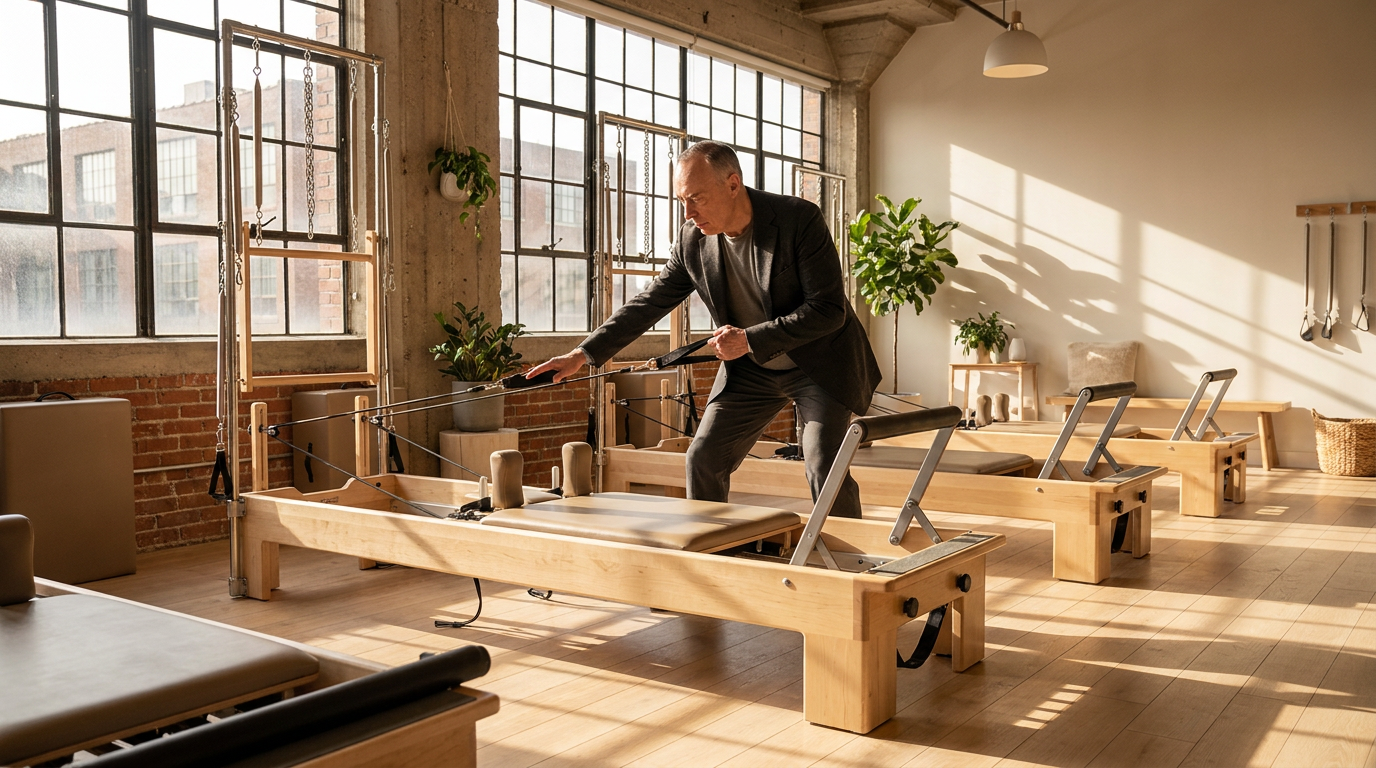
The practice is generally divided into two main modalities: Mat and Reformer. Mat Pilates relies entirely on body weight and gravity to create resistance, demanding exceptional foundational strength and body awareness to stabilize the trunk through various planes of motion. Reformer Pilates, by contrast, utilizes a specialized machine equipped with a sliding carriage, pulleys, and adjustable springs.[6]
The springs provide variable resistance that can either assist a beginner through a difficult movement or challenge an advanced practitioner by increasing the load. While both modalities share the same foundational principles, the Reformer allows for a broader range of exercises and greater scalability. The continuous tension of the springs also increases the metabolic demand; a vigorous Reformer session can burn between 250 and 450 calories per hour, while simultaneously building lean muscle mass and improving joint mobility.[6]

Beyond strength and flexibility, Pilates profoundly impacts proprioception—the body's ability to sense its position in space. The slow, controlled nature of the exercises, particularly those requiring single-leg balance on the moving carriage of a Reformer, trains the nervous system to react more efficiently to instability.[4][7]
This neurological adaptation is particularly beneficial for older adults, with studies showing a 34 percent decrease in instability and a significant reduction in fall risk among senior practitioners. The intense concentration required to maintain form also transforms the workout into a moving meditation, offering psychological benefits and stress relief akin to mindfulness practices.[1][4]

Ultimately, the enduring appeal of Pilates lies in its adaptability and focus on longevity. By treating the body as an integrated mechanical system rather than a collection of isolated parts, it provides a blueprint for moving through life with greater ease, resilience, and structural integrity.[8]
How we got here
1883
Joseph Pilates is born in Germany, suffering from childhood ailments that inspire his lifelong pursuit of physical fitness.
1914
Interned in England during WWI, Pilates develops his conditioning method and rigs hospital beds with springs to rehabilitate patients.
1926
Joseph and Clara Pilates open their first 'body conditioning gym' in New York City, attracting dancers and athletes.
1945
Pilates publishes 'Return to Life Through Contrology', outlining his philosophy and the original 34 mat exercises.
2020s
Pilates experiences a massive global resurgence, backed by modern clinical research validating its biomechanical benefits.
Viewpoints in depth
Clinical Rehabilitation Specialists
Focus on Pilates as a medical intervention for musculoskeletal issues.
Physical therapists and clinical researchers view Pilates primarily through the lens of biomechanics and injury recovery. They emphasize the method's ability to activate the transverse abdominis and multifidus muscles, which are often dormant in patients with chronic lower back pain. By using the Reformer's spring resistance to safely load joints without high impact, clinicians utilize Pilates to correct postural imbalances, rehabilitate herniated discs, and improve proprioception in older adults to prevent falls.
Classical Pilates Traditionalists
Advocate for strict adherence to Joseph Pilates' original methods and apparatus.
Traditionalists argue that the true benefits of Pilates are only unlocked when the method is practiced exactly as Joseph Pilates intended—a system he called 'Contrology.' This camp emphasizes the six foundational principles (breath, concentration, centering, control, precision, and flow) and insists on using apparatus built to the original specifications. They caution against modern 'fitness Pilates' classes that prioritize high repetitions and muscle burn over mindful, precise movement and spinal articulation.
Modern Fitness Enthusiasts
Embrace Pilates as a dynamic, scalable workout for overall physical conditioning.
The modern fitness community has adapted Pilates into a broader wellness lifestyle, often blending it with other modalities. This perspective values the Reformer for its ability to provide a full-body, resistance-based workout that builds lean muscle mass, increases metabolic rate, and improves flexibility. For these practitioners, Pilates is an essential cross-training tool that counteracts the stiffness caused by heavy weightlifting or the joint strain associated with high-impact cardio.
What we don't know
- Whether the psychological benefits of Pilates stem from the specific breathing techniques or simply the dedicated time spent in mindful movement.
- The exact long-term differences in bone density outcomes between practitioners of Reformer Pilates versus traditional heavy weightlifting.
Key terms
- Contrology
- Joseph Pilates' original name for his method, emphasizing the mind's conscious control over the body's movements.
- Powerhouse
- The foundational center of the body in Pilates, comprising the deep abdominal muscles, lower back, pelvic floor, and hips.
- Reformer
- A specialized piece of Pilates equipment featuring a sliding carriage, pulleys, and springs that provide variable resistance.
- Transverse Abdominis
- The deepest layer of abdominal muscle that wraps around the torso like a corset, crucial for spinal stability.
- Proprioception
- The nervous system's ability to sense the body's position, movement, and spatial orientation.
Frequently asked
Is Pilates better than yoga?
Neither is objectively better; they serve different purposes. Yoga often focuses on static holds and spiritual mindfulness, while Pilates emphasizes dynamic movement, core biomechanics, and physical conditioning.
Can Pilates help with weight loss?
While not primarily a cardiovascular workout, Pilates builds lean muscle mass which increases resting metabolic rate. A vigorous Reformer class can burn up to 450 calories per hour.
Do I need a Reformer to see results?
No. Mat Pilates uses body weight and gravity for resistance and is highly effective for building core strength and body awareness. The Reformer simply offers variable spring resistance for different challenges.
Is Pilates safe if I have lower back pain?
Yes, and it is often prescribed by physical therapists. By strengthening the deep stabilizing muscles of the spine, Pilates is clinically proven to reduce chronic lower back pain, though injured individuals should seek clinical guidance.
Sources
Source coverage
8 outlets
3 viewpoints surfaced








[1]Cleveland ClinicClinical Rehabilitation Specialists
The Health Benefits of Pilates
Read on Cleveland Clinic →[2]HealthlineModern Fitness Enthusiasts
19 Benefits of Pilates
Read on Healthline →[3]Pilates AnytimeClassical Pilates Traditionalists
The Joseph Pilates Story
Read on Pilates Anytime →[4]Sohl StudioClinical Rehabilitation Specialists
Physiological Benefits of Pilates
Read on Sohl Studio →[5]Gratz PilatesClassical Pilates Traditionalists
What Is Contrology? Understanding Joseph Pilates' Original Method
Read on Gratz Pilates →[6]Breathe EducationModern Fitness Enthusiasts
Reformer vs Mat Pilates: What's the Difference?
Read on Breathe Education →[7]Auckland PhysiotherapyClinical Rehabilitation Specialists
How Pilates Can Improve Your Health
Read on Auckland Physiotherapy →[8]Factlen Editorial Team
Synthesis by Factlen editorial team
Read on Factlen Editorial Team →
More in fitness
See all 6 stories →Exercise Science
The Science of Zone 2: Why Slowing Down is the Key to Cardiovascular Fitness
0 sources

Fitness Tech
The Science of Heart Rate Variability: Why the Best Athletes Train by Their Nervous System
0 sources
Digital Weight
How Electromagnetic Resistance is Reshaping Home Strength Training
0 sources
Strength Training
The Minimum Effective Dose: How Little Strength Training You Actually Need
0 sources
Every angle. Every day.
Get fitness stories with full source coverage and perspective breakdowns delivered to your inbox.