
The Multimillion-Dollar Science Behind the 2026 World Cup's Engineered Grass
Agronomists from the University of Tennessee and Michigan State University have spent eight years developing custom hybrid turfgrass to convert artificial-turf NFL stadiums into pristine, identical soccer pitches for the 2026 World Cup.
By Factlen Editorial Team
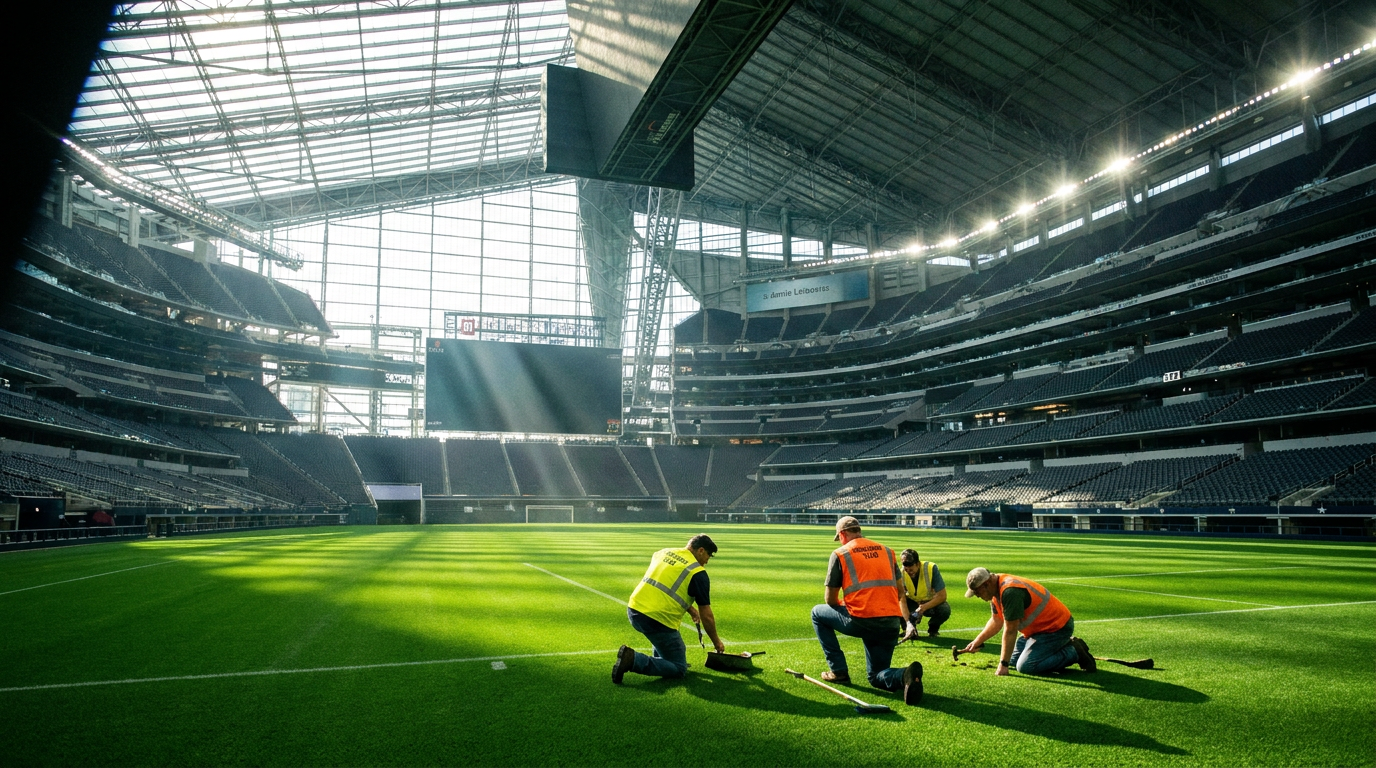
- Agronomists & Turf Scientists
- Focused on the biological and engineering challenges of keeping grass alive and structurally sound in unnatural, high-stress environments.
- FIFA Pitch Management
- Prioritizes competitive neutrality, demanding that the playing surface behaves identically across all 16 venues regardless of local climate.
- Stadium Operations
- Tasked with the immense logistical challenge of converting artificial-turf NFL venues into living agricultural ecosystems for a 39-day window.
What's not represented
- · Professional Players
- · Environmental Sustainability Advocates
Why this matters
The largest sporting event in history relies entirely on an unprecedented agricultural engineering feat. The techniques developed to keep this grass alive indoors and under extreme stress will revolutionize how local parks, golf courses, and professional stadiums manage safe, sustainable playing surfaces worldwide.
Key points
- FIFA requires all 2026 World Cup matches to be played on natural grass, forcing eight artificial-turf NFL stadiums to undergo massive conversions.
- University of Tennessee and Michigan State University led an eight-year research project to develop the perfect turf for the tournament.
- Researchers developed a 'shallow profile' system that allows grass to thrive in just 5 to 6 inches of soil by forcing roots to grow laterally.
- The pitches use hybrid stitching, reinforcing natural grass with synthetic fibers to withstand the wear of 104 matches.
- A custom testing machine called fLEX simulates athlete foot strikes to ensure the grass feels identical across all 16 venues.
As the 2026 FIFA World Cup kicks off across North America, millions of fans are focused on the world's greatest athletes. But beneath the cleats of every player lies the tournament's most heavily engineered, meticulously researched, and fiercely protected asset: the grass.[1][7]
The 2026 tournament presents a logistical nightmare that FIFA has never faced on this scale. Matches are spread across 16 cities in three countries, spanning 10 different climatic zones. Venues range from the humid, sea-level dome of BC Place in Vancouver to the thin, 7,200-foot altitude of Estadio Azteca in Mexico City.[4][6]
Complicating matters further, eight of the 16 host venues are North American stadiums primarily designed for the NFL, meaning they normally utilize artificial turf. FIFA's regulations, however, are uncompromising: every single World Cup match must be played on natural grass to ensure consistent ball roll and minimize player injury.[2][5]
To solve this, FIFA initiated a multimillion-dollar research project nearly eight years ago, tapping the world's leading turfgrass agronomists at the University of Tennessee (UT) and Michigan State University (MSU). Their mandate was simple in theory but monumental in practice: create a playing surface that behaves exactly the same way in a climate-controlled dome in Dallas as it does in the blazing sun of Miami.[2][3][7]
The first major hurdle the researchers faced was depth. A traditional elite soccer pitch is built on a "conventional rootzone" that requires 12 to 15 inches of sand and soil to allow deep root growth and rapid drainage. However, because many of the NFL stadiums were not designed to accommodate natural grass, their concrete floors only allow for a "shallow profile" of 5 to 6 inches.[2][5]

To make grass survive and hold together in such a shallow bed, the MSU and UT teams had to rethink how sod is grown. At specialized turf farms across the continent, the grass for the World Cup was grown on top of an impermeable plastic layer. When the grass roots grew downward and hit the plastic, they were forced to grow laterally, weaving together into an incredibly dense, indestructible subterranean mat.[3][6]
To make grass survive and hold together in such a shallow bed, the MSU and UT teams had to rethink how sod is grown.
The researchers also had to formulate specific seed recipes tailored to the diverse climates of the host cities. For cooler northern climates and indoor domed stadiums, they developed a highly precise blend consisting of 84% Kentucky bluegrass and 16% perennial ryegrass. The ryegrass germinates quickly and recovers well from cleat damage, while the bluegrass spreads underground to naturally repair divots.[4][6]

For the hotter, open-air stadiums in the southern United States and Mexico, the team opted for 100% Bermudagrass, a warm-season species that thrives in high heat and humidity while resisting drought.[3][7]
Regardless of the grass species, none of the World Cup pitches are 100% natural. To survive the brutal wear and tear of a 39-day tournament with 104 matches, the fields utilize "hybrid stitching." Massive machines inject synthetic fibers deep into the soil, reinforcing the natural grass. The resulting surface is roughly 95% natural living grass and 5% synthetic support, providing the structural integrity of a carpet with the playability of a traditional pitch.[2][5]
Ensuring that these disparate grasses and shallow profiles actually feel identical to the players required entirely new testing technology. The University of Tennessee developed a machine called "fLEX" (field or foot lower extremities). The device features a 3D-printed foot wearing a real soccer cleat, which strikes the ground to simulate the exact biomechanical forces of an elite athlete running, cutting, and stopping.[2][4]

By deploying the fLEX machine across all 16 venues, groundskeepers can measure traction, surface hardness, and energy return, adjusting watering and rolling schedules to ensure the "field feel" remains perfectly uniform across the continent.[4]
The final challenge was keeping the grass alive once it was installed inside dark, enclosed stadiums. At AT&T Stadium in Arlington, Texas—which will host nine matches—the retractable roof blocks vital sunlight. To compensate, engineers have suspended massive arrays of pink grow lights from the ceiling, bathing the pitch in a surreal, neon glow between matches to keep the turf photosynthesizing.[7]

How we got here
2018
FIFA initiates a research partnership with the University of Tennessee and Michigan State University to develop turf for the 2026 tournament.
June 2022
FIFA's Pitch Management Team officially implements the research and development project across the selected host cities.
Spring 2026
Sod farms across North America begin harvesting the custom-grown grass and shipping it to stadiums in refrigerated trucks.
May 2026
Stadiums finalize the installation of the hybrid pitches, utilizing grow lights and the fLEX machine to perfect the surfaces.
June 2026
The 2026 FIFA World Cup kicks off, putting the engineered grass to the ultimate test across 104 matches.
Viewpoints in depth
Agronomists & Turf Scientists
Focused on the biological and engineering challenges of keeping grass alive and structurally sound in unnatural, high-stress environments.
For the agricultural researchers at UT and MSU, the World Cup is less a sporting event and more a massive, continent-wide science experiment. Their primary concern is root density and plant survival. By growing the sod on impermeable plastic, they hacked the grass's natural growing patterns, forcing the roots to weave horizontally into a dense mat. They view the successful deployment of these shallow-profile, hybrid-stitched fields as a breakthrough that will eventually trickle down to improve the safety and durability of municipal parks and high school sports fields.
FIFA Pitch Management
Prioritizes competitive neutrality, demanding that the playing surface behaves identically across all 16 venues regardless of local climate.
FIFA's pitch management team approaches the grass strictly as a standardized piece of sporting equipment. Their nightmare scenario is a pitch that plays 'fast' in one city and 'slow' in another, which could alter the tactical outcome of a match. They rely heavily on data from the fLEX machine to measure surface hardness and rotational traction, ensuring that a player executing a sharp turn in the humid heat of Miami experiences the exact same physical feedback as they would in the climate-controlled dome in Vancouver.
Stadium Operations
Tasked with the immense logistical challenge of converting artificial-turf NFL venues into living agricultural ecosystems for a 39-day window.
For the operators of massive NFL venues like AT&T Stadium or MetLife Stadium, the World Cup presents a unique facility management crisis. They must temporarily replace their low-maintenance artificial turf with a living, breathing organism that requires constant watering, mowing, and artificial sunlight. Their focus is on the logistics of the installation—coordinating fleets of refrigerated trucks, managing the complex drainage layers placed over concrete floors, and running massive arrays of pink LED grow lights to keep the grass alive indoors.
What we don't know
- How well the shallow-profile grass will hold up during the final weeks of the tournament after enduring dozens of matches and training sessions.
- Whether the extreme microclimates inside fully enclosed domed stadiums will trigger unforeseen fungal or disease issues in the natural grass.
- If the massive financial investment in temporary natural grass will pressure NFL owners to permanently switch away from artificial turf in the future.
Key terms
- Shallow Profile
- A specialized field construction method that uses only 5 to 6 inches of sand and soil, designed for stadiums that cannot accommodate the traditional 12 to 15-inch depth.
- Hybrid Stitching
- A process where large machines inject synthetic fibers deep into the root zone of natural grass to anchor the turf and prevent it from tearing under heavy athletic use.
- fLEX Machine
- A testing device developed by the University of Tennessee that uses a 3D-printed foot and a real soccer cleat to simulate the impact of a player running on the grass.
- Competitive Neutrality
- The principle that the playing surface should not offer an advantage or disadvantage to any team, requiring the grass to feel and play identically across all venues.
Frequently asked
Why doesn't FIFA allow artificial turf?
FIFA mandates natural grass because artificial turf alters how the ball rolls and bounces, and it is widely believed by players to increase the risk of certain lower-body injuries compared to natural surfaces.
What is hybrid grass?
Hybrid grass consists of roughly 95% natural living grass reinforced with 5% synthetic fibers that are stitched directly into the soil, providing the durability of a carpet with the playability of a natural pitch.
How do they grow grass indoors?
For domed stadiums that lack natural sunlight, groundskeepers use massive arrays of specialized pink LED grow lights suspended over the pitch to stimulate photosynthesis between matches.
What happens to the grass after the World Cup?
In stadiums that primarily host NFL games on artificial turf, the temporary natural grass pitches will be removed shortly after the tournament concludes.
Sources
Source coverage
7 outlets
3 viewpoints surfaced







[1]Factlen Editorial TeamStadium Operations
Synthesis by Factlen editorial team
Read on Factlen Editorial Team →[2]University of TennesseeAgronomists & Turf Scientists
Tackling turfgrass: UT leads first-of-its-kind research for FIFA World Cup 26
Read on University of Tennessee →[3]Michigan State UniversityAgronomists & Turf Scientists
MSU researchers develop turfgrass for 2026 FIFA World Cup
Read on Michigan State University →[4]Fast CompanyAgronomists & Turf Scientists
How researchers designed the perfect grass for the 2026 World Cup
Read on Fast Company →[5]ForbesFIFA Pitch Management
FIFA-Led Research Designing World Cup 2026 Fields
Read on Forbes →[6]Michigan PublicAgronomists & Turf Scientists
How MSU researchers helped create the turf for the 2026 World Cup
Read on Michigan Public →[7]The Associated PressFIFA Pitch Management
The World Cup pitches are the result of years of engineering to find just the right grass
Read on The Associated Press →
More in science
See all 5 stories →GLP-1 Therapeutics
Beyond Weight Loss: The Clinical Evidence for GLP-1 Drugs in Heart Disease, Addiction, and Parkinson's
0 sources

Turf Science
The Agronomy and Biomechanics Behind the 2026 World Cup's Unprecedented Grass Experiment
0 sources
Sports Agronomy
The Multimillion-Dollar Science Behind the 2026 World Cup's Perfect Pitch
0 sources
Every angle. Every day.
Get science stories with full source coverage and perspective breakdowns delivered to your inbox.