
The Agronomy and Biomechanics Behind the 2026 World Cup's Unprecedented Grass Experiment
To meet FIFA's strict natural-grass mandate across 16 diverse climates and five indoor stadiums, agronomists have engineered a highly specific, transportable turf system that sits at the center of a fierce debate over athlete safety.
By Factlen Editorial Team
- Agronomists & Turf Scientists
- Focus on the biological triumph of standardizing a living organism across diverse climates.
- Player Safety Advocates
- Argue that natural grass is biomechanically superior and safer for joints than rigid synthetic turf.
- Stadium Operators & Leagues
- Highlight the economic and logistical challenges of maintaining natural grass in multi-use and indoor venues.
What's not represented
- · Environmental advocates concerned about the water and energy usage of indoor grass farming
- · Sod farmers tasked with executing the exact seed recipes at scale
Why this matters
The $3.8 billion tournament relies entirely on the biological performance of these engineered pitches, which sit at the center of a fierce, data-heavy debate over athlete safety, joint injuries, and the future of stadium infrastructure.
Key points
- FIFA requires all 104 matches of the 2026 World Cup to be played on natural grass, including inside five domed stadiums.
- Agronomists engineered a shallow-profile system that forces grass roots to grow laterally, creating a highly durable, transportable mat.
- Cooler and indoor venues will use a highly specific mix of 84% Kentucky bluegrass and 16% perennial ryegrass.
- Biomechanical engineers argue natural grass is safer because it deforms and absorbs energy, whereas rigid artificial turf returns force to the joints.
- While historical data shows higher injury rates on artificial turf, recent league-sponsored studies suggest the gap may be narrowing.
- The research could eventually lead to sustainable, hydroponic grass systems for municipal and local sports fields.
The 2026 FIFA World Cup presents an unprecedented biological and logistical challenge: hosting 104 matches across 16 stadiums in three countries, all on identical natural grass. Complicating matters, five of the selected venues are domed or feature retractable roofs, and eight typically utilize artificial turf for their domestic NFL or CFL seasons. Yet FIFA's mandate is absolute—every match must be played on a living, natural surface that provides consistent ball roll, bounce, and shock absorption.[1][2]
The core agronomic claim is that a living organism can be standardized across 10 distinct climate zones, from the altitude of Mexico City to the humidity of Miami and the controlled indoors of Atlanta. The evidence supporting this massive undertaking stems from a five-year, multimillion-dollar joint research project led by turfgrass scientists at Michigan State University and the University of Tennessee.[3][4]
To achieve this uniformity, researchers tested hundreds of seed ratios before settling on two primary biological profiles. Warm-weather stadiums utilize Bermudagrass—specifically a resilient strain known as Tahoma 31. Conversely, cooler and indoor venues rely on a highly specific, engineered mixture of 84 percent Kentucky bluegrass and 16 percent perennial ryegrass, a ratio chosen to maximize strength without compromising the maturity speed of the sod.[3][5]

Because half of the stadiums typically use artificial turf over concrete, agronomists had to engineer a portable grass system that could be installed temporarily without sacrificing elite performance. The evidence points to a novel "shallow profile" technique: rather than growing deep roots in native soil, the seeds are planted in wide, plastic trays filled with only 1.5 inches of specialized sand.[4][5]
This shallow profile forces a unique biological adaptation. Deprived of vertical depth, the grass roots are forced to grow laterally. As they spread sideways, they weave into a dense, interlocking biological mat that is remarkably strong, capable of withstanding the sheer force of a sliding 170-pound athlete without tearing or divoting.[5]

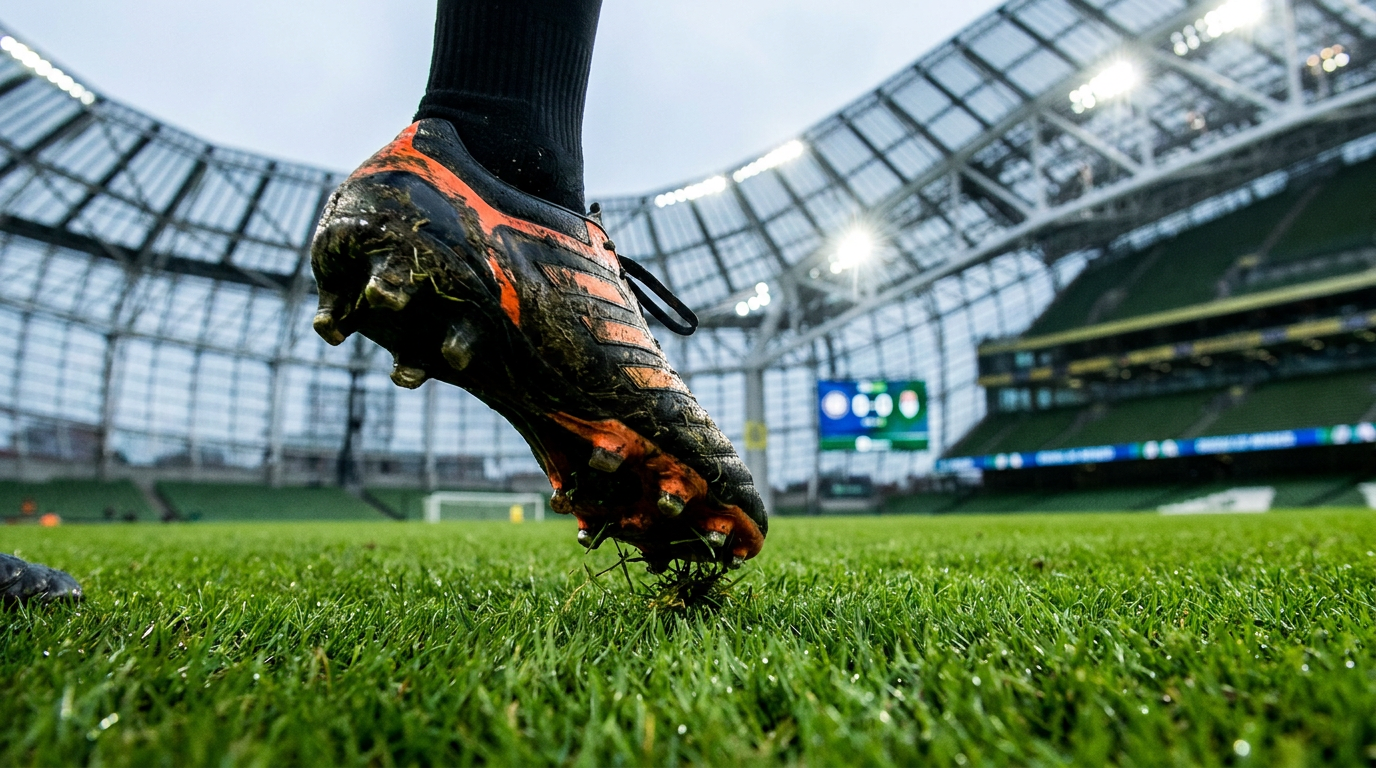
To prove the grass could survive the heavy wear and tear of a 39-day international tournament, University of Tennessee researchers developed the "fLEX" (foot lower extremity) machine. Equipped with a standard soccer cleat, this pneumatic device strikes turf plots repeatedly to simulate human biomechanics, allowing scientists to quantify structural degradation and recovery times with extreme precision.[3][4]

Beyond the agronomy, the World Cup's grass mandate highlights a fierce biomechanical claim: natural grass is fundamentally safer for human joints than artificial turf. This assertion sits at the center of an ongoing, highly contentious debate between professional players' unions and stadium operators.[7]
Beyond the agronomy, the World Cup's grass mandate highlights a fierce biomechanical claim: natural grass is fundamentally safer for human joints than artificial turf.
According to biomechanical engineers, the physics of the two surfaces differ drastically. Natural grass is a living, permeable system that deforms under pressure, absorbing kinetic energy. Artificial turf, built from synthetic fibers and rubber or plastic infill, is rigid. When a player lands heavily on turf, the surface does not give, returning that kinetic force directly into the athlete's knees, ankles, and lower back.[6]
The strongest mechanical evidence against synthetic turf involves "rotational traction"—the amount of grip a shoe maintains while twisting. When a player pivots sharply on natural grass, the root system eventually gives way, releasing the cleat and sparing the joint. On synthetic turf, the foot often sticks, transferring the violent rotational torque directly to the anterior cruciate ligament (ACL) or ankle.[6][7]
Epidemiological data on injury rates presents a mixed, highly contested picture, though historical evidence heavily supports the players' safety claims. A comprehensive 2019 study published in the American Journal of Sports Medicine found a 13 percent higher overall injury rate in NCAA football games played on artificial turf compared to natural grass.[7][9]
Furthermore, a 2021 report by the NFL Players Association found that athletes were 28 percent more likely to sustain a non-contact lower-body injury on artificial turf. For positions requiring constant cutting, pivoting, and acceleration—movements identical to elite soccer—the union argued the data proved synthetic surfaces were an occupational hazard.[7]

However, recent league-sponsored data complicates the narrative, presenting weaker evidence for the disparity. A 2024 joint committee study analyzing the 2023 NFL season found the difference in non-contact lower-extremity injuries was statistically negligible, recording 0.043 injuries per 100 plays on synthetic turf versus 0.042 on natural grass.[8]
Despite the conflicting epidemiological data in domestic leagues, FIFA's absolute refusal to compromise on natural grass has validated the global players' lived experiences. By forcing North American stadiums to adapt to the biological surface, the tournament has set a new standard for international play.[1][7]
The infrastructure required to sustain these indoor ecosystems is massive. Beneath the visible grass lies a highly engineered profile: a reinforcement layer, up to 12 inches of specialized sand in permanent installations, gravel for drainage, and an active vacuum-ventilation system designed to regulate oxygen and moisture directly at the root level.[3]
To keep the grass alive inside dark domes, stadium operators have installed massive arrays of LED grow lights and automated irrigation systems. These venues have essentially been transformed into massive, temporary indoor farms, carefully balancing humidity and light to mimic natural outdoor conditions.[1][3]
While the immediate goal is surviving the 104 matches of the 2026 World Cup, turf scientists argue the data gathered during this unprecedented experiment will eventually revolutionize municipal agronomy and local sports infrastructure.[4]
The successful development of shallow-profile, transportable grass systems paves the way for closed-loop hydroponic sports fields. By recycling water below the surface rather than spraying it from above, future stadiums and community parks could drastically reduce their environmental footprint while maintaining elite, biologically active playing surfaces.[4][5]
How we got here
1994
The Pontiac Silverdome becomes the first stadium to host a World Cup match indoors on temporary natural grass.
2021
Michigan State and the University of Tennessee begin a five-year FIFA-funded research project to engineer the 2026 pitches.
2022
The NFLPA releases data showing a 28% higher rate of non-contact lower-body injuries on artificial turf.
May 2026
Sod farms across North America begin harvesting and shipping the engineered grass to the 16 host stadiums.
June 11, 2026
The 2026 FIFA World Cup kicks off on standardized natural grass pitches.
Viewpoints in depth
Agronomists & Turf Scientists
Focus on the biological triumph of standardizing a living organism across diverse climates.
For turfgrass researchers, the 2026 World Cup is the ultimate applied biology experiment. By manipulating seed ratios, sand depth, and lighting, they have proven that a living ecosystem can be standardized, packed up, and installed inside an NFL dome without losing its structural integrity. They view this not just as a sports achievement, but as a breakthrough in sustainable, hydroponic agriculture that could eventually be scaled down to community parks.
Player Safety Advocates
Argue that natural grass is biomechanically superior and safer for joints than rigid synthetic turf.
Professional athletes and biomechanical engineers point to the fundamental physics of the playing surface. Because natural grass deforms and tears under extreme pressure, it acts as a shock absorber for the human body. Player unions argue that the rigidity and high rotational traction of artificial turf are directly responsible for career-altering ligament tears, and they view FIFA's strict grass mandate as vindication of their long-standing safety concerns.
Stadium Operators & Leagues
Highlight the economic and logistical challenges of maintaining natural grass in multi-use and indoor venues.
While acknowledging player preferences, stadium operators point to the massive logistical and financial burden of maintaining natural grass. Modern stadiums are designed as multi-use entertainment hubs that host concerts, monster truck rallies, and football games in rapid succession. Operators argue that the millions of dollars required to install grow lights, ventilation systems, and temporary sod for a soccer tournament are economically unfeasible for a standard domestic sports season.
What we don't know
- Whether the temporary indoor grass will hold up perfectly through the later knockout stages of the 39-day tournament.
- If the NFL and other domestic leagues will permanently adopt these shallow-profile grass systems or revert to artificial turf after the World Cup.
Key terms
- Turfgrass
- Real, living grass that is carefully selected, grown, and managed to create high-performance athletic surfaces.
- Artificial Turf
- A manufactured playing surface made from synthetic fibers and rubber or plastic infill designed to mimic the look of natural grass.
- Shallow Profile System
- An agronomic technique where grass is grown in shallow trays of sand, forcing roots to grow laterally to create a strong, interlocking mat.
- Rotational Traction
- The amount of grip a shoe maintains when twisting; excessive traction on rigid surfaces can transfer dangerous torque to a player's joints.
- fLEX Machine
- A pneumatic testing device that simulates the biomechanical impact of a human foot to measure wear and tear on playing surfaces.
Frequently asked
Why doesn't FIFA allow artificial turf?
FIFA mandates natural grass to ensure consistent ball roll, bounce, and superior shock absorption, which players and coaches strongly prefer for safety and performance.
How do they grow grass indoors?
Stadiums use a shallow-profile tray system with specialized sand, massive arrays of LED grow lights, and automated vacuum-ventilation systems to mimic outdoor conditions.
What kind of grass is used for the World Cup?
Warm climates use Bermudagrass, while cooler and indoor stadiums use a precise, engineered mix of 84% Kentucky bluegrass and 16% perennial ryegrass.
Sources
Source coverage
9 outlets
3 viewpoints surfaced








[1]The New York TimesStadium Operators & Leagues
The Secrets of a Soccer-Turf Master
Read on The New York Times →The Scientific Quest for Perfect World Cup Pitch
Read on The New York Times →[3]Michigan State UniversityAgronomists & Turf Scientists
What to know about the grass at the 2026 FIFA World Cup stadiums
Read on Michigan State University →[4]University of TennesseeAgronomists & Turf Scientists
Bringing UT's Turfgrass Expertise to FIFA World Cup 26
Read on University of Tennessee →[5]Fast CompanyAgronomists & Turf Scientists
Inside the painstaking, yearslong process of making perfect grass for the World Cup
Read on Fast Company →[6]Penn TodayPlayer Safety Advocates
Artificial versus real grass: How the difference changes the game
Read on Penn Today →[7]The PredictorsPlayer Safety Advocates
2026 World Cup Grass Requirement Continues Controversy Over Player Safety and League Priorities
Read on The Predictors →[8]Athletic BusinessStadium Operators & Leagues
FIFA World Cup Announcement Renews Natural Grass vs. Synthetic Turf Debate
Read on Athletic Business →[9]British Journal of Sports MedicinePlayer Safety Advocates
Risk of injury in elite football played on artificial turf versus natural grass: a prospective two-cohort study
Read on British Journal of Sports Medicine →

Every angle. Every day.
Get science stories with full source coverage and perspective breakdowns delivered to your inbox.