
The Resurgence of Classical Education: Inside the Rapid Growth of the Trivium Model
Driven by parental demand for academic rigor and moral coherence, classical education is experiencing explosive growth across the United States. The ancient model, rooted in the Trivium and the Great Books, is rapidly expanding through homeschooling, private academies, and public charter networks.
By Factlen Editorial Team
- Traditionalist Educators
- Advocates who view classical education as a necessary return to historical academic and moral standards.
- Pragmatic Parents & Investors
- Families and market analysts focused on the tangible academic outcomes and rapid economic expansion of the sector.
- Public Education Advocates
- Critics who warn that the classical movement drains public resources and promotes a narrow ideological worldview.
What's not represented
- · Secular classical educators who focus purely on the pedagogical benefits without religious ties
- · Students currently enrolled in classical academies
Why this matters
As classical education expands from a niche homeschooling movement into a $10 billion sector, it is fundamentally reshaping the American K-12 landscape. Understanding this model provides crucial insight into the shifting priorities of parents, the future of school choice legislation, and the analytical skills the next generation will bring to the workforce.
Key points
- Classical education enrollment surpassed 677,500 students in the 2023-2024 school year and is projected to reach 1.4 million by 2035.
- The pedagogy is built on the Trivium, a three-stage model consisting of Grammar, Logic, and Rhetoric.
- The curriculum prioritizes primary texts, the Great Books of the Western tradition, and Socratic discussion over modern textbooks and digital devices.
- Growth is being driven by post-pandemic parental dissatisfaction and the expansion of publicly funded charter schools and Education Savings Accounts.
- Critics warn that the movement diverts public funds and often serves as a vehicle for conservative political shaping.
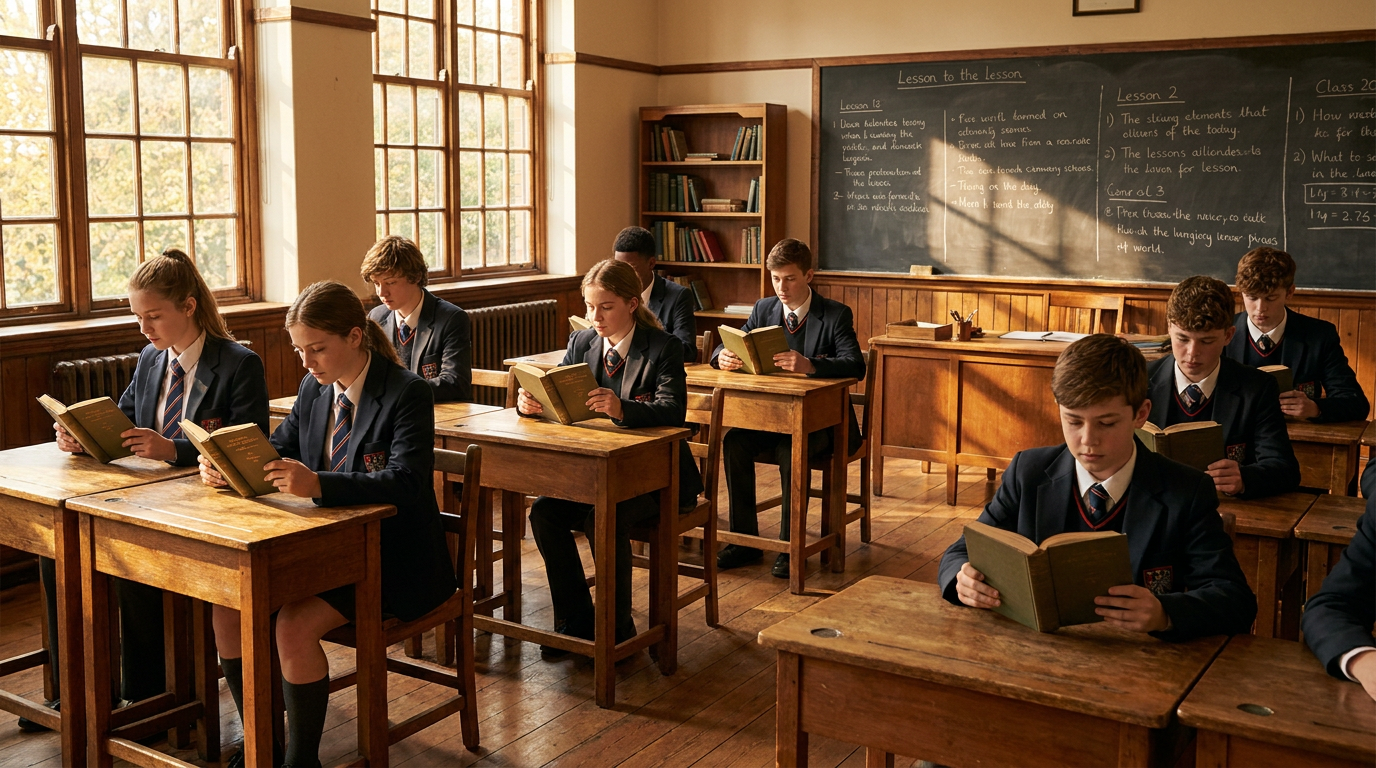
A 2,500-year-old educational model is quietly disrupting the $750 billion American K-12 schooling market. Far from a niche historical curiosity, classical education has emerged as one of the fastest-growing sectors in the country, drawing families who are increasingly dissatisfied with the fragmented, elective-heavy approach of modern public schools. Rooted in ancient Greek and Roman traditions and heavily utilized during the Middle Ages and the American founding, the classical model prioritizes moral virtue, historical continuity, and a rigorous, language-heavy curriculum. Today, it is experiencing a massive renaissance, expanding rapidly across private academies, homeschooling networks, and publicly funded charter schools.[8]
The growth metrics are striking. During the 2023–2024 academic year, enrollment in classical education programs topped 677,500 students across more than 1,500 institutions. Market analysts project that this figure will more than double to 1.4 million students by 2035, transforming what was once a grassroots movement into a sector generating up to $10 billion in annual economic impact. Between 2019 and 2023 alone, over 250 new classical schools opened their doors, outpacing the growth rates of nearly every other educational segment.[1][2]
The movement’s demographics reveal a decentralized but highly motivated coalition. Currently, about 39 percent of classical education students learn in home-based environments, utilizing specialized curricula designed for parent-led instruction. Another 34 percent attend evangelical Christian classical schools, while 9 percent are enrolled in Catholic classical academies. Perhaps most notably, 18 percent of these students now attend classical public charter schools, a rapidly expanding avenue that brings the tuition-free classical model to a broader socioeconomic demographic.[1]

At the heart of this educational revival is a pedagogical framework known as the Trivium. Rather than dividing learning strictly by modern subject areas, the Trivium aligns instruction with the natural developmental stages of a child. It operates on the premise that before students can express original thoughts, they must first absorb foundational knowledge, and before they can persuade others, they must learn how to reason logically.[3][7]
The first phase is the Grammar Stage, which spans kindergarten through sixth grade. In classical terminology, "grammar" does not merely refer to the rules of language; it represents the fundamental building blocks of any subject. During these years, children are considered naturally adept at memorization and observation. Instruction focuses heavily on absorbing facts, rules, vocabulary, and historical timelines through recitation, chanting, and song, laying a dense foundation of knowledge that will be drawn upon in later years.[3]
As students enter adolescence, typically in seventh and eighth grades, they transition into the Logic Stage. Recognizing that middle schoolers naturally begin to question authority and argue, the classical model channels this developmental shift into formal analytical thinking. Students are taught formal logic, how to construct valid arguments, and how to identify fallacies. They begin to analyze the relationships between the facts they memorized in the Grammar Stage, learning to ask "why" and "how" rather than just "what."[3]
The final phase, spanning high school, is the Rhetoric Stage. Here, the focus shifts to synthesis and persuasive expression. Students are expected to take the foundational knowledge they acquired and the logical frameworks they mastered to articulate complex ideas clearly, beautifully, and compellingly. The goal is not merely to pass a standardized test, but to develop a mature, independent voice capable of leading and persuading others in the public square.[3][4]

The final phase, spanning high school, is the Rhetoric Stage.
Alongside the Trivium, classical education is defined by its content. The curriculum heavily emphasizes the "Great Books" of the Western tradition, requiring students to engage directly with primary texts from Homer, Plato, and Aristotle to Shakespeare and the American Founders. Modern textbooks are frequently discarded in favor of original source material, and Socratic discussion replaces passive lectures. Additionally, the study of Latin—and sometimes Greek—is a staple, utilized not just for historical translation but to instill a deep, structural understanding of language and grammar.[8]
The recent explosion in classical education's popularity was heavily catalyzed by the COVID-19 pandemic. As remote learning brought the modern public school classroom into family living rooms, many parents grew frustrated with what they perceived as a lack of academic rigor, an over-reliance on digital screens, and a drift toward progressive ideological instruction. This dissatisfaction prompted a mass search for alternatives that offered a more coherent, traditional, and academically demanding environment.[2]
This parental demand has fueled a massive expansion of classical charter schools, which operate with public funding but independent governance. In Texas, for example, enrollment in classical charter schools surged by 21 percent between the 2019 and 2020 school years, and the share of charter students attending classical academies has tripled over the last decade. Networks like Great Hearts Academies and the Barney Charter School Initiative, affiliated with the conservative Hillsdale College, have rapidly scaled their operations to meet waitlists that often stretch into the thousands.[5][7]
The expansion is also being accelerated by legislative tailwinds. The recent push for universal school choice and Education Savings Accounts (ESAs) in states like Arizona, Florida, Iowa, and Arkansas allows parents to direct public education funds toward private classical academies or homeschooling curricula. This financial flexibility is breaking down the cost barriers that previously restricted classical education to affluent families, enabling a broader demographic to access the model.[5]

Proponents point to highly favorable outcomes to justify the model's rigorous demands. Polling of classical education graduates reveals that 67 percent are extremely likely to recommend the model to others, and a vast majority report that their education instilled a deep sense of life purpose and civic duty. Furthermore, data indicates that classical school graduates complete four-year college degrees at rates approaching 90 percent, significantly outperforming national averages.[2][6]
The business community is also taking notice. As corporate leaders increasingly lament a lack of critical thinking and communication skills among recent college graduates, the classical model's emphasis on synthesis and logic is viewed as a distinct advantage. In recent surveys, classical graduates cited critical thinking, analytical reasoning, and written communication as the skills they use most frequently in their professional lives—competencies that align perfectly with the demands of the modern knowledge economy.[1][6]
However, the rapid expansion of classical education has not occurred without fierce pushback. Public education advocates and teachers' unions argue that the proliferation of classical charter schools and voucher programs drains vital funding from traditional public school districts. Organizations like the Network for Public Education have raised alarms about the demographic makeup of these schools, noting that their student bodies are often disproportionately white and wealthier than surrounding district schools.[2][7]
Critics also express deep concerns about the ideological underpinnings of the movement. Opponents argue that many classical charter networks, despite receiving public funds, operate as vehicles for right-wing political shaping and Christian nationalism. They point to the heavy involvement of conservative politicians and institutions like Hillsdale College, arguing that the curriculum's intense focus on Western civilization and traditional virtues is a deliberate strategy to counter modern diversity, equity, and inclusion initiatives.[7]

Advocates of classical education reject these characterizations, arguing that the model simply restores a proven historical baseline. They maintain that the curriculum that educated the American Founders—steeped in the liberal arts, civic virtue, and objective truth—is inherently empowering, not exclusionary. By prioritizing timeless wisdom over contemporary political activism, they argue, classical education equips students of all backgrounds with the intellectual tools necessary to navigate an increasingly chaotic and fragmented world.[4][8]
Whether viewed as a necessary renaissance of academic rigor or a controversial retreat into traditionalism, the classical education movement has fundamentally altered the American educational landscape. With billions of dollars in revenue, a rapidly expanding footprint of charter and private schools, and a highly motivated base of parents and educators, the ancient Trivium is poised to shape the minds of millions of future citizens.[1][8]
How we got here
Middle Ages to 19th Century
The classical model, rooted in Greek and Roman traditions, serves as the standard educational framework across the Western world.
Mid-20th Century
Progressive education models largely replace classical methods in American public schools, shifting focus toward specialized tracks and electives.
1990s
A grassroots revival of classical education begins, primarily driven by homeschooling parents and small private Christian academies.
2010s
Classical charter school networks, such as Great Hearts Academies, begin expanding, bringing the model to the tuition-free public sector.
2020-2022
The COVID-19 pandemic and remote learning spark widespread parental dissatisfaction, triggering a massive surge in classical school enrollment.
2025
Classical education enrollment nears 700,000 students, with market analysts projecting the sector will double in size over the next decade.
Viewpoints in depth
Traditionalist Educators
Advocates who view classical education as a necessary return to historical academic and moral standards.
This camp argues that modern education has become dangerously fragmented, prioritizing hyper-specialization and contemporary political activism over foundational knowledge. By returning to the Trivium, the Great Books, and the study of Latin, they believe schools can cultivate civic virtue, moral coherence, and an appreciation for Western civilization. They frequently cite the fact that this exact educational model produced the American Founders, arguing it is the best framework for developing thoughtful, articulate citizens.
Pragmatic Parents and Investors
Families and market analysts focused on the tangible academic outcomes and rapid economic expansion of the sector.
For this group, the appeal of classical education is highly practical. Parents are drawn to the rigorous academic environment, the emphasis on phonics and foundational math, and the strict limitations on digital screens in the classroom. Meanwhile, investors and business leaders see a booming $10 billion market that is producing graduates with highly sought-after soft skills. They point to data showing that classical alumni excel in critical thinking, analytical reasoning, and written communication—traits that employers increasingly struggle to find.
Public Education Advocates
Critics who warn that the classical movement drains public resources and promotes a narrow ideological worldview.
This perspective, often championed by teachers' unions and public school defenders, views the classical boom with deep skepticism. They argue that classical charter schools and voucher programs siphon critical taxpayer funding away from traditional public school districts. Furthermore, they raise alarms about the movement's demographics and ideology, arguing that the student bodies lack diversity and that the curriculum is frequently used as a Trojan horse to instill Christian nationalism and right-wing political values under the guise of 'traditional virtue.'
What we don't know
- How the rapid scaling of classical charter schools will impact the quality and rigor of the model, which historically relied on highly specialized teachers.
- Whether the movement will successfully diversify its student demographics as it expands further into the tuition-free public sector.
Key terms
- Trivium
- The foundational three-stage framework of classical education, consisting of Grammar, Logic, and Rhetoric.
- Grammar Stage
- The elementary school phase of classical education focused on absorbing facts, rules, and vocabulary through memorization and recitation.
- Logic Stage
- The middle school phase of classical education that teaches students how to analyze facts, construct valid arguments, and identify fallacies.
- Rhetoric Stage
- The high school phase of classical education focused on teaching students to express complex ideas persuasively and eloquently.
- Socratic Discussion
- A teaching method based on asking and answering questions to stimulate critical thinking and illuminate ideas, heavily used in classical classrooms.
- Education Savings Account (ESA)
- A publicly funded account that allows parents to direct state education dollars toward private school tuition, homeschooling curricula, or tutoring.
Frequently asked
What is the Trivium in classical education?
The Trivium is a three-stage teaching model aligned with child development. It consists of the Grammar stage (memorizing foundational facts), the Logic stage (analytical thinking and argumentation), and the Rhetoric stage (persuasive expression and synthesis).
Are classical schools religious?
Many are, but not all. While a large portion of the sector consists of evangelical Christian and Catholic academies, there is a rapidly growing segment of secular, publicly funded classical charter schools.
How much does classical education cost?
Private classical school tuition typically ranges from $8,000 to $15,000 annually. However, the rise of classical charter schools and state-funded Education Savings Accounts (ESAs) has made the model increasingly accessible for free or at a reduced cost.
Do classical schools use modern technology?
Technology use varies, but most classical schools heavily restrict digital screens and devices in the classroom. They prioritize physical books, handwriting, and face-to-face Socratic discussion over tablets and laptops.
Sources
Source coverage
8 outlets
3 viewpoints surfaced






[1]ForbesPragmatic Parents & Investors
The Business Case For Classical Christian Education Market Growth
Read on Forbes →[2]Arcadia EducationPragmatic Parents & Investors
Classical Education Market Analysis
Read on Arcadia Education →[3]John Adams AcademyTraditionalist Educators
Why Classical Education Is Making a Comeback
Read on John Adams Academy →[4]The Imaginative ConservativeTraditionalist Educators
The Classical Education of the American Founders
Read on The Imaginative Conservative →[5]Texas Public Policy FoundationPragmatic Parents & Investors
The Demand of Texas Parents for Classical Charter Schools
Read on Texas Public Policy Foundation →[6]Belmont Abbey CollegeTraditionalist Educators
Classical Education Statistics USA 2025
Read on Belmont Abbey College →[7]Network for Public EducationPublic Education Advocates
A Sharp Turn Right: A New Breed of Charter Schools Delivers the Conservative Agenda
Read on Network for Public Education →[8]Factlen Editorial TeamPragmatic Parents & Investors
Synthesis by Factlen editorial team
Read on Factlen Editorial Team →

Every angle. Every day.
Get perspectives stories with full source coverage and perspective breakdowns delivered to your inbox.