
The Rise of Agrivoltaics: Why Solar Panels and Farming Are Sharing the Same Soil
A rapidly growing practice known as agrivoltaics is combining solar energy generation and agriculture on the same land, offering a dual-income solution to land-use conflicts. While the model promises to save water and protect crops from extreme heat, its success depends heavily on local climates and careful crop selection.
By Factlen Editorial Team
- Agricultural Producers
- Farmers focused on crop yields, farm survival, and operational practicalities.
- Solar Energy Developers
- Energy companies focused on land acquisition, clean power targets, and community relations.
- Agronomy & Climate Researchers
- Scientists focused on microclimates, ecological trade-offs, and data-driven deployment.
What's not represented
- · Rural Zoning Boards
- · Agricultural Equipment Manufacturers
Why this matters
As the transition to renewable energy accelerates, solar farms are increasingly competing for the same flat, sunlit land needed to grow food. Agrivoltaics could resolve this tension, securing the global food supply while providing farmers with a vital financial lifeline.
Key points
- Agrivoltaics combines solar energy generation and agriculture on the same plot of land.
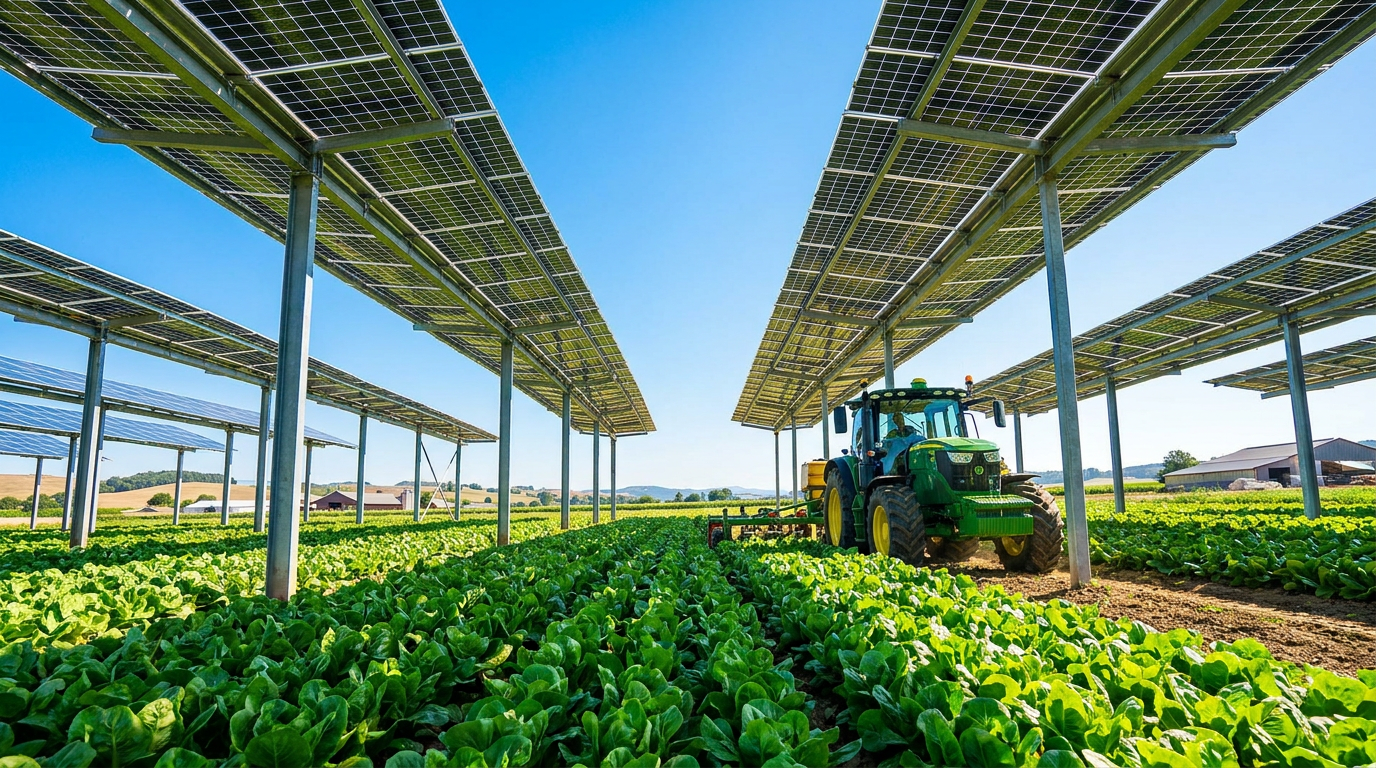
- Elevated panels and wider spacing allow standard farm machinery to operate normally.
- The shade from panels creates a microclimate that reduces heat stress and cuts water evaporation by up to 30%.
- Crop success is highly localized; shade-tolerant plants thrive, while sun-hungry crops may suffer yield drops.
- The dual-use model provides farmers with a stable secondary income, though initial construction costs are higher.
Across the globe, the race to secure affordable, reliable clean energy is transforming the rural landscape. Fueled by the electrification of transport, the rise of data centers, and industrial reshoring, electricity demand is surging. To meet this need, developers are rushing to build utility-scale solar farms. However, this boom comes with a geographic challenge: the flat, sunny, and accessible land ideal for solar expansion is often the exact same land required for agriculture. By 2050, the National Renewable Energy Laboratory projects that photovoltaic installations could require as much as 10 million acres of land in the United States alone.[3][6]
Historically, this has created a zero-sum game. When a solar developer leases a parcel of farmland, the tractors are parked, the soil is covered in gravel or turf, and food production ceases for the 25-year lifespan of the solar array. This dynamic has sparked intense local opposition in rural communities, where farmland conversion is a sensitive economic and cultural issue. But a rapidly maturing approach is attempting to replace this zero-sum conflict with a symbiotic relationship.[3][7]
Enter agrivoltaics—the practice of co-locating solar energy generation and agricultural production on the exact same plot of land. Rather than displacing crops or livestock, agrivoltaic systems are engineered to accommodate them. By elevating solar panels higher off the ground or spacing the rows further apart, farmers can continue to cultivate the soil beneath the silicon canopy.[2][7]
The mechanism behind agrivoltaics relies on structural adaptation and advanced photovoltaic technology. Standard solar farms mount panels just a few feet off the ground to minimize steel costs and wind resistance. Agrivoltaic arrays, by contrast, are often hoisted eight to fifteen feet into the air. This clearance allows standard agricultural machinery, including tractors and combine harvesters, to operate freely beneath the infrastructure.[5][7]
To maximize efficiency without casting overly dense shadows, many modern agrivoltaic farms utilize bifacial solar panels. These modules capture direct sunlight from above, while their transparent undersides absorb light reflected off the crops and soil below. This allows developers to space the panels wider apart—letting more ambient light reach the plants—without sacrificing the overall energy yield of the array.[5]
The core biological claim of agrivoltaics is the creation of a beneficial microclimate. Solar panels act as a protective canopy, shielding crops from the most punishing midday sun and extreme weather events. During intense summer heatwaves, the shade from the panels can lower ground surface temperatures by several degrees, significantly reducing heat stress on the plants below.[5][7]

This microclimate has a profound impact on water retention. By blocking direct solar radiation, the panels lower the rate of evapotranspiration—the process by which water evaporates from the soil and transpires from plant leaves. In arid and semi-arid regions, agrivoltaic systems have been shown to reduce irrigation water requirements by 15 to 30 percent. The soil stays damper for longer, providing a critical buffer against drought.[3][5]
Interestingly, this cooling effect is mutual. Solar panels lose efficiency when they get too hot. The crops growing beneath the arrays continuously release water vapor through transpiration, which rises and cools the underside of the silicon panels. This localized cooling can actually increase the electrical output of the solar array compared to panels installed over bare dirt or gravel.[2][7]
The crops growing beneath the arrays continuously release water vapor through transpiration, which rises and cools the underside of the silicon panels.
The agronomic evidence for agrivoltaics shows clear winners, particularly among shade-tolerant crops. Leafy greens like spinach and lettuce, as well as certain berries and tomatoes, often thrive under the partial shade. In several trials, crops grown beneath panels exhibited less leaf damage from heat scorch and, in some cases, produced higher yields than their full-sun counterparts.[5]
However, agrivoltaics is not a universal silver bullet, and recent data highlights significant trade-offs. The impact on crop yields varies dramatically depending on the local climate and the specific type of plant being cultivated. A landmark 2026 study published in the Proceedings of the National Academy of Sciences (PNAS) analyzed 14 years of crop data across the American Midwest to quantify these inherent compromises.[1]
The PNAS study revealed a stark geographic divide. In the humid, eastern stretch of the Midwest, the shade from solar panels reduced photosynthesis levels enough to curb maize yields by 24 percent and soybean yields by 16 percent. In these moisture-rich environments, the plants simply needed more sun, and the water-saving benefits of the panels were largely redundant.[1]
But in the drier, semi-arid western Midwest, the equation flipped. While maize yields still saw a slight reduction, soybeans experienced a 6 percent increase in yield when grown under solar panels. In this arid climate, the benefits of moisture retention and heat protection outweighed the penalty of reduced sunlight, resulting in a net gain for the crop.[1]

These findings underscore that agrivoltaics requires a highly localized, data-driven approach. Developers cannot simply paste a standard solar blueprint over a field of corn and expect success. The choice of crop, the height of the panels, and the density of the array must be meticulously calibrated to the specific latitude, humidity, and soil profile of the farm.[1][7]
Beyond crop cultivation, livestock integration has become one of the most popular and easily scalable forms of agrivoltaics. Solar grazing—particularly with sheep—is widely deployed across Europe and the United States. The sheep graze on the pasture beneath standard-height panels, effectively acting as biological lawnmowers. This saves the solar operator the cost of mechanical vegetation management while providing the shepherd with a new revenue stream and shaded pasture for the flock.[2][6]

The economic appeal of agrivoltaics lies in the promise of dual revenue. For farmers facing volatile commodity prices and increasingly unpredictable weather, leasing a portion of their land for solar generation provides a stabilized, guaranteed income for decades. This financial baseline can keep multi-generational farms solvent while allowing them to continue producing food.[3][5]
Yet, these systems come with steep financial barriers. The specialized elevated racking, deeper steel pylons, and modified spacing required for crop agrivoltaics result in initial capital expenditures that are 10 to 20 percent higher than conventional ground-mounted solar. For developers, this premium must be offset by government incentives, higher energy yields, or the avoidance of costly permitting battles.[5]
The policy landscape is racing to catch up with the technology. In Europe, where land scarcity is acute, recent EU strategies have explicitly recognized the role of dual-use solar. However, the regulatory environment remains fragmented. Only a handful of nations have established clear legal definitions of what qualifies as an agrivoltaic project, leading to inconsistent subsidy applications and zoning confusion.[4]
Despite these hurdles, the sector is scaling rapidly. By early 2026, industry analysts tracked over 12,000 operational agrivoltaic farms globally, generating billions in combined revenue. From the arid plains of the American West to the dense agricultural valleys of Italy and Japan, the technology has definitively moved from academic experiment to commercial reality.[4][5]
Ultimately, agrivoltaics represents a necessary evolution in how we manage the Earth's surface. As the demands for clean electricity and food security collide, treating land as a single-use asset is no longer viable. By carefully engineering systems that allow electrons and calories to be harvested from the same soil, agrivoltaics offers a pragmatic, climate-resilient path forward.[3][7]
How we got here
2015
The U.S. Department of Energy launches the InSPIRE project to formally study the co-location of solar and agriculture.
2019
Early agronomic studies in dryland regions confirm that solar panels create microclimates that significantly reduce plant heat stress.
2022
The Inflation Reduction Act accelerates U.S. solar deployment, intensifying the competition for flat agricultural land.
2025
Global operational agrivoltaic capacity surpasses 12,000 farms, moving the technology from experimental to commercial scale.
March 2026
A landmark PNAS study reveals a geographic divide in agrivoltaic success, showing crop benefits in arid regions but yield penalties in humid zones.
Viewpoints in depth
Agricultural Producers
Farmers focused on crop yields, farm survival, and operational practicalities.
For the agricultural sector, agrivoltaics is viewed primarily as a financial lifeline that must not compromise core farming operations. Producers emphasize that while the dual-income model provides crucial stability against volatile weather and commodity prices, the physical infrastructure must be designed around the farmer, not the other way around. Their primary concerns revolve around the ability to navigate heavy machinery around steel pylons, the upfront capital costs of specialized racking, and the risk of yield penalties for sun-hungry commodity crops.
Solar Energy Developers
Energy companies focused on land acquisition, clean power targets, and community relations.
Solar developers see agrivoltaics as the key to unlocking prime, flat land that would otherwise be blocked by local zoning boards and community opposition. By maintaining the agricultural character of the land, developers can bypass the 'food versus fuel' debate that often stalls utility-scale projects. While they acknowledge the 10 to 20 percent higher capital expenditures required for elevated structures, they argue that these costs are offset by smoother permitting processes, reduced vegetation management costs, and the slight boost in panel efficiency caused by the cooling effect of the crops below.
Agronomy & Climate Researchers
Scientists focused on microclimates, ecological trade-offs, and data-driven deployment.
Researchers view agrivoltaics as a highly promising but deeply nuanced climate adaptation tool. They caution against treating the technology as a universal solution, pointing to data showing that its benefits are highly dependent on local geography. In arid regions, the water-saving microclimate is a massive biological advantage, but in humid, sun-starved areas, the shading can severely depress yields. This camp advocates for rigorous, site-specific modeling to match the right crops and panel configurations to the right climates.
What we don't know
- How the long-term soil health and microbiome will adapt to decades of partial shading.
- Whether the higher capital costs of elevated agrivoltaic structures will remain viable without heavy government subsidies.
- How insurance markets will price the risk of heavy agricultural machinery operating in close proximity to high-voltage solar infrastructure.
Key terms
- Agrivoltaics
- The simultaneous use of areas of land for both solar photovoltaic power generation and agriculture.
- Microclimate
- The distinct, localized climate conditions created directly beneath the solar panels, typically characterized by lower temperatures and higher humidity.
- Evapotranspiration
- The process by which water is transferred from the land to the atmosphere by evaporation from the soil and by transpiration from plants.
- Bifacial Solar Panels
- Solar modules that can capture sunlight from both their front and back sides, utilizing light reflected off the ground or crops.
- Land Equivalent Ratio (LER)
- A metric used to measure the productivity of a dual-use system compared to using separate plots of land for farming and solar.
Frequently asked
Can standard farming equipment still be used?
Yes. Agrivoltaic systems are engineered with elevated panels or wider row spacing specifically to allow tractors and harvesters to operate freely beneath them.
Do the solar panels block too much rain?
No. Modern tracking panels can be tilted to allow rain to reach the soil evenly, and the panels actually reduce the rate at which water evaporates from the ground.
What crops work best with agrivoltaics?
Shade-tolerant crops like leafy greens, tomatoes, and berries thrive under the panels, while sun-hungry commodity crops like corn often see reduced yields.
Why don't all solar farms use this method?
Elevating panels and reinforcing the steel structures to accommodate tractors increases the initial construction costs by 10 to 20 percent, which deters some developers.
Sources
Source coverage
7 outlets
3 viewpoints surfaced







[1]Anthropocene MagazineAgricultural Producers
Do solar panels hurt crop yields? It depends on where you farm.
Read on Anthropocene Magazine →[2]U.S. Department of EnergyAgronomy & Climate Researchers
Agrivoltaics: Solar and Agriculture Co-Location
Read on U.S. Department of Energy →[3]Institute for Energy Economics and Financial AnalysisAgricultural Producers
Agrivoltaics: An economic option for farmers and rural development
Read on Institute for Energy Economics and Financial Analysis →[4]SolarplazaSolar Energy Developers
3 hard truths about agrivoltaics in Europe
Read on Solarplaza →[5]Energy Solutions IntelligenceSolar Energy Developers
Agrivoltaics 2026: Farming & Solar Dual Income
Read on Energy Solutions Intelligence →[6]National Renewable Energy LaboratoryAgronomy & Climate Researchers
The 5 Cs of Agrivoltaic Success Factors in the United States
Read on National Renewable Energy Laboratory →[7]Factlen Editorial TeamAgronomy & Climate Researchers
Synthesis by Factlen editorial team
Read on Factlen Editorial Team →
Every angle. Every day.
Get environment stories with full source coverage and perspective breakdowns delivered to your inbox.