
Why the Tech Industry is Finally Killing the Password
With 96% of devices now compatible, passkeys are replacing traditional passwords with device-bound cryptography. The shift promises to eliminate phishing and fundamentally alter how we secure our digital identities.
By Factlen Editorial Team
- Cybersecurity Experts
- Focus on the structural elimination of shared secrets and phishing.
- Enterprise IT Leaders
- Value passkeys for reducing operational costs and improving employee productivity.
- Security Skeptics
- Warn that account recovery and cloud syncing introduce new vulnerabilities.
- Privacy Advocates
- Highlight the privacy benefits of local biometric processing.
What's not represented
- · Small Business Owners
- · Elderly Tech Users
Why this matters
Passwords are the root cause of over three-quarters of all data breaches. Understanding how passkeys work empowers you to lock down your personal and professional accounts with technology that is mathematically immune to traditional hacking.
Key points
- Passkeys replace traditional passwords with a cryptographic key pair, structurally eliminating the risk of phishing and server breaches.
- The private key never leaves the user's device and is unlocked locally using biometric data like a fingerprint or facial scan.
- Major platforms including Apple, Google, and Microsoft have made passkeys the default, pushing global device readiness to 96%.
- While passkeys secure the authentication process, organizations still face challenges in verifying user identity during initial account recovery.
For decades, the standard advice for online security has been a masterclass in human friction: use a different, complex string of letters, numbers, and symbols for every single account, and change them frequently. Yet, as a reader recently asked The Guardian, the technology industry is now pushing a seemingly counterintuitive alternative: replacing those complex passwords with a simple smartphone PIN or a quick facial scan. To a public trained to believe that complexity equals security, unlocking a bank account with the same four-digit PIN used to unlock a phone screen feels inherently less safe.[1]
The reality, however, is that the traditional password is fundamentally broken. According to the FIDO Alliance, a consortium of tech giants that develops authentication standards, roughly 77% of all data breaches involve stolen or weak credentials. Passwords rely on a "shared secret" model—you memorize a secret, and the server stores a copy of that secret. If a hacker breaches the server, intercepts the password via a phishing email, or buys a leaked database on the dark web, your account is compromised, regardless of how many special characters you used.[2]
The solution to this vulnerability is the passkey, and 2026 is proving to be the tipping point for its global adoption. Data from industry analysts indicates that 96% of consumer devices worldwide are now passkey-ready, supported natively across iOS, Android, macOS, and Windows. Cybersecurity experts note that the transition has moved from an experimental phase into mainstream enterprise deployment, driven by major platforms like Apple, Google, and Microsoft making passkeys the default authentication method for new accounts.[3][7]

To understand why a simple biometric scan is safer than a 16-character password, it is necessary to look at the underlying mathematics. Passkeys abandon the shared secret model entirely, replacing it with public key cryptography. When a user creates a passkey for a website, their device generates a unique pair of mathematically linked keys: a public key and a private key.[8]
The public key is sent to the website's server, where it acts like a digital padlock. It is completely useless to a hacker on its own; even if the server is breached and the public key is stolen, it cannot be used to log into the account. The private key, meanwhile, never leaves the user's device. It is stored inside a specialized, tamper-resistant hardware chip known as a secure enclave.[4]
When a user attempts to log in, the website sends a cryptographic puzzle—a "challenge"—to the device. The device uses the private key to solve the puzzle and sign the challenge, sending the mathematical proof back to the server. The server verifies the signature using the public key and grants access. Crucially, the private key itself is never transmitted over the internet.[2][4]

This architecture structurally eliminates phishing, the most common vector for cyberattacks. If a user is tricked into visiting a fake website—for example, a perfect replica of their bank's login page—the passkey system will simply refuse to work. The cryptographic signature is strictly bound to the specific domain where it was created. Because the fake website's domain does not match the original, the device will not sign the challenge, stopping the attack in its tracks.[4]
This architecture structurally eliminates phishing, the most common vector for cyberattacks.
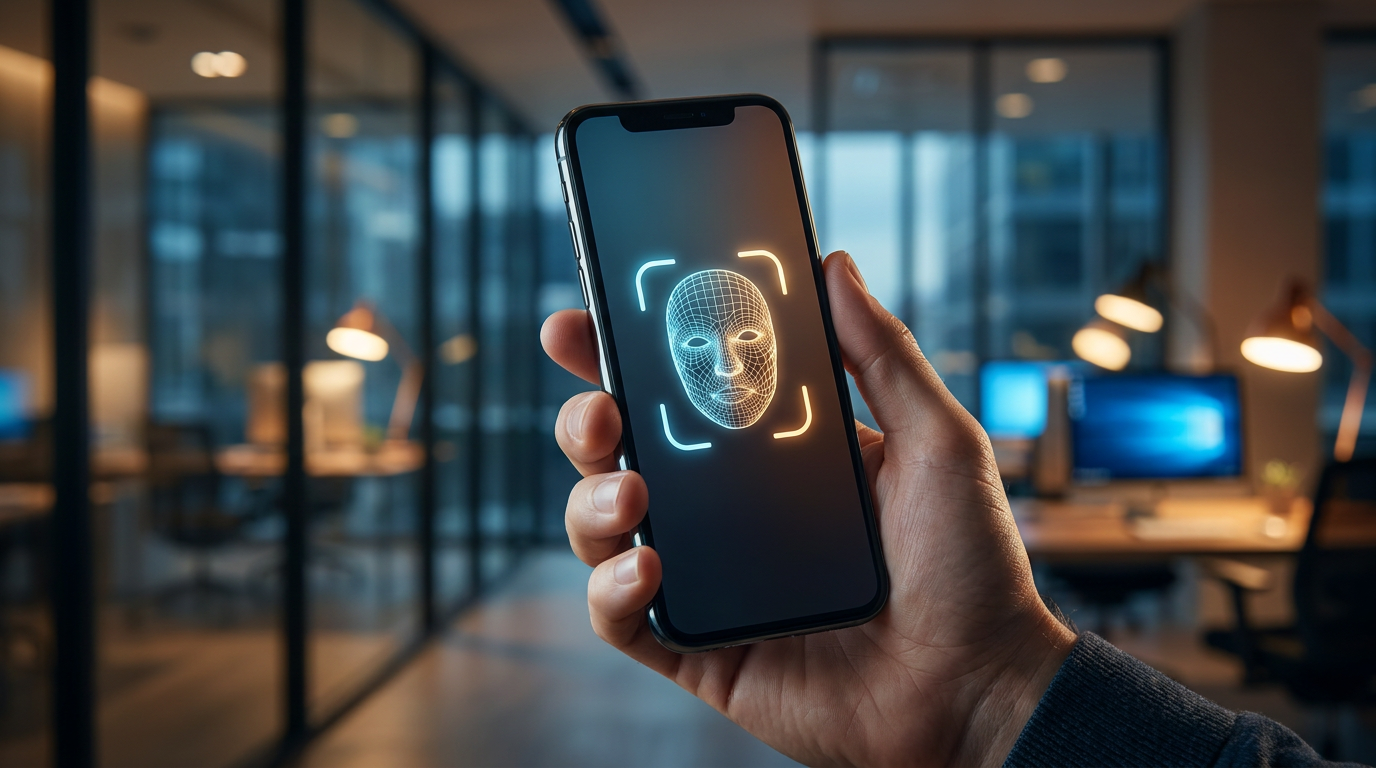
This brings us back to the paradox of the smartphone PIN. When a user looks at their phone or taps their finger to log in, they are not sending their biometric data or their PIN to the website. The biometric scan is merely the local trigger that unlocks the secure enclave on the device, granting it permission to use the private key for that specific login challenge. The website never sees the user's face, fingerprint, or PIN.[1][8]
Beyond consumer convenience, passkeys are rapidly transforming enterprise security. According to industry surveys, 87% of organizations have either deployed or are actively deploying passkeys for their workforce. For IT departments, the shift is driven as much by economics as it is by security. Helpdesk tickets for password resets consume massive amounts of operational budget, and traditional multi-factor authentication (MFA) has proven vulnerable to "MFA fatigue," where hackers spam employees with approval prompts until they accidentally click yes.[6]
The operational results of this shift are striking. The FIDO Alliance reports that passkeys achieve a 93% login success rate, compared to just 63% for traditional passwords. Furthermore, when Microsoft made passkeys the default option for its ecosystem, the company recorded a 120% surge in passkey authentications, with users logging in significantly faster than those relying on passwords and secondary authenticator apps.[2][5]

However, the implementation of passkeys is not monolithic, and the industry differentiates between two distinct types: synced passkeys and device-bound passkeys. Synced passkeys, which are backed up to cloud services like iCloud Keychain or Google Password Manager, are designed for consumers. If a user drops their phone in a lake, their passkeys are safely restored to their new device via their cloud account, preventing catastrophic lockouts.[8]
In high-security enterprise environments, organizations often opt for device-bound passkeys. These are typically tied to physical hardware tokens, such as YubiKeys, or locked to a specific corporate laptop. Because a device-bound passkey cannot be copied or synced to the cloud, it offers the highest possible level of security, ensuring that an attacker cannot access corporate systems without physically stealing the employee's hardware.[6]

Despite their structural advantages, passkeys are not a silver bullet, and security researchers point to account recovery as the system's remaining weak link. If a user loses all their devices and cannot access their cloud backup, most services will fall back to a traditional email-based password reset. This means that, in practice, a passkey-secured account is often only as secure as the email inbox associated with it.[6]
Furthermore, while passkeys perfectly secure the authentication step—proving that the device belongs to the account holder—they do not solve the problem of initial identity verification. Organizations still face the challenge of ensuring that the person registering the passkey in the first place is actually who they claim to be, a vulnerability that sophisticated attackers continue to probe.[6]
Nevertheless, the transition away from passwords represents the most significant upgrade to internet security in decades. By removing the human element from the authentication process and relying on invisible, device-level cryptography, the tech industry is finally closing its oldest and most exploited vulnerability. The password may linger as a legacy fallback for years to come, but its era as the primary gatekeeper of our digital lives is rapidly coming to an end.[8]
How we got here
2012
The FIDO Alliance is founded to solve the password problem.
2019
The World Wide Web Consortium (W3C) makes WebAuthn an official web standard.
2022
Apple, Google, and Microsoft announce expanded support for the FIDO standard, introducing the term 'passkey.'
Oct 2023
Google makes passkeys the default authentication method for all personal accounts.
May 2025
Microsoft makes passkeys the default for its ecosystem, driving a massive surge in adoption.
2026
Passkey readiness reaches 96% of consumer devices globally, marking the tipping point for enterprise deployment.
Viewpoints in depth
Cybersecurity Experts
Focus on the structural elimination of shared secrets and phishing.
Security researchers emphasize that passkeys fix the internet's original sin: the shared secret. By ensuring that no password is ever transmitted or stored on a server, passkeys render massive database breaches mathematically useless to attackers. They argue that this shift from knowledge-based authentication (what you know) to possession-based authentication (what you have) is the only viable defense against automated credential stuffing and AI-powered phishing kits.
Enterprise IT Leaders
Value passkeys for reducing operational costs and improving employee productivity.
For corporate technology officers, the appeal of passkeys extends beyond pure security into operational efficiency. IT departments spend a disproportionate amount of their budget managing helpdesk tickets for forgotten passwords and locked accounts. Enterprise leaders argue that passkeys not only close security vulnerabilities but also drastically reduce these friction costs, resulting in faster login times, higher success rates, and a workforce that is no longer burdened by complex password rotation policies.
Privacy Advocates
Highlight the privacy benefits of local biometric processing.
Privacy groups have historically been wary of biometric authentication, fearing the creation of massive, centralized databases of fingerprints and facial scans. However, they generally support the passkey model because of its strict adherence to local processing. Advocates emphasize that the WebAuthn standard ensures biometric data never leaves the user's physical device; it merely unlocks the local secure enclave. This architecture prevents tech companies and governments from harvesting or centralizing sensitive biometric identifiers.
Security Skeptics
Warn that account recovery and cloud syncing introduce new vulnerabilities.
While acknowledging the cryptographic strength of passkeys, some security analysts caution that the ecosystem is only as strong as its weakest link. They point out that synced consumer passkeys are tied to cloud accounts like Apple iCloud or Google. If an attacker manages to compromise the underlying cloud account, they could potentially gain access to all synced passkeys. Furthermore, skeptics argue that because most services maintain an email-based password reset option as a fallback for lost devices, the true security of the account is still tethered to the vulnerability of the user's email inbox.
What we don't know
- How quickly legacy systems and on-premises enterprise infrastructure can be updated to support passwordless authentication.
- Whether the industry will standardize a secure, universal method for transferring synced passkeys between different cloud ecosystems, such as moving from Apple to Google.
Key terms
- Passkey
- A digital credential that uses public key cryptography to replace passwords, allowing users to log in with a device unlock like Face ID or a PIN.
- Public Key Cryptography
- A cryptographic system that uses pairs of keys: public keys which may be disseminated widely, and private keys which are known only to the owner.
- WebAuthn
- The web standard that enables browsers and applications to communicate securely with a device's passkey.
- FIDO Alliance
- An open industry association launched to develop and promote authentication standards that reduce reliance on passwords.
- Secure Enclave
- A dedicated, isolated subsystem on a device's microchip designed to protect sensitive data, such as biometric information and private cryptographic keys.
- Phishing
- A cyberattack where criminals impersonate legitimate organizations to trick users into revealing sensitive information, like passwords.
Frequently asked
What happens if I lose my phone?
If you use synced passkeys, your credentials are safely backed up to your cloud account (like iCloud or Google) and will automatically restore when you sign into a new device. If you lose access entirely, most services offer a fallback recovery method, such as an email reset.
Does the website get a copy of my fingerprint or face scan?
No. Your biometric data never leaves your device. The fingerprint or face scan simply unlocks the secure chip on your phone, which then uses a mathematical key to log you in.
Can a passkey be intercepted by a hacker?
Passkeys are structurally resistant to interception and phishing. Because the private key never leaves your device, and the signature is tied to the specific website domain, a hacker cannot steal your login even if they trick you into visiting a fake website.
Are passkeys just a built-in password manager?
No. A password manager stores and autofills traditional text passwords. A passkey eliminates the password entirely, replacing it with an invisible cryptographic key pair that cannot be guessed or stolen in a server breach.
Sources
Source coverage
8 outlets
4 viewpoints surfaced








[1]The GuardianSecurity Skeptics
Readers reply: Experts say we should use passkeys, but can a smartphone pin really be safer than a password?
Read on The Guardian →[2]FIDO AllianceEnterprise IT Leaders
FIDO Passkeys: Passwordless Authentication
Read on FIDO Alliance →[3]CorbadoEnterprise IT Leaders
State of Passkeys: Passkey Adoption Statistics & Readiness
Read on Corbado →[4]AuthgearCybersecurity Experts
Passkey vs Password: Are Passkeys Safer? (2026 Guide)
Read on Authgear →[5]DescopeEnterprise IT Leaders
Passkey Trends for 2026: What the Data Says
Read on Descope →[6]WWPassCybersecurity Experts
Passkeys Protect Your Login. Who's Protecting Your Identity?
Read on WWPass →[7]NuSummit CybersecurityCybersecurity Experts
Why Passkeys Are Finally Taking Over in 2025
Read on NuSummit Cybersecurity →[8]Factlen Editorial TeamPrivacy Advocates
Synthesis by Factlen editorial team
Read on Factlen Editorial Team →
More in technology
See all 5 stories →Algorithmic Culture
Algorithmic Determinism vs. Personal Curation: How Users Are Reclaiming Their Taste
0 sources

Apple Intelligence
Apple Unveils 'Siri AI' at WWDC 2026, Rebuilding Its Assistant on Google Gemini
0 sources

Mechanistic Interpretability
Inside the AI Black Box: How Mechanistic Interpretability is Making Neural Networks Safe
0 sources

Every angle. Every day.
Get technology stories with full source coverage and perspective breakdowns delivered to your inbox.