
Apple Unveils 'Siri AI' at WWDC 2026, Rebuilding Its Assistant on Google Gemini
Apple introduced a profoundly upgraded Siri AI at its 2026 Worldwide Developers Conference, featuring deep cross-app integration, screen awareness, and a new underlying architecture powered by Google Gemini.
By Factlen Editorial Team
- Apple Ecosystem Users
- Consumers eager for a voice assistant that finally delivers on the promise of an AI companion.
- Tech Industry Analysts
- Market observers evaluating Apple's competitive positioning and reliance on Google.
- App Developers
- Software engineers adapting to Apple's new mandatory AI frameworks.
What's not represented
- · European regulators overseeing the Digital Markets Act compliance.
- · Google executives commenting on the infrastructure demands of the partnership.
Why this matters
After years of lagging behind competitors like ChatGPT and Alexa, Apple's fundamental rebuild of Siri transforms the iPhone from a grid of apps into an AI-driven ecosystem. The update promises to automate complex daily tasks, though its reliance on Google's AI models highlights the shifting power dynamics in Big Tech.
Key points
- Apple introduced Siri AI, a completely rebuilt digital assistant powered by a custom Google Gemini model.
- The new Siri features 'Visual Intelligence,' allowing it to understand and act upon on-screen context.
- Users can now customize Siri's speaking pace and emotional expressivity.
- SiriKit is officially deprecated, requiring developers to adopt the App Intents framework.
- The rollout is delayed in the EU and China due to regulatory hurdles.
- This marks Tim Cook's final WWDC as CEO before John Ternus takes over in September 2026.
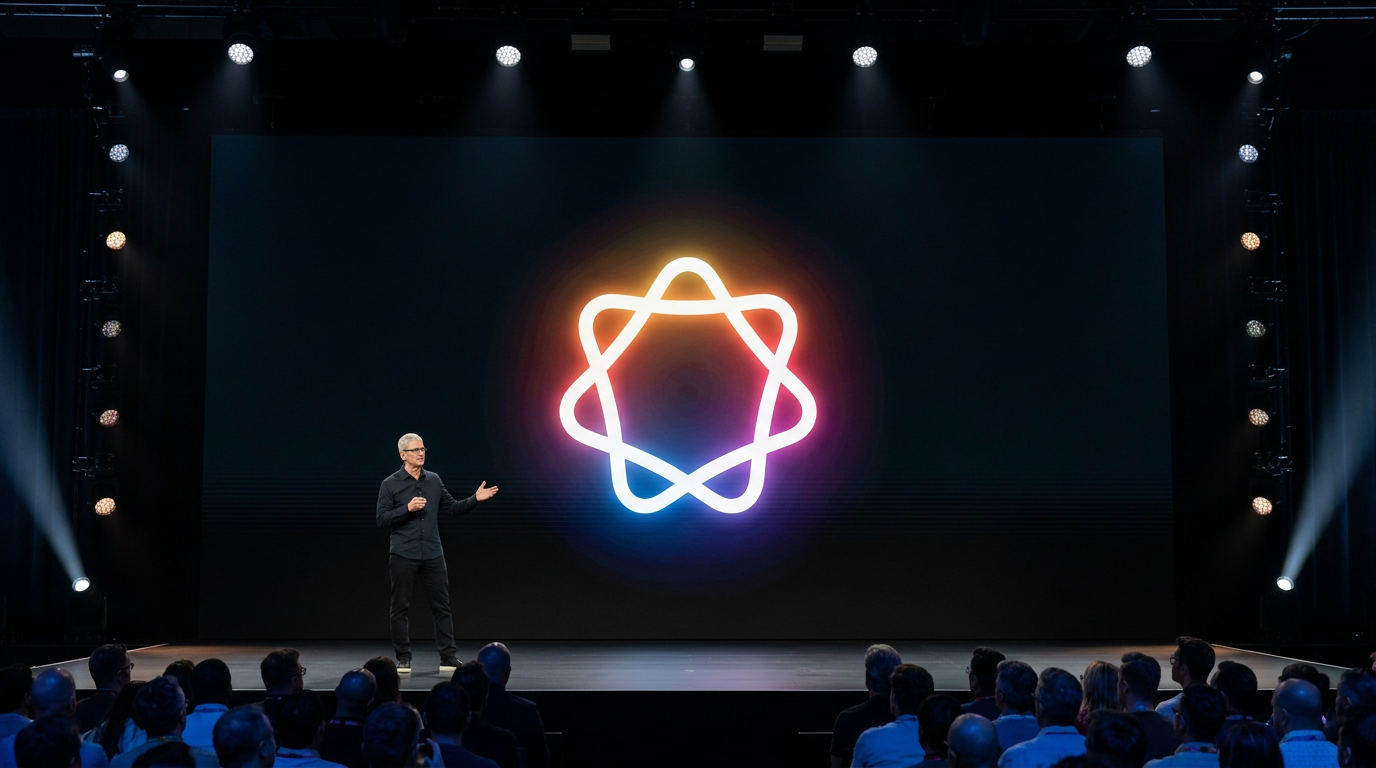
For years, iPhone users have asked Siri to perform complex tasks, only to be met with a frustrating web search or a misunderstood command. At the 2026 Worldwide Developers Conference (WWDC) in Cupertino, Apple officially closed that chapter. Under the banner of "All systems glow," the company unveiled Siri AI, a top-to-bottom rebuild of its digital assistant deeply integrated into iOS 27, macOS Golden Gate, and the broader Apple ecosystem.[1][4][6]
The new Siri AI represents a fundamental architectural shift. Rather than relying solely on in-house technology, Apple has partnered with Google, rebuilding the assistant's core on a custom 1.2-trillion-parameter Google Gemini model. This hybrid approach combines Apple's on-device Foundation Models with Google's cloud infrastructure, allowing Siri to handle complex reasoning and natural language processing that previously eluded it.[2][5][6]

Visually, Siri has received a major overhaul. The familiar glowing orb at the bottom of the screen has been replaced by a dynamic, edge-to-edge glow that emanates from the Dynamic Island on the iPhone. Users can now invoke a "Search or Ask" prompt, allowing them to type to Siri silently or speak commands. On the Apple Vision Pro, Siri appears as a translucent, floating sphere that users can interact with simply by looking at it.[4][6][7]
The most significant functional upgrade is "Visual Intelligence," a feature that grants Siri screen awareness. The assistant can now "see" what is on the user's display and take action based on that context. For example, if a user is looking at a photo of a restaurant in Messages, they can ask Siri to "add this to my calendar" or "get directions there," and the assistant will parse the on-screen information without requiring manual copy-pasting.[1][3][4]

Apple is also introducing unprecedented personalization options for voice interactions. Siri users can now adjust two new metrics: "Pace" and "Expressivity." Pace allows users to speed up or slow down Siri's speech—a crucial update for accessibility and efficiency—while Expressivity alters the assistant's inflection, making it sound more upbeat or deliberately robotic depending on user preference.[3]
Apple is also introducing unprecedented personalization options for voice interactions.
Conversational memory has been drastically improved. Siri AI now features a dedicated standalone app where users can view their conversation history, which syncs privately across devices via iCloud. A user can begin a complex query on their iPhone during a commute, pick up the thread on their iPad at home, and finalize the task on their Mac, with Siri remembering the entire context.[1][4][6]
For developers, the WWDC 2026 announcements carry massive implications. Apple has officially deprecated SiriKit, giving developers a two-to-three-year window to migrate to the expanded App Intents framework. App Intents is now the mandatory protocol for allowing Siri to control third-party applications, forcing a wave of architectural updates across the App Store to support Siri AI's new cross-app automation capabilities.[6]
The stakes for this launch were exceptionally high. Apple recently agreed to a $250 million class-action settlement with consumers who alleged the company falsely advertised AI features in 2024 that were subsequently delayed. Siri AI is, quite literally, the product that settlement was waiting on, designed to ease what analysts have described as Apple's internal "AI crisis."[2][6][7]

Privacy remains a cornerstone of Apple's pitch. The company emphasized its Private Cloud Compute architecture, assuring users that when Siri AI offloads complex queries to cloud servers, personal data is neither stored nor made accessible to Apple or Google. Outside security experts will be permitted to verify this privacy promise continuously.[1][5]
The keynote also marked a poignant leadership transition. This was Tim Cook's final WWDC presentation as CEO before hardware chief John Ternus takes the helm on September 1, 2026. Cook reflected on his tenure, noting that sharing powerful new tools with developers has been a highlight of his career.[5][6]
Despite the impressive feature set, the rollout will be staggered. Siri AI will launch in beta later this year, initially supporting only English. Furthermore, due to regulatory friction surrounding the Digital Markets Act, the new assistant will not be available on iPhones or iPads in the European Union or China at launch.[4][5]
Hardware requirements will also limit immediate adoption. Siri AI and the broader iOS 27 Apple Intelligence features require an iPhone 16 model, an iPhone 15 Pro or Pro Max, or an Apple device equipped with an M1 chip or the newly announced A18 Pro. For those with compatible hardware, however, the era of the truly capable digital assistant appears to have finally arrived.[1][4]
How we got here
June 2024
Apple first teases a massive AI overhaul for Siri, promising a more natural assistant.
March 2025
Apple officially delays the Siri revamp due to development hurdles with its internal models.
May 2026
Apple agrees to a $250 million class-action settlement over the delayed AI features.
June 8, 2026
Apple unveils Siri AI at WWDC 2026, confirming its underlying partnership with Google Gemini.
September 1, 2026
John Ternus is scheduled to officially succeed Tim Cook as Apple CEO.
Viewpoints in depth
Apple Ecosystem Users
Consumers eager for a voice assistant that finally delivers on the promise of an AI companion.
For everyday iPhone and Mac users, Siri AI is the update they have been waiting for since the generative AI boom began. The ability to adjust Siri's speaking pace and expressivity, combined with cross-device memory, transforms the assistant from a rigid command-line tool into an accessible, conversational partner. Users are particularly excited about Visual Intelligence, which eliminates the friction of manually copying and pasting information between apps.
Tech Industry Analysts
Market observers evaluating Apple's competitive positioning and reliance on Google.
Financial and tech analysts view Siri AI as a necessary, if slightly compromised, leap forward. While the feature set is robust, observers note that Apple had to lean heavily on a custom Google Gemini model to achieve parity with competitors like Microsoft's Copilot and OpenAI's ChatGPT. This reliance highlights Apple's internal struggles to develop a proprietary large language model of sufficient scale, though analysts concede that Apple's seamless UI integration and strict privacy guardrails remain unmatched.
App Developers
Software engineers adapting to Apple's new mandatory AI frameworks.
For the developer community, WWDC 2026 signaled a massive architectural migration. The deprecation of SiriKit means developers must rewrite their app integrations using the new App Intents framework. While this requires significant near-term labor, developers recognize that App Intents will allow their software to be controlled much more fluidly by Siri AI, potentially increasing user engagement by surfacing app features directly in voice conversations.
What we don't know
- It remains unclear exactly how Apple and Google are splitting the cloud computing costs for the Gemini integration.
- Apple has not provided a specific timeline for when Siri AI will become available in the European Union or China.
- The exact real-world battery drain of running continuous on-device Foundation Models on the iPhone 15 Pro and 16 has yet to be independently tested.
Key terms
- Apple Intelligence
- Apple's overarching suite of generative AI features and on-device machine learning models integrated into its operating systems.
- App Intents
- A developer framework that allows Siri and the iOS system to deeply understand and trigger specific actions inside third-party apps.
- Private Cloud Compute
- Apple's secure server architecture designed to process complex AI requests without storing or exposing user data.
- Visual Intelligence
- A new Siri capability that allows the assistant to 'see' and analyze the text and images currently displayed on the user's screen.
Frequently asked
Will Siri AI work on older iPhones?
No. Siri AI requires an iPhone 15 Pro, iPhone 15 Pro Max, or any of the newer iPhone 16 models due to the processing power required.
Is Apple using its own AI or Google's?
It uses a hybrid approach. Basic tasks are handled by Apple's on-device Foundation Models, while complex reasoning is routed to a custom 1.2-trillion-parameter Google Gemini model.
Can I change how Siri sounds?
Yes. In addition to changing voices, users can now adjust Siri's 'Pace' (speed) and 'Expressivity' (emotional tone) to suit their preferences.
When will Siri AI be available?
It will launch in beta later in 2026 for users with supported devices set to English, though it will be delayed in the EU and China.
Sources
Source coverage
7 outlets
3 viewpoints surfaced







[1]AppleApple Ecosystem Users
Apple introduces Siri AI, a profoundly more capable and personal assistant
Read on Apple →[2]BloombergTech Industry Analysts
Apple’s New Siri Is Just Good Enough to Ease Its AI Crisis
Read on Bloomberg →[3]CNETApple Ecosystem Users
Siri AI Is the Apple Voice Assistant Revamp We've All Been Waiting For
Read on CNET →[4]The VergeApple Ecosystem Users
Apple announces Siri AI and its next generation of Apple Intelligence at WWDC 2026
Read on The Verge →[5]Business InsiderTech Industry Analysts
Apple finally gives Siri an AI glow-up
Read on Business Insider →[6]LushbinaryApp Developers
WWDC 2026: Everything Apple Announced for Developers
Read on Lushbinary →[7]MashableTech Industry Analysts
At WWDC 2026, Apple officially announced a smarter, AI-infused version of Siri
Read on Mashable →

Every angle. Every day.
Get technology stories with full source coverage and perspective breakdowns delivered to your inbox.