
The Science of Pilates: How Low-Impact Resistance Reshapes the Body
Once a niche rehabilitation method, Pilates has emerged as a mainstream, evidence-backed system for building functional strength, stabilizing the core, and reducing chronic pain.
By Factlen Editorial Team
- Clinical & Rehabilitation Specialists
- View Pilates primarily as a critical tool for managing lower back pain, correcting postural imbalances, and preventing falls.
- Fitness & Strength Conditioning
- Emphasize that while Pilates is excellent for endurance and movement quality, it lacks the heavy progressive overload required for maximal strength and bone density.
- Holistic Health & Wellness
- Highlight the nervous system benefits, focusing on how the integration of breath and controlled movement reduces stress and improves overall mental well-being.
What's not represented
- · Professional ballet dancers who use classical Pilates for elite performance maintenance
Why this matters
Understanding the biomechanics of Pilates helps individuals make informed decisions about their fitness routines, offering a scientifically validated pathway to reduce pain, prevent injuries, and maintain mobility as they age.
Key points
- Pilates targets deep stabilizing muscles, building core strength from the inside out.
- The practice relies on eccentric contractions and sustained holds to build muscular endurance.
- Clinical studies show Pilates is highly effective at reducing non-specific lower back pain.
- While excellent for functional movement, it should be paired with heavy lifting for maximal strength.
Created in the early 20th century by Joseph Pilates, the exercise system originally known as "Contrology" was designed to reestablish bodily equilibrium through precise, controlled movements. For decades, it remained a niche rehabilitation tool favored primarily by ballet dancers. Today, it has exploded into a mainstream fitness pillar, backed by a growing body of biomechanical and clinical research validating its impact on functional strength and longevity.[10]
At the heart of the practice is a simple physiological premise: true strength begins with stability. While traditional weightlifting often isolates specific surface muscles to build size, Pilates integrates multiple muscle groups simultaneously to build a resilient foundation. The focus shifts from how much weight a person can move to how well they can control their body through space.[1]
This control originates in what practitioners call the "powerhouse"—the deep stabilizing muscles of the core. Rather than merely targeting the rectus abdominis (the visible "six-pack" muscles), Pilates heavily engages the transverse abdominis, which acts as a deep corset for the spine, and the multifidus, the small stabilizers running along the vertebrae. By activating these deeper layers, the practice builds core strength from the inside out.[2][5]

The biomechanics of Pilates also differ significantly from conventional resistance training. Research shows that the practice relies heavily on eccentric contractions—where the muscle lengthens while under tension—and sustained isometric holds lasting anywhere from 30 to 90 seconds. This time under tension creates high levels of muscle activation, building muscular endurance and improving flexibility simultaneously without subjecting the joints to high-impact stress.[3]
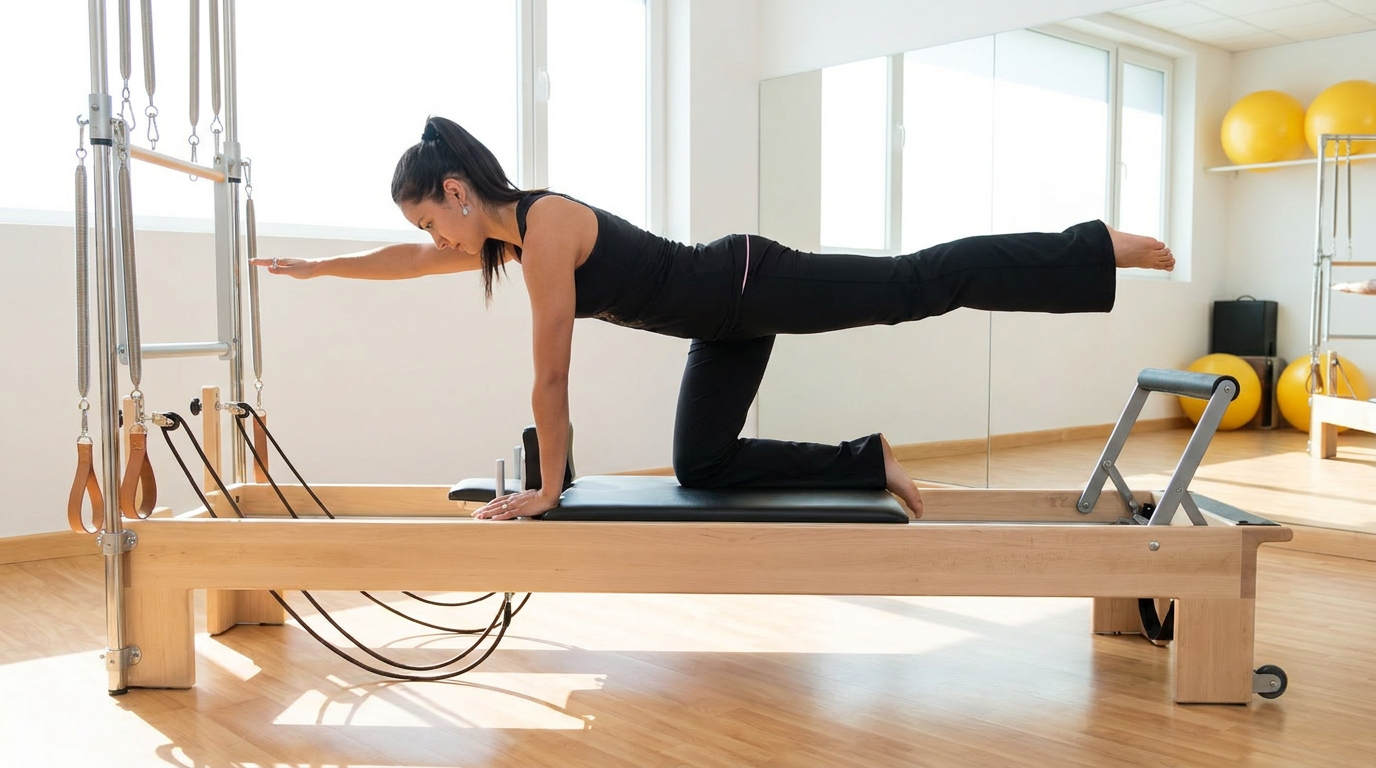
This unique resistance profile is most evident when using the Reformer, a specialized machine equipped with a sliding carriage and a system of springs. Unlike dumbbells or barbells, which provide constant gravitational resistance, the Reformer's springs offer variable resistance. The tension changes as the springs stretch, requiring the user to maintain continuous muscular control throughout the entire range of motion, both during the push and the return phase.[9]
The clinical applications of this controlled resistance are substantial, particularly for chronic pain management. Systematic reviews have consistently highlighted Pilates as an effective non-pharmacological strategy for reducing non-specific lower back pain. By strengthening the deep core stabilizers and improving spinal mobility, the exercises help decompress the lumbar spine and correct the postural imbalances that often trigger chronic discomfort.[7][9]
The clinical applications of this controlled resistance are substantial, particularly for chronic pain management.
Beyond back pain, the practice has shown remarkable benefits for aging populations. Studies involving adults aged 60 to 80 demonstrate that participating in just two Pilates sessions per week significantly improves lower body strength, dynamic balance, and walking ability. By enhancing proprioception—the body's awareness of its position in space—Pilates serves as a highly effective intervention for fall prevention, helping older adults maintain their independence.[4][6][8]
However, sports scientists are careful to distinguish the specific type of strength Pilates builds. Traditional resistance training is designed to induce mechanical tension and progressive overload, which are necessary for maximal strength gains and significant muscle hypertrophy (growth). Pilates, operating at lower absolute loads, primarily develops local muscular endurance and functional movement quality rather than raw power.[1][3]

For this reason, physical therapists often recommend combining Pilates with traditional heavy lifting. While Pilates perfects movement mechanics and protects against injury, lifting heavier weights two to three times a week remains crucial for developing bone density, improving metabolic health, and generating maximal muscular force. The two modalities are highly complementary, with the core stability gained on the mat translating to better form under a barbell.[2][3]
Flexibility is another area where Pilates excels over traditional static stretching. Because the movements require active engagement of the muscles while they are being lengthened, the practice improves functional mobility—the usable range of motion within a joint. This active flexibility makes everyday activities, from climbing stairs to reaching for high shelves, feel more fluid and less strained.[2]
The benefits extend beyond the musculoskeletal system into mental health and nervous system regulation. The deliberate pacing and focus on deep, diaphragmatic breathing stimulate the parasympathetic nervous system, helping to lower blood pressure and reduce circulating stress hormones. Studies indicate that regular participation positively impacts mood, reduces anxiety, and fosters a strong mind-muscle connection.[4][6][8]

Emerging research is also exploring the modality's role in managing complex chronic conditions. Clinical trials have found that Pilates can improve functional autonomy and balance in patients with mild to moderate Parkinson's disease. Additionally, the low-impact nature of the exercise makes it an accessible option for individuals managing inflammatory conditions like endometriosis or arthritis, allowing them to maintain strength and circulation without exacerbating joint or pelvic pain.[2][7][8]
When it comes to weight loss, the data is nuanced. While some meta-analyses show that regular Pilates can reduce body fat percentage and body mass index (BMI) in overweight populations, experts caution that it is not a primary driver of rapid weight loss on its own. Instead, its value lies in improving body composition—increasing lean muscle mass and endurance—which supports a more active lifestyle overall.[6][8]
Ultimately, the science of Pilates validates what its creator hypothesized a century ago. By prioritizing movement quality, deep core activation, and the integration of breath and body, it offers a sustainable, low-impact pathway to lifelong physical resilience. Whether used as a standalone practice, a rehabilitation tool, or a complement to heavy athletics, it reshapes the body not just to look stronger, but to function better.[10]
How we got here
Early 1920s
Joseph Pilates develops 'Contrology,' a system of exercises focused on breath, core strength, and controlled movement.
1990s
Pilates gains mainstream popularity beyond the dance community, becoming a staple in fitness studios and physical therapy clinics.
2010s
Clinical research accelerates, validating Pilates as an evidence-based intervention for lower back pain and fall prevention in older adults.
2020s
A surge in hybrid training models sees Pilates integrated with traditional strength training for comprehensive athletic conditioning.
Viewpoints in depth
Clinical Physiotherapists
Focus on rehabilitation, core stability, and injury prevention.
For clinical and rehabilitation specialists, Pilates is viewed primarily as a medical intervention rather than just a fitness class. They emphasize its ability to decompress the spine, correct postural imbalances, and strengthen the deep stabilizers that protect the joints. In this view, the controlled, low-impact nature of the movements makes it an ideal prescription for patients recovering from injuries or managing chronic conditions like lower back pain and arthritis.
Traditional Strength Coaches
Advocate for a hybrid approach, noting the limitations of Pilates for maximal strength.
Strength and conditioning professionals acknowledge the immense value of Pilates for improving movement quality, core stability, and muscular endurance. However, they caution against using it as a complete replacement for traditional weightlifting. They point out that building significant bone density and maximal muscle size requires the heavy progressive overload that only barbells and dumbbells can provide, arguing that the two modalities should be used together for optimal athletic performance.
Mind-Body Practitioners
Highlight the nervous system benefits and stress reduction of the practice.
Holistic health advocates focus on the psychological and physiological benefits of the mind-body connection fostered by Pilates. They emphasize how the deliberate pacing and deep, diaphragmatic breathing stimulate the parasympathetic nervous system, lowering blood pressure and reducing circulating stress hormones. For this camp, the mental clarity and emotional resilience gained from the practice are just as important as the physical strength.
What we don't know
- The exact optimal 'dosage' (frequency and duration) of Pilates required to treat specific clinical conditions like Parkinson's disease.
- How Pilates compares head-to-head against highly specialized, individualized physical therapy protocols for acute injury recovery.
- The long-term efficacy of Pilates as a primary intervention for significant weight loss, as results are heavily dependent on concurrent dietary changes.
Key terms
- Transverse Abdominis
- The deepest layer of abdominal muscles that wraps around the torso like a corset, providing critical spinal stability.
- Eccentric Contraction
- A type of muscle activation where the muscle lengthens while under tension, common in Pilates movements.
- Multifidus
- A series of small, deep muscles attached to the spinal column that play a vital role in stabilizing the vertebrae.
- Variable Resistance
- Resistance that changes throughout the range of motion, such as the tension provided by the stretching springs on a Pilates Reformer.
Frequently asked
Can Pilates replace traditional weightlifting?
No. While Pilates builds excellent muscular endurance and core stability, traditional weightlifting is still necessary for maximizing bone density and raw muscle size.
Is Reformer Pilates better than Mat Pilates?
Neither is strictly better. The Reformer provides variable spring resistance that can both assist and challenge movements, while Mat Pilates relies entirely on body weight and gravity.
Can Pilates help with lower back pain?
Yes. Numerous studies show that by strengthening the deep core stabilizers and improving spinal mobility, Pilates is highly effective at reducing non-specific lower back pain.
Sources
Source coverage
10 outlets
3 viewpoints surfaced









[1]Limitless Physio BronteClinical & Rehabilitation Specialists
Is Reformer Pilates Strength or Resistance Training?
Read on Limitless Physio Bronte →[2]Women's HealthFitness & Strength Conditioning
6 Health Benefits of Pilates, According to a Physical Therapist
Read on Women's Health →[3]Strong CurvesFitness & Strength Conditioning
Does Pilates Count as Strength Training for Women?
Read on Strong Curves →[4]Saber Healthcare GroupClinical & Rehabilitation Specialists
Health Benefits of Pilates
Read on Saber Healthcare Group →[5]FitBoutiqueFitness & Strength Conditioning
Anatomy & Biomechanics: Muscles Targeted in Reformer Pilates
Read on FitBoutique →[6]CBHS Health FundHolistic Health & Wellness
The health benefits of Pilates for your mind and body
Read on CBHS Health Fund →[7]WebMDClinical & Rehabilitation Specialists
Pilates: Overview, Pros and Cons, Benefits, and More
Read on WebMD →[8]Everyday HealthHolistic Health & Wellness
Pilates: Health Benefits, How to Get Started, and How to Get Better
Read on Everyday Health →[9]Complete PhysioClinical & Rehabilitation Specialists
Is reformer Pilates strength training? Find out here.
Read on Complete Physio →[10]Factlen Editorial TeamHolistic Health & Wellness
Synthesis by Factlen editorial team
Read on Factlen Editorial Team →

Every angle. Every day.
Get fitness stories with full source coverage and perspective breakdowns delivered to your inbox.