
Intermittent Fasting vs. Calorie Restriction: What the Clinical Evidence Shows
A wave of new clinical trials reveals that while intermittent fasting and calorie restriction produce identical weight loss when calories are matched, the best choice depends entirely on individual behavior and adherence.
By Factlen Editorial Team
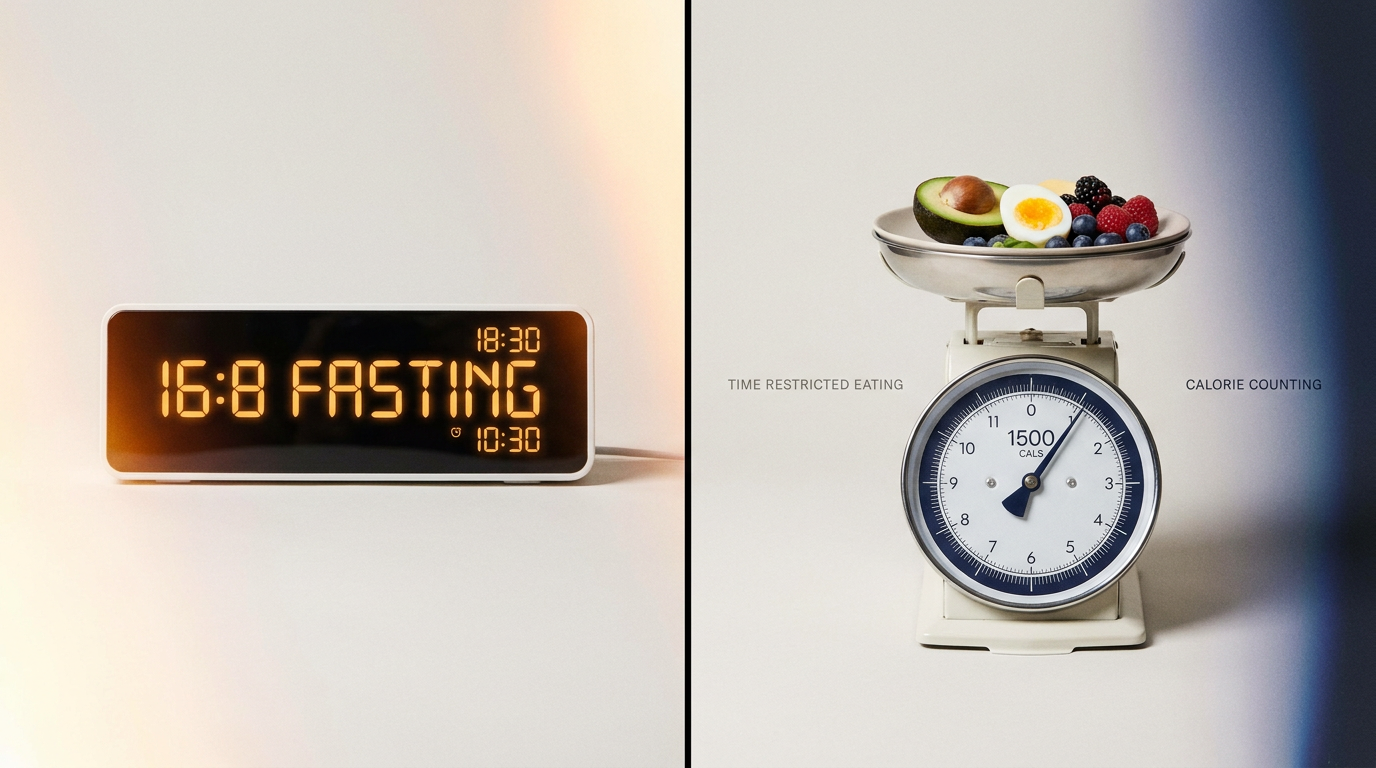
- Time-Restricted Advocates
- Argue that counting hours is psychologically easier than counting calories and provides unique metabolic benefits.
- Traditional Dietitians
- Emphasize that continuous calorie restriction offers more flexibility and teaches long-term portion control.
- Evidence-Based Synthesizers
- Maintain that both methods work purely through energy deficit, and the choice should be based entirely on personal adherence.
What's not represented
- · Individuals with eating disorders
- · High-performance athletes
Why this matters
With obesity rates rising, choosing a sustainable weight loss method is critical for long-term health. Understanding the distinct trade-offs between counting calories and counting hours empowers individuals to select a strategy they can actually stick to, rather than failing at a diet that doesn't fit their lifestyle.
Key points
- Both intermittent fasting and continuous calorie restriction operate by creating an energy deficit, leading to identical weight loss when calories are matched.
- Intermittent fasting offers the psychological benefit of counting hours instead of calories, which can improve long-term adherence for some individuals.
- Continuous calorie restriction provides greater flexibility for social eating and steady energy levels throughout the day.
- Recent clinical trials confirm that neither diet is biologically superior; the best choice depends entirely on an individual's lifestyle and behavioral preferences.
For decades, the foundation of weight management has been a simple mathematical equation: consume fewer calories than the body expends. Yet, as obesity rates climb globally, the traditional method of continuous calorie restriction has faced a formidable challenger in intermittent fasting. This dietary showdown pits the "what and how much you eat" philosophy against the "when you eat" approach. With a surge of new clinical data published between 2022 and 2026, the scientific community is finally equipped to directly compare these two strategies side-by-side. The debate is no longer about which diet is biologically superior in a vacuum, but rather which behavioral framework allows individuals to successfully maintain an energy deficit in the real world. By analyzing the trade-offs, evidence, and psychological impacts of both methods, a clearer picture emerges of how to match the right dietary tool to the right metabolic and lifestyle profile.[1][6]
At the physiological level, both continuous calorie restriction and intermittent fasting operate on the exact same fundamental mechanism: creating an energy deficit that forces the body to utilize stored fat for fuel. Continuous calorie restriction typically involves reducing total daily energy intake by roughly twenty to thirty percent, requiring individuals to track their meals and portion sizes every single day. Intermittent fasting, on the other hand, achieves this deficit by restricting the time window in which food is consumed. The most popular variations include time-restricted eating, where all meals are consumed within an eight-hour window, and alternate-day or modified fasting, such as the 4:3 protocol, which involves eating normally for four days and severely restricting calories for three non-consecutive days. While the physiological destination is identical, the psychological journey required to get there diverges significantly.[1][5]
The primary argument for continuous calorie restriction is its unparalleled flexibility and precision. By focusing purely on the total energy intake, individuals have the freedom to eat at any time of day, accommodating unpredictable work schedules, family dinners, and social events without the rigid constraints of a fasting clock. This method allows for a steady stream of energy throughout the waking hours, which can be particularly beneficial for individuals who experience hypoglycemia, intense hunger pangs, or mood fluctuations when deprived of food for extended periods. Furthermore, traditional calorie restriction encourages a deeper understanding of nutritional density and portion control, equipping individuals with the long-term knowledge required to make healthier food choices even after their weight loss phase is complete.[2][6]
However, the case against continuous calorie restriction centers on the psychological burden of perpetual vigilance. Tracking every morsel of food, weighing ingredients, and scanning barcodes can quickly lead to tracking fatigue. For many, the requirement to be in a state of mild deprivation every single day without a break becomes mentally exhausting, leading to a high rate of attrition. Clinical trials consistently show that while continuous calorie restriction produces a modest five to ten percent reduction in body weight over a year, adherence drops precipitously after the first few months. The cognitive load of constant calculation turns eating into a mathematical chore, which is why researchers have aggressively sought alternative frameworks that can deliver the same physiological results without the daily mental arithmetic.[1][5]

Intermittent fasting enters the arena with a compelling counter-offer: count the hours, not the calories. The strongest argument for fasting protocols is their sheer simplicity. By establishing a hard boundary between eating and fasting, individuals are freed from the tedious task of logging their meals. For many, it is psychologically easier to say a definitive "no" to food during fasting hours than to say "just a little bit" throughout the day. This binary approach eliminates decision fatigue and naturally curtails late-night snacking, a common pitfall in weight management. Proponents also point to secondary metabolic benefits, such as extended periods of low insulin levels, which theoretically optimize the body's fat-burning environment, though the primary driver of weight loss remains the incidental reduction in total calories.[5][6]
The arguments against intermittent fasting highlight its potential for social disruption and physical discomfort. Fasting protocols can be highly incompatible with standard social rhythms; skipping breakfast with family or declining a late dinner invitation can cause friction and isolation. Furthermore, the fasting windows can induce intense hunger, irritability, and a lack of focus, particularly during the initial adaptation phase. There is also a documented risk of compensatory overeating. Some individuals, knowing they have a limited window to consume food, may binge on highly palatable, calorie-dense foods, entirely negating the energy deficit created by the fast. For these reasons, fasting requires a specific type of behavioral discipline that is not universally sustainable.[3][4]
When subjected to rigorous head-to-head clinical trials, the biological evidence reveals a striking parity between the two approaches. A landmark 2022 study published in the New England Journal of Medicine tracked one hundred and thirty-nine patients over twelve months, meticulously matching the caloric intake of both groups. The researchers found that time-restricted eating combined with calorie restriction resulted in an average weight loss of eight kilograms, compared to six point three kilograms for the daily calorie restriction group. This difference of one point eight kilograms was not statistically significant. Secondary analyses of waist circumference, body fat percentage, and metabolic risk factors mirrored these primary outcomes, confirming that when total calories are equated, the timing of meals does not offer a magical metabolic advantage.[3]
When subjected to rigorous head-to-head clinical trials, the biological evidence reveals a striking parity between the two approaches.
This conclusion was further cemented by a comprehensive 2025 systematic review published in The BMJ, which analyzed nearly one hundred randomized clinical trials. The review confirmed that both intermittent fasting and traditional calorie restriction yielded similar health benefits and weight loss outcomes compared to unrestricted diets. The researchers noted that among the various fasting protocols, only alternate-day fasting resulted in slightly greater weight loss than continuous restriction, though the difference was less than three pounds—a margin considered clinically trivial. The consensus among the scientific community is now clear: intermittent fasting is not a superior biological hack, but rather an equally effective alternative vehicle for delivering an energy deficit.[1]

However, while the biological outcomes are identical, the behavioral outcomes tell a different story, shifting the spotlight to adherence. A pivotal 2025 study published in the Annals of Internal Medicine compared a 4:3 intermittent fasting model with daily calorie restriction over a full year. The results bucked previous trends, showing that the fasting group achieved a seven point six percent reduction in body weight compared to a five percent reduction in the continuous restriction group. The researchers utilized doubly labeled water to objectively measure energy expenditure and intake, concluding that the greater weight loss in the fasting group was driven entirely by superior adherence to the protocol. For these participants, enduring three days of intense restriction was easier to sustain than enduring a moderate deficit every single day.[2]
Beyond the scale, researchers have also scrutinized the psychological toll of these diets. A secondary analysis of a twelve-month trial, published in the journal Nutrients, compared the effects of time-restricted eating and daily calorie restriction on mood and quality of life. The study found that both regimens resulted in similar reductions in caloric intake and body weight, and crucially, neither diet negatively impacted the participants' mood or physical activity levels over the year. The time-restricted eating group adhered to their eating window on eighty-seven percent of the days, while the calorie restriction group met their daily targets sixty-one percent of the time. This data suggests that both methods are psychologically safe, but the simplicity of fasting may offer a slight edge in long-term compliance for certain personality types.[4]

Ultimately, the choice between intermittent fasting and continuous calorie restriction is a trade-off between structure and flexibility. Intermittent fasting provides rigid temporal boundaries that simplify decision-making but demand a high tolerance for acute hunger and social inflexibility. Continuous calorie restriction offers the ultimate freedom in meal timing and food choices but requires a high tolerance for daily tracking, portion measurement, and chronic, low-level deprivation. Because the physiological results are virtually indistinguishable, the decision matrix must be based entirely on an individual's lifestyle, psychological relationship with food, and daily schedule.[6]
Intermittent fasting fits well when an individual thrives on clear, binary rules rather than moderation. It is highly effective for people who have busy morning schedules and naturally skip breakfast without significant distress. It is also an excellent fit for those who experience severe tracking fatigue and find the daily logging of calories to be mentally exhausting or triggering. Furthermore, time-restricted eating serves as a powerful behavioral guardrail for individuals whose primary source of excess calories comes from late-night snacking while watching television or working late, as the hard cutoff time eliminates this specific vulnerability.[2][6]
Conversely, intermittent fasting does not fit well when an individual has a history of disordered eating, particularly binge eating disorder, as the restriction windows can trigger compensatory gorging. It is also poorly suited for athletes or individuals engaged in heavy physical labor who require a steady influx of energy throughout the day to maintain performance and safety. Additionally, those with medical conditions requiring food to be taken with medication at specific times, or individuals who experience severe hypoglycemia, irritability, or migraines when fasting, should avoid this approach. Finally, it may not fit well for those whose social or professional lives revolve around shared meals at varying hours.[3][6]
Continuous calorie restriction fits well when an individual values flexibility above all else and wants the freedom to participate in social events, family breakfasts, and late dinners without watching the clock. It is ideal for people who prefer a steady, predictable stream of energy throughout the day and who manage hunger better by eating multiple small meals rather than enduring long periods of fasting. This approach is also highly beneficial for individuals who are data-driven and enjoy the process of tracking macros and calories, using the feedback to learn about the nutritional density of different foods and optimize their overall diet quality.[4][6]

On the other hand, continuous calorie restriction does not fit well when an individual lacks the time, patience, or desire to weigh food and log meals consistently. It is a poor choice for those who find that tracking every bite leads to obsessive thoughts about food or heightens their anxiety. Furthermore, it may not be sustainable for individuals who struggle with portion control once they start eating; for these people, the instruction to eat "just a little bit" of a highly palatable food is much harder to execute than the instruction to not eat it at all. If the daily mental arithmetic of calorie counting leads to rapid burnout, this traditional method will likely fail.[1][6]
The evolution of weight loss science has moved past the search for a single, universal solution. The robust clinical data from the past several years confirms that there is no metabolic magic in meal timing, nor is there a fatal flaw in traditional calorie counting. Both intermittent fasting and continuous calorie restriction are scientifically validated tools that effectively leverage the laws of thermodynamics to reduce body mass. The ultimate victor in this dietary comparison is not one specific protocol, but rather the concept of personalization. By understanding the distinct trade-offs of each method, individuals can select the behavioral framework that best aligns with their lifestyle, ensuring that the diet they choose is the one they can actually sustain.[6]
How we got here
April 2022
The New England Journal of Medicine publishes a landmark trial showing time-restricted eating is not more beneficial than daily calorie restriction when calories are matched.
October 2023
A study in Nutrients reveals that both fasting and calorie restriction have similar, safe impacts on mood and quality of life over a 12-month period.
March 2025
The Annals of Internal Medicine publishes data showing 4:3 intermittent fasting yields slightly greater weight loss than daily restriction due to better adherence.
June 2025
The BMJ releases a systematic review of nearly 100 trials, confirming both approaches are equally effective for cardiometabolic health.
Viewpoints in depth
Time-Restricted Advocates
Focusing on the simplicity and adherence benefits of fasting windows.
Proponents of intermittent fasting argue that the modern food environment makes continuous moderation nearly impossible. By implementing hard temporal boundaries, individuals can bypass the cognitive fatigue of logging every meal. This camp points to studies showing higher long-term adherence rates for time-restricted eating, arguing that it is easier to abstain entirely during fasting windows than to constantly negotiate portion sizes throughout the day.
Traditional Dietitians
Advocating for the flexibility and educational value of continuous calorie restriction.
Experts favoring traditional calorie restriction argue that it is the only method that truly teaches nutritional literacy. They emphasize that intermittent fasting can sometimes mask poor dietary choices if individuals consume highly processed foods within their eating windows. This camp values the flexibility of continuous restriction, noting that it accommodates social events, stabilizes blood sugar, and provides a more sustainable framework for lifelong weight management once the initial weight is lost.
Metabolic Realists
Emphasizing that thermodynamics, not meal timing, dictates weight loss.
This perspective, heavily supported by recent randomized controlled trials, argues that the debate between the two diets is biologically moot. When caloric intake is strictly matched, the physiological outcomes—including fat loss, insulin sensitivity, and cardiovascular markers—are virtually identical. Therefore, this camp insists that neither diet is inherently superior; rather, they are simply different behavioral tools used to achieve the exact same metabolic state of energy deficit.
What we don't know
- Whether the long-term (5+ years) maintenance of weight loss differs significantly between the two methods.
- How genetic variations might make certain individuals biologically more responsive to fasting versus continuous restriction.
Key terms
- Continuous Calorie Restriction (CCR)
- A dietary approach that involves reducing total daily energy intake by a specific percentage, requiring daily tracking of food and portion sizes.
- Time-Restricted Eating (TRE)
- A form of intermittent fasting where all daily calories are consumed within a specific time window, typically 8 to 10 hours, followed by a fasting period.
- Alternate-Day Fasting (ADF)
- A fasting protocol that alternates between days of normal eating and days of severe calorie restriction or complete fasting.
- Energy Deficit
- A metabolic state where the body expends more calories than it consumes, forcing it to burn stored fat for fuel.
- Doubly Labeled Water
- A highly accurate clinical method used by researchers to measure a person's total energy expenditure and calorie intake over time.
Frequently asked
Does intermittent fasting burn more fat than calorie restriction?
No. Recent clinical trials, including a 2022 study in the New England Journal of Medicine, show that when total calories are equal, both diets result in the same amount of fat loss.
Which diet is easier to stick to long-term?
It depends on the individual, but some studies show higher adherence rates for intermittent fasting because counting hours is often less mentally exhausting than logging every calorie.
Can I eat whatever I want during an intermittent fasting window?
No. While fasting does not explicitly restrict food types, weight loss still requires an overall calorie deficit. Bingeing on high-calorie foods during the eating window will prevent weight loss.
Do these diets affect mood or cause depression?
A 12-month study published in Nutrients found that neither time-restricted eating nor daily calorie restriction negatively impacted participants' mood or quality of life.
Sources
Source coverage
6 outlets
3 viewpoints surfaced






[1]The BMJTraditional Dietitians
Intermittent fasting versus traditional calorie restriction for weight loss: systematic review
Read on The BMJ →[2]Annals of Internal MedicineTime-Restricted Advocates
4:3 Intermittent Fasting Shows Modestly Greater Weight Loss Than Daily Caloric Restriction
Read on Annals of Internal Medicine →[3]New England Journal of MedicineEvidence-Based Synthesizers
Calorie Restriction with or without Time-Restricted Eating in Weight Loss
Read on New England Journal of Medicine →[4]NutrientsTraditional Dietitians
Effect of Time-Restricted Eating versus Daily Calorie Restriction on Mood and Quality of Life in Adults with Obesity
Read on Nutrients →[5]PubMed CentralTime-Restricted Advocates
Intermittent Fasting versus Continuous Calorie Restriction: Which Is Better for Weight Loss?
Read on PubMed Central →[6]Factlen Editorial TeamEvidence-Based Synthesizers
Synthesis by Factlen editorial team
Read on Factlen Editorial Team →

More in fitness
See all 5 stories →Exercise Science
The Minimum Effective Dose for Strength Training: How Little Can You Actually Lift?
0 sources

Fascia Science
The Science of Fascia Training: How Connective Tissue Stretching is Redefining Mobility and Longevity
0 sources

Temperature Therapy
Cold Plunges vs. Saunas: The Science of Temperature-Based Muscle Recovery
0 sources

Every angle. Every day.
Get fitness stories with full source coverage and perspective breakdowns delivered to your inbox.