
How the Historic Malaria Vaccine Rollout is Reshaping Child Survival in Africa
With 25 African countries now administering the RTS,S and R21 vaccines, early data confirms a 13% drop in early childhood mortality, though logistical and funding hurdles remain.
By Factlen Editorial Team
- Global Health Agencies
- Focuses on scaling routine immunization programs and securing long-term international funding to reach 50 million children by 2030.
- Field Implementers & Analysts
- Advocates for flexible, seasonal delivery models to maximize vaccine efficacy during the rainy season in high-transmission zones.
- Vaccine Researchers
- Prioritizes the development of next-generation, multi-stage vaccines to close biological loopholes and push toward total eradication.
What's not represented
- · Parents navigating clinic access in remote rural areas
- · Local health ministers managing competing disease budgets
Why this matters
Malaria has historically been one of the deadliest diseases for children under five in Sub-Saharan Africa. The successful deployment of these vaccines represents one of the most significant public health breakthroughs of the century, directly saving tens of thousands of lives annually.
Key points
- 25 African countries have integrated malaria vaccines into routine childhood immunizations.
- Over 39 million doses of RTS,S and R21 vaccines have been delivered as of early 2026.
- Real-world data confirms the vaccines have reduced early childhood mortality by 13% in pilot regions.
- Health ministries are pioneering seasonal delivery to align peak immunity with the rainy season.
- Next-generation trials are underway to develop multi-stage vaccines for long-term eradication.
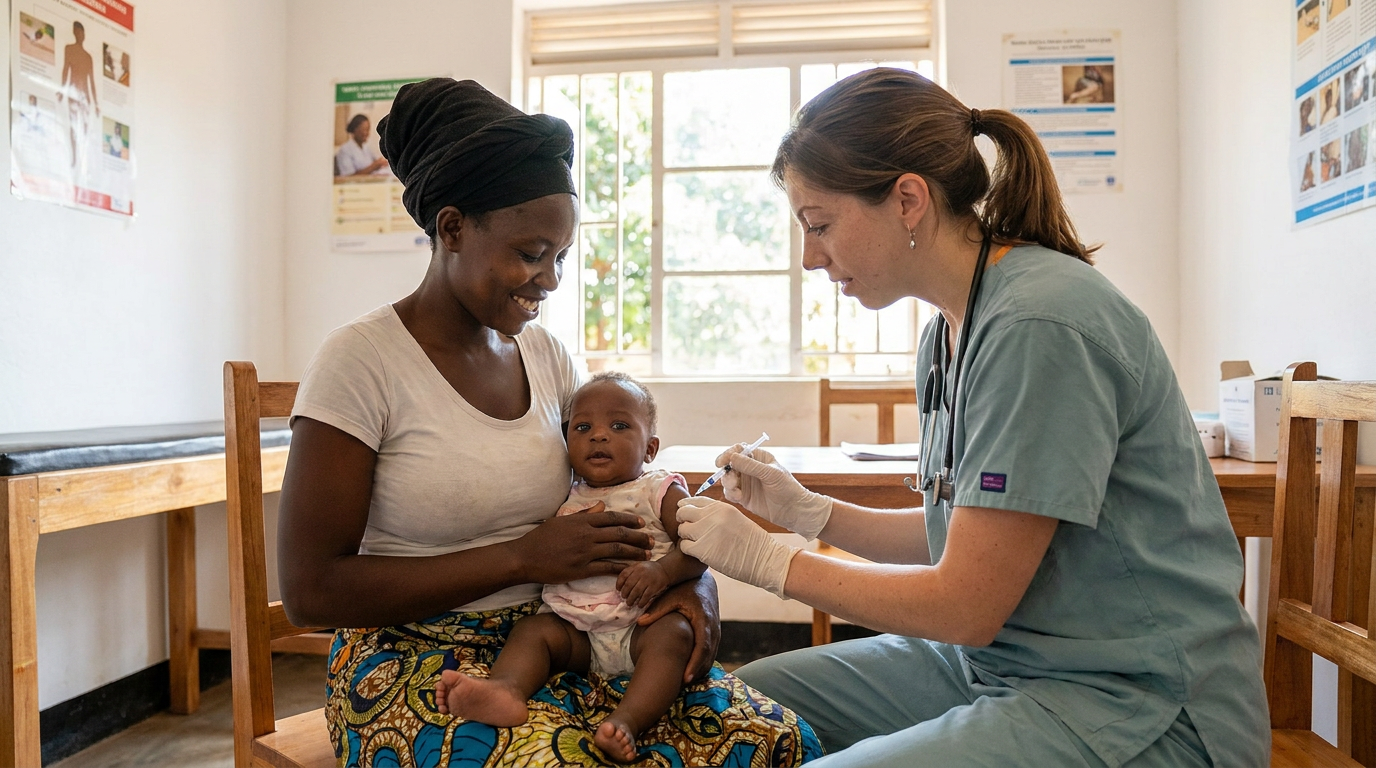
By mid-2026, the fight against one of humanity's oldest and deadliest pathogens has crossed a historic threshold. Across Sub-Saharan Africa, 25 countries have now successfully integrated malaria vaccines into their routine childhood immunization programs, delivering over 39 million doses to the continent's most vulnerable populations.[1][2]
The real-world impact of this rollout is no longer theoretical. A landmark evaluation published in The Lancet in May 2026 confirmed that in the initial pilot countries of Ghana, Kenya, and Malawi, the vaccine drove a 13% reduction in early childhood mortality.[1][4]
Public health officials estimate that one in eight child deaths were averted among those eligible for the shots, providing concrete evidence that the vaccine is fundamentally altering the trajectory of child survival in endemic regions.[1]

The stakes could not be higher. In 2024 alone, malaria claimed the lives of approximately 438,000 African children.[1]
Unlike adults in endemic areas who develop partial immunity over years of repeated exposure, children under five possess no such biological defense, making them acutely susceptible to severe illness, hospitalization, and death following a mosquito bite.[2]
The turnaround is being driven by two groundbreaking vaccines: RTS,S (branded as Mosquirix) and the newer R21/Matrix-M, developed by the University of Oxford.[2][4]
Both vaccines have been prequalified by the World Health Organization (WHO) and utilize a similar biological mechanism to train the infant immune system against Plasmodium falciparum, the deadliest species of the malaria parasite.[1][4]
To understand why these vaccines are revolutionary, one must look at the parasite's complex lifecycle. When an infected mosquito bites a child, it injects the parasite in a form known as a sporozoite.[6]
Both RTS,S and R21 are "liver-stage" vaccines; they prompt the immune system to intercept and neutralize these sporozoites in the bloodstream before they can reach the liver, multiply, and trigger the devastating symptomatic phase of the disease.[4][6]

When administered correctly, the biological shield is highly effective. Clinical trials and real-world data show that both vaccines reduce symptomatic malaria cases by roughly 75% when their administration is timed to coincide with the highest periods of transmission.[2][4]
When administered correctly, the biological shield is highly effective.
However, translating clinical efficacy into population-wide immunity presents a formidable logistical puzzle. Both vaccines require a strict four-dose schedule to achieve full protection.[1][5]
The WHO recommends a three-dose primary series starting around five months of age, followed by a crucial fourth booster dose given 12 to 18 months later.[1]
Ensuring infants return to clinics for the final doses has proven difficult. Implementation research conducted by the Sabin Vaccine Institute in countries like Kenya and Liberia has highlighted concerning drop-off rates for the third and fourth doses.[7]
Because the booster dose falls outside the traditional schedule for other early-childhood immunizations, parents often miss the appointment. To combat this, health ministries are pioneering new integration strategies by linking the malaria booster to other routine health touchpoints, such as vitamin A supplementation or malnutrition screenings.[5][7]
An even greater logistical innovation is emerging in the Sahel region, where malaria transmission is not perennial but highly seasonal, spiking violently during the rainy months. In these environments, the standard age-based vaccination schedule can sometimes leave a child's peak antibody levels misaligned with the peak mosquito season.[5]
In response, countries like Mali and Guinea-Bissau have pioneered a "hybrid" delivery approach. Rather than vaccinating strictly based on a child's birth month, health workers administer the doses in a synchronized campaign just before the rainy season begins, ensuring maximum protection when the risk is highest.[2][4]

Medical organizations are pushing this seasonal strategy even further. Médecins Sans Frontières (MSF) and its research arm, Epicentre, are currently running clinical trials in Chad and Burkina Faso to evaluate synchronizing the R21 vaccine with Seasonal Malaria Chemoprevention (SMC)—a routine distribution of antimalarial drops.[5]
Even as the current rollout saves tens of thousands of lives, scientists are already looking toward the next frontier of eradication. Plasmodium falciparum is a shape-shifting enemy; if even a few sporozoites evade the current liver-stage vaccines, they can multiply in the liver and burst into the bloodstream.[6]
To close this biological loophole, researchers at the University of Oxford and the European Vaccine Initiative launched new clinical trials in Burkina Faso testing next-generation "multi-stage" vaccine candidates, known as R78C and RH5.1, administered in combination with the existing R21 vaccine.[6]

The goal of a multi-stage vaccine is to fight a two-front war. While the R21 component targets the parasite before it reaches the liver, the new blood-stage components are designed to neutralize any parasites that manage to escape and enter the red blood cells.[6]
For now, the immediate priority remains scaling the existing tools. Gavi, the Vaccine Alliance, has set an ambitious target to fully protect 50 million African children with four doses of the malaria vaccine between 2026 and 2030.[2]
Achieving that goal will require sustained global investment. While vaccine supply has stabilized and manufacturing capacity has increased, health leaders warn that funding uncertainties—including shifts in international aid budgets—could threaten the pace of expansion.[3]
Despite these hurdles, the mood among global health professionals is overwhelmingly optimistic. By combining the new vaccines with proven interventions like insecticide-treated nets and rapid diagnostic testing, African nations are mounting the most effective defense against malaria in history.[1][3]
How we got here
October 2021
WHO recommends the widespread use of the first malaria vaccine, RTS,S.
October 2023
WHO recommends the second malaria vaccine, R21/Matrix-M, easing global supply constraints.
January 2024
Routine immunization rollouts begin scaling rapidly across multiple African nations.
September 2025
Clinical trials for next-generation multi-stage vaccines launch in Burkina Faso.
May 2026
The Lancet publishes data confirming a 13% drop in early childhood mortality in pilot countries.
Viewpoints in depth
Public Health Coordinators
Focuses on the necessity of integrating the vaccine into routine, year-round childhood immunization schedules.
For global health agencies and national health ministries, the primary goal is ensuring the malaria vaccine becomes as routine as the polio or measles shots. They argue that building the vaccine into the standard age-based immunization schedule is the most sustainable way to guarantee long-term funding and widespread coverage. While they acknowledge the drop-off rates for the third and fourth doses, they believe the solution lies in strengthening the overall primary healthcare system rather than creating parallel, disease-specific delivery campaigns.
Frontline Implementers
Advocates for seasonal, campaign-style delivery to maximize protection during peak transmission periods.
Medical NGOs and field researchers operating in the Sahel and other highly seasonal environments argue that strict age-based schedules are biologically inefficient. Because malaria transmission spikes violently during the rainy season, a child vaccinated in the dry season may see their antibody levels wane just as the mosquitoes return. These groups advocate for "hybrid" or purely seasonal delivery campaigns, synchronizing the administration of the vaccine with the onset of the rains to ensure peak immunity exactly when it is needed most.
Next-Generation Researchers
Argues that current vaccines are a stopgap, and true eradication requires multi-stage biological targeting.
While celebrating the rollout of RTS,S and R21, vaccine developers and parasitologists caution that a single-stage liver vaccine will never achieve 100% efficacy against a shape-shifting pathogen like Plasmodium falciparum. They are focused on the future, arguing that true eradication requires "multi-stage" vaccines that attack the parasite in both the liver and the bloodstream. By layering multiple biological defenses, they hope to trap any parasites that evade the first line of immunity, eventually driving transmission rates to zero.
What we don't know
- Whether international funding will remain stable enough to hit the target of vaccinating 50 million children by 2030.
- How effectively the new multi-stage vaccines currently in trials will perform in broader populations.
- The long-term impact of climate change on mosquito habitats and how it might shift the required timing for seasonal vaccine delivery.
Key terms
- Sporozoite
- The form of the malaria parasite injected into the bloodstream by an infected mosquito before it reaches the liver.
- Plasmodium falciparum
- The deadliest species of the malaria parasite, responsible for the vast majority of malaria cases and deaths in Africa.
- Seasonal Malaria Chemoprevention (SMC)
- The routine administration of antimalarial medicines to children during the rainy season to prevent infection.
- Multi-stage vaccine
- An experimental type of vaccine designed to attack the malaria parasite at multiple points in its lifecycle, such as both the liver and blood stages.
Frequently asked
Which malaria vaccines are currently being used in Africa?
The two WHO-approved vaccines are RTS,S (Mosquirix) and R21/Matrix-M. Both target the parasite before it reaches the liver.
How effective is the malaria vaccine?
When administered seasonally, the vaccines can reduce symptomatic malaria cases by up to 75% and have been shown to reduce early childhood mortality by 13%.
Why do children need four doses?
The first three doses build the initial immune response, but a fourth booster dose given 12 to 18 months later is required to maintain high levels of protection.
Does the vaccine replace bed nets?
No. The highest impact is achieved when the vaccine is used alongside existing tools like insecticide-treated nets and indoor spraying.
Sources
Source coverage
7 outlets
3 viewpoints surfaced






[1]World Health OrganizationGlobal Health Agencies
New evidence confirms malaria vaccine saves child lives and will have high impact in wider rollout
Read on World Health Organization →[2]Gavi, the Vaccine AllianceGlobal Health Agencies
Malaria vaccine support and rollout in Africa
Read on Gavi, the Vaccine Alliance →[3]NatureField Implementers & Analysts
Africa launches historic malaria vaccine rollout amid funding uncertainty
Read on Nature →[4]View-HubField Implementers & Analysts
Malaria Vaccines: Introduction, Use, and Potential Impact
Read on View-Hub →[5]Médecins Sans FrontièresField Implementers & Analysts
Malaria Vaccine: Comparison of two strategies for administering the R21-Matrix M vaccine
Read on Médecins Sans Frontières →[6]University of OxfordVaccine Researchers
Assessing multi-stage malaria vaccines: New clinical trials begin in Burkina Faso
Read on University of Oxford →[7]Sabin Vaccine InstituteVaccine Researchers
Accelerating Malaria Vaccine Uptake
Read on Sabin Vaccine Institute →
Every angle. Every day.
Get world stories with full source coverage and perspective breakdowns delivered to your inbox.