
How Accurate Are Consumer Sleep Trackers? The Clinical Evidence
We analyzed peer-reviewed validation studies to see how devices like the Oura Ring, Apple Watch, and Whoop compare to medical-grade sleep labs.
By Factlen Editorial Team
- Clinical Sleep Specialists
- Medical professionals who rely on brainwave data (EEG) for accurate sleep assessment.
- Wearable Manufacturers & Researchers
- The companies and affiliated researchers developing the algorithms for consumer sleep tracking.
- Consumer Tech Analysts
- Everyday users, athletes, and reviewers who use wearables to optimize their daily habits.
What's not represented
- · Individuals with diagnosed sleep disorders
- · Data privacy advocates
Why this matters
Millions of consumers spend hundreds of dollars on wearables to optimize their rest, often experiencing anxiety over low 'sleep scores.' Understanding the scientific limits of these devices empowers users to focus on actionable behavioral trends rather than stressing over inaccurate deep sleep estimates.
Key points
- Consumer sleep trackers are highly accurate (85-95%) at detecting total sleep time and wakefulness.
- Wearables struggle to accurately classify specific sleep stages like deep and REM sleep.
- Most devices have a conservative bias, underestimating deep sleep and overestimating light sleep.
- Ring-based trackers often outperform wrist-based trackers due to better optical signal quality on the finger.
- While not medical diagnostic tools, wearables are highly effective for tracking behavioral trends and lifestyle impacts.
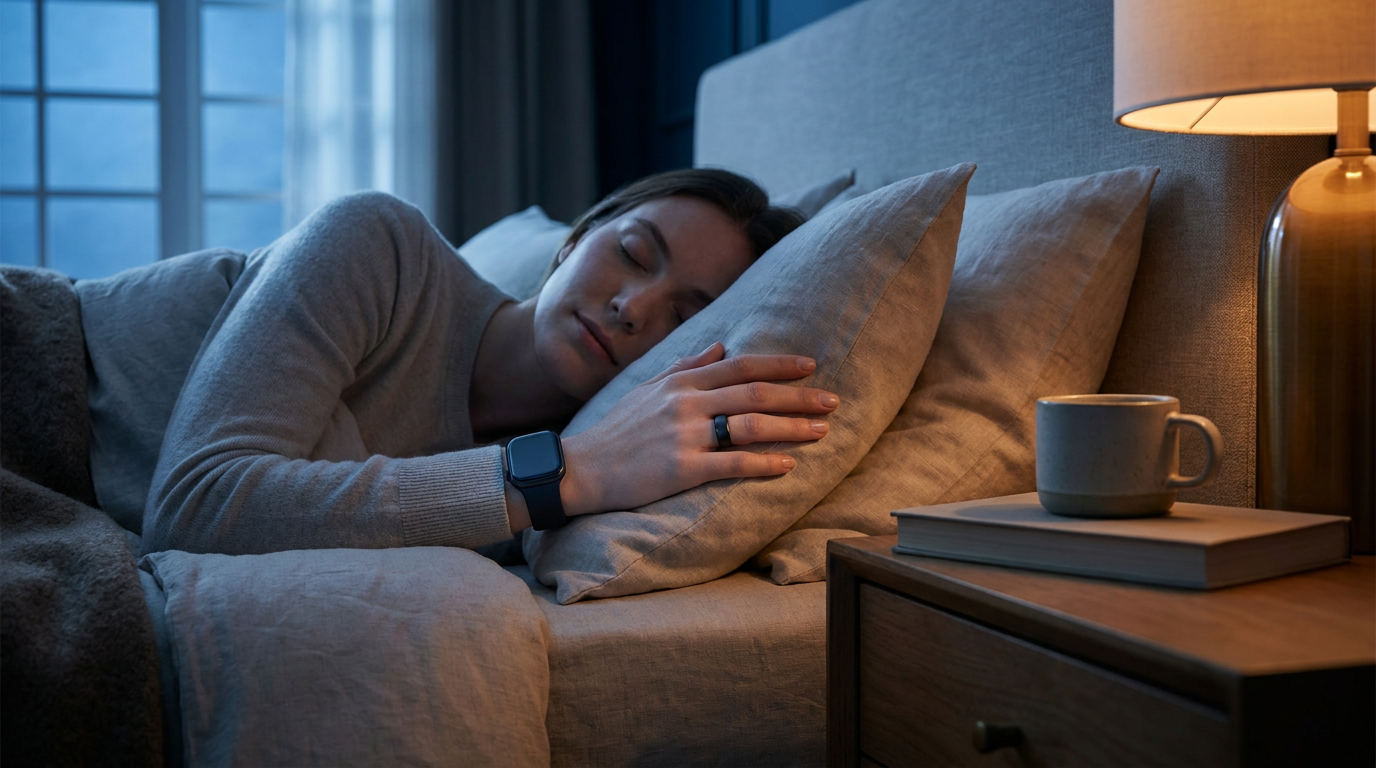
Millions of people wake up every morning and immediately check their "sleep score" on an Oura Ring, Apple Watch, or Whoop strap. The booming consumer sleep tech industry promises to demystify our nights, offering precise breakdowns of light, deep, and REM sleep.[5][6]
For shoppers deciding whether to invest hundreds of dollars in these devices, the core question is whether the data is actually accurate or just an expensive random number generator. To find out, clinical researchers continuously test these commercial wearables against polysomnography (PSG)—the medical gold standard that uses brain electrodes to measure sleep architecture.[8]
When it comes to the primary claim of detecting whether a user is asleep or awake, the evidence is highly robust. Across multiple peer-reviewed studies, devices like the Oura Ring Gen 3, Apple Watch Series 8, and Whoop 4.0 consistently demonstrate 85% to 95% sensitivity for detecting sleep.[1][3][4]
For measuring total sleep time and pinpointing the exact moment a user falls asleep, consumer wearables perform exceptionally well. A 2024 validation study published in the Sensors journal found that the Oura Ring, Fitbit Sense, and Apple Watch all exhibited over 90% agreement with clinical PSG for basic sleep-versus-wake classification.[1]

However, the evidence becomes significantly weaker when evaluating the secondary claim: sleep stage classification. Because consumer wearables measure movement, heart rate, and temperature from the wrist or finger—rather than measuring actual brainwaves—they are forced to make educated algorithmic guesses about when a user transitions between light, deep, and REM sleep.[2][6]
The clinical data shows significant variance between brands in this arena. In a Brigham and Women's Hospital study, the Oura Ring Gen 3 achieved the highest accuracy among its peers, demonstrating a sensitivity of 76% to 79.5% across the different sleep stages.[1][5]
The clinical data shows significant variance between brands in this arena.
In contrast, wrist-worn competitors struggled more with specific stage detection. The same study found that the Apple Watch correctly identified deep sleep only about 50.5% of the time, while the Fitbit Sense hovered around 61.7% for deep sleep accuracy.[1][5]

A transparent look at the data reveals a consistent algorithmic failure mode across almost all consumer devices: a conservative bias that underestimates deep sleep and overestimates light sleep. When a wearable's algorithm is unsure of a specific sleep stage, it typically defaults to categorizing the epoch as light sleep.[4][7]
As a result, users often wake up to alarming data suggesting they got almost no restorative deep sleep. Data analysis indicates that the Apple Watch confuses deep sleep for core, or light, sleep 38% of the time, leading to an artificially low deep sleep average of just 12% for most users.[7]
The Whoop strap faces similar physiological challenges. A validation study in the Journal of Sports Sciences found that while Whoop is excellent for tracking total sleep duration and athletic strain, its four-stage sleep classification showed only moderate agreement with clinical PSG, achieving a Cohen's kappa score of 0.47.[3]

When evaluating this evidence, it is crucial to acknowledge the transparent uncertainty inherent in the "gold standard" itself. Human sleep technicians scoring the exact same clinical EEG data disagree with each other about 25% of the time. If the medical baseline has a 75% inter-rater reliability, a wearable achieving 70% accuracy is actually performing near the theoretical limit of the science.[8]
Furthermore, independent multicenter studies highlight that wearable accuracy can vary based on user physiology, particularly skin tone. Wrist-worn optical sensors often struggle to get a clean signal through darker skin, making ring-based trackers slightly more reliable for diverse populations due to the thinner skin and higher vascular density on the finger.[2][8]
For consumers, the verdict depends entirely on the intended use case. If a shopper is buying a wearable to diagnose a medical sleep disorder like sleep apnea or chronic insomnia, no consumer device can replace a clinical sleep study.[5][6]
However, if the goal is behavioral change, the current generation of trackers is highly effective. The exact minutes of REM sleep matter far less than directional trends. Knowing that your sleep duration drops and your resting heart rate spikes every time you eat a late meal is actionable data that can genuinely improve daily health.[5][8]
How we got here
2015
Early consumer wearables rely purely on actigraphy (movement) to guess sleep duration.
2018
Optical heart rate sensors become standard, allowing algorithms to attempt sleep stage classification.
2021
Oura Ring Gen 3 introduces advanced temperature sensing, improving stage detection accuracy.
2024
Major validation studies confirm wearables are excellent at detecting sleep but still struggle with deep and REM stages.
Viewpoints in depth
Clinical Sleep Specialists
Medical professionals who rely on brainwave data (EEG) for accurate sleep assessment.
This camp emphasizes that consumer wearables cannot diagnose sleep disorders like apnea or insomnia. They often warn about "orthosomnia"—a condition where users become so anxious about achieving a perfect wearable sleep score that it actually degrades their sleep quality. They argue that without measuring brain activity, any sleep stage data is merely an educated guess.
Wearable Manufacturers & Researchers
The companies and affiliated researchers developing the algorithms for consumer sleep tracking.
Manufacturers argue that while a single night in a $3,000 clinical sleep lab is highly accurate, it is also an unnatural environment that doesn't reflect real life. They believe the true value of wearables lies in continuous, longitudinal data. Tracking a user's baseline over months allows the algorithms to detect meaningful deviations in recovery, temperature, and heart rate, even if the absolute sleep stage numbers aren't clinically perfect.
Consumer Tech Analysts
Everyday users, athletes, and reviewers who use wearables to optimize their daily habits.
For this group, absolute clinical precision is secondary to behavioral nudges. They value how the devices reveal the consequences of lifestyle choices—such as how a late meal or alcohol consumption visibly ruins their overnight heart rate variability (HRV). The wearable serves as an accountability partner, turning abstract sleep hygiene advice into measurable daily feedback.
What we don't know
- Whether future consumer devices will ever be able to measure brainwaves (EEG) directly from the wrist or ear.
- How much the algorithms vary their accuracy across different age groups and underlying health conditions.
- The exact proprietary machine-learning weights each company uses to turn raw sensor data into a final sleep score.
Key terms
- Polysomnography (PSG)
- The medical gold standard for sleep testing, utilizing electrodes to measure brain waves, eye movement, and muscle activity.
- Epoch
- A 30-second block of time used by sleep scientists and algorithms to categorize sleep stages.
- Sensitivity
- In diagnostic testing, the ability of a device to correctly identify a specific state, such as accurately detecting when a person is actually in deep sleep.
- Heart Rate Variability (HRV)
- The fluctuation in the time intervals between adjacent heartbeats, used by wearables to gauge nervous system recovery.
- Actigraphy
- The continuous measurement of movement using an accelerometer, which is the foundational technology for basic sleep-versus-wake tracking.
Frequently asked
Can a smartwatch or ring diagnose sleep apnea?
No. Consumer wearables cannot officially diagnose sleep apnea or other medical sleep disorders, as they do not measure breathing effort or brainwaves directly.
Why does my tracker say I get almost no deep sleep?
Wearable algorithms are often conservative; when they are unsure of a sleep stage, they default to categorizing it as light sleep, which frequently leads to an underestimation of deep sleep.
Is a smart ring better than a smartwatch for sleep?
Rings like Oura often perform slightly better in validation studies because the skin on the finger is thinner and has a higher density of blood vessels, yielding a clearer optical heart rate signal than the wrist.
What is polysomnography (PSG)?
PSG is the clinical gold standard for sleep testing. It involves spending a night in a lab hooked up to sensors that measure brain waves (EEG), eye movements, and muscle activity.
Sources
Source coverage
8 outlets
3 viewpoints surfaced








[1]Sensors JournalWearable Manufacturers & Researchers
Accuracy of Three Commercial Wearable Devices for Sleep Tracking in Healthy Adults
Read on Sensors Journal →[2]JMIR mHealth and uHealthClinical Sleep Specialists
Accuracy of 11 Wearable, Nearable, and Airable Consumer Sleep Trackers: Prospective Multicenter Validation Study
Read on JMIR mHealth and uHealth →[3]Journal of Sports SciencesWearable Manufacturers & Researchers
A validation study of the WHOOP strap against polysomnography to assess sleep
Read on Journal of Sports Sciences →[4]Sleep AdvancesClinical Sleep Specialists
Performance of six consumer sleep trackers in comparison with polysomnography in healthy adults
Read on Sleep Advances →[5]WareableConsumer Tech Analysts
Oura wins sleep accuracy study – and why that doesn't really matter
Read on Wareable →[6]RepReturnConsumer Tech Analysts
Apple Watch Sleep Tracking: Is It Actually Accurate in 2026?
Read on RepReturn →[7]Empirical HealthConsumer Tech Analysts
The average deep sleep on Apple Watch is 12%
Read on Empirical Health →[8]Factlen Editorial TeamConsumer Tech Analysts
Synthesis by Factlen editorial team
Read on Factlen Editorial Team →
Every angle. Every day.
Get shopping stories with full source coverage and perspective breakdowns delivered to your inbox.