
Israeli Strikes on Beirut Threaten U.S.-Iran Peace Deal Hours Before Expected Signing
Israeli airstrikes on Hezbollah targets in Beirut have triggered furious warnings from Tehran, threatening to derail a U.S.-Iran peace agreement just as mediators prepared for a final signing.
By Factlen Editorial Team
- Iranian Leadership
- Views the Beirut strike as a violation of the ceasefire spirit and questions U.S. ability to uphold commitments.
- U.S. Administration
- Pushing aggressively to finalize the deal, reopen the Strait of Hormuz, and secure a diplomatic win.
- Israeli Government
- Sidelined from the main talks, prioritizing immediate border security against Hezbollah, and skeptical of the nuclear concessions.
What's not represented
- · Lebanese Civilians
- · Global Energy Markets / Shipping Industry
Why this matters
The U.S.-Iran war has choked global energy markets for four months. If this escalation scuttles the peace deal, the Strait of Hormuz will remain blocked, risking a wider regional war and a sustained global economic shock.
Key points
- Israeli forces struck Hezbollah targets in Beirut on Sunday in retaliation for projectiles fired into northern Israel.
- The strikes occurred hours before the U.S. and Iran were expected to sign a peace deal ending their four-month war.
- Iranian officials warned the attack could derail the negotiations, questioning Washington's ability to control its ally.
- The proposed deal would extend the ceasefire by 60 days and reopen the Strait of Hormuz.
- Israel has been largely sidelined from the U.S.-Iran talks and remains skeptical of the emerging nuclear concessions.
Just hours before the United States and Iran were expected to sign a landmark agreement to end their four-month war, Israeli airstrikes on Beirut's southern suburbs have threatened to derail the fragile peace process.[1][2]
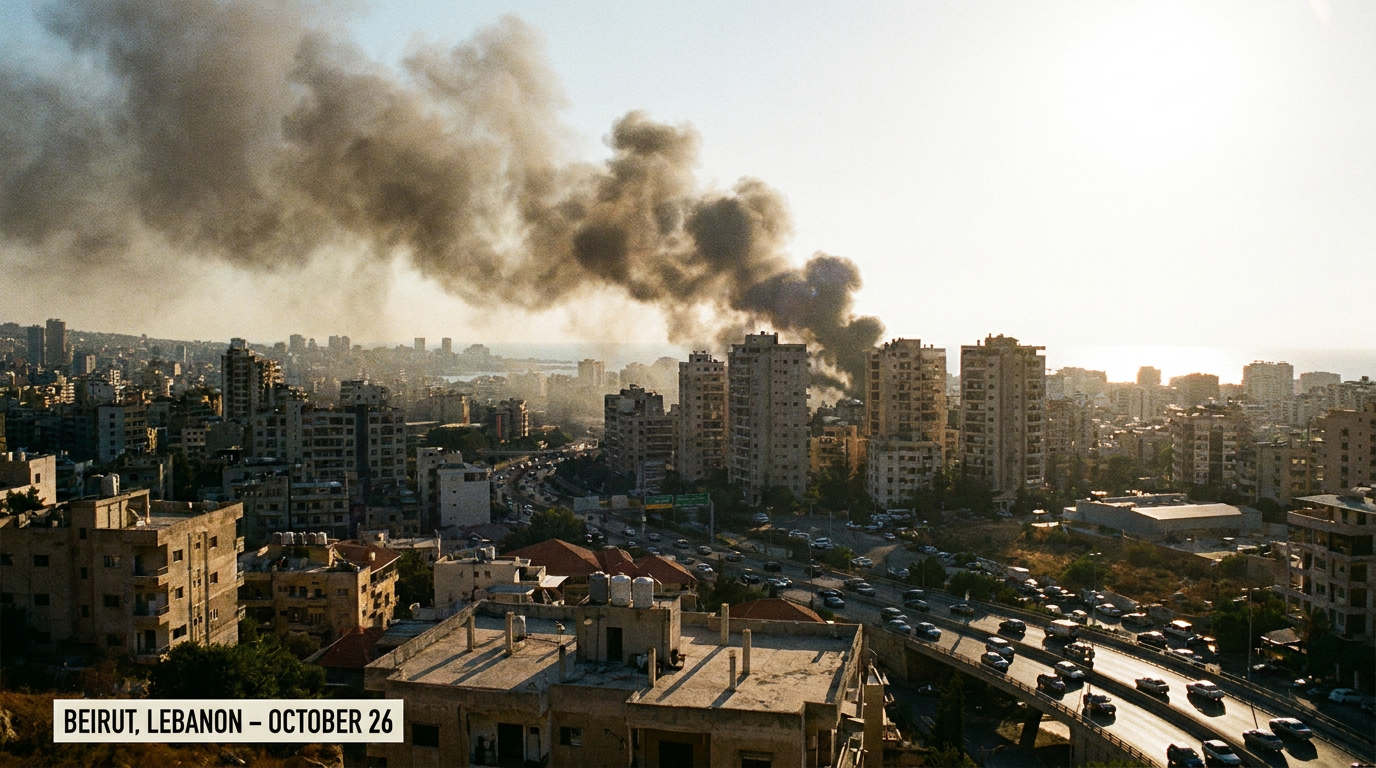
On Sunday morning, the Israeli military launched targeted strikes against Hezbollah infrastructure in the Dahiyeh district of the Lebanese capital. The Israel Defense Forces stated the operation was a direct retaliation for three projectiles fired by Hezbollah into northern Israel earlier in the day.[2][5]
Smoke was seen rising over the densely populated area, marking the most severe escalation between Israel and Iran-backed forces since a tenuous ceasefire took hold on April 7. The office of Israeli Prime Minister Benjamin Netanyahu issued a statement emphasizing that Israel would not tolerate firing into its territory, regardless of broader regional diplomacy.[1][2]
The strikes landed at an extraordinarily sensitive moment. Mediated by Pakistan, the U.S. and Iran have spent weeks hammering out a memorandum of understanding to formally end the conflict that began in late February.[5][6]

U.S. President Donald Trump had publicly announced that the deal was scheduled to be signed on Sunday, promising the immediate reopening of the Strait of Hormuz—a vital global oil artery that has been virtually shut down by the hostilities. Pakistani Prime Minister Shehbaz Sharif echoed the optimism, stating the two sides were closer to peace than ever before and preparing for an electronic signing.[2][4][6]
However, the Beirut strikes immediately threw the diplomatic timeline into chaos. Iranian officials reacted furiously, warning that the attack on their Lebanese ally could scuttle the agreement entirely.[1][3]
However, the Beirut strikes immediately threw the diplomatic timeline into chaos.
Iran's Parliament Speaker Mohammad Bagher Qalibaf stated that the strikes prove the United States either lacks the will to fulfill its commitments or the ability to control its allies. A senior Iranian military official went further, vowing that the attack on Beirut would not go "unanswered."[2][3]
Following the strikes, Iran's Foreign Ministry spokesperson Esmaeil Baghaei denied that any signing would take place on Sunday, though he left the door open for an agreement in the coming days.[4][6]

The friction highlights a core vulnerability in the peace process: Israel has been largely sidelined from the U.S.-Iran negotiations. The Israeli government views the emerging deal with deep skepticism, particularly regarding its provisions on Iran's nuclear program.[2][4][7]
According to U.S. officials, the proposed agreement would extend the current ceasefire by 60 days. During this window, technical discussions would commence on dismantling Iran's highly enriched uranium stockpile, which the U.S. and Israel targeted during the opening days of the war.[4][6]
In exchange for nuclear concessions and the reopening of the Strait of Hormuz, Iran would receive phased relief from U.S. sanctions and access to billions of dollars in frozen assets.[5][6]

Trump has reportedly pressed Netanyahu to hold off on major military actions while the deal is finalized, hoping to secure a definitive diplomatic victory. Yet Sunday's events underscore the difficulty of decoupling the U.S.-Iran track from the ongoing border conflict between Israel and Hezbollah.[2][3][7]
The world now watches to see if the diplomatic framework can survive the weekend's violence. Qatari and Pakistani mediators are scrambling to keep both sides at the table, knowing that a collapse in talks could plunge the region back into full-scale war and send global energy markets into a tailspin.[1][5]
How we got here
Feb 28, 2026
The U.S. and Israel launch a military campaign against Iran, sparking a four-month regional war.
April 7, 2026
A fragile ceasefire takes hold between the U.S. and Iran.
June 13, 2026
U.S. and Pakistani officials announce a peace deal is finalized and scheduled for signing.
June 14, 2026
Israel strikes Beirut in retaliation for Hezbollah rocket fire, prompting Iranian threats to scuttle the deal.
Viewpoints in depth
Iranian Leadership
Views the Beirut strike as a violation of the ceasefire spirit and questions U.S. ability to uphold commitments.
Iranian officials argue that Israel's actions in Lebanon cannot be separated from the broader U.S.-Iran conflict. By striking Hezbollah just hours before a scheduled signing, Tehran believes Israel is actively attempting to sabotage the peace talks. Hardliners in Iran are using the strikes to argue that the U.S. cannot be trusted to guarantee regional stability or rein in its allies, making any long-term security commitments worthless.
U.S. Administration
Pushing aggressively to finalize the deal, reopen the Strait of Hormuz, and secure a diplomatic win.
The U.S. views the memorandum of understanding as a critical off-ramp from a devastating four-month war. The administration's primary goals are stabilizing global energy markets by unblocking the Strait of Hormuz and establishing a framework to dismantle Iran's nuclear program. U.S. officials have reportedly pressured Israel to exercise restraint, viewing the northern border skirmishes as a dangerous distraction that threatens a historic geopolitical settlement.
Israeli Government
Sidelined from the main talks, prioritizing immediate border security against Hezbollah, and skeptical of the nuclear concessions.
Israel is not a party to the U.S.-Iran negotiations and views the emerging deal with profound skepticism. Israeli leadership argues that any agreement leaving Iran's proxy network intact is fundamentally flawed. For Jerusalem, responding to Hezbollah's rocket fire is a non-negotiable matter of national defense, regardless of the diplomatic calendar in Washington and Tehran.
What we don't know
- Whether Iran will officially walk away from the negotiating table or merely delay the signing.
- How Hezbollah plans to respond to the Beirut strikes, and if it will trigger further Israeli retaliation.
- The exact technical mechanisms proposed for dismantling Iran's highly enriched uranium stockpile.
Key terms
- Strait of Hormuz
- A vital maritime chokepoint between the Persian Gulf and the Gulf of Oman through which a significant portion of the world's oil passes.
- Dahiyeh
- A predominantly Shia suburb south of Beirut that serves as a stronghold for Hezbollah.
- Memorandum of Understanding
- A formal agreement between two or more parties outlining the terms and details of an understanding, often serving as the foundation for a binding treaty.
Frequently asked
Why is the U.S. negotiating with Iran?
The U.S. and Iran have been engaged in a four-month war that has severely disrupted global energy markets. The negotiations aim to establish a long-term peace, reopen the Strait of Hormuz, and dismantle Iran's nuclear program.
Why did Israel strike Beirut?
The Israeli military stated the airstrikes were a direct retaliation for three projectiles fired by Hezbollah into northern Israel earlier in the day.
Is the peace deal officially dead?
Not officially. While Iranian officials warned the strikes could imperil the deal and denied a Sunday signing, mediators from Pakistan and Qatar are still working to finalize the agreement in the coming days.
Sources
Source coverage
7 outlets
3 viewpoints surfaced







[1]AxiosIranian Leadership
Iran warns Israel's Beirut strike could derail U.S. deal
Read on Axios →[2]The Washington PostU.S. Administration
Israel strikes Beirut suburbs as US-Iran deal talks near finish line
Read on The Washington Post →[3]The GuardianIranian Leadership
Middle East crisis live: Iran army official says Beirut attack will not go 'unanswered'
Read on The Guardian →[4]Times of IsraelIsraeli Government
Islamabad's announcement quickly followed by Iranian denial that agreement will be signed Sunday
Read on Times of Israel →[5]Saudi GazetteIranian Leadership
Israel strikes Beirut suburbs as US-Iran deal talks near finish line
Read on Saudi Gazette →[6]PBSU.S. Administration
The United States and Iran once again appear close to a deal to end the war
Read on PBS →[7]CBS NewsU.S. Administration
Netanyahu spoke with Trump about proposed peace deal
Read on CBS News →

More in news politics
See all 6 stories →Voting Systems
Does Ranked-Choice Voting Work? Fact-Checking the Data Behind the Ballot Reform
0 sources

Social Media Policy
UK to Announce 'Australia Plus' Social Media Ban for Under-16s
0 sources
Information Ecosystem
Fact-Checking the Cure: The Evidence Behind 'Pre-Bunking' Political Misinformation
0 sources

U.S.-Iran Deal
Israeli Airstrikes in Beirut Threaten Historic U.S.-Iran Peace Deal Hours Before Signing
0 sources
Every angle. Every day.
Get news politics stories with full source coverage and perspective breakdowns delivered to your inbox.