
Invisible Filmmaking: How AI and Micro-Drones Are Revolutionizing Nature Documentaries
A new generation of AI-assisted cameras, FPV drones, and rugged VR rigs is allowing filmmakers to capture unprecedented wildlife behaviors with zero human disturbance.
By Factlen Editorial Team
- Wildlife Technologists
- Focus on the creative possibilities unlocked by high-speed AI autofocus and zero-latency drone transmission.
- Conservation Ethicists
- Prioritize the 'zero disturbance' mandate, arguing that true animal behavior can only be seen when humans are absent.
- Traditional Broadcasters
- Value the cost-efficiency and high audience engagement that immersive, authentic storytelling provides.
What's not represented
- · Amateur drone hobbyists
- · National park regulators
Why this matters
By removing the intrusive presence of human camera crews, this technology is unlocking a deeper, more authentic understanding of animal behavior, which studies show directly increases public empathy and conservation funding.
Key points
- Traditional nature documentaries often disturbed wildlife with helicopters and large crews.
- AI-assisted cameras now autonomously track animal eyes at high speeds, ensuring perfect focus.
- Agile FPV drones can navigate dense forests and follow animals without intrusive noise.
- Rugged 360-degree VR cameras are left in the wild to capture intimate, unbothered encounters.
- Studies show VR nature documentaries significantly boost human empathy and environmental awareness.
The era of the helicopter-mounted telephoto lens is quietly coming to an end. For decades, the gold standard of nature documentaries relied on massive crews, loud aircraft, and heavy equipment that inherently disturbed the very ecosystems they sought to capture.[1][7]
Today, a quiet revolution is sweeping through the wildlife filmmaking industry. Driven by the convergence of artificial intelligence, micro-drone technology, and ruggedized virtual reality cameras, production teams are adopting a philosophy of "invisible filmmaking."[1]
The core premise is simple: the truest animal behavior can only be documented when the animal has no idea it is being watched. By removing the human footprint from the immediate environment, filmmakers are unlocking biological secrets that were previously impossible to record.[6][7]
The most significant leap forward lies in the mechanism of modern camera autofocus, which is now heavily driven by artificial intelligence. In the unpredictable wild, a filmmaker often waits weeks for a single, fleeting moment of action.[1]
In the past, keeping a sprinting cheetah or a diving falcon in perfect focus required immense manual skill and a fair amount of luck. Now, AI-assisted cameras can autonomously lock onto an animal's eye and track it at 120 frames per second, regardless of erratic movement or foreground obstructions.[1]

This technological safety net means that solo operators can capture cinema-quality footage that once required a dedicated focus-puller and a massive rig. It allows crews to shrink their footprint, blending into the background rather than dominating it.[1][6]
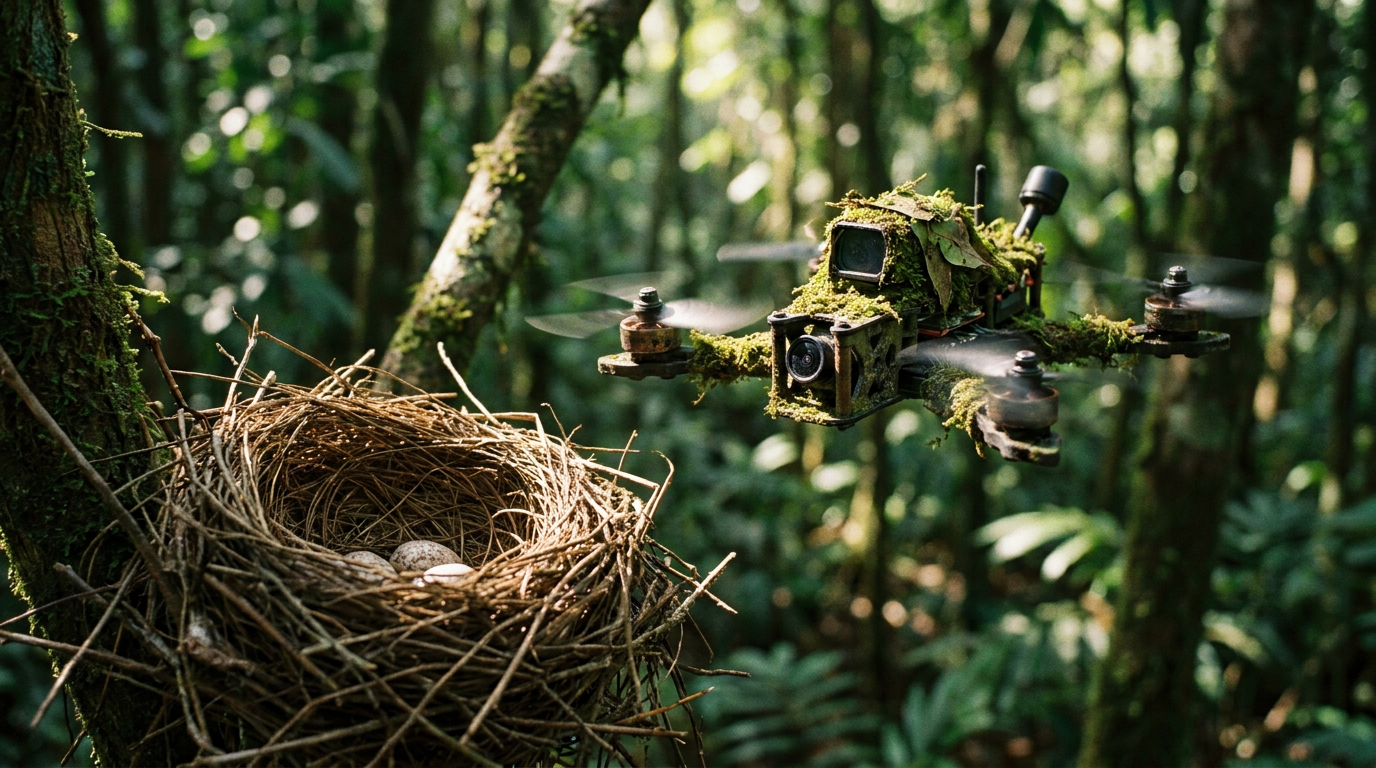
Beyond the camera body, the way lenses move through the air has been entirely reimagined. First-Person View (FPV) drones, originally popularized by drone racing leagues, have become a critical production asset for major broadcasters.[3]
Beyond the camera body, the way lenses move through the air has been entirely reimagined.
Unlike traditional, bulky camera drones that hover high above the canopy, FPV units are small, agile, and capable of threading the needle through dense forests or flying in formation with migrating birds.[3]
With digital transmission latency reduced to under 30 milliseconds, pilots wearing immersive goggles can react to animal movements in real-time. This agility was recently utilized to capture unprecedented wildlife pursuit sequences, achieving shots that cable-cams could never reach.[3]
The innovation extends beneath the surface as well. In aquatic environments, advanced underwater drones are replacing scuba-diving camera operators. These submersibles, equipped with integrated sensors and high-end cinema cameras, can dive deeper and stay submerged longer than any human.[2]
Recent documentaries exploring the Great Lakes utilized these remote-operated vehicles to film the impact of invasive species over hundreds of hours, capturing the ecosystem without the disruptive bubbles and physical presence of human divers.[2]
Perhaps the most intimate technological shift is the deployment of 360-degree Virtual Reality (VR) cameras. Studios operating in the African savannah are now leaving rugged, bite-proof VR rigs directly in the path of wildlife.[4]

These specialized cameras have been chewed on by lions, kicked by elephants, and investigated by wild dogs. Because they are stationary and emit no human scent, animals quickly accept them as part of the landscape, resulting in eye-to-eye encounters that are impossible for a human operator to safely film.[4]
The impact of this immersive footage extends far beyond entertainment. Media psychologists have found that nature documentaries presented in 360-degree VR have a demonstrably stronger positive effect on human well-being and environmental awareness than traditional two-dimensional video.[5]
By virtually placing the viewer inside a forest canopy or face-to-face with an endangered rhino, these technologies trigger primal neural circuits related to empathy and connection.[4][5]

How we got here
2006
The release of 'Planet Earth' ushers in the blockbuster era of nature documentaries, relying heavily on helicopters and massive budgets.
2016
Consumer drones begin replacing helicopters for wide aerial shots, though they remain too loud for close wildlife encounters.
2024
Broadcasters begin integrating FPV racing drones into major productions to capture high-speed, agile pursuit sequences.
2026
AI-driven autofocus and bite-proof VR rigs become standard, allowing for 'invisible filmmaking' with zero human disturbance.
Viewpoints in depth
Wildlife Technologists
Focus on the creative possibilities unlocked by high-speed AI autofocus and zero-latency drone transmission.
For camera operators and technologists, the integration of AI and FPV drones represents a liberation from physical constraints. Previously, capturing a cheetah at full sprint required a massive rig, a dedicated focus-puller, and a wide margin for error. Today, AI algorithms can lock onto a subject's eye and hold focus at 120 frames per second, while low-latency digital transmission allows drone pilots to react to animal movements in milliseconds. This technological safety net allows filmmakers to take creative risks that were previously impossible.
Conservation Ethicists
Prioritize the 'zero disturbance' mandate, arguing that true animal behavior can only be seen when humans are absent.
Conservationists argue that the observer effect has long tainted wildlife filmmaking; the presence of a loud helicopter or a human crew inevitably alters how an animal hunts, mates, or socializes. By utilizing silent micro-drones and stationary VR rigs that emit no human scent, filmmakers are finally capturing authentic, unbothered behavior. Furthermore, ethicists point to psychological studies showing that immersive VR experiences foster a deeper sense of empathy and connection to nature than traditional television broadcasts.
Traditional Broadcasters
Value the cost-efficiency and high audience engagement that immersive, authentic storytelling provides.
From a production standpoint, the shift toward micro-technology fundamentally changes the business model of nature documentaries. Massive crews and expensive helicopter rentals are being replaced by small, agile teams equipped with drones and AI cameras. This reduction in overhead allows studios to spend more time in the field waiting for the perfect shot. Broadcasters are also responding to a shift in audience expectations, as viewers increasingly demand authentic, immersive storytelling over highly staged, traditional formats.
What we don't know
- How the proliferation of cheap, high-quality drones will impact wildlife if amateur filmmakers fail to follow ethical guidelines.
- Whether the long-term use of stationary VR cameras might eventually habituate certain predators to synthetic objects in their environment.
Key terms
- FPV (First-Person View)
- A method of flying a drone where the pilot wears goggles that display a live video feed from the drone's camera, allowing for highly precise, acrobatic maneuvers.
- AI Autofocus
- A camera feature that uses machine learning algorithms to automatically identify and track specific subjects, such as an animal's eye, keeping them in sharp focus.
- 360-Degree VR
- Video captured by omnidirectional cameras that record a view in every direction simultaneously, allowing viewers to look around the scene using a virtual reality headset.
- Latency
- The delay between the camera capturing an image and the pilot seeing it in their goggles; modern digital systems have reduced this to under 30 milliseconds.
Frequently asked
What is an FPV drone?
FPV stands for First-Person View. These are highly agile drones flown by pilots wearing immersive goggles, allowing them to navigate complex environments like dense forests in real-time.
How does AI help film animals?
Modern cameras use AI to instantly recognize and lock focus onto an animal's eye, keeping the subject perfectly sharp even if it moves erratically or runs behind trees.
Do VR cameras get destroyed by animals?
Filmmakers use specially ruggedized, bite-proof housings. While they are frequently chewed on by lions or kicked by elephants, the cameras usually survive to capture the footage.
Sources
Source coverage
7 outlets
3 viewpoints surfaced







[1]Factlen Editorial TeamConservation Ethicists
Synthesis by Factlen editorial team
Read on Factlen Editorial Team →[2]PlaybackWildlife Technologists
Producers explore new tech for nature documentary production
Read on Playback →[3]Market Data ForecastWildlife Technologists
Europe FPV Drone Market Size, Share & Trends Analysis Report
Read on Market Data Forecast →[4]Insta360Wildlife Technologists
5 Tips for Filming a VR Nature Documentary in the African Savannah
Read on Insta360 →[5]Natural Habitat AdventuresConservation Ethicists
How Virtual Reality and Artificial Intelligence Are Benefiting Nature
Read on Natural Habitat Adventures →[6]Wildlife FilmTraditional Broadcasters
Groundbreaking Filming Technology Reveals the Extraordinary World of Bees
Read on Wildlife Film →[7]GeographicalTraditional Broadcasters
Wildlife filmmakers debate the future of natural world storytelling
Read on Geographical →

Every angle. Every day.
Get entertainment stories with full source coverage and perspective breakdowns delivered to your inbox.