
The Engineering Quest to Build a Better, Cruelty-Free Badminton Shuttlecock
The Badminton World Federation is trialing advanced synthetic shuttlecocks in international tournaments, aiming to solve the sport's massive environmental and animal-welfare footprint without sacrificing elite aerodynamics.
By Xia Wu

Badminton is a game of extreme aerodynamic contrasts. It is the fastest racket sport on Earth, with elite jump smashes routinely exceeding 400 kilometers per hour. Yet, within a fraction of a second, that same projectile must decelerate drastically, dropping vertically to land just inside the baseline. The engine of this unique flight path is the traditional feather shuttlecock, a marvel of natural engineering that has defined the sport for over a century.[6]
However, the traditional shuttlecock is also an environmental and ethical nightmare. In a major step toward modernizing the sport, the Badminton World Federation (BWF) recently expanded its approval of synthetic shuttlecocks, clearing models from manufacturers like Victor and Yonex for use in Grade 3 and Junior International tournaments. This 2026 trial marks a critical phase in a long-term plan to eventually replace natural feathers at the highest levels of competition.[1][2]
To understand why this transition is so difficult, one must look at the staggering scale of the problem. A competition-grade shuttlecock is crafted from exactly 16 overlapping feathers embedded into a cork base. Crucially, these feathers must all come from the left wing of a goose or duck. Left and right-wing feathers have different natural curvatures; mixing them would cause the shuttle to wobble erratically in flight. By using only left-wing feathers, manufacturers ensure the shuttlecock spins consistently, stabilizing its trajectory.[4][6]
Because natural feathers are incredibly fragile, they break easily under the immense force of professional play. A single elite match can burn through up to 30 shuttlecocks. When doing the math, the feathers of up to 54 birds are required to supply just one professional game. Across the globe, this translates to millions of birds subjected to live-plucking—a process heavily criticized by animal welfare groups—and millions of discarded shuttles ending up in landfills.[4][5]
Replacing the feather shuttlecock is not as simple as molding a piece of plastic. The shuttlecock is a highly complex aerodynamic projectile known to physicists as a "bluff body." It generates immense drag, which is the resistance caused by moving through the air. When a player executes a powerful smash, the force of the air causes the feather skirt to physically deform and narrow. This temporary streamlining reduces the frontal area and the drag coefficient, allowing the shuttle to travel at blistering speeds.[3][6]
As the shuttlecock loses velocity, the natural stiffness of the feather shafts causes the skirt to snap back into its original, wider shape. This sudden expansion acts like a parachute, drastically increasing the drag coefficient and causing the rapid deceleration that elite players rely on for precise drop shots and clears. Early nylon and plastic shuttles failed spectacularly at mimicking this dynamic deformation.[3]
Historically, synthetic shuttles acted as "constant velocity" projectiles. Because their plastic skirts were too rigid, they did not deform significantly at high speeds, meaning they flew slower off the racket. Conversely, because they didn't "parachute" open at low speeds, they didn't decelerate quickly enough, often flying out of bounds when hit with professional force. They also struggled with the "flip phenomenon"—the requirement that a shuttlecock must instantly turn over mid-air after being struck so that the cork always leads the flight.[3][6]
The breakthrough has come through advanced materials science. Working closely with the BWF, sports engineers have developed next-generation synthetic shuttles, such as the Yonex Crosswind 70 and the Victor New Carbon Sonic Max. Instead of a single molded piece of nylon, these new designs utilize carbon-fiber struts to mimic the rigid-yet-flexible shafts of natural feathers, paired with advanced polymer membranes that replicate the porosity and aerodynamic drag of the feather vanes.[1][2]
Wind tunnel testing confirms that these new carbon-polymer hybrids closely match the drag coefficient curve of natural feathers. They deform under high-speed impact to allow for 400 km/h smashes, and they expand rapidly to provide the necessary deceleration. Furthermore, their rotational stability during the crucial flip phenomenon has been fine-tuned to satisfy the exacting standards of professional players.[3][6]
The BWF's decision to mandate these synthetic shuttles in Grade 3 and Junior International events serves as a high-stakes proving ground. By collecting performance data and direct feedback from up-and-coming elite athletes, technical officials can identify any remaining aerodynamic discrepancies before the technology is introduced to Grade 1 events, such as the World Championships and the Olympic Games.[1]
Beyond the clear animal welfare benefits, the shift to synthetic materials offers a massive economic advantage for the sport's grassroots development. The BWF's initial testing indicated that synthetic shuttles are significantly more durable, reducing overall shuttlecock usage by up to 25 percent. For amateur clubs, schools, and developing badminton nations, the high recurring cost of fragile feather shuttles has long been a barrier to entry.[2][6]
While traditionalists may mourn the loss of the crisp acoustic "crack" that a natural feather shuttle makes upon impact, the momentum toward sustainability is undeniable. If the current trials prove successful, badminton is poised to shed its reliance on animal agriculture, transforming into a more ethical, economical, and accessible sport for its 220 million global participants.[4][5][6]
Key points
- The BWF has approved advanced synthetic shuttlecocks for use in Grade 3 and Junior International tournaments.
- Traditional shuttlecocks require 16 left-wing feathers, consuming up to 54 birds per professional match.
- Natural feathers deform during high-speed smashes to reduce drag, then expand to decelerate rapidly.
- New synthetic models use carbon-fiber and polymers to mimic this complex aerodynamic behavior.
- The transition promises to reduce shuttlecock usage by 25%, lowering costs for amateur players.
How we got here
2020
The BWF officially approves the concept of synthetic feather shuttlecocks for future international play.
2021
Initial testing of Yonex synthetic prototypes demonstrates a 25% reduction in shuttlecock usage.
April 2026
The BWF clears specific synthetic models for competitive use in Grade 3 and Junior International tournaments.
- Badminton Governing Bodies
- Focused on maintaining elite performance standards while gradually transitioning to sustainable equipment.
- Animal Welfare Advocates
- Pushing for an immediate ban on feather shuttles due to the cruelty of live-plucking and massive waste.
- Aerospace Engineers
- Focused on the complex fluid dynamics required to perfectly replicate the drag coefficient of a natural feather.
- Traditionalist Players
- Skeptical of synthetic alternatives, prioritizing the crisp sound and familiar feel of traditional goose-feather shuttles.
Perspectives this story doesn't cover
- Traditional feather shuttlecock manufacturers in Asia facing potential industry disruption.
Sources
Source coverage
6 outlets
4 viewpoints surfaced






- [1]DD NewsBadminton Governing Bodies
BWF clears synthetic shuttlecocks for select tournaments
Read on DD News → - [2]Badminton World FederationBadminton Governing Bodies
BWF Approves Synthetic Feather Shuttlecocks
Read on Badminton World Federation → - [3]MDPI Applied SciencesAerospace Engineers
Aerodynamic Characteristics of Feather and Synthetic Shuttlecocks
Read on MDPI Applied Sciences → - [4]USC ViterbiAnimal Welfare Advocates
Developing Ethical and Sustainable Shuttlecocks
Read on USC Viterbi → - [5]Vegan BadmintonAnimal Welfare Advocates
The Push for Animal-Free Badminton
Read on Vegan Badminton → - [6]Factlen Editorial Team
Synthesis by Factlen editorial team
Read on Factlen Editorial Team →
More in Sports
See all →Japan Open
Brian Yang Stuns Former World Champion Loh Kean Yew in Japan Open First Round
5 sources
Japan Open
PV Sindhu Cruises Past Wong Ling Ching in Japan Open 2026 Opener
3 sources
Japan Open
Kusuma and Puspitasari Mount Stunning Comeback to Advance at Japan Open
4 sources
Injury
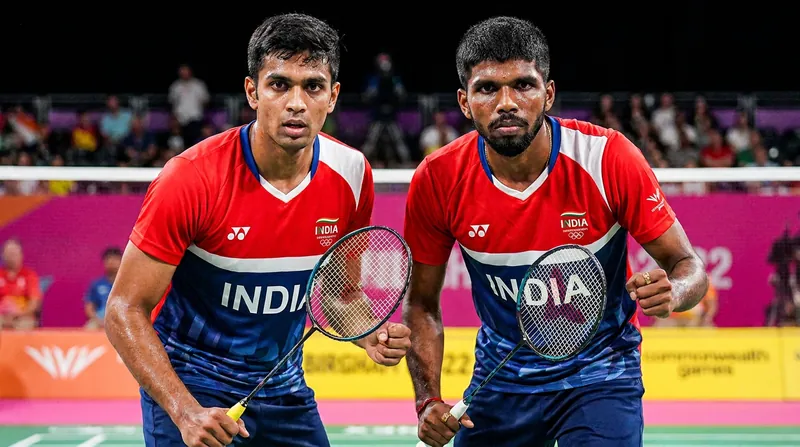
Satwiksairaj Rankireddy and Chirag Shetty Return from Injury to Lead India at Japan Open
3 sources
Comments
Every angle. Every day.
Get Sports stories with full source coverage and perspective breakdowns, free every day.