
Fed Up With Corporate Exits, Neighborhoods Are Building Their Own Grocery Stores
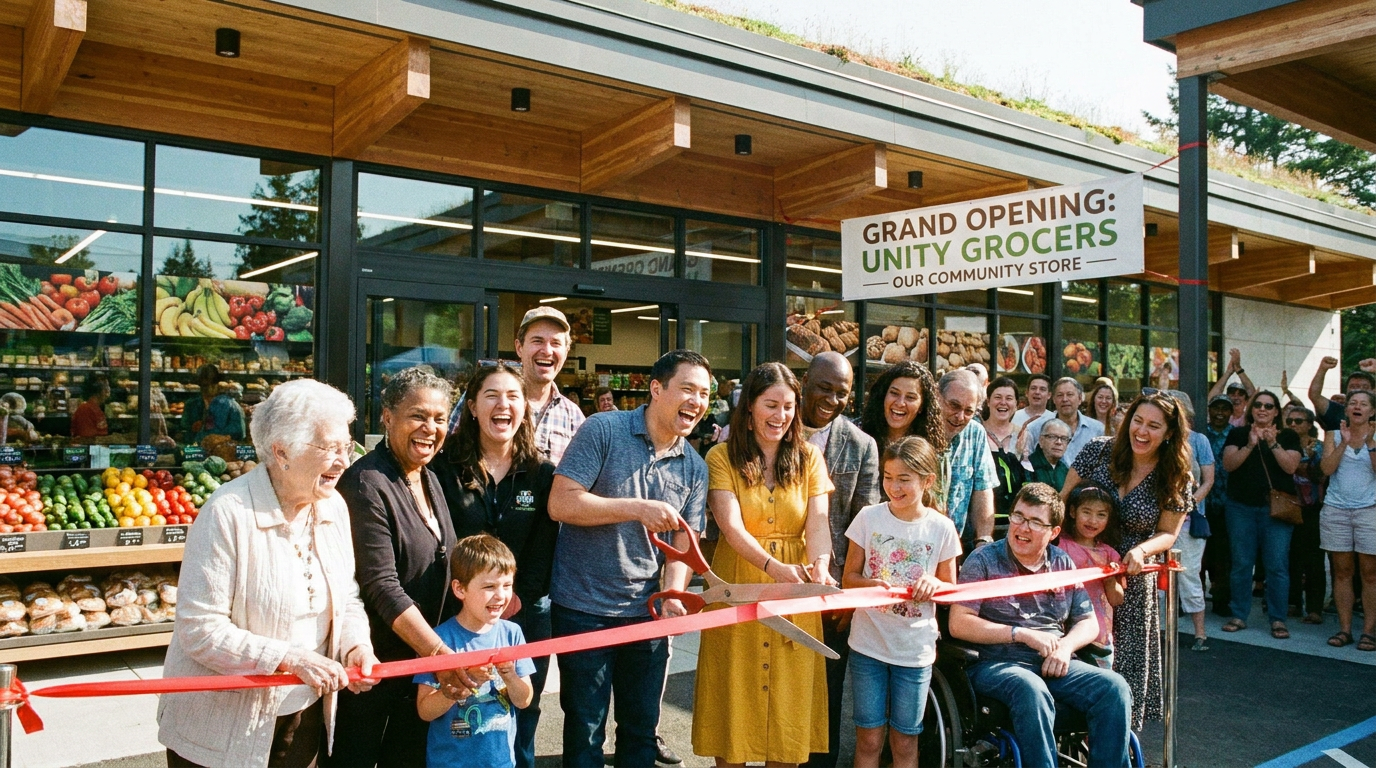
Across the United States, communities left behind by major supermarket chains are pooling resources and utilizing federal grants to open cooperative, community-owned grocery stores.
By Factlen Editorial Team
- Community Organizers
- Argue that cooperative ownership restores dignity, keeps wealth local, and provides food security where corporate chains have failed.
- Federal & Financial Backers
- View co-ops as a sustainable economic development tool that requires initial public seed capital to overcome market failures.
- Local Agricultural Producers
- Value community markets for providing a reliable, fair-priced retail outlet that prioritizes regional supply chains over national distributors.
What's not represented
- · Corporate supermarket executives who previously operated in these neighborhoods
- · Commercial real estate developers managing the abandoned retail spaces
Why this matters
When corporate supermarkets abandon neighborhoods, residents are left with few options for fresh, affordable food. The rise of community-owned cooperatives proves that neighborhoods can successfully build and sustain their own essential infrastructure, keeping food dollars within the local economy.
Key points
- Communities across the U.S. are opening cooperative grocery stores to replace departed corporate supermarkets.
- The North Flint Food Market recently opened in Michigan, ending a decade-long food desert for its 900 member-owners.
- Salt Lake City's Wasatch Food Co-op opened in May 2026, mandating that 20% of its inventory be locally sourced.
- The USDA's $60 million FARE Fund is providing crucial seed capital to help these community projects overcome high startup costs.
- Cooperative models keep food dollars circulating locally rather than extracting profits for distant shareholders.
For over a decade, residents of North Flint, Michigan, had to travel miles just to buy fresh vegetables after major supermarket chains like Kroger and Meijer abandoned the area. The departure of corporate retailers left a sprawling food desert in its wake, forcing families to rely on convenience stores or undertake long commutes for basic nutrition. But instead of waiting for a corporate savior to return, the neighborhood took matters into its own hands.[2][3]
The North Flint Food Market recently opened its doors, marking a historic victory for the community. Unlike traditional supermarkets governed by distant corporate boards, the new market is a cooperative entirely owned by approximately 900 local residents. The opening ends a long-standing food desert and serves as a tangible blueprint for cooperative economics, proving that neighborhoods can successfully build their own essential infrastructure.[2][3]
Flint is not an isolated case. Across the United States, a wave of community-owned grocery stores is successfully launching in 2026, transforming abandoned retail spaces into vibrant, locally controlled food hubs. Driven by a combination of grassroots organizing and strategic federal grants, these cooperatives are stepping in where the traditional free market has failed to provide equitable access to fresh food.[4][6][7]

In Salt Lake City, the Wasatch Food Co-op celebrated its grand opening on May 20, 2026, in the Liberty Wells neighborhood. The project was a labor of love that took 15 years of organizing, fundraising, and overcoming logistical hurdles. On opening day, the line of eager shoppers wrapped around the block, eager to support a store that prioritizes community well-being over shareholder extraction.[1]
A defining feature of these new cooperatives is their commitment to regional agriculture. While corporate supermarkets typically source only about five percent of their items locally, the Wasatch Co-op mandates that at least 20 percent of its inventory comes from local or regional producers. Shoppers can easily identify these items by bright green tags, ensuring that their grocery budgets directly support nearby farmers.[1]

A defining feature of these new cooperatives is their commitment to regional agriculture.
The momentum is accelerating in cities large and small. In St. Louis, the People's Harvest Community Grocery Store is preparing to open its doors, featuring specialized cold storage designed specifically to support Black farmers in the region. Meanwhile, the Kennett Community Grocer in Pennsylvania recently secured a 3,000-square-foot storefront, targeting a May 2026 launch after eight years of community perseverance.[4][5]
Opening a full-scale grocery store requires massive upfront capital, which is where federal intervention is bridging the gap. The United States Department of Agriculture's Healthy Food Financing Initiative has become a critical lifeline for these projects. By providing targeted financial assistance, the initiative helps community groups overcome the steep barriers to entry that typically prevent independent grocers from launching.[6][7]
Partnering with the Reinvestment Fund, the USDA recently deployed the $60 million Food Access and Retail Expansion Fund. This program provides essential grants, loans, and technical assistance to help these cooperatives cover high pre-development costs, land acquisition, and commercial refrigeration equipment. The federal seed money acts as a catalyst, unlocking further local investment and community shares.[4][6]

The stakes for this movement are remarkably high. Approximately 40 million Americans currently live in areas with severely limited access to fresh, healthy food. Corporate chains often cite thin profit margins and complex logistical hurdles when abandoning these neighborhoods, leaving a void that exacerbates chronic health inequities and economic stagnation.[4]
Community ownership fundamentally changes the economic math of food retail. Because cooperatives are not pressured to extract maximum quarterly profits for Wall Street, they can operate sustainably on thinner margins while keeping dollars circulating within the local economy. Profits are reinvested into the store, used to lower prices, or returned to the member-owners as dividends.[5][7]

For the residents involved, the impact goes far beyond basic nutrition. Organizers describe the cooperative movement as a profound exercise in food sovereignty and dignity. By taking control of their food supply chain, historically excluded communities are practicing cooperative economics and demonstrating that they have the capacity to manage complex, multi-million-dollar enterprises.[2][4]
With federal funding secured through the coming years and a proven model spreading from Utah to Michigan, the cooperative grocery movement is fundamentally reshaping the retail landscape. These stores are proving that when the traditional market fails a neighborhood, the community itself is the most reliable and resilient investor.[1][2][6]
How we got here
2014
The Healthy Food Financing Initiative (HFFI) is established in the Farm Bill to combat food deserts.
2021
The American Rescue Plan Act injects new capital into the HFFI, paving the way for the $60 million FARE Fund.
Late 2025
The North Flint Food Market opens in Michigan, ending a decade-long food desert after major chains departed.
May 20, 2026
Salt Lake City's Wasatch Food Co-op opens its doors after 15 years of community organizing and fundraising.
Viewpoints in depth
Community Organizers
Argue that cooperative ownership restores dignity, keeps wealth local, and provides food security where corporate chains have failed.
Grassroots leaders emphasize that food access is fundamentally tied to economic justice and self-determination. By utilizing a cooperative model, neighborhoods are no longer dependent on the whims of corporate boards that view their communities solely through the lens of profit margins. Organizers point out that co-ops practice cooperative economics, ensuring that the money spent on basic necessities continues to circulate locally, creating jobs and fostering a profound sense of collective ownership and pride.
Federal Policymakers
View co-ops as a sustainable economic development tool that requires initial public seed capital to overcome market failures.
Officials managing programs like the Healthy Food Financing Initiative view food deserts as a classic market failure that requires targeted government intervention. They argue that while community enthusiasm is essential, the sheer capital required for commercial refrigeration and real estate makes federal grants indispensable. From this perspective, public seed money is a highly efficient investment that leverages local dollars to improve public health outcomes, create stable jobs, and revitalize neglected commercial corridors.
Local Agricultural Producers
Value community markets for providing a reliable, fair-priced retail outlet that prioritizes regional supply chains over national distributors.
Small and mid-sized farmers often struggle to secure shelf space in massive corporate supermarkets, which rely on consolidated national supply chains. Regional agricultural producers champion the rise of community co-ops because these stores intentionally mandate high percentages of local sourcing. Farmers argue that this direct-to-community pipeline not only guarantees them a fair price for their harvests but also builds a more resilient local food system that is less vulnerable to global supply chain disruptions.
What we don't know
- How vulnerable these newly established cooperatives will be to future economic downturns or shifts in federal grant availability.
- Whether corporate supermarket chains will attempt to re-enter these neighborhoods once the cooperatives prove the markets are financially viable.
- The long-term retention rate of the local sourcing mandates as the stores scale and face pressure to keep consumer prices low.
Key terms
- Food Desert
- A geographic area where residents have severely limited access to affordable, nutritious food, often due to the absence of full-service grocery stores.
- Cooperative Economics
- A business model where an enterprise is jointly owned and democratically controlled by the people who use its services, rather than distant shareholders.
- Healthy Food Financing Initiative (HFFI)
- A federal public-private partnership that provides grants and loans to help fresh food retailers overcome the high costs of opening in underserved areas.
- Food Sovereignty
- The right of communities to control their own food and agriculture systems, ensuring access to healthy and culturally appropriate food.
Frequently asked
What is a food desert?
A geographic area where residents have severely limited access to affordable, nutritious food, often due to the absence of full-service grocery stores.
Who can shop at a community-owned grocery store?
While they are owned by community members who purchase shares, almost all cooperative grocery stores are open to the general public for daily shopping.
How are these new stores funded?
They rely on a mix of community-purchased ownership shares, local fundraising, and federal grants, such as the USDA's Healthy Food Financing Initiative.
Why do corporate grocery chains leave these neighborhoods?
Major supermarket chains often cite thin profit margins, high operational costs, and logistical hurdles, leading them to abandon lower-income or less densely populated areas.
Sources
Source coverage
7 outlets
3 viewpoints surfaced







[1]KUERLocal Agricultural Producers
Salt Lake City's long-awaited food co-op is finally open
Read on KUER →[2]TheGrioCommunity Organizers
'We own it': Community-owned grocery store opens in Flint, Mich., marking the end of a longtime food desert
Read on TheGrio →[3]EBONYCommunity Organizers
Community-Owned Grocery Store Opens in Flint, Michigan
Read on EBONY →[4]Reinvestment FundFederal & Financial Backers
A New Food Retailer, People's Harvest Community Grocery Store, to Expand Healthy Food Access in North County
Read on Reinvestment Fund →[5]Kennett Community GrocerCommunity Organizers
BREAKING NEWS: We have a HOME!
Read on Kennett Community Grocer →[6]USDA Rural DevelopmentFederal & Financial Backers
Healthy Food Financing Initiative
Read on USDA Rural Development →[7]NCBA CLUSALocal Agricultural Producers
USDA and Reinvestment Fund announce investments to increase equitable access to healthy foods through co-ops
Read on NCBA CLUSA →
Every angle. Every day.
Get community stories with full source coverage and perspective breakdowns delivered to your inbox.