
Does Ranked-Choice Voting Actually Work? Fact-Checking the Evidence
Advocates champion ranked-choice voting as a cure for political polarization and negative campaigning. A review of the latest electoral data reveals where the system succeeds, and where its promises fall short.
By Factlen Editorial Team
- Reform Advocates
- Argue that ranked-choice voting reduces hyperpartisanship and rewards consensus-building candidates.
- Academic Researchers
- Focus on empirical data, finding that RCV solves the spoiler effect but has mixed results on polarization.
- Election Administrators
- Emphasize the logistical hurdles, costs, and voter education challenges required to implement complex new ballot systems.
What's not represented
- · Third-Party Candidates
- · Voters in newly adopted RCV districts
Why this matters
As dozens of states and municipalities consider adopting ranked-choice voting, voters need to know whether the system actually delivers on its promises to fix a broken political culture—or if it simply introduces new complexities.
Key points
- Ranked-choice voting successfully eliminates the 'spoiler effect' by allowing voters to support third-party candidates without wasting their ballot.
- Academic models show the system can sometimes backfire in highly polarized states by eliminating moderate candidates in the first round.
- While voters perceive campaigns as less negative, data from Maine shows independent negative spending actually increased after implementation.
- The system eliminates low-turnout runoff elections, but complex ballot designs lead to higher rates of improper marking and ballot exhaustion.
American democracy is actively searching for a structural fix to its deepening partisan divides, and ranked-choice voting has emerged as the most popular prescription. Over the last decade, the system has expanded from a handful of progressive municipalities to statewide adoption in Maine and Alaska, with dozens of other jurisdictions actively considering the switch. The appeal is highly intuitive: by allowing citizens to rank their preferences rather than picking just one name, the system promises to eliminate the "spoiler effect," reward moderate consensus-builders, and disincentivize toxic, negative campaigning. For voters exhausted by a binary, zero-sum political culture, it sounds like a silver bullet.[6]
But as the sample size of real-world ranked-choice elections grows, political scientists and election administrators are finally able to test these lofty promises against hard empirical data. The resulting evidence pack paints a much more nuanced picture than the advocacy brochures suggest. While the system undeniably solves certain mechanical flaws in traditional plurality voting, its psychological impact on the electorate—and its ability to magically cool the temperature of American politics—remains highly contested.[6]
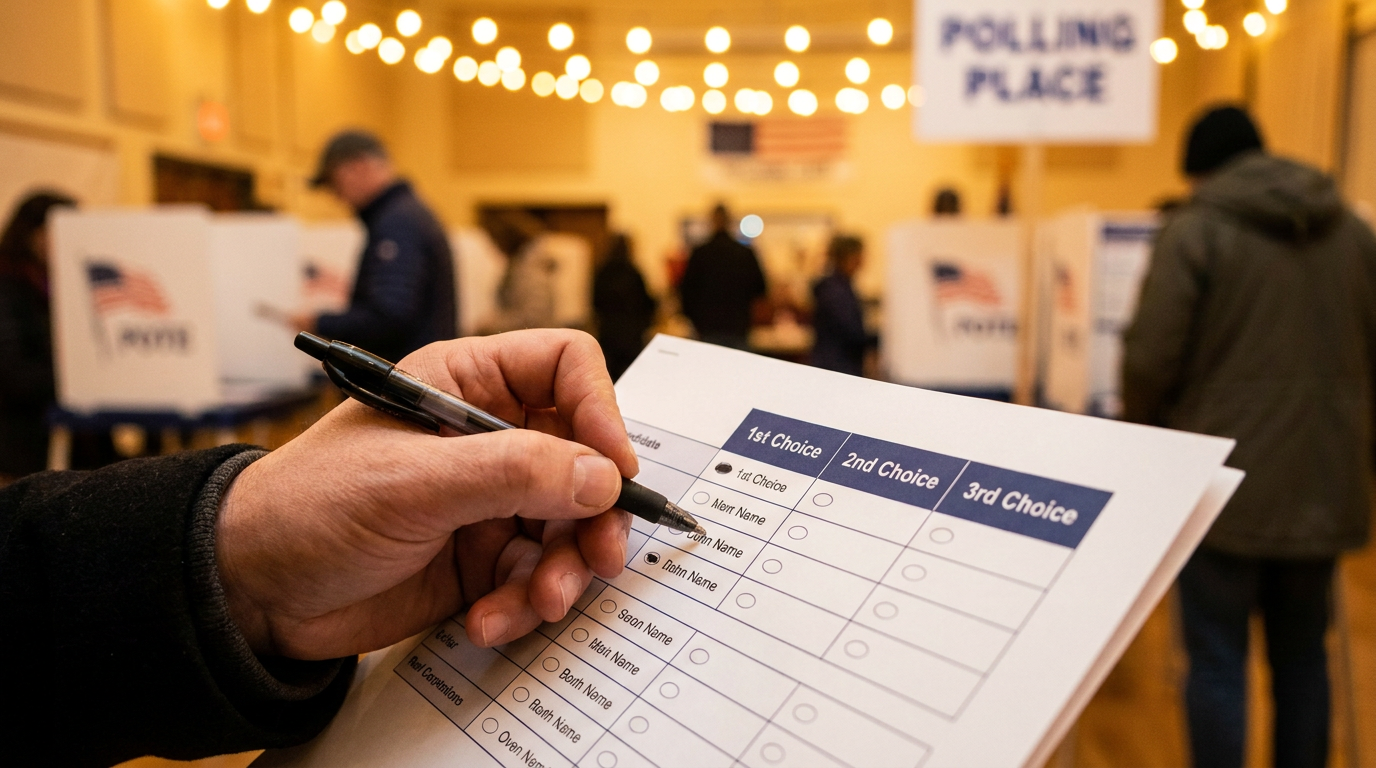
To understand the data, it is first necessary to understand the mechanism. In the most common form of ranked-choice voting, known as Instant Runoff Voting, voters rank candidates in order of preference: first, second, third, and so on. If a candidate secures an outright majority of first-place votes, they win immediately. If no one crosses the 50 percent threshold, the candidate with the fewest first-place votes is eliminated. The ballots of voters who chose the eliminated candidate are then redistributed to their second choices. This process repeats until one candidate achieves a majority.[6]

The most undeniable success of this mechanism is the elimination of the "spoiler effect." In traditional elections, a popular third-party candidate can siphon votes away from an ideologically similar major-party candidate, inadvertently handing victory to their mutual political opposite. Ranked-choice voting frees citizens to vote sincerely for their true favorite without fear of wasting their ballot. Data from the MIT Election Data and Science Lab confirms this benefit, showing a roughly six-point increase in vote share for non-major-party candidates in Maine following the system's implementation.[4]
However, the most ambitious claim made by advocates is that ranked-choice voting will fundamentally reduce political polarization. The theory posits that because candidates need second- and third-choice votes to survive later tabulation rounds, they will naturally moderate their platforms to appeal to a broader swath of the electorate. FairVote, a leading advocacy group, points to Alaska's 2022 congressional elections as the ultimate proof of concept. In that race, moderate Republican Senator Lisa Murkowski and moderate Democratic Representative Mary Peltola cross-endorsed each other, successfully building broad coalitions that defeated more extreme challengers from their respective flanks.[1]
Academic researchers, however, warn against extrapolating Alaska's unique political dynamics to the rest of the country. A comprehensive study published by NYU Law examined the mathematical relationship between ranked-choice voting and political polarization, finding a non-monotonic relationship. The researchers discovered that in highly polarized electorates, the system can actually backfire. When the electorate is deeply divided, a moderate consensus candidate often fails to secure enough passionate first-place votes to survive the initial round of elimination, resulting in a final matchup between two extremes.[2]
Academic researchers, however, warn against extrapolating Alaska's unique political dynamics to the rest of the country.
This finding is corroborated by research in the University of Illinois Law Review, which modeled millions of simulated elections using a nationally representative sample of over 50,000 voters. The analysis demonstrated that Instant Runoff Voting tends to produce winning candidates who are more ideologically divergent from the median voter than other forms of ranked voting. Crucially, this polarizing effect was most pronounced in the most heavily polarized states—the exact environments where advocates claim the reform is needed most.[3]

The second major promise of ranked-choice voting is a return to campaign civility. The logic suggests that candidates will refrain from launching vicious attack ads against rivals if they hope to court those rivals' supporters for secondary rankings. Survey data provides some backing for this theory; FairVote highlights polling showing that voters in cities with ranked-choice systems generally perceive their local campaigns to be less negative and more issue-focused than voters in traditional plurality jurisdictions.[1]
Yet, when researchers look at actual campaign spending rather than voter vibes, the picture shifts. The MIT Election Lab conducted a difference-in-differences analysis of independent expenditures in Maine before and after the state adopted ranked-choice voting. The study found that negative spending actually increased significantly following the system's implementation. While candidates themselves might moderate their rhetoric on the debate stage to appear collaborative, outside political action committees and dark-money groups continue to flood the zone with negative attacks, casting doubt on the idea that a ballot redesign can disarm the modern campaign industry.[4]
Voter turnout and participation represent another contested battleground. Advocates frequently claim that by offering more choices and eliminating the spoiler effect, ranked-choice voting will draw more disillusioned citizens to the polls. The strongest evidence for a participation boost comes from the elimination of traditional runoff elections. In states like Georgia, secondary runoffs held weeks after the general election notoriously suffer from massive drop-offs in voter turnout. By consolidating the process into a single "instant" runoff, ranked-choice voting ensures that the decisive round of counting features the highest possible participation.[5]
Beyond the runoff effect, however, there is little evidence that ranked-choice voting fundamentally increases baseline turnout for general elections. Furthermore, election administrators have raised serious concerns about the complexity of the ballot and its impact on marginalized voters. The Bipartisan Policy Center notes that the transition requires massive investments in voter education, new tabulation software, and staff training. When voters are confused by the new grid-style ballots, the results can be highly disruptive to the democratic process.[5]
This complexity manifests in a phenomenon known as "ballot exhaustion" and improper marking. A study analyzing millions of cast vote records found that in a typical ranked-choice race, nearly 4.8 percent of voters improperly mark their ballot in at least one way—a rejection rate roughly ten times higher than in standard choose-one elections. If a voter only ranks one candidate who is eliminated early, their ballot is "exhausted" and does not factor into the final decisive rounds. Researchers have found evidence that these mismarking and exhaustion rates are disproportionately higher in areas with more racial minorities, lower-income households, and lower levels of educational attainment.[7]

Ultimately, the evidence suggests that ranked-choice voting is a powerful, highly effective mechanical upgrade for specific electoral flaws, rather than a psychological cure for a divided nation. It successfully eliminates the spoiler effect, allows third-party candidates to compete fairly, and removes the need for costly, low-turnout secondary runoffs. But voters expecting the system to magically produce moderate politicians, silence negative attack ads, or heal the country's deep partisan rifts are likely to be disappointed by the mathematical and political realities of the modern electorate.[6]
How we got here
2002
San Francisco becomes one of the first major U.S. cities to adopt ranked-choice voting for municipal elections.
2018
Maine becomes the first state to use ranked-choice voting in federal congressional elections.
2020
Maine expands the use of the system to include the presidential primary.
2022
Alaska holds its first elections under a new top-four ranked-choice voting system, drawing national attention.
2024
Dozens of municipalities and several states place electoral reform and ranked-choice voting initiatives on their ballots.
Viewpoints in depth
Reform Advocates
Proponents argue that ranked-choice voting is the best structural fix for a toxic political culture.
Organizations like FairVote maintain that the traditional plurality system incentivizes hyperpartisanship and negative campaigning. By forcing candidates to compete for second- and third-choice rankings, advocates argue that ranked-choice voting naturally rewards consensus-builders who appeal to a broad majority. They point to successful cross-partisan endorsements in states like Alaska as proof that the system can lower the temperature of American politics and break the two-party duopoly.
Academic Skeptics
Researchers warn that the mathematical realities of the system often fail to match the psychological promises.
Political scientists and legal scholars analyzing millions of simulated and real-world ballots have found that Instant Runoff Voting is not a silver bullet for polarization. In highly divided electorates, moderate candidates are often eliminated in the first round because they lack a passionate base of first-choice supporters. Furthermore, campaign finance data from early adopters like Maine shows that negative spending by outside groups can actually increase under the new system, suggesting that structural ballot changes cannot easily disarm the modern political attack industry.
Election Administrators
Officials focus on the practical challenges of implementing a fundamentally different way of voting.
For the administrators tasked with running elections, ranked-choice voting introduces significant logistical hurdles. The Bipartisan Policy Center highlights the need for entirely new tabulation software, extensive staff training, and massive public education campaigns. Administrators are particularly concerned about the high rates of improperly marked ballots and 'ballot exhaustion,' which data shows disproportionately impacts lower-income and minority voters who may be less familiar with the complex grid design.
What we don't know
- Whether the higher rates of ballot exhaustion will decrease over time as voters become more accustomed to the system.
- How ranked-choice voting will impact the long-term viability and funding of third-party organizations.
- If the system's effects on polarization will shift as more politically diverse states adopt the mechanism.
Key terms
- Instant Runoff Voting (IRV)
- The most common form of ranked-choice voting in the U.S., where voters rank candidates and the lowest vote-getters are sequentially eliminated until one candidate reaches a majority.
- Ballot Exhaustion
- A scenario where a voter's ballot no longer counts in the final rounds of tabulation because all the candidates they ranked have been eliminated.
- Plurality Voting
- The traditional American electoral system where the candidate with the most votes wins, even if they do not secure an absolute majority.
- Difference-in-Differences
- A statistical technique used by researchers to measure the impact of a new policy by comparing changes over time between a group that adopted the policy and a similar group that did not.
Frequently asked
What is the spoiler effect?
The spoiler effect occurs when a third-party candidate draws votes away from an ideologically similar major-party candidate, inadvertently helping their mutual opponent win.
Does ranked-choice voting favor Democrats or Republicans?
Research shows the system does not inherently favor either major party; instead, it tends to favor candidates who can build broad coalitions, though results vary heavily based on local polarization.
What happens if I only vote for one candidate?
Your vote will count for that candidate in the first round. If they are eliminated and you have not ranked any backups, your ballot becomes 'exhausted' and does not factor into subsequent rounds.
Does ranked-choice voting increase voter turnout?
It effectively increases turnout for decisive rounds by eliminating the need for separate, low-turnout runoff elections, but studies show it does not significantly increase baseline general election turnout.
Sources
Source coverage
7 outlets
3 viewpoints surfaced







[1]FairVoteReform Advocates
Ranked choice voting lowers polarization in politics
Read on FairVote →[2]NYU LawAcademic Researchers
Ranked Choice Voting and Political Polarization
Read on NYU Law →[3]University of Illinois Law ReviewAcademic Researchers
Beyond the Spoiler Effect: Can Ranked-Choice Voting Solve the Problem of Political Polarization?
Read on University of Illinois Law Review →[4]MIT Election LabAcademic Researchers
The Effect of Ranked-Choice Voting in Maine
Read on MIT Election Lab →[5]Bipartisan Policy CenterElection Administrators
Reform Meets Reality: How Ranked Choice Voting Impacts Election Administration
Read on Bipartisan Policy Center →[6]Factlen Editorial TeamAcademic Researchers
Synthesis by Factlen editorial team
Read on Factlen Editorial Team →[7]NBERAcademic Researchers
Improper Marking and Ballot Rejection in Ranked Choice Voting
Read on NBER →

More in news politics
See all 6 stories →Middle East Peace
Trump Condemns Israeli Strike on Beirut as U.S.-Iran Peace Deal Hangs in the Balance
0 sources

Universal Meals
Fact-Checking the Impact of Universal Free School Meals: The 2026 Evidence Pack
0 sources

Deepfake Detection
How Open-Source AI Fact-Checking Tools Are Catching Deepfakes in 2026
0 sources

Middle East Diplomacy
US-Iran Peace Deal Hangs in Balance After Israeli Airstrikes on Beirut
0 sources

Every angle. Every day.
Get news politics stories with full source coverage and perspective breakdowns delivered to your inbox.