
How AI and Smartphone Biomechanics Are Rewriting the Golf Swing
Once restricted to elite touring professionals, 3D motion capture and ground-force analysis have migrated to the smartphone, giving amateur golfers unprecedented insight into the physics of their swing.
By Factlen Editorial Team
- Data-Driven Instructors
- Embrace 3D kinematics and force plates to validate traditional 'feel' with objective, measurable data.
- AI Tech Developers
- Focus on democratizing lab-grade analysis via smartphones, prioritizing real-time feedback loops over post-session review.
- Biomechanics Hardware Makers
- Argue that true power generation can only be understood by measuring the invisible forces between the golfer and the ground.
What's not represented
- · Traditionalists who warn against 'paralysis by analysis'
- · Budget-conscious amateur golfers
Why this matters
For decades, improving at golf meant relying on subjective 'feel' and expensive trial-and-error. The democratization of 3D motion capture and AI coaching means any amateur with a smartphone can now access the exact same biomechanical insights used by touring professionals, fundamentally changing how the game is learned.
Key points
- Smartphone AI can now generate 3D skeletal models from standard 2D video.
- Force plates reveal how golfers use the ground to generate power.
- Real-time AI voice coaching provides instant feedback between practice swings.
- Technology measures root biomechanical causes rather than just visual symptoms.
- These tools validate human coaching rather than replacing it.
Every golfer knows the universal frustration of the 'feel vs. real' dilemma. You step up to the tee, execute what feels like a perfectly fluid, powerful swing, and look up only to watch the ball slice weakly into the trees. What you think your body is doing is often a world away from what is actually happening.[2]
Historically, bridging this gap between sensation and reality required a multi-million-dollar biomechanics laboratory. Players had to be strapped into reflective markers and surrounded by high-speed infrared cameras just to understand how their hips and shoulders were moving through space.[3]
By 2026, that paradigm has completely inverted. The biomechanics lab has been compressed into the smartphone in your pocket, democratizing elite-level swing analysis for the weekend amateur and rewriting the rules of golf instruction.[6]
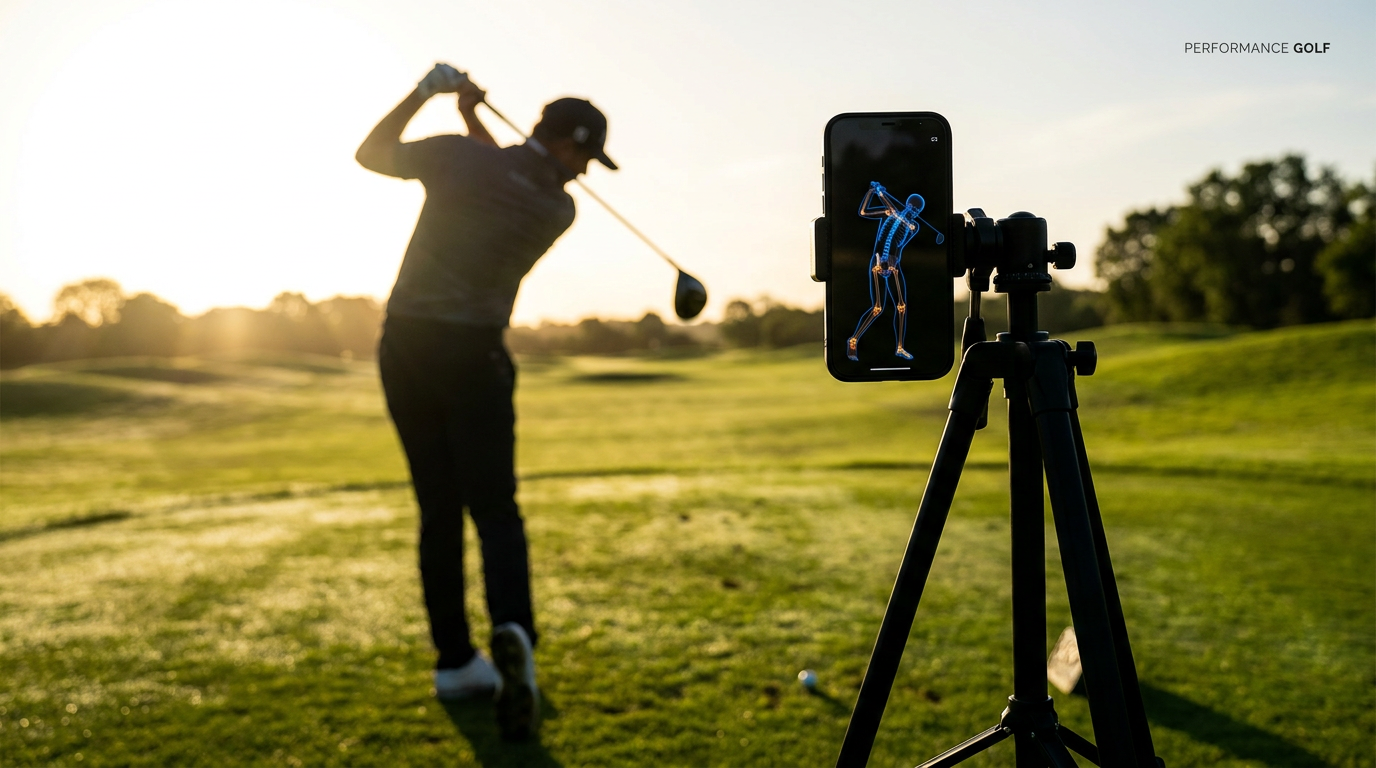
The breakthrough lies in advanced computer vision and depth estimation technology. Apps like Sportsbox AI can now take a standard 2D video from an iPhone camera and construct a fully interactive 3D skeletal model of the golfer's body in a matter of seconds.[6][8]
This markerless motion capture allows players to view their swing from any angle—face-on, down-the-line, or even from directly above—without ever attaching a single sensor to their clothing. It reveals the invisible mechanics that dictate ball flight.[8]
With this 3D model, the software extracts the holy grail of golf mechanics: the kinematic sequence. This is the precise order in which energy transfers from the pelvis, to the thorax, to the lead arm, and finally into the clubhead.[6][8]

For decades, traditional instruction relied on 2D video to draw lines on a screen, measuring symptoms like a 'flying elbow' or 'early extension.' Now, AI measures the root causes, such as the exact degrees of hip rotation or pelvic sway at the top of the backswing.[5][8]
But what happens above the ground is only half the equation. The true engine of a powerful golf swing lies in how the player interacts with the turf beneath their feet.[2]
But what happens above the ground is only half the equation.
Enter the dual force plate. Once a bulky, expensive piece of clinical equipment, portable force plates from companies like Smart2Move and Bertec are now standard fixtures in local teaching bays and indoor simulators.[1][4]
These plates measure Ground Reaction Forces (GRFs) in three dimensions: vertical (upward push), horizontal (front-to-back braking), and lateral (side-to-side weight shift). They act like high-speed cameras for a golfer's feet.[1][2]

By capturing these ground reaction forces, biomechanists can understand exactly how energy is transferred from the ground up. It quantifies the invisible foundation of power, balance, and consistency.[1]
The data reveals that raw upper-body strength is rarely the secret to distance. Instead, it is the precise timing of when a player applies pressure to the ground and when they release it—a sequential motion far more complex than simply swinging harder.[2][3]
The most recent leap in 2026 is the shift from passive analysis to active, real-time coaching. It is no longer just about looking at a 3D model after the practice session is over.[5]
Platforms like GOATCode.ai and DeepSwing utilize on-device AI to track up to 33 body landmarks in real-time. A golfer simply sets their phone on the ground, presses start, and begins hitting balls.[5][7]
Between every rep, the AI evaluates the movement against biomechanical checkpoints and speaks a specific coaching cue aloud. This creates a tight feedback loop, allowing the player to adjust their mechanics while the muscle memory of the previous swing is still fresh.[5]

Crucially, this technology is not replacing human instructors. Instead, it is giving them sharper edges, allowing coaches to validate their intuitive advice with concrete, objective data that the student can actually see.[3][8]
As Miami University biomechanics researcher Mark Walsh notes, the data provides undeniable validation. Coaches can show a student exactly where they started, where they are now, and the concrete physical changes that led to hitting the ball further.[3]
How we got here
Pre-2020
3D motion capture in golf is restricted to expensive, multi-camera biomechanics labs requiring wearable sensors.
2022
Researchers begin using advanced force plates and infrared cameras to build vast databases of amateur and professional swing data.
2024
Markerless motion capture technology begins arriving on consumer smartphones, allowing 3D models to be built from 2D video.
2026
AI apps introduce real-time voice coaching, shifting the technology from post-swing analysis to active practice feedback.
Viewpoints in depth
Data-Driven Instructors
Coaches who use biomechanics to validate their teaching methods.
For modern golf instructors, AI and force plates are not a threat to their livelihood, but a powerful validation tool. Historically, coaches had to rely on their trained eye to diagnose a swing fault, which could sometimes lead to a disconnect with a student who 'felt' they were doing something different. By putting a student on a force plate or showing them a 3D skeletal model, the coach can point to objective, irrefutable data. It removes the guesswork and builds trust, allowing the lesson to focus on actionable corrections rather than debating what actually happened during the swing.
AI Tech Developers
Engineers focused on democratizing elite sports science.
The developers behind platforms like Sportsbox AI and GOATCode view their mission as the democratization of elite performance. They argue that the physics of a perfect golf swing shouldn't be locked behind the doors of a $100,000 biomechanics lab. By leveraging the advanced neural engines and cameras already present in modern smartphones, they aim to give the weekend amateur the exact same kinematic sequence data that touring professionals use. Their current focus is on tightening the feedback loop—moving away from apps that just show you what you did wrong after the fact, to AI that coaches you in real-time while you practice.
Biomechanics Hardware Makers
Companies building the physical sensors that measure ground interaction.
Hardware manufacturers like Bertec and Smart2Move emphasize that camera-based AI, no matter how advanced, can only measure the visual result of a swing. To truly understand power generation, they argue, you must measure the invisible forces happening below the golfer's feet. They focus on Ground Reaction Forces (GRFs), pointing out that the most efficient ball-strikers in the world share specific patterns of vertical, horizontal, and lateral pressure. By making dual force plates portable and more affordable, they are bringing this foundational layer of biomechanics to the masses.
What we don't know
- Whether reliance on real-time AI coaching will inhibit a golfer's ability to self-correct on the course without their phone.
- How quickly traditional golf instruction certifications will adapt to mandate biomechanical and AI training.
Key terms
- Kinematic Sequence
- The order and timing of how energy transfers through the body segments (pelvis, thorax, arm, club) during a golf swing.
- Ground Reaction Force (GRF)
- The force exerted by the ground on a body in contact with it, crucial for generating power in a golf swing.
- Depth Estimation
- An AI computer vision technique that calculates the distance of objects from a camera, allowing a 2D video to be converted into a 3D model.
- Force Plate
- A biomechanical measurement tool placed under a golfer's feet to capture real-time data on how they interact with the ground.
- Markerless Motion Capture
- Technology that tracks human movement using standard cameras and AI, eliminating the need for the subject to wear physical reflective sensors.
Frequently asked
Do I need special equipment to use AI swing analyzers?
No. The latest generation of AI golf apps in 2026 requires only a standard smartphone camera to track your body and generate 3D models.
What are ground reaction forces?
Ground reaction forces (GRFs) are the invisible forces a golfer exerts against the ground to generate power, measured in vertical, horizontal, and lateral directions.
Can an app replace a human golf coach?
AI apps are viewed as a complement to human coaches, not a replacement. They provide objective data and real-time practice cues, while human coaches provide strategy, context, and intuition.
What is the kinematic sequence?
It is the precise order in which a golfer's body parts accelerate and decelerate to transfer energy to the club, typically moving from the pelvis, to the torso, to the arms, and finally the clubhead.
Sources
Source coverage
9 outlets
3 viewpoints surfaced







[1]BertecBiomechanics Hardware Makers
What Are Golf Force Plates?
Read on Bertec →[2]Meloq DevicesBiomechanics Hardware Makers
Seeing Your Swing: Feel Versus Real Data
Read on Meloq Devices →[3]Miami UniversityData-Driven Instructors
Unlocking the secrets of a superior golf swing
Read on Miami University →[4]Smart2MoveBiomechanics Hardware Makers
Dual force plates technology for golf
Read on Smart2Move →[5]GOATCodeAI Tech Developers
Best AI Golf Coach 2026: Which AI Actually Coaches You?
Read on GOATCode →[6]SportsReflectorAI Tech Developers
Best Golf Swing Analysis Apps in 2025 and 2026
Read on SportsReflector →[7]DeepSwingAI Tech Developers
Swing Profile vs DeepSwing (2026)
Read on DeepSwing →[8]The Clubhouse BlogData-Driven Instructors
Exploring Sportsbox AI at St Andrews
Read on The Clubhouse Blog →[9]Factlen Editorial Team
Synthesis by Factlen editorial team
Read on Factlen Editorial Team →

More in sports
See all 14 stories →Splitboard Tech
The Splitboarding Revolution: How Snowboarders Conquered the Backcountry
0 sources

Injury
Detroit Tigers Ace Tarik Skubal Returns to Mound in Record Time Following 'NanoNeedle' Elbow Surgery
0 sources

Standings
MLB Standings Update: Yankees and Braves Set the Pace as Summer Races Heat Up
0 sources

Olympic Governance
How World Boxing Saved the Sport's Olympic Future for LA 2028
0 sources

Every angle. Every day.
Get sports stories with full source coverage and perspective breakdowns delivered to your inbox.