
The Rise of 'Green Amendments': How State Constitutions Are Securing Environmental Rights
A landmark Montana Supreme Court ruling has energized a nationwide movement to embed the right to a clean environment directly into state constitutions.
By Factlen Editorial Team
- Environmental Rights Advocates
- Argue that clean air and water are fundamental human rights that must be protected from shifting political agendas.
- Industry and Developers
- Warn that broad constitutional language creates legal uncertainty, drives up costs, and can ironically slow down clean energy projects.
- Legal and Legislative Observers
- Focus on the separation of powers, debating whether environmental policy belongs in the legislature or the courts.
What's not represented
- · Local municipal zoning boards
- · Federal environmental regulators
Why this matters
By elevating clean air and water to the status of fundamental human rights, citizens are gaining the legal power to block toxic pollution and force government action, even when traditional environmental regulations fail.
Key points
- A December 2024 Montana Supreme Court ruling affirmed that the state's constitution guarantees the right to a stable climate.
- Green Amendments elevate clean air and water to the same legal status as free speech.
- Pennsylvania, Montana, and New York currently have active Green Amendments, with campaigns in over 15 other states.
- Industry groups warn the amendments create legal uncertainty and could slow down renewable energy permitting.
- The movement relies on 'New Judicial Federalism,' using state courts to secure rights absent from the federal constitution.
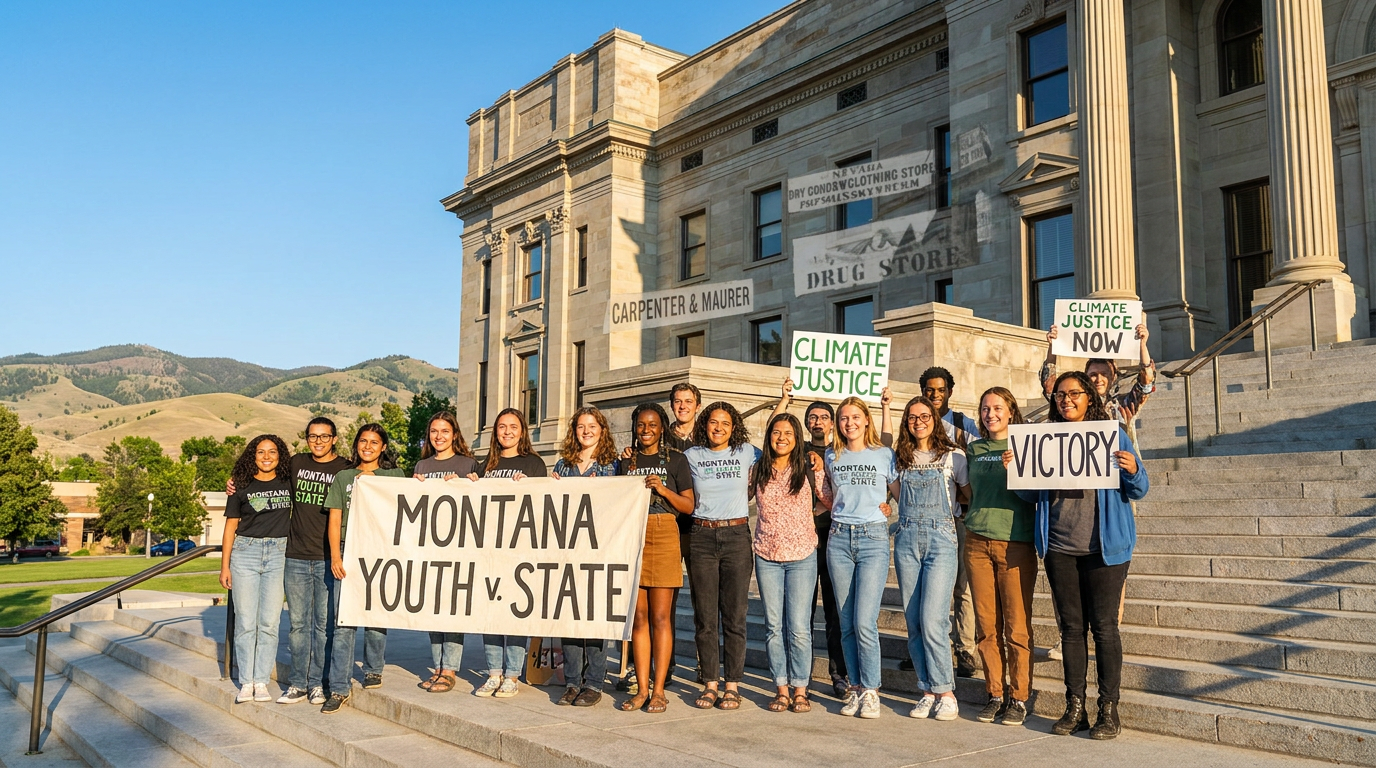
On December 18, 2024, the Montana Supreme Court delivered a watershed ruling that sent shockwaves through the American legal and environmental landscape. In a 6-1 decision, the court affirmed that the state’s constitutional guarantee to a "clean and healthful environment" inherently includes the right to a stable climate system. The ruling marked the culmination of Held v. Montana, a landmark lawsuit brought by 16 youth plaintiffs who argued that the state's aggressive promotion of fossil fuels was actively degrading their future. By striking down a state law that forbade environmental agencies from considering greenhouse gas emissions, the court did more than hand a victory to climate activists; it validated a profound shift in how environmental protections can be enforced.[1][5][6]
The Montana decision is the most visible triumph of a rapidly accelerating legal strategy known as the "Green Amendment" movement. For decades, environmental protection in the United States has relied on a complex, often fragile patchwork of statutory laws and regulatory agencies. These laws dictate how much pollution is permissible and establish the bureaucratic hoops industries must jump through to secure permits. However, advocates argue that this regulatory framework is fundamentally designed to manage environmental harm rather than prevent it, leaving communities vulnerable when political winds shift or agencies are captured by industry interests.[4][8]
A Green Amendment fundamentally upends this dynamic by elevating environmental health to the status of an inalienable human right. By placing the right to pure water, clean air, and a stable climate directly into the Bill of Rights of a state constitution, these amendments grant environmental protections the same supreme legal standing as the freedom of speech or the right to bear arms. Crucially, these provisions are designed to be "self-executing," meaning citizens do not need to wait for the legislature to pass enabling laws before they can hold the government accountable in court.[3][8]

The modern blueprint for this movement was forged not in a coastal progressive stronghold, but in the shale fields of Pennsylvania. In 1971, Pennsylvania voters overwhelmingly approved an environmental rights amendment, but for nearly forty years, the state's courts treated the language as merely aspirational. That changed dramatically in 2013, when a coalition of municipalities and environmentalists successfully used the amendment to strike down "Act 13," a state law that had stripped local governments of their ability to zone and regulate hydraulic fracturing, or fracking. The Pennsylvania Supreme Court ruled that the law violated the citizens' constitutional right to a healthy environment, breathing unprecedented life into the dormant provision.[4][8]
The Pennsylvania victory catalyzed a nationwide campaign spearheaded by Maya van Rossum, a veteran environmental attorney who coined the term "Green Amendment" and founded a national organization to replicate the strategy. Van Rossum recognized that while securing a federal constitutional amendment was politically unfeasible in the near term, state constitutions offered a highly accessible and potent alternative. This strategy taps into "New Judicial Federalism," a legal doctrine where state courts rely on their own constitutions to grant citizens broader rights than those explicitly protected by the U.S. Constitution.[3][4][8]
The momentum has steadily built over the last decade. In 2021, New York became the third state—joining Pennsylvania and Montana—to enshrine a Green Amendment, with voters approving the measure by a wide margin. Today, active campaigns are underway in more than 15 states, spanning the political spectrum from deep-blue enclaves like Hawaii and Connecticut to conservative strongholds like Texas and Nevada. In each of these states, grassroots coalitions are working to convince lawmakers and voters that clean air and water should not be subject to the shifting whims of partisan politics.[2][3][8]

For marginalized communities that have historically borne the brunt of industrial pollution, Green Amendments offer a powerful new tool for environmental justice. Traditional environmental laws often fail to account for the cumulative impact of multiple polluting facilities clustered in a single neighborhood. Because a Green Amendment guarantees the right to a healthy environment for all people, regardless of race or socioeconomic status, it provides a legal backstop for communities to challenge zoning decisions and permits that disproportionately concentrate toxic burdens in their backyards.[4][8]
For marginalized communities that have historically borne the brunt of industrial pollution, Green Amendments offer a powerful new tool for environmental justice.
However, the push to constitutionalize environmental rights has encountered fierce opposition, primarily from manufacturing, mining, and fossil fuel industries. Opponents argue that Green Amendments introduce paralyzing legal uncertainty into the economy. By relying on broad, undefined terms like "healthful environment" or "stable climate," these amendments effectively transfer environmental policymaking from elected legislators to unelected judges. Industry representatives warn that this ambiguity invites a flood of protracted, expensive litigation against both the government and private businesses, ultimately driving up the cost of living and stifling economic development.[2][7]
The opposition is not limited to traditional heavy industry; it has also created unexpected friction with the renewable energy sector. In states like New Mexico, coalitions representing utility-scale wind and solar developers have voiced deep concerns about proposed Green Amendments. They argue that the sweeping language could be weaponized by local activists to block or delay the construction of critical clean energy infrastructure, such as solar farms and high-voltage transmission lines. For states racing to meet aggressive carbon-reduction targets, developers warn that constitutionalizing environmental rights could ironically slow down the green transition.[2]

State legislatures, protective of their own authority, have also pushed back against the movement. Lawmakers frequently argue that environmental policy requires delicate balancing acts between ecological preservation, economic growth, and energy reliability—trade-offs that are best negotiated in the statehouse, not the courtroom. When courts use Green Amendments to strike down legislation, as seen in Pennsylvania and Montana, it often triggers a separation-of-powers clash, with legislators accusing the judiciary of overstepping its bounds and legislating from the bench.[1][7]
This tension is currently playing out in real-time in Montana. Following the Supreme Court's December 2024 affirmation of the Held decision, conservative lawmakers swiftly introduced a suite of bills in early 2025 designed to neutralize the ruling. These legislative efforts aim to rewrite the state's environmental review processes, restrict air quality regulations, and even limit the jurisdiction of the courts in environmental matters. The backlash underscores the reality that while a constitutional amendment is a powerful shield, it is not entirely immune to sustained political counter-attacks.[1]
Despite these hurdles, the legal landscape continues to shift in favor of constitutional environmentalism. Legal scholars note that as more cases reach state supreme courts, a robust body of jurisprudence is beginning to define exactly what a "clean and healthful environment" entails. This emerging precedent is gradually reducing the legal uncertainty that industry groups fear, while simultaneously providing a clearer roadmap for citizens seeking to enforce their rights. The Held decision, in particular, established a vital evidentiary baseline by explicitly linking greenhouse gas emissions to constitutional harms.[5][6]

The true power of a Green Amendment often lies not in the lawsuits it wins, but in the preventative effect it has on government decision-making. When state agencies and lawmakers know that their actions must survive strict constitutional scrutiny, they are forced to prioritize environmental health at the very beginning of the planning process. Instead of asking how much pollution a community can legally tolerate, regulators must ask how to avoid degrading the environment in the first place. This paradigm shift represents a fundamental realignment of the relationship between the state, the citizen, and the natural world.[4][8]
As the movement looks to the future, the focus is expanding beyond just passing new amendments to ensuring the rigorous enforcement of existing ones. Organizations like Green Amendments for the Generations are conducting extensive training for local officials, judges, and community activists to ensure these constitutional provisions are not relegated to mere symbolic gestures. The goal is to weave environmental rights so deeply into the fabric of state governance that protecting the earth becomes as routine and unquestioned as protecting private property.[8]
The youth plaintiffs in Montana have proven that when armed with the right legal tools, ordinary citizens can successfully challenge entrenched industrial power and demand a livable future. Their victory has energized a new generation of activists who view climate change not just as a scientific or political crisis, but as a profound violation of their fundamental human rights. As climate impacts accelerate, the courts are increasingly becoming the arena where the fight for generational equity is waged.[1][5]
Ultimately, the rise of Green Amendments reflects a deep, growing consensus that the basic elements of survival—the air we breathe, the water we drink, and the climate that sustains us—are too important to be left entirely to the volatile machinery of statutory politics. By embedding these rights in the foundational documents of state governance, communities are reclaiming their power and securing a permanent, unassailable mandate for environmental stewardship.[3][4][8]
How we got here
1971
Pennsylvania and Montana add environmental rights provisions to their state constitutions.
2013
The Pennsylvania Supreme Court uses the state's environmental amendment to strike down a pro-fracking law, revitalizing the legal strategy.
2021
New York voters overwhelmingly approve a Green Amendment to their state constitution.
August 2023
A Montana trial court rules in favor of 16 youth plaintiffs in Held v. Montana, striking down a law that ignored climate impacts.
December 2024
The Montana Supreme Court affirms the Held decision, cementing the constitutional right to a stable climate system.
Early 2025
Montana lawmakers introduce a suite of bills attempting to bypass the court's climate ruling and restrict environmental reviews.
Viewpoints in depth
Environmental Rights Advocates
Argue that clean air and water are fundamental human rights that must be protected from shifting political agendas.
Advocates argue that the traditional regulatory system is broken because it is designed to permit and manage pollution rather than prevent it. By elevating environmental health to a constitutional right, citizens are empowered to hold the government accountable when agencies fail to protect them. They point to successes in Pennsylvania and Montana as proof that these amendments provide a crucial legal backstop for marginalized communities disproportionately affected by industrial pollution.
Industry and Developers
Warn that broad constitutional language creates legal uncertainty, drives up costs, and can ironically slow down clean energy projects.
Business groups, including both fossil fuel interests and renewable energy developers, argue that terms like 'healthful environment' are too vague and invite endless litigation. They warn that Green Amendments allow local opponents to weaponize the courts to block critical infrastructure, from housing developments to solar farms and transmission lines. This legal uncertainty, they argue, ultimately drives up the cost of living and stifles the economic growth necessary to fund a green transition.
State Legislatures
Focus on the separation of powers, debating whether environmental policy belongs in the legislature or the courts.
Many lawmakers argue that environmental policy requires complex trade-offs between ecological preservation, economic stability, and energy reliability. They contend that these balancing acts are the constitutional duty of elected legislatures, not unelected judges. When courts use Green Amendments to strike down state laws, legislators often view it as judicial overreach, prompting legislative backlashes aimed at reasserting the statehouse's authority over environmental regulations.
What we don't know
- Whether the conservative legislative backlash in states like Montana will successfully neutralize the power of existing Green Amendments.
- How state courts will balance the constitutional right to a healthy environment against the need to rapidly build renewable energy infrastructure.
- Which of the 15+ states currently considering Green Amendments will successfully pass them through their legislatures and voter referendums.
Key terms
- Green Amendment
- A provision added to the Bill of Rights of a state constitution that guarantees citizens the inalienable right to a clean and healthy environment.
- Self-executing provision
- A constitutional rule that is legally enforceable on its own, without requiring the legislature to pass enabling statutes.
- New Judicial Federalism
- A legal trend where state courts rely on their own state constitutions to grant citizens broader rights than those protected by the U.S. Constitution.
- MEPA Limitation
- A controversial Montana state law that barred environmental agencies from considering greenhouse gas emissions in their reviews, which was struck down by the state Supreme Court.
- Standing
- The legal right to initiate a lawsuit, requiring the plaintiff to demonstrate they have suffered a concrete harm that the court can remedy.
Frequently asked
Does the U.S. Constitution guarantee a healthy environment?
No. The federal constitution does not explicitly mention environmental rights, which is why advocates are focusing on amending state constitutions instead.
What makes a Green Amendment different from a regular environmental law?
Regular environmental laws regulate and manage pollution through state agencies. A Green Amendment establishes a fundamental, inalienable right to a clean environment, allowing citizens to sue the government directly if that right is violated.
Can a Green Amendment block renewable energy projects?
Potentially. Clean energy developers have expressed concern that the broad language in these amendments could be used by local opponents to file lawsuits delaying wind, solar, and transmission line projects.
What does 'self-executing' mean?
A self-executing constitutional provision takes effect immediately upon passage. Citizens do not have to wait for the state legislature to pass additional laws before they can enforce their rights in court.
Sources
Source coverage
8 outlets
3 viewpoints surfaced







[1]Inside Climate NewsLegal and Legislative Observers
In the Wake of a Landmark Climate Ruling, Montana Republicans Push to Gut State Environmental Protections
Read on Inside Climate News →[2]The Washington PostIndustry and Developers
‘Green amendments’ are running up against concerns they’d hamper clean energy projects
Read on The Washington Post →[3]Fast CompanyIndustry and Developers
Why more states are trying to add ‘green amendments’ to their constitutions
Read on Fast Company →[4]Sierra ClubEnvironmental Rights Advocates
The US Constitution Left Out Nature. Green Amendments Could Fix That.
Read on Sierra Club →[5]State Court ReportLegal and Legislative Observers
Held v. Montana and the Future of State Constitutional Environmental Rights
Read on State Court Report →[6]Manko, Gold, Katcher & FoxLegal and Legislative Observers
Montana Supreme Court Finds Constitutional Right to Stable Climate
Read on Manko, Gold, Katcher & Fox →[7]Yankee InstituteIndustry and Developers
The Dangers of a 'Green' Amendment
Read on Yankee Institute →[8]Green Amendments For The GenerationsEnvironmental Rights Advocates
Securing a Constitutional Right to Pure Water, Clean Air, a Stable Climate & Healthy Environments
Read on Green Amendments For The Generations →
Every angle. Every day.
Get law justice stories with full source coverage and perspective breakdowns delivered to your inbox.