
The Rise of Astrotourism: Why Travelers Are Chasing the Darkest Skies on Earth
As global light pollution increases, a multi-billion-dollar travel movement is driving tourists to remote 'Dark Sky Sanctuaries' to witness pristine celestial events.
By Factlen Editorial Team
- Conservationists & Ecologists
- Focus on reducing light pollution to protect nocturnal wildlife and preserve natural ecosystems.
- Rural Economic Developers
- View astrotourism as a sustainable, high-yield revenue stream that revitalizes remote communities.
- Tourism Operators & Enthusiasts
- Seek to balance the influx of visitors with the strict infrastructure limits required to maintain dark sky certifications.
What's not represented
- · Urban planners struggling to balance public safety lighting with dark sky compliance
- · Local residents in remote areas facing increased traffic and tourism gentrification
Why this matters
Astrotourism is transforming remote, rural economies by turning darkness into a highly lucrative, renewable resource. For travelers, it offers a profound reconnection with nature while incentivizing municipalities to reduce ecological light pollution.
Key points
- Astrotourism is surging as global light pollution increases by nearly 10% annually.
- The 2026 celestial calendar, featuring a solar maximum and European total eclipse, is driving record travel demand.
- DarkSky International certifies remote locations as Sanctuaries, Reserves, or Parks based on strict lighting codes.
- Overnight astrotourists spend three times more than day-trippers, revitalizing rural economies.
- Preserving dark skies protects nocturnal wildlife, including migratory birds and sea turtles.
- The industry is introducing 'DarkSky Approved Lodging' to prevent new hotels from creating light pollution.
For most of human history, the night sky was a shared inheritance, a glittering tapestry visible from any point on Earth. Today, it is a vanishing resource. With global light pollution increasing by nearly 10% annually, an estimated 80% of Americans and a vast majority of Europeans can no longer see the Milky Way from their homes.[1][2]
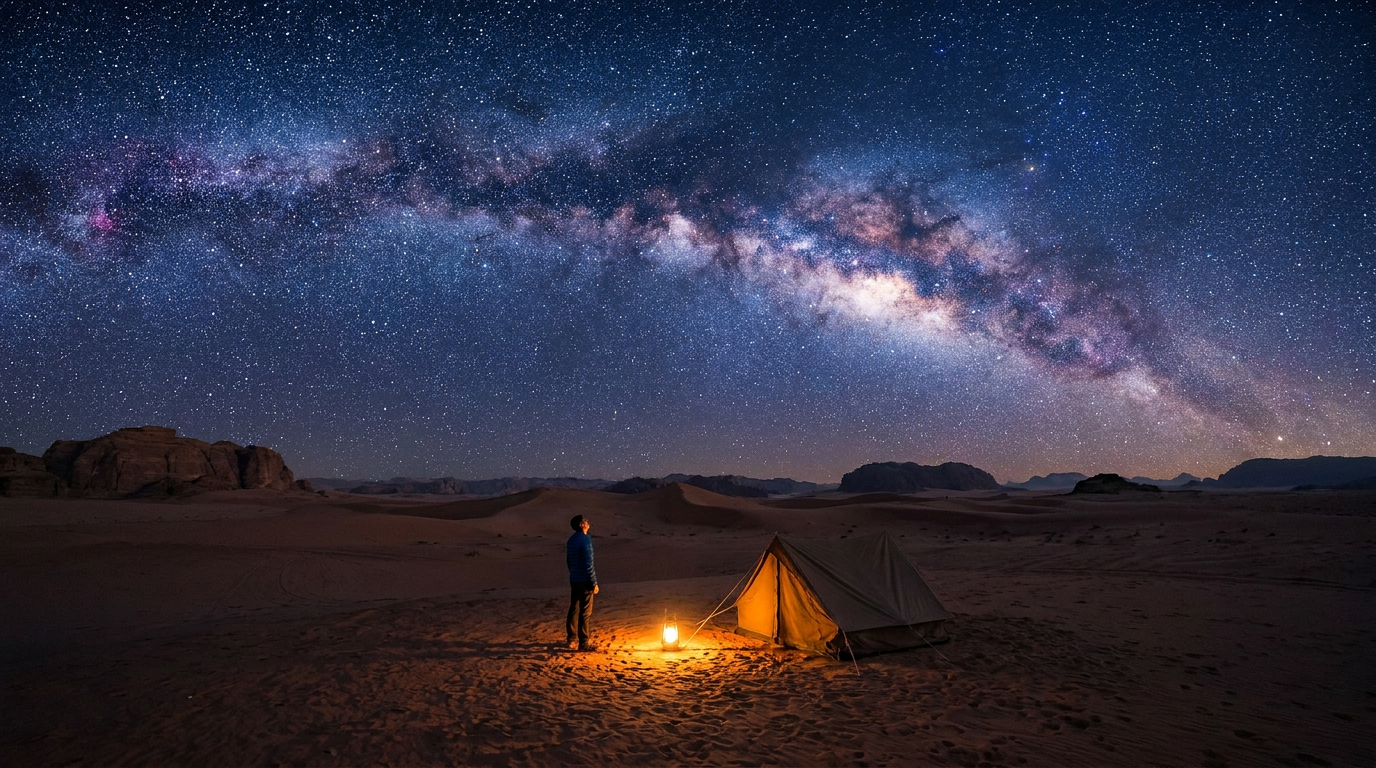
In response, a rapidly accelerating travel movement has emerged: astrotourism. Rather than chasing sun-drenched beaches or crowded urban landmarks, a growing demographic of travelers is seeking out the darkest, most remote corners of the planet.[6]
This shift is transforming rural economies and reshaping conservation priorities. Driven by a desire to reconnect with the cosmos and fueled by a spectacular calendar of celestial events in 2026, astrotourism has evolved from a niche hobby for amateur astronomers into a multi-billion-dollar global industry.[3][6]
The surge in nocturnal travel is heavily catalyzed by the astronomical calendar. The year 2026 is widely considered a benchmark year for celestial phenomena. The sun is currently riding the peak of its 11-year solar maximum, triggering intense geomagnetic storms that push vibrant auroras far south into mid-latitudes.[1][5]

Furthermore, August 2026 will deliver the first total solar eclipse visible from Europe since 1999, casting a shadow over Iceland, Spain, and Portugal right at the peak of the Perseid meteor shower. These overlapping events have created a sense of urgency among travelers, resulting in booked-out observatories and sold-out wilderness lodges years in advance.[5][6]
Social media has also played an unexpected role in democratizing the night sky. Platforms like TikTok have seen a surge in "SpaceTok" content, inspiring a younger generation of travelers to prioritize stargazing. Industry surveys indicate that a quarter of Gen Z travelers now express interest in planning trips specifically around astronomical events.[1]
But finding true darkness requires more than simply driving away from a city. The gold standard for astrotourism destinations is certification by DarkSky International, a nonprofit organization that evaluates and protects the nighttime environment.[2]
DarkSky categorizes protected areas into several tiers. "Dark Sky Parks" are publicly accessible lands with exceptional starry nights, while "Dark Sky Reserves" consist of a dark core zone surrounded by populated areas that enforce strict lighting codes.[2]
The most pristine and fragile designation is the "Dark Sky Sanctuary." These are the most remote places on Earth, such as the Cosmic Campground in New Mexico or the Aotea Great Barrier Island in New Zealand, where artificial light is virtually nonexistent. Achieving and maintaining these certifications requires rigorous community cooperation to retrofit streetlights, shield commercial signage, and eliminate upward-facing bulbs.[1][2]
For remote communities, the economic incentives to dim the lights are staggering. Because astrotourism inherently requires nighttime observation, visitors cannot simply pass through as day-trippers; they must book overnight accommodations.[3]
For remote communities, the economic incentives to dim the lights are staggering.
Economic data reveals that overnight astrotourists spend roughly three times as much as standard day visitors. A comprehensive study of the Colorado Plateau—a region spanning parts of Utah, Arizona, Colorado, and New Mexico—projected that dark sky tourism will generate $5.8 billion in visitor spending over a decade, supporting over 10,000 jobs annually.[3]

This influx of capital is particularly vital for rural areas transitioning away from extractive industries like mining or logging. By commodifying the darkness, these regions can build sustainable, year-round tourism economies that do not rely on depleting natural resources.[4]
The benefits of preserving the night sky extend far beyond human economics. Artificial light at night is a severe ecological pollutant, disrupting the migratory patterns of birds, the reproductive cycles of amphibians, and the foraging behaviors of nocturnal mammals.[3][4]
In places like Isla Cañas, Panama, community-led astrotourism initiatives double as conservation projects. By keeping the beaches dark for stargazers, locals simultaneously protect the critical nesting grounds of sea turtles, which rely on the natural light of the moon and stars to navigate to the ocean.[1]
Astrotourism also fosters cultural preservation. In New Zealand's Aoraki Mackenzie Reserve, stargazing tours are co-led by Indigenous guides who share traditional Māori astronomical knowledge alongside Western astrophysics, offering a holistic view of the cosmos that honors the region's heritage.[1]

Despite its sustainable ethos, the astrotourism boom faces a central paradox: the infrastructure required to host tourists threatens the very darkness they come to see.[6]
As demand grows, developers are eager to build new hotels, restaurants, and roads near certified dark sky areas. Without strict regulatory frameworks, this development introduces light trespass, skyglow, and glare, potentially stripping a destination of its DarkSky certification and destroying its primary attraction.[4][6]
To combat this, the industry is pioneering new standards for hospitality. DarkSky International recently introduced a "DarkSky Approved Lodging" certification, which requires properties to use fully shielded, low-color-temperature lighting and to actively educate guests about light pollution.[2]

Ultimately, the rise of astrotourism represents a profound shift in how humanity values the natural world. It reframes darkness not as something to be feared and illuminated, but as a precious, fragile resource worthy of protection.[6]
How we got here
2001
Flagstaff, Arizona becomes the world's first International Dark Sky City.
2007
Mont-Mégantic in Quebec is certified as the first International Dark Sky Reserve.
2019
A major economic study reveals the multi-billion-dollar potential of astrotourism in the American West.
2023
DarkSky International launches its 'Approved Lodging' certification to regulate hospitality infrastructure.
August 2026
A total solar eclipse crosses Europe during the Perseid meteor shower, driving a massive spike in global astrotourism.
Viewpoints in depth
Conservationists & Ecologists
Focus on reducing light pollution to protect nocturnal wildlife and preserve natural ecosystems.
Conservationists argue that artificial light is an under-regulated pollutant that disrupts migratory birds, sea turtle hatchlings, and insect populations. For them, astrotourism is a Trojan horse for conservation—using the economic appeal of stargazing to force municipalities to adopt strict lighting ordinances that ultimately save wildlife and restore natural nocturnal rhythms.
Rural Economic Developers
View astrotourism as a sustainable, high-yield revenue stream that revitalizes remote communities.
Economic developers point to the data showing astrotourists spend three times more than day-trippers because stargazing necessitates overnight stays. For towns historically reliant on mining or logging, the night sky offers a renewable resource that requires minimal hard infrastructure, provided they can keep the lights dim and the skies clear.
Tourism Operators
Seek to balance the influx of visitors with the strict infrastructure limits required to maintain dark sky certifications.
Hospitality developers face a unique paradox: building the hotels and amenities that high-end astrotourists demand inherently risks creating the light pollution that ruins the sky. They advocate for specialized 'DarkSky Approved Lodging' standards, investing heavily in shielded, low-lumen lighting and red-light pathways to accommodate guests without breaking certification rules.
What we don't know
- Whether the rapid influx of tourists to remote Dark Sky Sanctuaries will eventually degrade the fragile ecosystems they aim to protect.
- How effectively global municipalities will enforce new lighting ordinances as urban sprawl continues to encroach on protected reserves.
Key terms
- Astrotourism
- A form of nature-based travel where the primary goal is to observe the night sky and celestial events in areas free from light pollution.
- Light Trespass
- Artificial light that falls beyond the boundary of the property it is intended to illuminate, often spilling into natural habitats or neighboring windows.
- Skyglow
- The diffuse, ambient glow of artificial light scattered in the atmosphere above populated areas, which washes out the visibility of stars.
- Solar Maximum
- The period of greatest solar activity during the sun's 11-year cycle, characterized by frequent sunspots and solar flares that produce intense auroras on Earth.
- Bortle Scale
- A nine-level scale used by astronomers to measure the darkness of the night sky at a specific location.
Frequently asked
What is the Bortle Scale?
A nine-level numeric scale that measures the brightness of the night sky and the observability of celestial objects. Class 1 is the darkest pristine sky, while Class 9 is an inner-city sky where only the moon and brightest planets are visible.
What makes a Dark Sky Sanctuary different from a Park?
Sanctuaries are the most remote and darkest places in the world, often with fragile conservation states. Parks are more accessible to the public and focus heavily on educational programming.
Why do astrotourists spend more money than regular tourists?
Because stargazing happens at night, astrotourists are forced to book overnight accommodations, buy evening meals, and often hire specialized local guides, tripling their local spending compared to day-trippers.
How does light pollution affect wildlife?
Artificial light disrupts the navigational instincts of sea turtles, alters the migratory paths of birds, and interferes with the reproductive cycles of amphibians and nocturnal mammals.
Sources
Source coverage
6 outlets
3 viewpoints surfaced






[1]Outside OnlineTourism Operators & Enthusiasts
Meet Your New Travel Companion: The Night Sky
Read on Outside Online →[2]DarkSky InternationalConservationists & Ecologists
International Dark Sky Places Program
Read on DarkSky International →[3]Miles PartnershipRural Economic Developers
Studying Dark Sky Tourism's Potential Economic Impacts
Read on Miles Partnership →[4]Emerald PublishingConservationists & Ecologists
Developing astrotourism destinations through dark sky reserves
Read on Emerald Publishing →[5]Futura SciencesTourism Operators & Enthusiasts
2026 Astronomical Calendar: Events You Cannot Miss
Read on Futura Sciences →[6]Factlen Editorial TeamRural Economic Developers
Synthesis by Factlen editorial team
Read on Factlen Editorial Team →
Every angle. Every day.
Get travel stories with full source coverage and perspective breakdowns delivered to your inbox.