
SpaceX Completes Record-Breaking $75 Billion IPO, Reaching $2.1 Trillion Valuation
SpaceX has made its highly anticipated stock market debut, raising $75 billion in the largest initial public offering in history and pushing CEO Elon Musk's net worth past $1 trillion.
By Factlen Editorial Team
- Space & Tech Optimists
- View the IPO as a necessary financial step to fund Mars colonization and advanced AI.
- Financial Markets & Analysts
- Focus on the unprecedented scale of the listing and its mechanical impact on index funds.
- Economic Watchdogs
- Highlight the extreme concentration of wealth as Musk crosses the trillion-dollar mark.
What's not represented
- · Traditional Aerospace Competitors
- · Retail Investors
Why this matters
The sheer scale of SpaceX's public debut fundamentally reshapes the global equity markets, instantly making it one of the most valuable companies on Earth. For everyday investors, it opens direct access to the commercial space economy and artificial intelligence, while forcing major index funds to rapidly adjust their portfolios to absorb the massive new stock.
Key points
- SpaceX debuted on the Nasdaq under the ticker SPCX, raising $75 billion in the largest IPO in global history.
- Shares opened at $150 and closed at $160.95 on the first day, giving the aerospace company a $2.1 trillion valuation.
- The massive surge in valuation pushed CEO Elon Musk's personal net worth to $1.14 trillion, making him the world's first trillionaire.
- The capital injection is earmarked to accelerate the development of the Starship rocket program and fund future Mars colonization efforts.
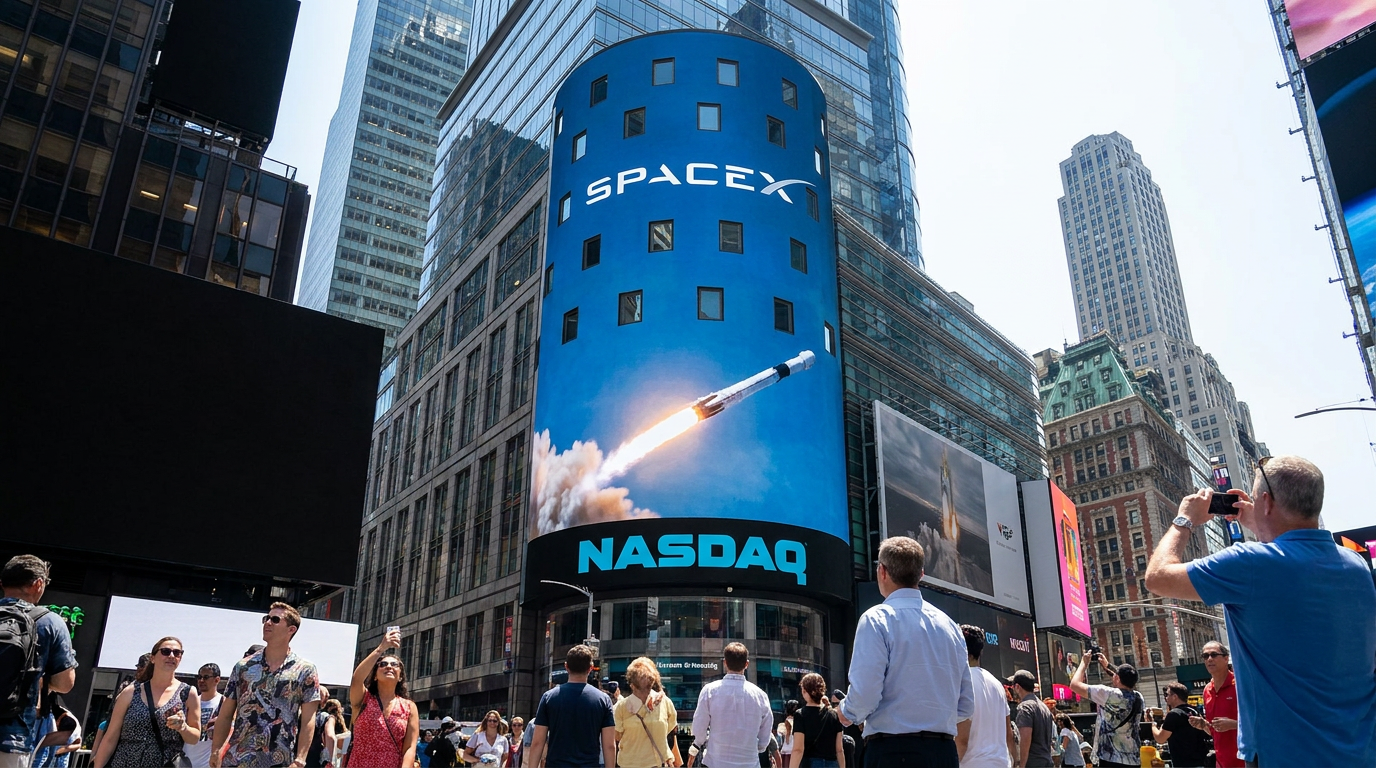
Space Exploration Technologies Corp. has officially transitioned from a private aerospace startup to a publicly traded juggernaut, executing the largest initial public offering in the history of global capital markets. Trading under the ticker symbol SPCX, the company debuted on the Nasdaq exchange on Friday, raising a staggering $75 billion. The listing shatters the previous IPO record set by Saudi Aramco in 2019, marking a historic milestone for the commercial space industry and the broader technology sector.[1][6]
The market response was immediate and overwhelming. SpaceX bypassed the traditional Wall Street bookbuilding process, offering an unnegotiable, fixed pre-open price of $135 per share. When public trading commenced shortly before noon, the stock opened at $150 and surged throughout the day. By the time the closing bell rang, shares had climbed nearly 19% to settle at $160.95.[1][3]
That closing price catapulted SpaceX's total market capitalization to approximately $2.1 trillion. In a single day of trading, the 24-year-old company established itself as the seventh-largest firm in the world, leapfrogging legacy giants and placing it in the elite ranks alongside Apple, Microsoft, and Nvidia. The valuation is particularly notable given that SpaceX posted a $4.94 billion net loss last year, underscoring immense investor confidence in its future growth trajectory.[1][3]

The blockbuster debut also triggered an unprecedented milestone in personal wealth: CEO Elon Musk has become the first person in history to cross the trillionaire threshold. With a 42% ownership stake in SpaceX, alongside his holdings in Tesla, Musk's net worth surged to an estimated $1.14 trillion by Friday afternoon. To put that figure into perspective, his personal fortune now rivals the gross domestic product of nations like the Netherlands and Saudi Arabia, and is worth more than the next four richest people in the world combined.[2][5]
Beyond Musk, the IPO represents one of the most lucrative wealth-creation events in Silicon Valley history. Early institutional backers who funded the company's nascent rocket tests nearly two decades ago are seeing astronomical returns. Peter Thiel's Founders Fund, which wrote SpaceX's first institutional check in 2008 shortly before a critical launch, now holds a stake worth roughly $67 billion. Google, which invested heavily in 2015, also secured a massive windfall, highlighting the intertwined nature of the tech ecosystem despite past rivalries between Musk and Google co-founder Larry Page.[3][4][7]
Beyond Musk, the IPO represents one of the most lucrative wealth-creation events in Silicon Valley history.
The wealth distribution extends deep into the company's own ranks. Because SpaceX has long compensated its workforce with equity, the public listing instantly minted an estimated 4,400 new millionaires among the company's current and former employees. This massive liquidity event rewards the engineers and technicians who spent years developing reusable Falcon 9 rockets and deploying the Starlink satellite internet constellation.[2][4]

The sheer size of the SPCX listing is now forcing a mechanical reshuffling of the broader stock market. Major index providers, including Nasdaq, have implemented "Fast Entry" rules to rapidly absorb the company into their headline benchmarks. Because passive mutual funds and ETFs are required to replicate these indexes, they will be forced to purchase hundreds of billions of dollars worth of SpaceX shares in the coming weeks. Analysts at CME Group note that this intense liquidity demand means the stock's near-term price discovery may be driven as much by algorithmic supply-and-demand imbalances as by underlying business fundamentals.[6]
Retail investors are also playing a significant role in the stock's early momentum. In a highly unusual move for a mega-cap IPO, SpaceX reserved up to 30% of its float specifically for retail buyers, democratizing access to a company that had previously been locked behind private venture capital doors. Brokerages reported that retail demand topped $100 billion in the days leading up to the listing.[1][3]
Investors are betting heavily on the convergence of space infrastructure and artificial intelligence. SpaceX recently merged its operations with Musk's AI startup, xAI, positioning the combined entity to leverage its massive Starlink data network for advanced machine learning. Starlink itself remains the company's primary financial engine, boasting over 10 million active subscribers globally and projecting more than $20 billion in revenue for 2026.[3][5]

For Musk, the capital raised is a means to an end. Speaking to employees at the company's Starbase headquarters in Texas on Friday morning, he reiterated that the ultimate goal of the IPO is to fund the development of the Starship rocket program and establish a self-sustaining human colony on Mars. "It is certainly hard to believe that a little company that started in a warehouse in El Segundo is now going public with the largest IPO ever," Musk said, adding that the funding will help "take the fiction out of science fiction."[1]
How we got here
2002
Elon Musk founds Space Exploration Technologies Corp. with the goal of reducing space transportation costs.
2008
SpaceX secures its first major institutional investment from Founders Fund just days before a critical, successful Falcon 1 launch.
April 2026
The company confidentially submits a draft registration statement to the SEC, signaling its intent to go public.
May 2026
SpaceX publicly files its S-1 prospectus, revealing a massive $75 billion fundraising target.
June 11, 2026
The company bypasses traditional bookbuilding and locks in a fixed IPO price of $135 per share.
June 12, 2026
SpaceX debuts on the Nasdaq, closing its first day of trading at a $2.1 trillion valuation.
Viewpoints in depth
Space & Tech Optimists
Viewing the IPO as a necessary funding mechanism to achieve multiplanetary life.
For space enthusiasts and technologists, the $75 billion raised is not just a financial victory, but a critical war chest for human expansion. Proponents argue that developing the Starship rocket and building a self-sustaining city on Mars requires capital on a scale that private markets simply cannot support indefinitely. By tapping into public equity, they believe SpaceX has secured the financial runway needed to push the boundaries of aerospace engineering and artificial intelligence without slowing down.
Financial Markets & Analysts
Focused on the unprecedented mechanical impact the mega-cap listing will have on index funds.
Market analysts are closely watching the structural shockwaves caused by a $2.1 trillion company suddenly entering the public float. Because major index providers are fast-tracking SpaceX's inclusion into benchmarks like the Nasdaq-100, passive mutual funds and ETFs are legally obligated to buy the stock to match the index weight. Financial experts warn that this forced buying could detach the stock's near-term price from its actual business fundamentals, creating intense volatility driven purely by algorithmic supply and demand.
Economic Watchdogs
Raising alarms about the extreme concentration of wealth as the world sees its first trillionaire.
While Wall Street celebrates, economic justice advocates point to the IPO as a stark symbol of modern wealth inequality. Organizations like Oxfam have noted that Elon Musk's $1.14 trillion net worth now exceeds the economic output of many developed nations, making him wealthier than the bottom 46% of the global population combined. Critics argue that this level of concentrated financial power represents a 'new Gilded Age' of oligarchy, raising questions about taxation, corporate monopolies, and the outsized influence of a single individual over global communications and space infrastructure.
What we don't know
- How the stock will perform in the coming weeks once the initial wave of forced index-fund buying subsides.
- Whether the massive $4.94 billion net loss posted last year will eventually deter investors if Starlink and AI revenues do not scale as projected.
Key terms
- Initial Public Offering (IPO)
- The process by which a private company offers shares of its stock to the public for the first time, allowing it to raise capital from everyday investors.
- Market Capitalization
- The total dollar value of a company's outstanding shares of stock, calculated by multiplying the current share price by the total number of shares.
- Bookbuilding
- The traditional process where investment banks generate demand from institutional investors to determine the price of an IPO before it lists.
- Index Fund
- A type of mutual fund or ETF designed to follow certain preset rules so that it tracks a specific basket of underlying investments, like the Nasdaq-100.
- Float
- The number of a company's shares that are actually available for trading by the general public, excluding closely held shares by insiders.
Frequently asked
What is SpaceX's stock ticker symbol?
SpaceX trades on the Nasdaq exchange under the ticker symbol SPCX.
How much is Elon Musk worth now?
Following the IPO, Elon Musk's net worth is estimated at $1.14 trillion, making him the first trillionaire in history.
Can retail investors buy SpaceX stock?
Yes. The company is now publicly traded, and retail investors can purchase shares through standard brokerage accounts. SpaceX notably reserved up to 30% of its initial offering specifically for retail buyers.
Why did SpaceX go public?
CEO Elon Musk stated that the primary goal of raising $75 billion through the IPO is to secure the massive capital required to fund the Starship rocket program and establish a human settlement on Mars.
Sources
Source coverage
7 outlets
3 viewpoints surfaced







[1]The GuardianSpace & Tech Optimists
SpaceX makes biggest stock market debut in history, making Musk first trillionaire
Read on The Guardian →[2]CBS NewsEconomic Watchdogs
Elon Musk becomes world's first trillionaire after SpaceX IPO
Read on CBS News →[3]ForbesFinancial Markets & Analysts
SpaceX's Monster IPO Delivers Massive Gains For Early Backers
Read on Forbes →[4]Business InsiderFinancial Markets & Analysts
The SpaceX IPO just created one of the biggest wealth events in Silicon Valley history
Read on Business Insider →[5]The Washington PostEconomic Watchdogs
Elon Musk becomes history's first trillionaire thanks to SpaceX IPO
Read on The Washington Post →[6]CME GroupFinancial Markets & Analysts
The SpaceX Mega-IPO: Why Index Choice Matters
Read on CME Group →[7]CNBCSpace & Tech Optimists
Elon Musk drifted from Larry Page over a decade ago, but their companies are closer than ever
Read on CNBC →
More in business
See all 5 stories →Micro-Manufacturing
The Rise of the 3D-Printed Micro-Factory: How a Father-Daughter Duo Built a $428,000 Fidget Toy Empire
0 sources

Fed Watch
New Fed Chair Kevin Warsh Faces Inflation Dilemma Ahead of First Policy Meeting
0 sources
Micro-Manufacturing
From Spare Rooms to Target Aisles: How 3D-Printing Startups Are Disrupting the Toy Industry
0 sources
Every angle. Every day.
Get business stories with full source coverage and perspective breakdowns delivered to your inbox.