
The Rise of the 3D-Printed Micro-Factory: How a Father-Daughter Duo Built a $428,000 Fidget Toy Empire
Accessible 3D printing and viral social media marketing are enabling a new wave of 'garage-to-global' micro-businesses, turning niche products into highly profitable enterprises.
By Factlen Editorial Team
- Micro-Entrepreneurs
- Focuses on the low overhead, creative freedom, and direct-to-consumer sales enabled by desktop manufacturing.
- Additive Manufacturing Analysts
- Focuses on market scale, hardware accessibility, and the shift from prototyping to end-use production.
- Sensory & Wellness Advocates
- Focuses on the mental health benefits of sensory toys, stress relief, and the appeal of customization.
What's not represented
- · Traditional toy manufacturers facing disruption
- · Logistics providers handling the surge in micro-shipments
Why this matters
The democratization of manufacturing means anyone with a computer, a $500 printer, and a clever idea can now build a global, high-margin physical products business from their spare bedroom.
Key points
- A 32-year-old former teacher and her father generated $428,000 in revenue last year by selling 3D-printed fidget toys from their home.
- The global 3D printing market reached $16 billion in 2025, driven by a surge in accessible desktop manufacturing and 'print farms'.
- Social media algorithms heavily reward the visual and auditory satisfaction of mechanical clickers, creating a direct-to-consumer pipeline.
- Most consumer 3D prints utilize PLA, a biodegradable bioplastic that offers a more sustainable alternative to traditional petroleum-based plastics.
Victoria Baumann, a 32-year-old former teacher, and her father Charlie Moreton never intended to become manufacturing moguls. Yet, from their homes in North Carolina, the duo built Victoria Essie Studio, a business that generated $428,000 in revenue last year.[1]
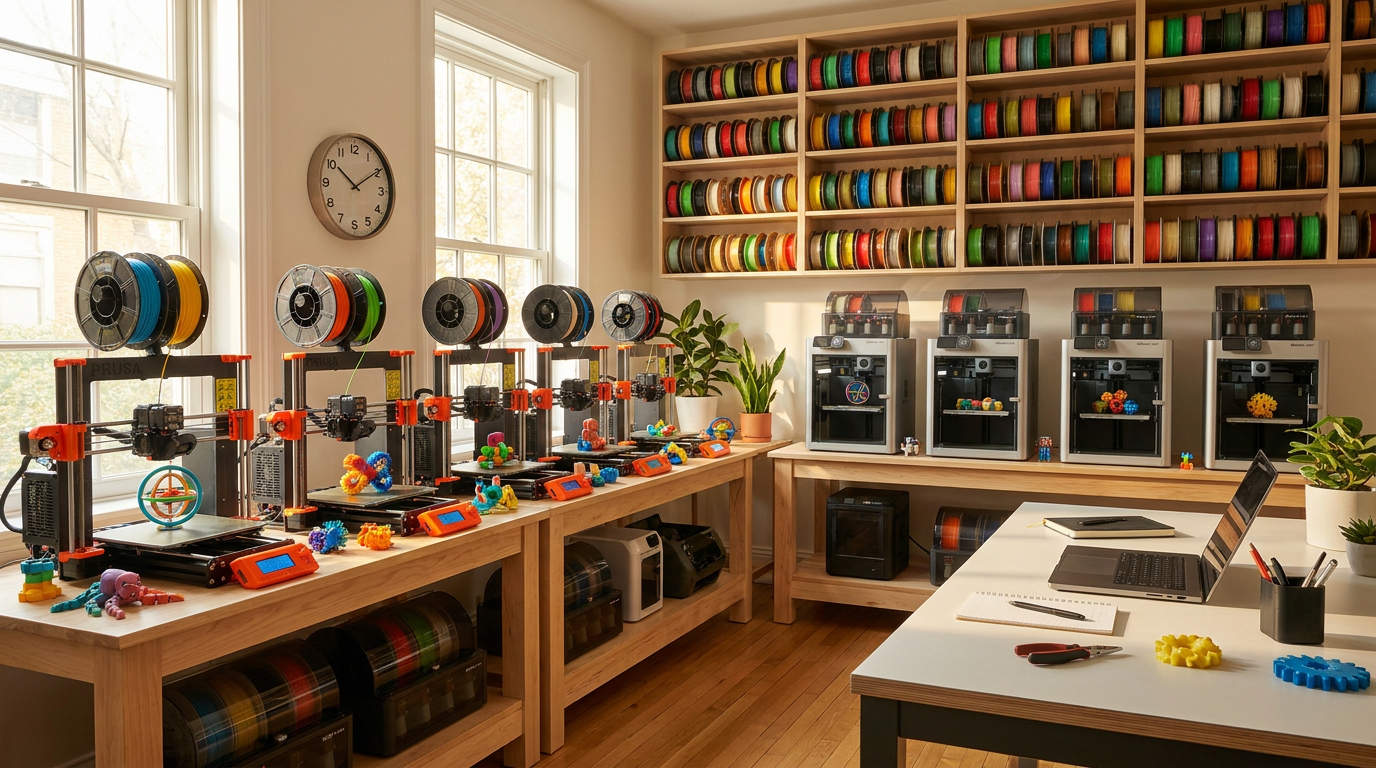
Their product? 3D-printed fidget toys and mechanical "clickers." Their factory? A spare room filled with consumer-grade 3D printers running around the clock.[1]
This father-daughter success story is not an isolated phenomenon. It represents a fundamental shift in the global economy: the rise of the "micro-factory," where individuals bypass traditional supply chains to build highly profitable physical product businesses from scratch.[5]
For decades, manufacturing required massive capital, overseas logistics, and expensive injection-molding tooling. Today, additive manufacturing—better known as 3D printing—has democratized production, allowing entrepreneurs to design, manufacture, and ship products entirely from their living rooms.[2][6]

The global 3D printing market reached $16 billion in 2025, driven by a surge in both industrial applications and desktop manufacturing. While aerospace and automotive companies use the technology for complex hardware, small businesses are using it to capture highly specific consumer niches.[2][6]
The mechanism behind this boom is the "print farm." Instead of relying on a single, expensive industrial machine, micro-entrepreneurs link together dozens of affordable, high-speed desktop printers.[4]
These machines use digital design files to build objects layer by layer, offering the flexibility to produce elaborate, interactive mechanical devices with impressive detail. If a product goes viral overnight, a print farm can instantly pivot its entire production capacity to meet demand the next morning.[3][4][5]
But why fidget toys? The sensory toy market has exploded in recent years, evolving far beyond the basic metal-and-plastic spinners that dominated the cultural conversation in 2017.[3]
Today's consumers seek highly customized, aesthetically pleasing mechanical devices. Victoria Essie Studio, for instance, produces whimsical designs like "Cake Clickers" and "Cereal Bowl Keychains" that provide satisfying tactile and auditory feedback.[1]

Today's consumers seek highly customized, aesthetically pleasing mechanical devices.
These devices serve a genuine psychological purpose. Fidget toys help keep hands busy so the mind can focus, easing stress and aiding concentration for children and adults alike.[3]
They are increasingly utilized in classrooms, therapy offices, and high-stress corporate workplaces as tools for self-regulation and managing conditions like ADHD and autism.[3]
3D printing allows these therapeutic tools to be deeply personalized. Buyers can choose specific colors, textures, and mechanical resistance levels—a level of customization that traditional mass-production factories simply cannot offer profitably.[3][4]
The marketing engine driving this micro-manufacturing boom is social media. Platforms with short-form video algorithms are perfectly suited for showcasing the visual appeal and satisfying "ASMR" sounds of mechanical clickers.[5]
A single viral video demonstrating a clever new 3D-printed design can translate into thousands of immediate orders. Because the creators control the means of production, they capture the full retail margin without splitting profits with distributors or overseas factories.[1][5]
Furthermore, this new wave of manufacturing is surprisingly sustainable. Most 3D-printed consumer goods, including those made by Victoria Essie Studio, utilize PLA, or polylactic acid.[1][4]
PLA is a biodegradable bioplastic derived from renewable resources like corn starch and sugarcane, offering a significantly lower carbon footprint than traditional petroleum-based plastics.[3]
The additive nature of the process also means zero waste during production; machines only use the exact amount of material required for the object, and failed prints can often be recycled into new filament.[4]
Industry analysts project the 3D printing market will reach $57 billion by 2034, signaling that decentralized manufacturing is not a passing fad.[2]

As printers become faster, materials become stronger, and design software becomes more intuitive, the barrier to entry for physical product creation will continue to drop.[2][6]
For aspiring entrepreneurs, the story of Victoria Essie Studio offers a compelling blueprint. The future of manufacturing might not be a sprawling industrial complex, but rather a quiet room of glowing printers, turning digital imagination into physical reality one layer at a time.[1][5]

How we got here
2017
The original metal-and-plastic fidget spinner craze introduces sensory toys to the global mainstream.
2020-2023
Desktop 3D printers become significantly faster, cheaper, and more reliable, lowering the barrier to entry for home manufacturing.
2025
The global 3D printing market reaches $16 billion as growth accelerates in both industrial and consumer sectors.
June 2026
Victoria Essie Studio, a father-daughter micro-business, reports $428,000 in annual revenue from 3D-printed fidget toys.
Viewpoints in depth
Micro-Entrepreneurs
Advocates for the democratization of manufacturing and direct-to-consumer business models.
For independent creators, 3D printing represents the ultimate leveling of the playing field. By eliminating the need for expensive injection molds and overseas minimum order quantities, entrepreneurs can test new product ideas for pennies. If a design fails, the only loss is a few hours of design time and a few cents of plastic. If it succeeds, the creator captures the entire profit margin, scaling up production simply by purchasing more desktop printers and plugging them into the wall.
Additive Manufacturing Analysts
Focuses on the macroeconomic shift from rapid prototyping to end-use production.
Industry analysts view the fidget toy boom as a proof-of-concept for a much larger shift in global supply chains. For years, 3D printing was relegated to prototyping—creating a single model before sending the design to a traditional factory. Now, the speed and reliability of modern desktop machines have made 'additive manufacturing' viable for end-use consumer products. Analysts project this decentralized model will increasingly disrupt traditional logistics, moving production closer to the end consumer and reducing reliance on international shipping.
Sensory & Wellness Advocates
Highlights the therapeutic benefits and accessibility of customized sensory tools.
Therapists and consumer psychologists emphasize that the current wave of mechanical clickers and articulated toys serves a vital mental health function. Unlike mass-produced toys, 3D-printed fidgets can be tailored to an individual's specific sensory needs—whether they require a silent, smooth slider for a quiet classroom or a highly tactile, audible clicker for stress relief. This infinite customizability transforms a simple plastic object into a personalized tool for focus, anxiety management, and neurodivergent support.
What we don't know
- How traditional mass-market toy manufacturers will adapt to the hyper-fragmented, rapid-response nature of 3D-printed micro-trends.
- Whether the current boom in sensory fidget toys will sustain its momentum or evolve into other categories of functional desktop objects.
Key terms
- Additive Manufacturing
- The industrial term for 3D printing, where objects are built by adding material layer by layer rather than cutting it away.
- Print Farm
- A collection of multiple desktop 3D printers operating simultaneously to mass-produce items, often run by a single person or small team.
- PLA (Polylactic Acid)
- A biodegradable bioplastic derived from renewable resources like corn starch, commonly used in consumer 3D printing.
- Print-in-Place
- A 3D design technique where an object with moving parts (like hinges or gears) is printed fully assembled, requiring no manual construction afterward.
Frequently asked
Are 3D-printed fidget toys safe for young children?
Most creators warn that 3D-printed toys with small mechanical parts are not intended for children under 5, as they can pose a choking hazard if broken.
How much does it cost to start a 3D printing business?
The barrier to entry is remarkably low. High-quality desktop 3D printers now cost between $300 and $800, allowing entrepreneurs to start production with minimal upfront capital.
What makes 3D-printed toys different from store-bought ones?
3D printing allows for infinite customization in color, texture, and mechanical resistance, offering a personalized sensory experience that mass-produced factory toys cannot match.
Is 3D printing plastic bad for the environment?
Many consumer 3D prints use PLA, a biodegradable plastic made from renewable resources. Additionally, the additive process creates virtually zero waste compared to traditional manufacturing.
Sources
Source coverage
6 outlets
3 viewpoints surfaced






[1]CNBCMicro-Entrepreneurs
32-year-old quit teaching and built a fidget-toy business with her dad. It brought in $428,000 last year
Read on CNBC →[2]Additive Manufacturing ResearchAdditive Manufacturing Analysts
3D Printing Market Hits $16B in 2025 as Growth Picks Up Again
Read on Additive Manufacturing Research →[3]BarchartSensory & Wellness Advocates
Modern 3D Printing Revolution Fuels Massive Growth in Fidget Toy Industry
Read on Barchart →[4]Siraya TechSensory & Wellness Advocates
Top 5 3D Printed Fidget Toys You Can Make Today
Read on Siraya Tech →[5]Factlen Editorial TeamMicro-Entrepreneurs
Synthesis by Factlen editorial team
Read on Factlen Editorial Team →[6]MediumAdditive Manufacturing Analysts
3D Printing in 2026: The Companies, Machines, and AI Tools to Watch
Read on Medium →

Every angle. Every day.
Get business stories with full source coverage and perspective breakdowns delivered to your inbox.