
How "Logical Qubits" Finally Fixed Quantum Computing's Biggest Flaw
After years of struggling with fragile hardware, a series of breakthroughs in "logical qubits" has exponentially reduced error rates, moving quantum computing from a physics experiment to an engineering reality.
By Factlen Editorial Team
- Superconducting Advocates
- Believe that solid-state circuits offer the fastest and most proven path to scaling quantum computers.
- Neutral-Atom Pioneers
- Emphasize high connectivity, room-temperature infrastructure, and massive encoding efficiency using lasers.
- Trapped-Ion Developers
- Focus on ultra-high fidelity gates and all-to-all connectivity, yielding the lowest error rates per physical qubit.
- Commercial Adopters
- Care less about the underlying hardware modality and more about reaching the 100-logical-qubit threshold for practical utility.
What's not represented
- · Classical Supercomputing Providers
- · Post-Quantum Cryptography Researchers
Why this matters
Quantum computers have the theoretical power to discover new drugs, optimize global supply chains, and break modern encryption in minutes. By solving the hardware's crippling error rates, logical qubits cross the threshold from theoretical promise into reliable, commercial viability.
Key points
- Quantum computers have historically been limited by the extreme fragility of their physical hardware.
- Logical qubits solve this by grouping multiple physical qubits into a single, stable virtual unit.
- Recent breakthroughs have demonstrated exponential error reduction, proving fault-tolerance is achievable.
- Microsoft and Quantinuum successfully entangled 12 highly reliable logical qubits for chemistry simulation.
- Harvard and QuEra achieved a record 2:1 physical-to-logical encoding ratio using neutral atoms.
- The industry is now racing toward the 100-logical-qubit threshold to unlock scientific advantage.
For decades, quantum computing has been trapped in a frustrating paradox. The underlying physics promises machines capable of solving problems in minutes that would take classical supercomputers millennia—from simulating complex molecular interactions for drug discovery to optimizing global supply chains. Yet, the actual hardware has been stuck in what researchers call the Noisy Intermediate-Scale Quantum (NISQ) era. The fundamental building blocks of these machines, known as physical qubits, are notoriously fragile. Even the slightest environmental disturbance—a stray photon, a microscopic temperature fluctuation, or ambient electromagnetic radiation—can cause them to lose their quantum state, a fatal phenomenon known as decoherence.[6]
Because of this extreme sensitivity, early quantum computers were essentially highly sophisticated random number generators once a calculation exceeded a few dozen steps. The errors would compound faster than the machine could calculate. Classical computers solve hardware errors through simple redundancy: making multiple copies of a bit and taking a majority vote if one flips. But the laws of quantum mechanics, specifically the "no-cloning theorem," dictate that you cannot perfectly copy an unknown quantum state. For years, this fundamental physics constraint made large-scale quantum computing look like an insurmountable engineering wall.[6]
The solution to this paradox is a concept known as the "logical qubit." Instead of relying on a single, error-prone physical qubit to store information, researchers theorized that they could entangle a large group of physical qubits together to act as a single, highly stable "virtual" qubit. Through a complex mathematical choreography called quantum error correction, the system can detect and fix errors in the underlying physical qubits without ever directly measuring—and thus destroying—the delicate quantum information stored within the logical qubit.[6]
For a long time, logical qubits existed mostly on whiteboards and in simulation software. Building them required physical qubits with baseline error rates lower than the industry could manufacture. But over the past 36 months, culminating in a series of landmark milestones in mid-2026, the quantum computing industry has crossed a critical threshold. The field has officially graduated from the NISQ era into the "Fault-Tolerant Foundation Era," where logical qubits are no longer theoretical constructs, but the primary computational abstraction.[4][6]

The most dramatic validation of this shift came from a collaboration between Microsoft and Quantinuum. By applying Microsoft’s advanced qubit-virtualization software to Quantinuum’s H2 trapped-ion quantum processor, the teams successfully created 12 highly reliable logical qubits. These virtual qubits were entangled in a complex arrangement known as a Greenberger-Horne-Zeilinger (GHZ) state, demonstrating a circuit error rate 800 times better than the underlying physical qubits.[2][4]
This 800-fold improvement is the difference between a prototype and a usable machine. The joint team demonstrated the ability to run thousands of independent instances of a quantum circuit entirely error-free. More importantly, they used these logical qubits to perform a fault-tolerant chemistry simulation, marking one of the first times a hybrid system—combining classical cloud supercomputing, artificial intelligence, and error-corrected quantum hardware—has been used to model molecular interactions end-to-end.[2]
Simultaneously, Google’s Quantum AI division proved that error correction can scale exponentially. Using their 105-qubit "Willow" processor, Google demonstrated what physicists call "below-threshold" error correction. Historically, adding more physical qubits to a system actually made it worse, because each new component introduced more noise than the error-correction code could handle. Google's Willow chip proved the opposite: as they increased the size of the surface-code lattice, the logical error rate decreased by a factor of roughly 2.14x with each step.[5]
Simultaneously, Google’s Quantum AI division proved that error correction can scale exponentially.
This below-threshold demonstration is arguably the most important physics milestone of the decade. It proves that fault-tolerant quantum computing obeys the scaling curves theorists predicted in the 1990s. It shifts the challenge of building a useful quantum computer from a fundamental physics research problem into a massive, but solvable, systems engineering discipline. If you want a more reliable quantum computer, you simply build a larger lattice.[5]

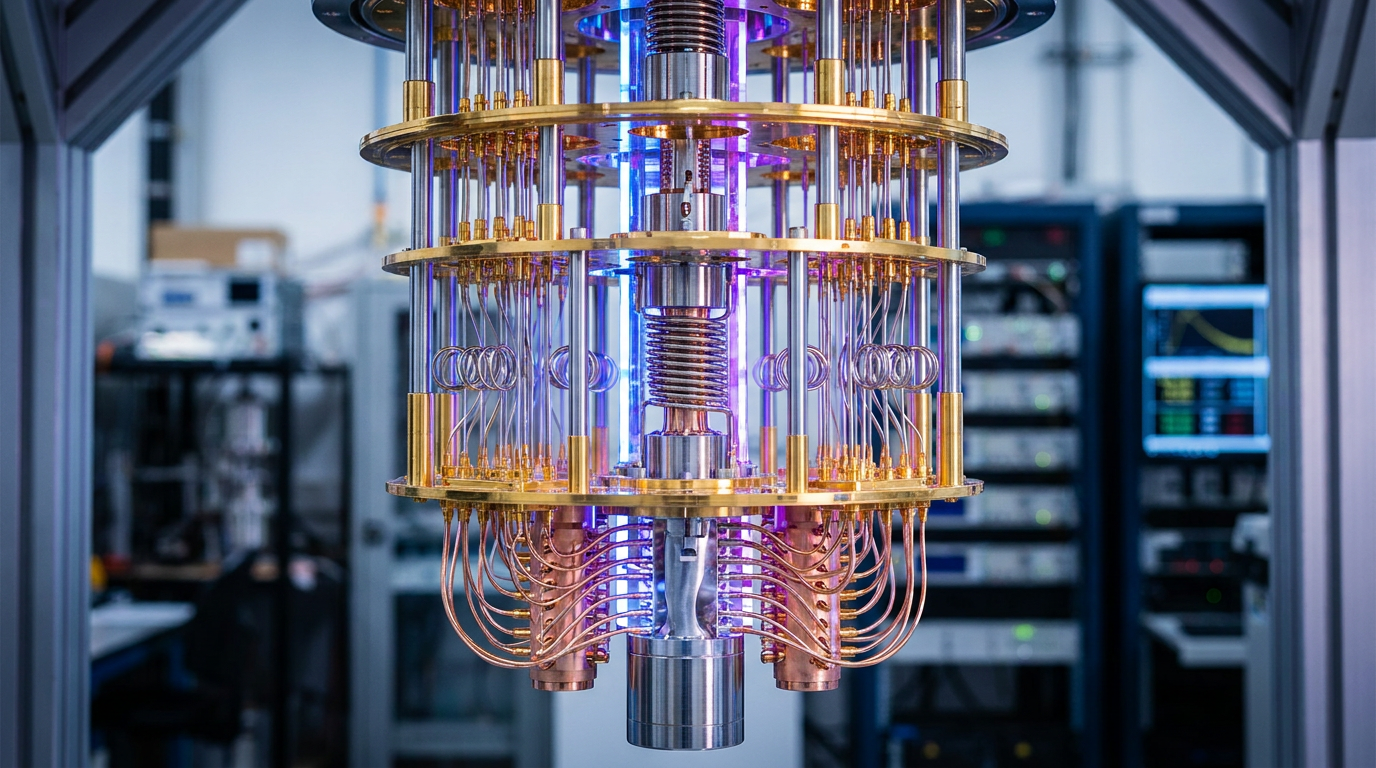
But scaling up superconducting circuits like Google's and IBM's requires massive, energy-intensive dilution refrigerators operating at temperatures colder than deep space. This has driven intense interest in alternative hardware modalities, particularly neutral-atom arrays. In a neutral-atom system, lasers acting as "optical tweezers" trap and arrange individual rubidium or strontium atoms in a vacuum chamber at room temperature, offering vastly higher qubit connectivity.[3]
A consortium featuring Harvard University, MIT, and Boston-based QuEra Computing recently leveraged this neutral-atom architecture to shatter previous records for encoding efficiency. Standard error-correction approaches often require a massive overhead—sometimes 1,000 physical qubits to create just one logical qubit. Using a new family of codes called quantum Low-Density Parity-Check (qLDPC), the Harvard-led team demonstrated a staggering physical-to-logical qubit ratio of approximately 2:1.[3]
By encoding 580 logical qubits into just 1,152 physical qubits, the QuEra and Harvard team proved that fault-tolerant quantum computers might not require millions of physical qubits to be useful. Their simulations, grounded in real hardware performance, achieved error rates in the "Teraquop" regime—meaning the system would experience only one error per trillion logical operations. This is the exact reliability threshold required for cryptanalysis and complex molecular simulation.[3]

The Harvard and MIT researchers didn't stop at efficient encoding; they also tackled the hardest operation in quantum logic: "magic state distillation." While basic quantum operations (Clifford gates) are relatively easy to protect from errors, they aren't powerful enough to achieve universal quantum computation. To run truly complex algorithms, a quantum computer needs non-Clifford gates, which require the injection of highly pure, resource-intensive "magic states."[1]
In a landmark paper published in Nature, the team reported the first experimental demonstration of magic state distillation carried out entirely on logical qubits. By dynamically moving the neutral atoms mid-computation using acousto-optic deflectors, they created a high-speed "magic-state factory" that operates in parallel. This dramatically shortens the time required to execute complex algorithms, preventing the system from idling and accumulating background errors.[1]
The convergence of these breakthroughs—Microsoft's high-fidelity trapped ions, Google's scalable superconducting surface codes, and Harvard's hyper-efficient neutral-atom architectures—signals that the quantum industry is no longer betting on a single horse. Multiple distinct hardware paths have successfully crossed the fault-tolerance threshold, and the focus is now rapidly shifting toward commercial integration.[6]

The roadmap for the next five years is now defined by logical, rather than physical, qubit counts. Industry consensus suggests that reaching approximately 100 reliable logical qubits will unlock "scientific quantum advantage," allowing researchers to simulate novel materials and chemical catalysts that are impossible to model classically. Scaling to 1,000 logical qubits will unlock broad "commercial advantage," disrupting industries from logistics optimization to financial risk modeling.[2][6]
For decades, skeptics argued that the noise inherent in quantum systems would forever prevent them from fulfilling their theoretical promise. The arrival of functional, scalable logical qubits has decisively answered that skepticism. The era of quantum utility is no longer a distant, hypothetical horizon; it is an active engineering roadmap, and the foundation has finally been poured.[6]
How we got here
Dec 2023
Harvard and QuEra execute algorithms on 48 logical qubits, proving large-scale error correction is possible.
Apr 2024
Microsoft and Quantinuum demonstrate logical qubits with an error rate 800 times better than physical qubits.
Jul 2025
Harvard and MIT researchers demonstrate "magic state distillation" entirely on logical qubits.
Early 2026
The quantum industry officially shifts focus from physical qubit counts to logical qubit performance, entering the "Fault-Tolerant Era."
Viewpoints in depth
Superconducting Advocates
Proponents of solid-state circuits believe they offer the fastest path to scaling.
Companies like Google and IBM have invested heavily in superconducting circuits, which operate at near absolute zero. They argue that the semiconductor industry's decades of experience in fabricating silicon chips gives this modality an insurmountable manufacturing advantage. Google's demonstration of below-threshold error correction on its Willow processor validates their belief that surface codes can scale predictably.
Neutral-Atom Pioneers
Advocates for neutral atoms emphasize room-temperature infrastructure and massive encoding efficiency.
Researchers at Harvard, MIT, and QuEra Computing argue that superconducting circuits are too rigid and require too much cooling infrastructure to scale to millions of qubits. By using lasers to trap neutral atoms in a vacuum, they can dynamically move qubits around mid-computation. This allows for highly efficient error-correction codes (like qLDPC) that drastically reduce the physical hardware required to build a logical qubit.
Trapped-Ion Developers
Focus on ultra-high fidelity gates and all-to-all connectivity.
Organizations like Quantinuum and Microsoft favor trapped-ion architectures because the underlying physical qubits are identical, naturally occurring atoms, which eliminates manufacturing defects. Because these ions can be moved around in an electromagnetic trap, any qubit can interact with any other qubit. This "all-to-all connectivity" allows for incredibly complex error correction with very few physical qubits, leading to the lowest error rates currently recorded in the industry.
What we don't know
- Which hardware modality (superconducting, neutral-atom, or trapped-ion) will ultimately prove the most cost-effective to scale to 1,000 logical qubits.
- Exactly how quickly software developers will be able to write algorithms that take full advantage of fault-tolerant logical qubits.
- Whether unforeseen physics challenges will emerge when attempting to network multiple quantum processors together.
Key terms
- Logical Qubit
- A stable, "virtual" quantum bit created by grouping many physical qubits together using error-correction software.
- Physical Qubit
- The actual hardware component (like a trapped ion or superconducting circuit) that stores quantum information, which is highly prone to errors.
- Decoherence
- The process where a qubit loses its delicate quantum state due to interference from the outside environment, causing calculation errors.
- Magic State Distillation
- A complex process used to purify quantum states so the computer can perform advanced, universal logic operations.
- qLDPC Codes
- A highly efficient mathematical error-correction technique that drastically reduces the number of physical qubits needed to make a logical qubit.
Frequently asked
Will quantum computers replace my laptop?
No. Quantum computers are highly specialized machines designed to solve specific complex problems, like molecular simulation or optimization, while classical computers will still handle everyday tasks.
Why can't we just use regular error correction?
Classical error correction relies on copying data, but the laws of quantum mechanics forbid perfectly copying an unknown quantum state, requiring entirely new mathematical approaches.
When will quantum computers be commercially useful?
Industry consensus suggests that reaching around 100 reliable logical qubits will unlock scientific advantage, a milestone expected within the next few years.
What is the difference between a physical and logical qubit?
A physical qubit is the actual, error-prone hardware component, while a logical qubit is a stable, virtual unit of computation made by grouping many physical qubits together.
Sources
Source coverage
6 outlets
4 viewpoints surfaced






[1]NatureNeutral-Atom Pioneers
Experimental Demonstration of Logical Magic State Distillation
Read on Nature →[2]Microsoft Quantum BlogTrapped-Ion Developers
Microsoft and Quantinuum create 12 logical qubits and demonstrate a hybrid, end-to-end chemistry simulation
Read on Microsoft Quantum Blog →[3]Quantum Computing ReportNeutral-Atom Pioneers
QuEra, Harvard, and MIT Demonstrate 2:1 Physical-to-Logical Qubit Ratio
Read on Quantum Computing Report →[4]Quantum ZeitgeistTrapped-Ion Developers
Logical Qubit Performance Surpasses Physical Qubits by 800x
Read on Quantum Zeitgeist →[5]Google Quantum AISuperconducting Advocates
Willow: Scaling quantum error correction below the threshold
Read on Google Quantum AI →[6]Factlen Editorial TeamCommercial Adopters
Synthesis by Factlen editorial team
Read on Factlen Editorial Team →

Every angle. Every day.
Get technology stories with full source coverage and perspective breakdowns delivered to your inbox.