
The Right to Repair: How New Laws Are Giving Consumers the Power to Fix Their Own Devices
A wave of new state laws and federal enforcement actions is dismantling the 'repair monopoly,' forcing manufacturers to share parts, tools, and manuals with consumers and independent shops.
By Factlen Editorial Team
- Consumer Advocates
- Argue that repair restrictions create monopolies, drive up costs, and generate massive electronic waste.
- Equipment Manufacturers
- Contend that controlling the repair ecosystem is necessary to ensure device safety, protect intellectual property, and maintain cybersecurity.
- Federal Regulators
- Focus on enforcing antitrust laws and warranty protections to ensure fair competition in the aftermarket.
What's not represented
- · Small independent repair shop owners whose daily operations are directly impacted by parts pricing.
- · Cybersecurity researchers evaluating the actual risk of open diagnostic software.
Why this matters
This legal shift promises to save consumers billions of dollars, extend the lifespan of expensive electronics and machinery, and significantly reduce global e-waste by ending the era of forced obsolescence.
Key points
- New laws in states like California and New York force manufacturers to sell parts and tools to consumers.
- Oregon recently became the first state to ban 'parts pairing,' a software lock that rejects third-party components.
- The FTC is aggressively enforcing the 1975 Magnuson-Moss Warranty Act to protect independent repair choices.
- 'Warranty Void if Removed' stickers are largely deceptive and legally unenforceable in most situations.
- Manufacturers argue that open repair access compromises device safety, cybersecurity, and intellectual property.
For decades, a broken screen or a failing battery presented consumers with a frustrating ultimatum: pay an exorbitant fee at an authorized service center or throw the device away and buy a new one. The modern electronics industry was built on a foundation of forced obsolescence, where devices were glued shut, secured with proprietary screws, and locked down by software. When a simple component failed, the entire machine was often deemed unfixable by design. This dynamic left consumers powerless, forced to rely entirely on the original manufacturer for any hope of extending their product's lifespan. But a sweeping legal transformation is currently dismantling this ecosystem, shifting the balance of power back to the people who actually own the devices.
The transition from a culture of tinkering to one of sealed black boxes did not happen overnight. Historically, appliances and vehicles were sold with detailed schematics, and local repair shops thrived by fixing everything from toasters to televisions. However, as technology became more miniaturized and complex, manufacturers realized that controlling the aftermarket for repairs was immensely profitable. By restricting access to diagnostic software, refusing to sell official replacement parts to independent shops, and utilizing industrial adhesives instead of screws, companies effectively created a closed loop. This process actively discouraged consumers from attempting their own repairs, pushing them instead toward purchasing the latest model whenever a minor defect arose.[6]
Legal scholars and consumer advocates refer to this closed ecosystem as a "repair monopoly." In an aftermarket monopoly, the company that originally built the product dictates exactly who can fix it, how much it will cost, and what parts can be used. Because independent repair shops were systematically starved of original parts and diagnostic manuals, they were often forced to use inferior counterfeit components or cannibalize broken devices to survive. This artificial scarcity drove up the cost of authorized repairs, making them economically unviable for older devices. The repair monopoly effectively transformed the concept of ownership; consumers bought the hardware, but the manufacturer retained absolute control over its lifecycle.[2]
Frustration with this dynamic birthed the modern "Right to Repair" movement, a grassroots coalition of independent technicians, environmentalists, and consumer rights advocates. For years, their legislative efforts were repeatedly crushed by well-funded lobbying campaigns from the tech and appliance industries. However, the tide began to turn as public awareness grew and the sheer volume of electronic waste became impossible to ignore. The movement argued a simple premise: if you buy a product, you should have the legal right to fix it yourself or take it to a technician of your choosing, without facing artificial barriers erected by the manufacturer.[2]

The legislative icebreaker occurred at the state level, bypassing the gridlock of federal politics. New York became the first state to pass a comprehensive digital fair repair law, which went into effect in late 2023. The Digital Fair Repair Act mandated that manufacturers operating in the state must provide consumers and independent repairers with access to the same manuals, diagrams, and original parts that they provide to their own authorized technicians. While the New York law contained several last-minute compromises that exempted certain corporate secrets, it proved that right-to-repair legislation could survive industry opposition and be implemented in a major market.[2][5]
Following New York's lead, California enacted an even more robust Right to Repair Act, which took effect in July 2024. Because of California's massive market size, its regulations often become de facto national standards. The California law requires manufacturers of consumer electronics and appliances to provide tools, parts, software, and documentation for any device with a wholesale price over $50. Crucially, for products priced over $100, manufacturers are legally obligated to supply these repair resources for a full seven years after the device is first placed on the market. This seven-year mandate ensures that consumers can keep their laptops and smartphones running long after the manufacturer has moved on to newer models.[3][5]
The legislative frontier recently expanded again with Oregon, which enacted a groundbreaking law that directly targets the software side of repair monopolies. Taking effect in 2025, Oregon became the first U.S. state to explicitly ban a controversial practice known as "parts pairing." Parts pairing is a digital lock that ties a specific hardware component—like a screen or a battery—to the device's main logic board using unique serial numbers. If a consumer or independent shop replaces a broken screen with an identical, fully functional screen taken from another device, the software detects the mismatched serial number and intentionally disables features or triggers persistent warning messages.[2][5]
The legislative frontier recently expanded again with Oregon, which enacted a groundbreaking law that directly targets the software side of repair monopolies.
By banning parts pairing, Oregon's law strikes at the heart of modern repair restrictions. Manufacturers can no longer use software updates to brick devices that have been repaired with third-party or salvaged components. This ensures that the physical modularity of a device is not undermined by invisible digital fences. The ban on parts pairing is widely considered the holy grail for independent repair shops, as it allows them to harvest perfectly good parts from broken electronics and use them to refurbish other units, drastically lowering the cost of repairs for the end consumer.[2][5]

While states have led the charge on new legislation, the federal government has aggressively stepped up its enforcement of existing laws. The Federal Trade Commission (FTC) has made the right to repair a central pillar of its consumer protection agenda, unanimously voting to ramp up law enforcement against illegal repair restrictions. To do this, the FTC resurrected the Magnuson-Moss Warranty Act, a 1975 federal law designed to ensure transparency in consumer warranties. Under the anti-tying provisions of this act, it is strictly illegal for a manufacturer to condition a warranty on the consumer using the company's own branded parts or authorized service providers, unless those parts and services are provided completely free of charge.[1][4]
Armed with the Magnuson-Moss Warranty Act, the FTC has begun cracking down on one of the most pervasive bluffs in the electronics industry: the "Warranty Void if Removed" sticker. For decades, manufacturers placed these fragile stickers over screw holes, tricking consumers into believing that simply opening their own device would legally void their warranty. The FTC has issued formal warning letters to major corporations, explicitly stating that these stickers are deceptive and largely illegal. Unless the manufacturer can definitively prove that the consumer's specific repair attempt caused the damage, the underlying warranty remains entirely valid, regardless of broken seals or third-party components.[2][4]
The battle for repair rights extends far beyond consumer smartphones and laptops; it is a critical issue in the agricultural sector. Modern tractors and combine harvesters are highly computerized, and manufacturers like John Deere historically required farmers to use proprietary diagnostic software to clear error codes or authorize new parts. If a tractor broke down in the middle of a harvest, a farmer could not simply swap a part; they had to wait days for an authorized technician to arrive with a laptop, costing thousands of dollars in lost crop yields. Following intense pressure and antitrust lawsuits, major agricultural manufacturers have recently signed memorandums of understanding, agreeing to provide farmers and independent shops with the diagnostic tools necessary to fix their own equipment.[1][2]

Manufacturers have not surrendered their repair monopolies without a fight, consistently arguing that restricting access is a matter of public safety and cybersecurity. Industry lobbying groups contend that modern electronics are incredibly dense and house volatile lithium-ion batteries. They argue that providing untrained consumers with the tools to pry open these devices dramatically increases the risk of thermal runaway, fires, and physical injury. Furthermore, manufacturers claim that opening up diagnostic software and bypassing digital locks could create vulnerabilities that malicious actors might exploit to compromise user data or network security.[1][3]
Alongside safety concerns, original equipment manufacturers (OEMs) heavily lean on intellectual property defenses. They argue that forcing them to publish detailed schematics and sell proprietary diagnostic tools essentially mandates the handover of valuable trade secrets. From the manufacturer's perspective, these laws make it significantly easier for overseas counterfeiters to reverse-engineer their products and flood the market with cheap, unsafe knockoffs. They maintain that the closed ecosystem is not just a profit center, but a necessary mechanism to protect the massive research and development investments required to build cutting-edge technology.[1][3]
Despite these objections, the writing is on the wall, and the market is already shifting to comply with the new legal reality. Major tech giants, anticipating a patchwork of strict state laws, have begun launching their own self-service repair programs. Consumers can now rent heavy-duty repair equipment directly from the manufacturer and order official replacement screens, batteries, and camera modules to their homes. While critics note that the pricing of these official parts is often kept artificially high to discourage the practice, the mere existence of these programs represents a monumental concession from an industry that previously refused to acknowledge DIY repair as a legitimate concept.[6]
Beyond consumer empowerment and economic savings, the right to repair is fundamentally an environmental imperative. Electronic waste is currently the fastest-growing waste stream on the planet, with millions of tons of toxic heavy metals and rare earth elements discarded annually. When devices are designed to be disposable, the environmental toll of mining, manufacturing, and shipping replacement units is catastrophic. By legally ensuring that devices can be maintained, upgraded, and repaired, these new laws aim to drastically extend the lifecycle of consumer electronics, keeping toxic materials out of landfills and reducing the overall carbon footprint of the technology sector.[2][6]

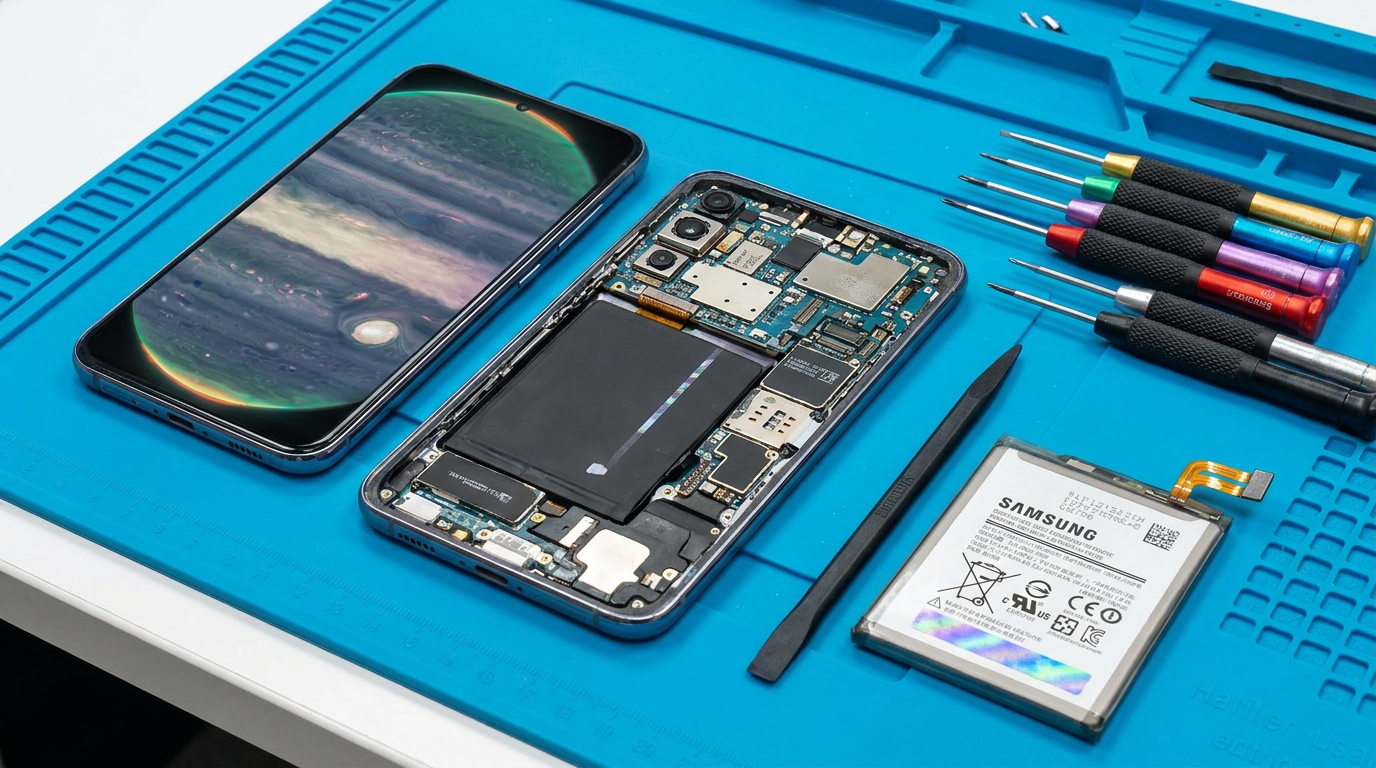
As the legal landscape continues to evolve, the ultimate victory for the right to repair movement will be a fundamental shift in industrial design. We are already seeing early signs of this transformation, with some manufacturers redesigning their latest flagship devices to open from both the front and the back, replacing industrial adhesives with standard screws, and modularizing internal components. The era of the unfixable black box is slowly coming to an end, replaced by a legal and cultural framework that recognizes a simple truth: if you cannot fix it, you do not truly own it.[7]
How we got here
1975
The Magnuson-Moss Warranty Act is passed, prohibiting companies from tying warranty coverage to specific parts or services.
July 2021
The FTC unanimously votes to ramp up law enforcement against illegal repair restrictions.
December 2022
New York signs the Digital Fair Repair Act, becoming the first state to pass comprehensive electronics repair legislation.
July 2024
California's Right to Repair Act goes into effect, mandating seven years of parts availability for devices over $100.
January 2025
Oregon's law takes effect, becoming the first in the nation to explicitly ban the practice of parts pairing.
Viewpoints in depth
Consumer Advocates & Independent Repairers
Argue that repair restrictions create monopolies, drive up costs, and generate massive electronic waste.
This coalition, which includes organizations like iFixit and U.S. PIRG, argues that when a consumer purchases a device, they own it entirely and should have the right to modify or fix it. They contend that manufacturers artificially inflate the cost of repairs by monopolizing the supply of original parts and diagnostic software, forcing independent shops out of business. By breaking this monopoly, advocates believe consumers will save billions of dollars annually while significantly reducing the environmental impact of discarded electronics.
Original Equipment Manufacturers (OEMs)
Contend that controlling the repair ecosystem is necessary to ensure device safety, protect intellectual property, and maintain cybersecurity.
Tech giants and appliance manufacturers argue that modern devices are highly complex and potentially dangerous if mishandled. They frequently cite the risk of thermal runaway and fires associated with punctured lithium-ion batteries during amateur repairs. Furthermore, OEMs argue that mandating the release of detailed schematics and diagnostic software forces them to hand over valuable trade secrets, making it easier for counterfeiters to produce unsafe knockoffs and potentially opening backdoors that hackers could exploit.
What we don't know
- Whether federal lawmakers will eventually pass a unified national right-to-repair law to replace the current patchwork of state regulations.
- How aggressively manufacturers will price their official replacement parts, which could still make DIY repairs economically unviable.
- If the ban on parts pairing will survive inevitable legal challenges from tech companies citing copyright and security concerns.
Key terms
- Parts Pairing
- A software lock that ties a specific hardware component to a device's motherboard, preventing third-party replacement parts from functioning.
- Magnuson-Moss Warranty Act
- A 1975 federal law that prohibits manufacturers from voiding warranties simply because a consumer used a third-party repair service or aftermarket part.
- OEM (Original Equipment Manufacturer)
- The company that originally designed and built the product, such as Apple, John Deere, or Samsung.
- Anti-Tying Rule
- A legal principle preventing a company from conditioning the validity of a warranty on the use of their own branded parts or authorized repair services.
- E-Waste
- Discarded electronic appliances and devices, which often contain toxic heavy metals and represent the fastest-growing waste stream globally.
Frequently asked
Does fixing my own phone void the manufacturer's warranty?
No. Under the federal Magnuson-Moss Warranty Act, a manufacturer cannot void your warranty just because you or an independent shop opened the device, unless they can prove your specific repair attempt caused the damage.
What devices are covered by these new state laws?
The laws generally cover consumer electronics like smartphones, laptops, tablets, and home appliances. However, medical devices, video game consoles, and specialized agricultural equipment are frequently excluded from the consumer electronics bills.
What is 'parts pairing' and why is it being banned?
Parts pairing uses software to reject unauthorized replacement parts, even if they are physically identical and fully functional. Oregon recently became the first state to ban this practice to ensure consumers can use third-party or salvaged components.
Sources
Source coverage
7 outlets
3 viewpoints surfaced







[1]Federal Trade CommissionFederal Regulators
FTC to Ramp Up Law Enforcement Against Illegal Repair Restrictions
Read on Federal Trade Commission →[2]WikipediaConsumer Advocates
Right to repair
Read on Wikipedia →[3]Crowell & Moring LLPEquipment Manufacturers
Right To Repair – A Growing Trend for States Creating Compliance Challenges for Manufacturers
Read on Crowell & Moring LLP →[4]ArentFox SchiffFederal Regulators
Manufacturer Beware: FTC (Again) Defends Consumers' Right to Repair
Read on ArentFox Schiff →[5]H2 ComplianceEquipment Manufacturers
A Tough Consumer Electronics Right to Repair Law Goes Live in the US
Read on H2 Compliance →[6]Built InConsumer Advocates
What You Need To Know About the Right To Repair Act in 2024
Read on Built In →[7]Factlen Editorial TeamConsumer Advocates
Synthesis by Factlen editorial team
Read on Factlen Editorial Team →

Every angle. Every day.
Get law justice stories with full source coverage and perspective breakdowns delivered to your inbox.