
How Radar and AI Are Rewriting the Rules of Motorcycle Safety
Advanced Rider Assistance Systems (ARAS) are bringing adaptive cruise control, blind-spot monitoring, and predictive AI to motorcycles, promising to drastically reduce crashes without diluting the thrill of the ride.
By Factlen Editorial Team
- Safety Technologists
- Engineers and developers focused on eliminating human error from the riding equation.
- Everyday Commuters & Tourers
- Practical riders who view ARAS as a valuable tool for reducing fatigue and managing chaotic traffic.
- Riding Purists
- Traditionalists who believe motorcycling should remain a purely analog experience.
What's not represented
- · Motorcycle driving instructors
- · Insurance actuaries evaluating premium impacts
Why this matters
For decades, motorcycle safety relied entirely on rider skill and protective gear. The arrival of radar and AI on two wheels means riders now have an active digital co-pilot, fundamentally lowering the barrier to entry and reducing the risk of catastrophic accidents for commuters and tourers alike.
Key points
- Advanced Rider Assistance Systems (ARAS) use radar and IMUs to bring car-like safety features to motorcycles.
- Adaptive cruise control now adjusts dynamically for lean angles and staggered group riding formations.
- Blind-spot monitoring uses rear-facing radar to alert riders of unseen vehicles before lane changes.
- The technology is rapidly scaling down from $25,000 premium bikes to sub-400cc commuter motorcycles.
Motorcycling has long been defined by its raw, unfiltered connection to the road. For decades, safety meant a high-quality helmet, thick protective leather, and the rider's own hyper-vigilance. But as the automotive world rapidly adopted autonomous safety nets and predictive sensors, motorcycles were largely left behind. The delay wasn't due to a lack of interest, but rather the complex physics of two-wheeled dynamics. A car stays flat when it turns; a motorcycle leans, altering the horizon and confusing standard sensors. Today, that engineering gap is finally closing, bringing a wave of sophisticated digital co-pilots to the riding experience.[6]
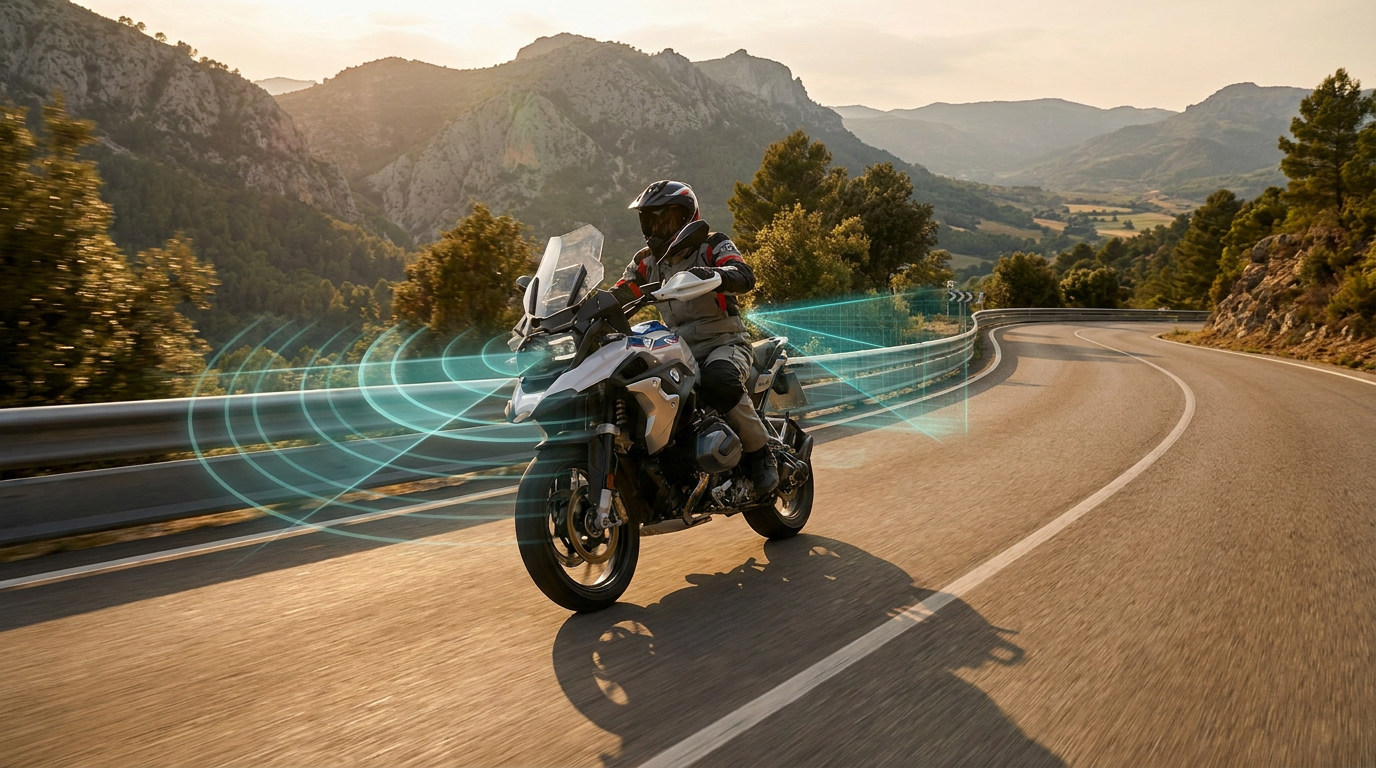
A suite of technologies collectively known as Advanced Rider Assistance Systems (ARAS) is fundamentally changing how motorcycles interact with their environment. Driven by miniaturized radar units, high-speed processors, and sophisticated algorithms, ARAS is transforming the bike from a passive, purely mechanical machine into an active safety partner. These systems are designed to anticipate hazards before the human eye can register them, offering a critical buffer in a transport mode where the risk of a fatal accident is historically twenty times higher than in a passenger car.[1][2]
The core of this revolution lies in the hardware integration. Modern ARAS relies on front and rear-facing radar sensors, optical cameras, and an Inertial Measurement Unit (IMU)—essentially the motorcycle's electronic inner ear. The IMU measures the bike's pitch, roll, and yaw hundreds of times per second. By feeding this constant stream of spatial data to the engine control unit (ECU), the motorcycle gains a precise understanding of exactly what it is doing in three-dimensional space at any given millisecond.[1][4]
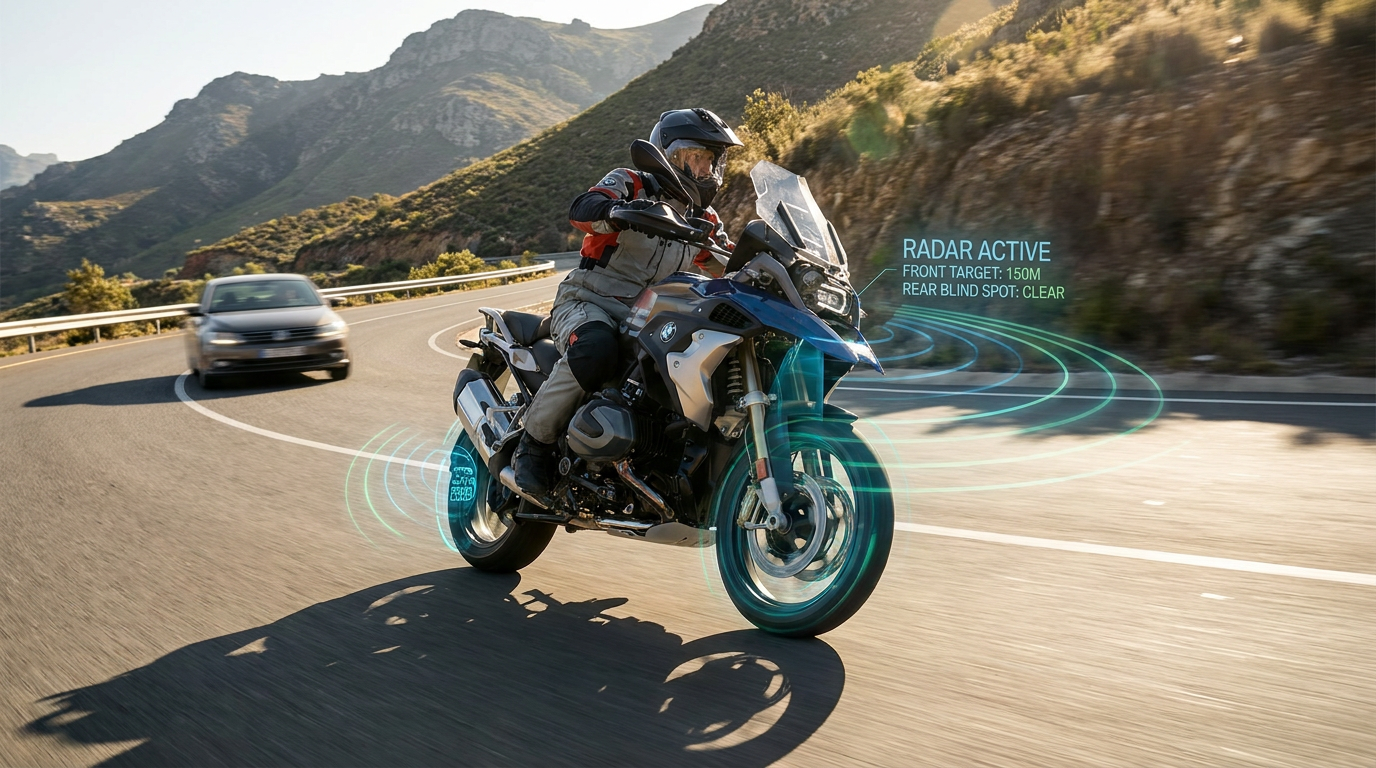
When combined with radar, this spatial awareness unlocks features previously thought impossible on two wheels. Take Adaptive Cruise Control (ACC). While standard on cars for years, implementing ACC on a motorcycle requires the system to understand lean angles. If a rider leans into a sweeping curve, the radar must track the road ahead and the vehicle in front, rather than locking onto the guardrail or oncoming traffic. The IMU tells the radar exactly how much the bike is leaning, allowing the sensor's field of view to adjust dynamically.[1][3]

Bosch, a pioneer in motorcycle safety technology, recently introduced "Group Ride Assist" to solve a uniquely two-wheeled problem. Traditional adaptive cruise control struggles when motorcycles ride in a staggered formation, often confusing the offset bikes for obstacles or losing track of the lead rider. The new algorithm specifically recognizes the staggered pattern of a group ride, allowing the bike to automatically maintain its position and distance within the pack without the rider needing to constantly adjust the throttle.[1]
Blind-spot detection is another critical addition that addresses a fundamental vulnerability of riding. Motorcycles have notoriously poor rearward visibility due to narrow mirrors and vibrating handlebars, and performing a quick shoulder check at highway speeds can be physically destabilizing. Rear-facing radar now continuously scans the rider's blind spots with precision. If a vehicle is lurking out of sight, the system illuminates a bright warning light in the corresponding rearview mirror, giving the rider an "extra set of eyes" before they initiate a lane change. This simple visual cue drastically reduces the anxiety of navigating multi-lane highways.[3][4]
Blind-spot detection is another critical addition that addresses a fundamental vulnerability of riding.
But perhaps the most life-saving application of this sensor suite is the Forward Collision Warning system. If the front radar detects an impending rear-end collision—such as traffic suddenly halting—and the rider hasn't reacted, the system triggers immediate visual and acoustic warnings. In some advanced iterations, if the rider still fails to brake, the system can initiate a brief, stabilizing brake jerk. This physical pulse is designed to snap the rider's attention back to the road without applying full emergency braking, which could upset the bike's balance.[1][4]
This active intervention builds upon the foundation of Motorcycle Stability Control (MSC), often referred to as cornering ABS. Traditional anti-lock brakes can be dangerous in a curve; applying them mid-corner can cause the bike to stand up and run wide into oncoming traffic. MSC uses the IMU's lean-angle data to modulate brake pressure perfectly. It allows riders to grab a handful of brake while leaned over without losing front tire grip or suffering a violent high-side crash, fundamentally rewriting the rules of emergency braking.[3][5]

The rapid integration of these digital systems hasn't been without friction within the culture. A vocal segment of the motorcycling community worries that excessive technology dilutes the pure, analog experience that draws people to riding in the first place. They argue that relying on screens, radar, and automated interventions might erode fundamental riding skills, creating a false sense of security. For these traditionalists, managing risk through personal skill, mechanical sympathy, and hyper-vigilant situational awareness is an integral part of the motorcycling ethos, and they fear that digitizing the ride turns the motorcyclist into a mere passenger.[5]
Industry engineers and safety advocates counter that ARAS is designed strictly as a safety net, not an autopilot. The goal is to reduce the cognitive load on the rider—especially during long, fatiguing highway stints, heavy rain, or chaotic urban traffic. By offloading the stress of constantly monitoring blind spots and following distances, the rider is left with more mental bandwidth to actually enjoy the ride. The systems are calibrated to intervene only when the rider's own limits are exceeded.[2][5]
Crucially, this life-saving technology is no longer reserved exclusively for $25,000 flagship adventure bikes. While ARAS debuted on premium, heavy-weight models like the Ducati Multistrada and KTM Super Adventure, manufacturers are now aggressively scaling these systems down to the broader market. Bosch's compact ABS 10 base unit, for example, is bringing advanced stability control and sensor integration to sub-400cc commuter motorcycles. This democratization of safety tech is especially vital in emerging markets across Southeast Asia and India, where small-displacement motorcycles serve as the primary, everyday mode of transportation for millions of people navigating chaotic urban infrastructure.[3][4]

Looking ahead to the next generation of safety, the industry's focus is shifting toward predictive artificial intelligence and vehicle-to-everything (V2X) communication. Future smart helmets equipped with augmented reality (AR) heads-up displays will project radar warnings, telemetry, and navigation directly into the rider's line of sight, eliminating the need to glance down at a dashboard. Meanwhile, connected motorcycles will communicate wirelessly with traffic lights, municipal infrastructure, and surrounding cars to anticipate hidden hazards—such as a vehicle preparing to run a red light at a blind intersection—before they even become visible to the human eye.[2]
Ultimately, the fundamental physics of motorcycling will always carry inherent risks; balancing on two wheels at highway speeds while exposed to the elements leaves no room for absolute complacency. But by giving motorcycles the unprecedented ability to see, think, and react to their surroundings, Advanced Rider Assistance Systems are systematically stripping away the most common causes of multi-vehicle accidents. These invisible digital co-pilots ensure that the ride remains as thrilling and liberating as it has always been, but significantly more forgiving when the unpredictable realities of the road inevitably unfold.[6]
How we got here
2013
Bosch introduces Motorcycle Stability Control (MSC), enabling the first iteration of cornering ABS.
2018
First announcements of radar-based ARAS development specifically tailored for two-wheeled dynamics.
2020
Ducati and KTM debut the first production motorcycles equipped with adaptive cruise control.
2025
Introduction of Group Ride Assist, allowing radar to recognize and adapt to staggered motorcycle formations.
2026
ARAS technology begins scaling down to sub-400cc commuter motorcycles in emerging markets.
Viewpoints in depth
Safety Technologists
Engineers and developers focused on eliminating human error from the riding equation.
This camp views the motorcycle's inherent instability not as a charm, but as an engineering problem to be solved. By integrating radar, IMUs, and eventually vehicle-to-infrastructure (V2X) communication, they aim to create a "360-degree safety shield." They point to data showing that radar-based systems could prevent one in seven motorcycle accidents, arguing that technology can react in milliseconds—far faster than human reflexes.
Riding Purists
Traditionalists who believe motorcycling should remain a purely analog experience.
For purists, the appeal of a motorcycle is the direct, unfiltered mechanical connection. They express concern that layers of electronic intervention—like adaptive cruise control and automatic brake jerks—insulate the rider from the road. This camp argues that relying on screens and sensors might erode fundamental riding skills, creating a false sense of security that could prove dangerous if the technology ever fails or behaves unpredictably.
Everyday Commuters & Tourers
Practical riders who view ARAS as a valuable tool for reducing fatigue and managing chaotic traffic.
Riders who log heavy mileage or commute in dense urban environments largely welcome the technological shift. They see blind-spot monitoring and adaptive cruise control as essential tools that reduce cognitive load. Rather than diluting the experience, they argue that these systems act as an "extra set of eyes," allowing them to arrive at their destinations less fatigued and better equipped to handle the unpredictable nature of surrounding car traffic.
What we don't know
- How quickly ARAS will become a mandatory legal requirement for new motorcycles globally.
- Whether the widespread adoption of ARAS will lead to a measurable decrease in insurance premiums for riders.
Key terms
- ARAS
- Advanced Rider Assistance Systems, a suite of electronic safety features including radar cruise control and blind-spot monitoring designed specifically for motorcycles.
- IMU
- Inertial Measurement Unit, an electronic sensor that measures a motorcycle's pitch, roll, and yaw to inform traction control and cornering ABS.
- Cornering ABS
- An advanced braking system that uses lean-angle data to prevent wheel lockup even when the motorcycle is leaned over in a turn.
- High-side crash
- A severe accident where a sliding rear tire suddenly regains traction, violently throwing the rider over the motorcycle.
Frequently asked
Does adaptive cruise control work when a motorcycle leans into a corner?
Yes. Modern systems use an Inertial Measurement Unit (IMU) to track lean angles, allowing the radar to adjust its field of view and maintain smooth speed control through curves without locking onto roadside obstacles.
Will the bike brake automatically if a car stops suddenly?
Most current motorcycle systems provide forward collision warnings and may initiate a brief 'brake jerk' to alert the rider, but they do not apply full emergency braking like a car, as that could destabilize the bike.
Is this technology only available on expensive touring bikes?
While it debuted on premium models, manufacturers are now scaling ARAS down to mid-range and sub-400cc commuter motorcycles, especially in emerging markets where two-wheelers are primary transportation.
Sources
Source coverage
6 outlets
3 viewpoints surfaced





[1]Bosch MobilitySafety Technologists
Advanced Rider Assistance Systems
Read on Bosch Mobility →[2]BennettsEveryday Commuters & Tourers
ARAS: The Next Frontier in Motorcycle Safety
Read on Bennetts →[3]Channel News AsiaSafety Technologists
Bosch pushes for wider adoption of motorcycle ABS
Read on Channel News Asia →[4]Cycle NewsEveryday Commuters & Tourers
Bosch Announces New Motorcycle Safety Tech
Read on Cycle News →[5]VisordownRiding Purists
What are Advanced Rider Assistance Systems?
Read on Visordown →[6]Factlen Editorial Team
Synthesis by Factlen editorial team
Read on Factlen Editorial Team →

More in shopping
See all 5 stories →

Every angle. Every day.
Get shopping stories with full source coverage and perspective breakdowns delivered to your inbox.