
The Invisible Co-Pilot: How Radar and ARAS Are Rewriting Motorcycle Safety in 2026
Advanced Rider Assistance Systems are moving from luxury touring bikes to the mainstream market, using military-grade radar to prevent collisions and reduce rider fatigue.
By Factlen Editorial Team
- Active Safety Proponents
- Argue that radar technology is a necessary evolution that dramatically reduces fatigue and prevents fatal collisions.
- Touring & Tech Enthusiasts
- Value the convenience of adaptive cruise control for long-distance rides and embrace the integration of smart tech.
- Analog Purists
- Express concern that automated braking interventions could disrupt the delicate balance of a single-track vehicle.
What's not represented
- · Insurance Actuaries
- · Motorcycle Training Instructors
Why this matters
Motorcycle accidents are disproportionately fatal compared to car crashes. The democratization of radar technology means everyday commuters and weekend riders now have access to active safety nets that can literally hit the brakes before human reflexes even register a threat.
Key points
- Motorcycle radar systems use 77 GHz sensors to monitor traffic 360 degrees around the rider.
- Adaptive Cruise Control reduces physical and mental fatigue on long-distance highway rides.
- Emergency Brake Assist can automatically apply brake pressure to prevent or mitigate rear-end collisions.
- The technology is expanding from premium $25,000 touring bikes to mid-range commuters and scooters.
- Aftermarket radar kits allow riders to add blind-spot detection to older motorcycles.
For decades, motorcycle safety was a purely analog equation: wear good gear, keep your head on a swivel, and trust your reflexes. But as the 2026 riding season kicks into gear, the industry is undergoing a quiet revolution. The focus has shifted from passive protection—what happens during a crash—to active prevention. The driving force behind this shift is a suite of technologies collectively known as Advanced Rider Assistance Systems, or ARAS. Once the exclusive domain of luxury automobiles, these invisible electronic safety nets are now fundamentally rewriting the rules of two-wheeled survival [1][6].[1][6]
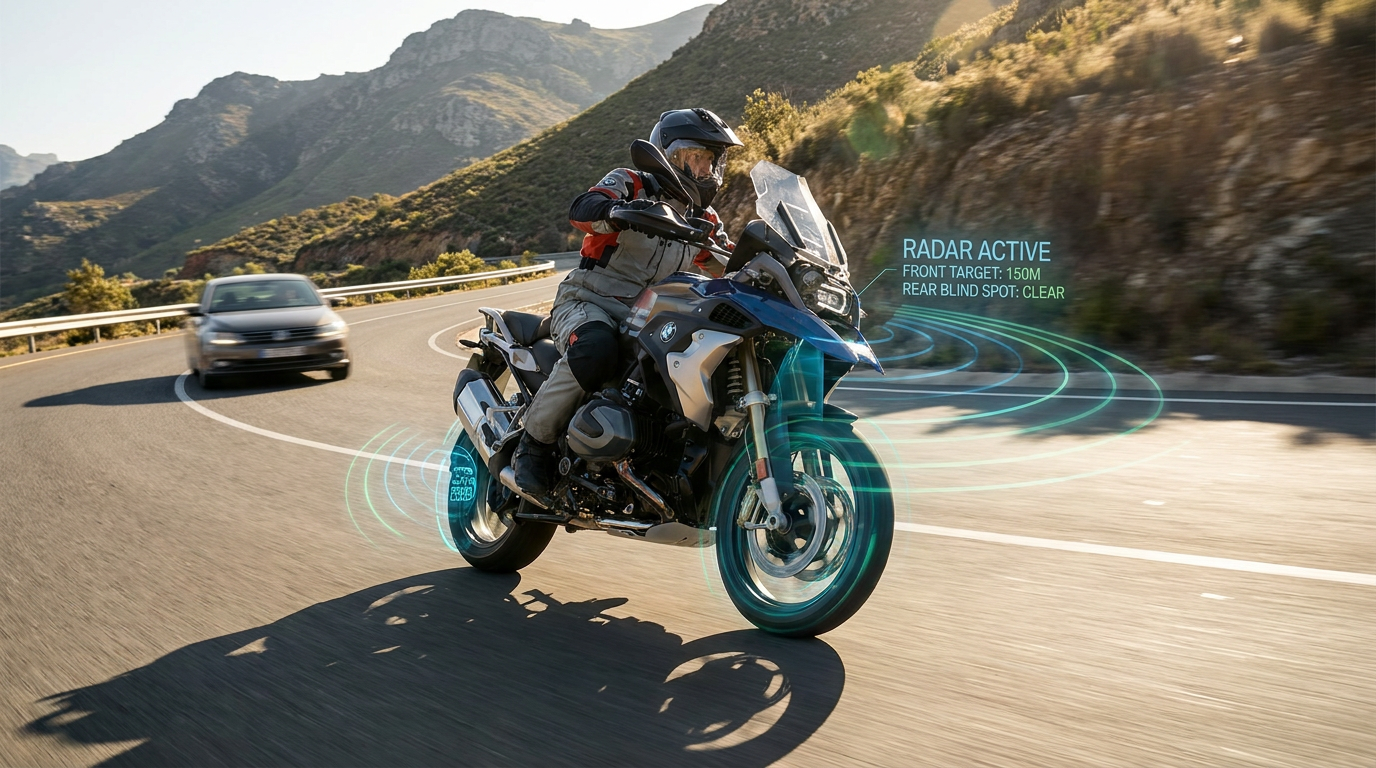
At the heart of this transformation is military-grade radar. Unlike early camera-based systems that could be blinded by sun glare, heavy rain, or fog, modern motorcycle ARAS relies on compact 77 GHz radar sensors mounted at the front and rear of the bike [1][6]. These sensors continuously scan the environment, bouncing radio waves off surrounding vehicles to calculate their exact distance, speed, and trajectory. The data is fed into the motorcycle's Electronic Control Unit (ECU) dozens of times per second, creating a 360-degree digital map of the road [6].[1][6]
The most widely adopted ARAS feature is Adaptive Cruise Control (ACC). While standard cruise control simply holds a static speed, radar-guided ACC dynamically adjusts the motorcycle's pace to match the flow of traffic [1]. If a car merges into your lane, the front radar detects the intrusion and automatically rolls off the throttle or gently applies the brakes to maintain a pre-set following distance [5]. When the lane clears, the system smoothly accelerates back to the target speed. For 2026, systems like Bosch's second-generation ARAS have introduced "Stop & Go" functionality, allowing the bike to come to a complete halt in heavy traffic and pull away again when the cars move [1][4].[1][4][5]
The impact of ACC on rider fatigue cannot be overstated. On a 600-mile touring day, the constant micro-adjustments of the throttle and brakes accumulate physical and mental exhaustion, which degrades reaction times [1]. By offloading the speed management to the radar, the rider's cognitive load is dramatically reduced. They can keep their right hand relaxed on the grip for steering input while the system handles the pacing, effectively eliminating a major source of highway fatigue [1].[1]

While the front radar manages what lies ahead, the rear-facing sensor watches the rider's six o'clock. Blind Spot Detection (BSD) is rapidly becoming a must-have feature for highway commuters [5]. When a vehicle enters the motorcycle's blind spot, the system triggers a visual alert—typically a bright amber LED integrated into the rearview mirror or the TFT dashboard [1]. If the rider activates their turn signal while a car is in the blind spot, the light flashes urgently to warn against a lane change.[1][5]
The rear radar also powers Rear Collision Warning systems. If the sensors calculate that a vehicle is approaching from behind at a dangerous speed—a terrifying scenario for a motorcyclist stopped at a traffic light—the system can automatically flash the bike's hazard lights to grab the distracted driver's attention [6]. This simple intervention addresses one of the most common and helpless situations a rider can face in urban traffic.[6]
The most complex and controversial element of the new ARAS suite is Emergency Brake Assist (EBA) and Forward Collision Warning (FCW). If the front radar determines that a rear-end collision is imminent, it initiates a multi-stage intervention [1]. First, it flashes a bright red warning on the dashboard and sounds an audible alarm. If the rider fails to react, the system delivers a brief, haptic pulse through the brakes—a physical tap on the shoulder to break the rider's target fixation [1].[1]
The most complex and controversial element of the new ARAS suite is Emergency Brake Assist (EBA) and Forward Collision Warning (FCW).
If a crash is mathematically unavoidable and the rider still hasn't braked, the system can automatically apply brake pressure to scrub off speed before the impact [1][4]. Applying brakes autonomously on a single-track vehicle is an engineering tightrope; grab the front brake too hard while leaned over, and the front tire will wash out, causing a crash. To prevent this, the ARAS is deeply integrated with the motorcycle's Inertial Measurement Unit (IMU), which tracks the bike's lean angle, pitch, and yaw [6]. The system calculates exactly how much brake pressure the tires can handle at that specific lean angle and modulates the ABS accordingly [1].[1][4][6]
The data supporting these systems is compelling. According to accident research conducted by Bosch, the widespread adoption of radar-based assistance systems could prevent one in six motorcycle accidents globally [6]. This potential for harm reduction has driven massive market growth. The global motorcycle ARAS market, valued at $1.93 billion in 2025, is projected to surge past $2 billion this year, fueled by a 47% increase in front radar adoption and a 36% rise in rear radar penetration [7].[6][7]

Historically, this level of technology was reserved for flagship adventure bikes and grand tourers carrying price tags north of $25,000, such as the Ducati Multistrada V4 Rally or the KTM 1390 Super Adventure [4][5]. However, 2026 marks the tipping point for democratization. Major component manufacturers are scaling down the hardware to fit mid-range motorcycles and even premium scooters [4].[4][5]
The push into the commuter segment is being led by massive global partnerships. At CES 2026, French automotive tech giant Valeo announced a joint venture with Hero MotoCorp—the world's largest manufacturer of two-wheelers—to co-develop ARAS specifically for entry-level commuters and electric scooters [2]. By adapting radar and camera technology for the chaotic, mixed-traffic realities of Indian roads, the partnership aims to bring a "digital co-pilot" to millions of riders who rely on small-displacement bikes for daily transport [2].[2]
For riders who aren't ready to buy a brand-new motorcycle, the aftermarket is stepping in to fill the gap. Tech companies like Garmin have introduced standalone radar units, such as the $599 zūmo R1, which can be retrofitted to almost any motorcycle or scooter [3]. While these aftermarket systems cannot tap into the bike's brakes for adaptive cruise control, they provide crucial blind-spot monitoring and rear-collision warnings via handlebar-mounted LED displays and smartphone integration [3].[3]

Despite the clear safety benefits, the march toward automation has met resistance from some analog purists. In online forums and riding communities, skeptics express concern over the idea of a motorcycle braking on its own, fearing that unexpected interventions could cause a loss of control or prevent a rider from accelerating out of a dangerous road-rage situation [4]. The core philosophy of motorcycling has always been absolute mechanical control, and delegating that authority to a microchip feels antithetical to the experience for some.[4]
Manufacturers are acutely aware of this tension. Engineers calibrate these systems to act as a safety net, not a chauffeur. The interventions are designed to be overridden; a firm twist of the throttle will instantly cancel an automated braking event, ensuring the rider always has the final say [1]. Furthermore, features like Group Ride Assist have been specifically developed to accommodate motorcycle culture, allowing the radar to recognize and adapt to staggered group riding formations without getting confused by the offset bikes [1][6].[1][6]
As we navigate the 2026 riding season, the integration of ARAS represents the most significant leap in motorcycle safety since the invention of the anti-lock braking system. By acting as an unblinking second set of eyes, radar technology is systematically stripping away the most common causes of multi-vehicle accidents. It doesn't dilute the thrill of the ride; rather, it provides the peace of mind necessary to truly enjoy the open road, knowing that an invisible co-pilot is always watching your back.
How we got here
2020
Ducati introduces the first radar-equipped production motorcycle, the Multistrada V4 S, featuring basic adaptive cruise control.
2023
Bosch introduces compact dual-radar kits, significantly improving detection speeds and allowing for rear blind-spot monitoring.
Late 2024
The second generation of ARAS debuts, adding Stop & Go functionality and automated emergency braking to flagship models.
Jan 2026
Hero MotoCorp and Valeo announce a partnership at CES to bring ARAS technology to entry-level commuter motorcycles and scooters.
Viewpoints in depth
Active Safety Proponents
Safety advocates and component manufacturers emphasize the undeniable statistical benefits of radar.
For safety organizations and companies like Bosch, the math is simple: human reaction time is flawed, and radar never blinks. By their estimates, widespread adoption of ARAS could eliminate one in six motorcycle accidents. They argue that the reduction in cognitive load provided by Adaptive Cruise Control actually makes riders sharper and more attentive when they do need to take manual control, effectively neutralizing highway fatigue before it sets in.
Analog Purists
Traditional riders worry about the loss of mechanical control and the risks of automated braking.
A vocal subset of the riding community views ARAS with deep skepticism. Their primary concern revolves around Emergency Brake Assist. Because a motorcycle is a single-track vehicle that relies on delicate balance and traction, purists fear that an unexpected automated brake pulse mid-corner or during an evasive maneuver could upset the chassis and cause a crash. They argue that the best safety feature is a highly trained rider, not a microchip that might misinterpret a complex traffic scenario.
Urban Commuters
Daily riders in dense cities view the technology as a vital shield against distracted drivers.
For riders navigating the chaotic streets of cities in India, Europe, and Southeast Asia, the democratization of ARAS is a game-changer. Features like Rear Collision Warning—which flashes hazard lights at approaching cars—directly address the terrifying vulnerability of sitting at a red light. The partnership between Hero MotoCorp and Valeo signals that these life-saving features are no longer just luxury touring toys, but essential daily tools for the working commuter.
What we don't know
- How insurance companies will adjust premiums for motorcycles equipped with active collision-avoidance systems.
- Whether automated braking systems will require specialized maintenance or recalibration after minor drops or fender-benders.
Key terms
- ARAS
- Advanced Rider Assistance Systems, a suite of electronic safety features like adaptive cruise control and blind-spot monitoring.
- IMU
- Inertial Measurement Unit, a sensor that tracks a motorcycle's lean angle, pitch, and acceleration in real-time.
- EBA
- Emergency Brake Assist, a system that can automatically apply brake pressure if a collision is imminent.
- 77 GHz Radar
- The high-frequency automotive radar standard used to precisely detect the distance and speed of surrounding vehicles.
Frequently asked
Can the motorcycle brake completely on its own?
Yes, but only in extreme emergencies. Systems like Bosch's ARAS can apply brake pressure to mitigate a crash, but they are calibrated conservatively and can be instantly overridden by the rider twisting the throttle.
Does motorcycle radar work in the rain?
Yes. Unlike camera-based systems that can be blinded by weather or glare, 77 GHz radar waves easily penetrate rain, fog, and dust.
Can I add radar to my current motorcycle?
Yes, aftermarket solutions like the Garmin zūmo R1 can be added to older bikes to provide blind-spot detection and rear-collision warnings, though they cannot control the bike's brakes or throttle.
Will adaptive cruise control work in a group ride?
Modern systems feature a "Group Ride Assist" mode that recognizes staggered riding formations, allowing the radar to track the correct lead bike without getting confused by offset riders.
Sources
Source coverage
7 outlets
3 viewpoints surfaced







[1]RevZillaTouring & Tech Enthusiasts
Testing Bosch's next-generation motorcycle radar
Read on RevZilla →[2]VisordownActive Safety Proponents
Hero and Valeo launch two-wheeled ARAS partnership at CES 2026
Read on Visordown →[3]ForbesTouring & Tech Enthusiasts
Garmin Introduces Radar System For Motorcycles
Read on Forbes →[4]BikeWaleAnalog Purists
Bosch self-stopping radar tech to come in more motorcycles
Read on BikeWale →[5]TopSpeedTouring & Tech Enthusiasts
The Ducati Multistrada V4 Rally Is Built For The Long Way Round
Read on TopSpeed →[6]Bosch MobilityActive Safety Proponents
Motorcycle Advanced Rider Assistance Systems
Read on Bosch Mobility →[7]Market.usActive Safety Proponents
Motorcycle Advanced Rider Assistance System Market Report 2026
Read on Market.us →

More in shopping
See all 5 stories →

Every angle. Every day.
Get shopping stories with full source coverage and perspective breakdowns delivered to your inbox.