
Israeli Strikes on Beirut Threaten to Derail Imminent US-Iran Peace Deal
Israel launched airstrikes on Beirut's southern suburbs on Sunday, prompting warnings from Tehran that the escalation could scuttle a highly anticipated peace agreement between the US and Iran.
By Factlen Editorial Team
- Israeli Government
- Prioritizes border security and the neutralization of Hezbollah over the broader US-Iran diplomatic timeline.
- Iranian Leadership
- Views the strikes as a deliberate sabotage of the peace process and insists on a comprehensive regional ceasefire.
- US Administration
- Focused on finalizing the deal to reopen the Strait of Hormuz and stabilize global energy markets ahead of elections.
- Regional Mediators
- Working to keep all parties at the negotiating table to prevent a return to full-scale regional war.
What's not represented
- · Lebanese Civilians
- · Global Energy Markets
Why this matters
The pending US-Iran deal is expected to immediately reopen the Strait of Hormuz, easing a global energy crisis that has driven up fuel prices. If the agreement collapses, the Middle East risks plunging back into a full-scale regional war with devastating economic and humanitarian consequences.
Key points
- Israel launched airstrikes on Beirut's southern suburbs on Sunday, targeting Hezbollah infrastructure.
- The strikes occurred hours before the US and Iran were expected to sign a historic peace agreement.
- Iran warned that the attack violates the ceasefire and could derail the impending deal.
- The proposed agreement includes reopening the Strait of Hormuz to ease the global energy crisis.
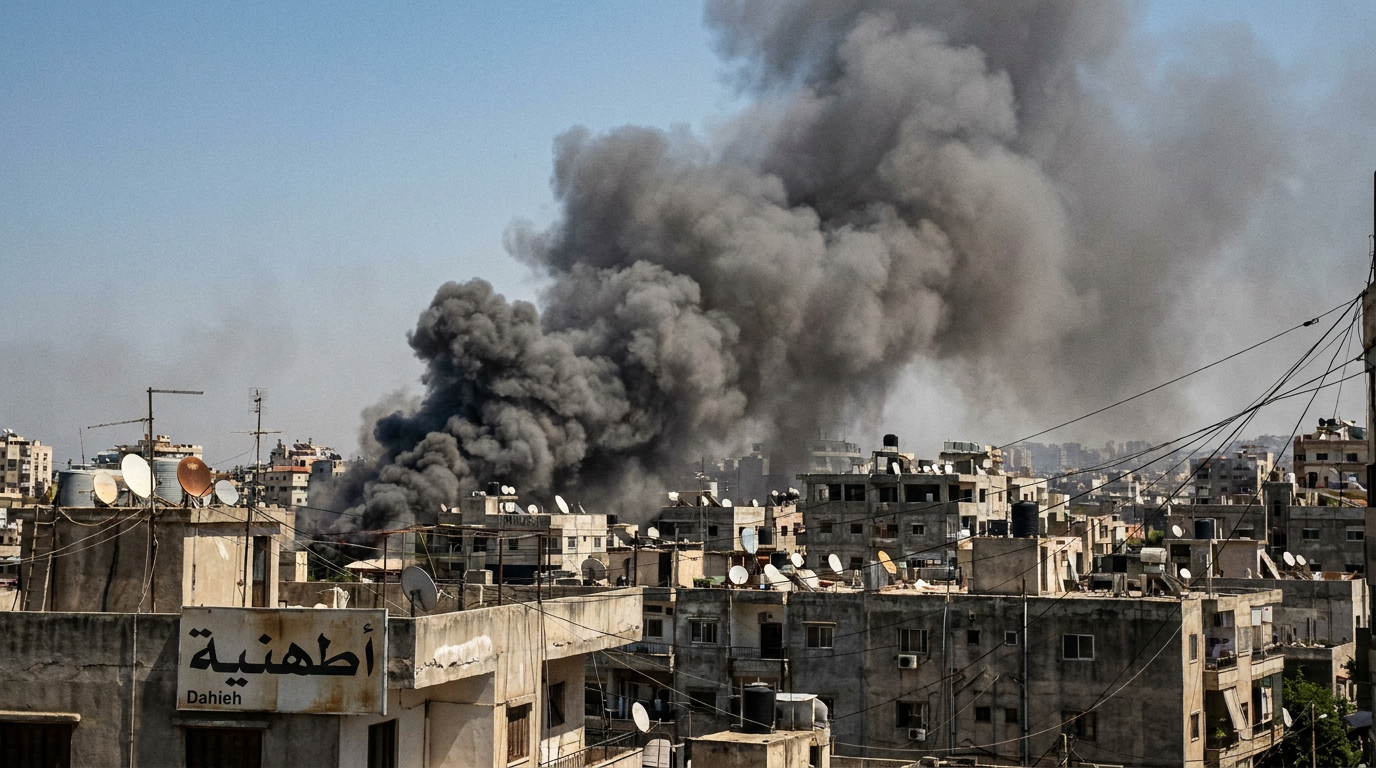
Israel launched airstrikes on Beirut's southern suburbs on Sunday, sending plumes of smoke over the Lebanese capital and threatening to unravel a historic peace agreement between the United States and Iran just hours before its anticipated signing.[1][3]
The strikes hit the Dahiyeh district, a Hezbollah stronghold, following an evacuation order from the Israel Defense Forces for 29 villages in southern Lebanon. Lebanese civil defense officials reported casualties, while residents who had recently returned during a period of relative calm were forced to flee once again.[4][6]
The office of Israeli Prime Minister Benjamin Netanyahu stated the bombardment was a direct response to Hezbollah launching three projectiles into northern Israel earlier in the day. Israeli Defense Minister Israel Katz emphasized that Israel would not tolerate attacks on its northern communities and would continue to retaliate against Hezbollah command centers in Beirut.[6][7]
The timing of the escalation has thrown frantic diplomatic efforts into chaos. On Saturday, US President Donald Trump and Pakistani Prime Minister Shehbaz Sharif announced that an electronic signing of a memorandum of understanding between Washington and Tehran was expected within 24 hours.[3][5]

The proposed US-Iran agreement aims to end months of direct hostilities and immediately reopen the Strait of Hormuz to all commercial vessels. The closure of the critical maritime chokepoint has triggered a severe global energy crisis, making its reopening a top priority for the Trump administration ahead of the November midterm elections.[3][7]
The proposed US-Iran agreement aims to end months of direct hostilities and immediately reopen the Strait of Hormuz to all commercial vessels.
However, Iranian officials quickly warned that the Beirut strikes could scuttle the entire framework. Brigadier General Mohammad Jafar Asadi, deputy commander of Iran's highest military command, stated that the attack would "not go unanswered," while Iranian media reported that Tehran had not yet made a final decision on signing the deal.[1][4]
Iran has consistently demanded that any ceasefire agreement with the US must include an end to Israeli military operations in Lebanon. Hezbollah, an Iran-backed militant group, has rejected the US-brokered deal in its current form, urging the Lebanese government to end direct talks with Israel.[5][6]
The Israeli government, which has been largely sidelined in the Pakistan-led negotiations, views the impending US-Iran deal with deep disappointment. Netanyahu has resisted pressure from Washington to halt the offensive in Lebanon, insisting that Israel must press ahead until Hezbollah no longer poses a security threat.[5][6]

This weekend's violence mirrors a similar escalation just last week, when an Israeli strike on Beirut prompted Iran to fire missiles at northern Israel for the first time since a tenuous April ceasefire. That exchange forced Trump to personally intervene, urging Netanyahu to de-escalate to preserve the diplomatic track.[3][6]
Despite the renewed hostilities, regional mediators are scrambling to salvage the agreement. Qatari negotiators flew to Tehran on Sunday to coordinate with US and Pakistani officials, hoping to finalize a 60-day framework for technical discussions on Iran's nuclear program and frozen assets before the fragile peace process collapses entirely.[4][5]
How we got here
March 2026
The US and Israel attack Iran, sparking a broader regional war and prompting Hezbollah to fire missiles into Israel.
April 7, 2026
A tenuous preliminary ceasefire takes hold between the warring parties.
Early June 2026
Israel strikes Beirut, prompting Iran to retaliate with missiles in the first major escalation since April.
June 13, 2026
US President Donald Trump and Pakistani PM Shehbaz Sharif announce a peace deal is expected to be signed on Sunday.
June 14, 2026
Israel launches fresh strikes on Beirut, leading Iran to warn that the peace deal could be derailed.
Viewpoints in depth
Israeli Government's view
Prioritizing border security and the neutralization of Hezbollah over the broader US-Iran diplomatic timeline.
Israeli officials, including Prime Minister Benjamin Netanyahu and Defense Minister Israel Katz, argue that the nation cannot tolerate continuous projectile attacks on its northern communities. They view the strikes on Beirut as necessary retaliation and insist that military operations in Lebanon must continue until Hezbollah is no longer a threat, regardless of how this impacts the US-Iran negotiations.
Iranian Leadership's view
Viewing the strikes as a deliberate sabotage of the peace process and insisting on a comprehensive regional ceasefire.
Tehran maintains that any peace agreement with the United States must encompass a cessation of Israeli military activities in Lebanon. Iranian military and political leaders perceive the recent airstrikes on Beirut as a calculated move by Israel to derail the impending deal, warning that such actions violate the spirit of the ceasefire and will provoke a response.
US Administration's view
Focused on finalizing the deal to reopen the Strait of Hormuz and stabilize global energy markets, while managing its complex alliance with Israel.
The Trump administration is eager to secure a diplomatic victory and alleviate the global energy crisis by reopening the Strait of Hormuz ahead of the November midterm elections. Washington has repeatedly urged Israel to de-escalate its operations in Lebanon to preserve the fragile negotiations, finding itself caught between its strategic alliance with Israel and its urgent domestic economic priorities.
What we don't know
- Whether Iran will officially withdraw from the peace deal or proceed with the electronic signing.
- How the US administration will respond to Israel's defiance of its requests to de-escalate in Lebanon.
- The exact timeline for reopening the Strait of Hormuz if the memorandum of understanding is signed.
Key terms
- Strait of Hormuz
- A vital maritime chokepoint between the Persian Gulf and the Gulf of Oman, through which a significant portion of the world's oil supply passes.
- Dahiyeh
- A predominantly Shia suburb south of Beirut, Lebanon, known as a stronghold for the militant and political group Hezbollah.
- Memorandum of Understanding
- A formal agreement between two or more parties that outlines the terms and details of an understanding, often preceding a legally binding treaty.
Frequently asked
Why did Israel strike Beirut?
The Israeli military stated the strikes were in retaliation for Hezbollah launching three projectiles into northern Israel earlier in the day.
What is in the proposed US-Iran deal?
The agreement includes a 60-day framework for technical discussions, an end to direct hostilities, and the immediate reopening of the Strait of Hormuz to commercial vessels.
How does the Beirut strike affect the US-Iran deal?
Iran has warned that the strike violates the terms of the ceasefire and could derail the signing of the agreement, as Tehran insists the deal must include an end to fighting in Lebanon.
Sources
Source coverage
7 outlets
4 viewpoints surfaced







[1]AxiosRegional Mediators
Iran warns Israel's Beirut strike could derail U.S. deal
Read on Axios →[2]Al JazeeraIranian Leadership
Anticipation, pushback in Iran as mediators work to finalise deal with US
Read on Al Jazeera →[3]Financial TimesUS Administration
Israel strikes Beirut hours after Trump says US-Iran deal imminent
Read on Financial Times →[4]The GuardianIranian Leadership
Middle East crisis live: Iran army official says Beirut attack will not go 'unanswered'
Read on The Guardian →[5]Global NewsIsraeli Government
Strike comes as mediators push Iran and the US closer to a deal
Read on Global News →[6]AP NewsIsraeli Government
Israeli military strikes Beirut suburbs ahead of anticipated U.S.-Iran deal
Read on AP News →[7]Washington PostUS Administration
Escalating violence in the Middle East is threatening to derail stalled peace talks
Read on Washington Post →


Every angle. Every day.
Get news politics stories with full source coverage and perspective breakdowns delivered to your inbox.