
The Science and Surging Adoption of Induction Cooktops
Driven by indoor air quality concerns and leaps in electromagnetic technology, induction cooking is rapidly replacing gas stoves in American kitchens.
By Factlen Editorial Team
- Public Health & Environmental Advocates
- Focuses on the respiratory risks of gas combustion and the climate benefits of residential electrification.
- Technology & Consumer Analysts
- Evaluates the scientific mechanisms, energy efficiency, and consumer value of induction appliances.
- Editorial Synthesis
- Provides the overarching context bridging the scientific, health, and market trends.
What's not represented
- · Professional chefs who rely on open-flame techniques
- · Electricians and contractors handling the grid retrofits
Why this matters
Gas stoves have been linked to elevated levels of indoor air pollution and childhood asthma. Understanding how induction technology works empowers consumers to make healthier, more efficient choices for their homes as building codes increasingly phase out fossil fuels.
Key points
- Gas stoves are increasingly linked to indoor air pollution, prompting a shift toward electric alternatives.
- Induction cooktops use electromagnetism to induce heat directly inside the cookware, rather than heating the surface.
- The technology is highly efficient, converting 85 to 90 percent of energy into heat and boiling water in minutes.
- A Columbia University study found switching to induction reduced indoor nitrogen dioxide levels by 56 percent.
- Induction requires ferromagnetic cookware, meaning pots and pans must contain iron or a magnetic steel base.
The American kitchen is undergoing its most significant technological shift in decades. For generations, the blue flame of a gas stove was the gold standard for serious home cooks, marketed as the ultimate tool for culinary precision. But a growing consensus around indoor air quality and energy efficiency is rapidly dethroning gas in favor of a technology that cooks without a flame or a hot coil: the induction cooktop.[4]
The transition is being driven largely by startling new data on the health impacts of traditional ranges. Gas stoves, which are used in roughly 38 percent of U.S. homes, are one of the only appliances that regularly vent combustion exhaust directly into living spaces. Recent studies have linked this daily exposure to elevated rates of childhood asthma and other respiratory issues, prompting a wave of consumer anxiety and regulatory scrutiny.[4][5]
A landmark 2024 pilot study led by scientists at the Columbia University Mailman School of Public Health quantified the exact impact of making the switch. Researchers replaced gas stoves with induction models in twenty low-income public housing units in the Bronx. By continuously monitoring the indoor air quality, they found that the induction group experienced a 56 percent reduction in average daily nitrogen dioxide (NO2) concentrations compared to the control group.[1]
During controlled cooking tests in the gas-equipped homes, background NO2 levels spiked from 18 parts per billion to 197 parts per billion—far exceeding chronic exposure guidelines. In the induction homes, the NO2 levels barely registered a change. For public health advocates, the data confirmed what they had long suspected: removing combustion from the kitchen is one of the fastest ways to clean up the air inside a home.[1][4][5]

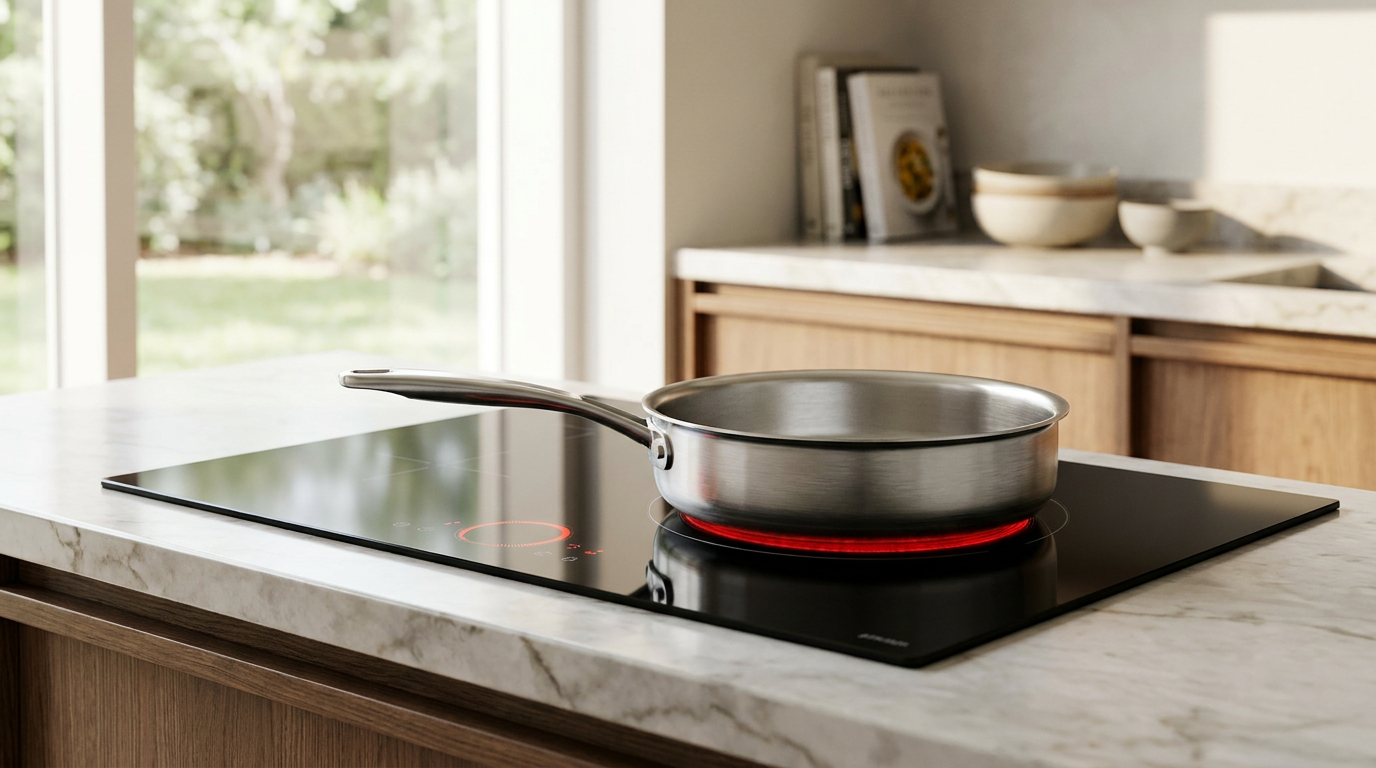
But how exactly does an induction cooktop generate intense heat without a flame or a glowing red electric coil? The answer lies in the 19th-century science of electromagnetism. Beneath the smooth, deceptively simple ceramic glass surface of an induction range sits a tightly wound coil of copper wire.[2][3]
When you turn the stove on, the appliance's controller pushes an alternating electrical current through this copper coil. This current changes direction dozens of times per second, generating a rapidly fluctuating, invisible magnetic field directly above the cooking zone. Crucially, this magnetic field passes effortlessly through the glass surface and the surrounding air without heating either of them.[2][3]
The magic happens when a compatible piece of cookware is placed on the glass. According to Faraday's Law of Induction, a changing magnetic field will induce a voltage—and consequently, an electric current—in any nearby electrical conductor. The magnetic field penetrates the metal base of the pan, generating localized, swirling electrical currents inside the metal itself.[2][3]
These swirling forces are known as eddy currents. Because the metal of the pan is not a perfect conductor, it has an inherent electrical resistance. As the eddy currents swirl through the atomic structure of the pan's base, they encounter this resistance.[2][3]
Because the metal of the pan is not a perfect conductor, it has an inherent electrical resistance.
Governed by Joule's Law of Heating, the electrical friction between the moving electrons and the resistive metal converts the kinetic energy directly into thermal energy. In plain terms: the cooktop doesn't heat the pan. The magnetic field forces the pan to heat itself. The pan becomes the primary heat source, transferring its thermal energy directly into the food or water inside it via conduction.[2][3]

This localized heat generation makes induction cooking ruthlessly efficient. Traditional gas stoves lose a massive amount of their thermal energy to the ambient air around the pot, hovering at roughly 40 to 50 percent efficiency. Standard electric radiant coils are better, but still waste heat. Induction cooktops, however, convert about 85 to 90 percent of their electrical energy directly into cooking heat.[2]
That efficiency translates to blistering speed. Modern high-output induction burners from brands like LG, Signature Kitchen Suite, and Miele are now pushing between 6,000 and 7,300 watts of power. At those wattages, an induction cooktop can bring a full gallon of water to a rolling boil in under three and a half minutes—vastly outperforming the most powerful residential gas burners.[7]
Beyond raw speed, the technology offers unparalleled precision. Because the heat is generated by an electrical field rather than a lingering flame or a slowly cooling ceramic block, temperature adjustments are practically instantaneous. If a pot of pasta is boiling over, turning the dial down stops the heat generation immediately, mimicking the immediate responsiveness that chefs traditionally loved about gas.[3]

The design also yields significant safety and maintenance benefits. Because the glass surface is only warmed by the residual heat of the pan resting on it, it stays relatively cool to the touch. You can place a paper towel between the cooktop and the pan while frying bacon, and the paper will not catch fire. This cooler surface also means that accidental spills and splatters don't bake onto the glass, making cleanup a simple wipe-down.[2][3][6]
The primary drawback of induction is its strict requirement for ferromagnetic cookware. Because the technology relies on magnetic fields, pans made of pure aluminum, copper, or glass will not work unless they have a bonded magnetic steel base. The standard test for compatibility is simple: if a refrigerator magnet sticks firmly to the bottom of a pan, it will work on an induction stove.[3]
Appliance manufacturers are rapidly iterating on the technology to win over skeptical consumers. High-end brands like Gaggenau and Thermador have introduced "full surface" cooktops. Instead of designated circular burners, these models use an array of micro-sensors to detect the exact size and placement of a pot anywhere on the glass, dynamically activating only the coils directly beneath it.[7]
Despite the clear advantages, the transition is not without friction. While the cost of the appliances themselves has dropped—with highly rated models from LG and Frigidaire now available for under $2,000—retrofitting an older kitchen can be expensive. Switching from gas often requires hiring an electrician to run a dedicated 40- or 50-amp circuit to the kitchen, adding thousands to the installation cost.[4][6]

For renters or those unwilling to commit to a full kitchen remodel, portable induction burners have emerged as a popular gateway. For less than $100, a plug-in single-burner unit allows home cooks to boil water faster and reduce their reliance on gas without a massive upfront investment.[4]
As municipalities across the United States—including New York City and dozens of cities in California—move to ban gas hookups in new construction to meet climate goals, the appliance market is fundamentally shifting. Induction is no longer a niche European luxury; it is rapidly becoming the new baseline for the modern, health-conscious home.[1][8]
How we got here
19th Century
Scientists discover the principles of electromagnetism and Faraday's Law of Induction.
1970s
The first modern induction cooktops are introduced by Westinghouse, though they are prohibitively expensive for most consumers.
2022
California adopts an electric-friendly building code, requiring new buildings to be 'all-electric ready.'
2023
New York City passes legislation banning gas-powered heaters and stoves in most new building construction.
2024
A Columbia University pilot study demonstrates a 56% reduction in indoor nitrogen dioxide when switching from gas to induction.
Viewpoints in depth
Public Health Advocates
View the transition to induction as a necessary intervention to improve indoor air quality.
Public health experts argue that indoor air quality is a hidden crisis, pointing to studies linking gas stoves to childhood asthma and respiratory distress. They view the transition to induction not just as a culinary upgrade, but as a necessary public health intervention, particularly in affordable housing where ventilation is often poor.
Culinary Traditionalists
Prefer the visual feedback and tactile techniques associated with open-flame cooking.
Many professional chefs and enthusiastic home cooks remain attached to gas. They value the visual feedback of an open flame, the ability to char ingredients directly on the burner, and the technique of tossing food in a pan without breaking the heat connection—something induction struggles with when the pan is lifted from the glass.
Energy Transition Policymakers
See induction technology as a critical lever in broader decarbonization efforts.
For city planners and environmental policymakers, induction technology is a key component of the energy transition. By electrifying residential cooking, municipalities can cap gas lines, reduce reliance on fossil fuels, and integrate homes into a grid increasingly powered by renewable energy sources.
What we don't know
- How quickly the electrical grid and older residential wiring can be upgraded to support widespread adoption of high-amperage induction ranges.
- Whether the upfront costs of electrical retrofits will prevent lower-income households from accessing the health benefits of induction cooking without heavy subsidies.
Key terms
- Electromagnetism
- The physical interaction between electric currents and magnetic fields, which induction cooktops use to generate heat.
- Faraday's Law of Induction
- A fundamental principle of physics stating that a changing magnetic field will induce an electric current in a nearby conductor.
- Eddy Currents
- Loops of electrical current induced within the metal base of a pan by the cooktop's alternating magnetic field.
- Joule's Law of Heating
- The principle that passing an electric current through a material with electrical resistance generates thermal energy (heat).
- Ferromagnetic
- Materials, such as iron or certain steel alloys, that are highly susceptible to magnetization and are required for induction cooking.
Frequently asked
Do I need to buy all new pots and pans for an induction stove?
Not necessarily. Induction requires ferromagnetic cookware, meaning a magnet must stick to the bottom. Cast iron and many stainless steel pans work perfectly, while pure aluminum or copper will not.
Is an induction cooktop safer than a gas or electric stove?
Yes. Because induction heats the pan directly via magnetic fields, the glass surface itself does not generate heat and stays relatively cool, significantly reducing the risk of burns and preventing kitchen fires.
Can an induction cooktop interfere with pacemakers?
While induction cooktops generate electromagnetic fields, most studies indicate they are safe for pacemaker users if a standard distance (usually about 2 feet) is maintained, though patients should consult their cardiologist.
Why is induction faster than boiling water on a gas stove?
Induction transfers 85 to 90 percent of its energy directly into the cookware, whereas gas loses up to 60 percent of its heat to the surrounding air. This direct energy transfer allows high-wattage induction burners to boil water in under four minutes.
Sources
Source coverage
8 outlets
3 viewpoints surfaced








[1]Columbia University Mailman School of Public HealthPublic Health & Environmental Advocates
Switching from Gas to Induction Stoves Reduces Indoor Air Pollution
Read on Columbia University Mailman School of Public Health →[2]The Indian ExpressTechnology & Consumer Analysts
Explained: So you just bought an induction cooktop. Here's how it works.
Read on The Indian Express →[3]CNETTechnology & Consumer Analysts
How can you have heat without fire? The science of induction cooktops
Read on CNET →[4]KQEDPublic Health & Environmental Advocates
I Tested My Gas Stove's Pollution. Here's Why I'm Switching to Induction.
Read on KQED →[5]Environmental Health NewsPublic Health & Environmental Advocates
Gas stoves vs. induction cooktops: Health concerns brought to light
Read on Environmental Health News →[6]House DigestTechnology & Consumer Analysts
The Cooktop Appliance Brand That Tops Consumer Reports' Test
Read on House Digest →[7]Yale ApplianceTechnology & Consumer Analysts
Ranking the Best Induction Cooktops for 2026
Read on Yale Appliance →[8]Factlen Editorial TeamEditorial Synthesis
Synthesis by Factlen editorial team
Read on Factlen Editorial Team →
Every angle. Every day.
Get home stories with full source coverage and perspective breakdowns delivered to your inbox.