
Researchers Create Light-Powered AI Chip, Promising to Slash Computing Energy Demands
A new hybrid light-matter particle developed at the University of Pennsylvania could replace traditional electronic chips, dramatically accelerating AI while reducing its massive carbon footprint.
By Factlen Editorial Team
- Hardware Researchers
- Focused on overcoming the physical and thermal limits of traditional silicon through quantum and optical physics.
- Sustainability Advocates
- Prioritizing the reduction of the technology sector's massive carbon footprint and energy grid strain.
- Industry Analysts
- Evaluating how scalable, low-cost computing will disrupt the global economy and democratize AI access.
What's not represented
- · Traditional Silicon Manufacturers
- · Energy Grid Operators
Why this matters
Artificial intelligence is currently constrained by the massive amounts of electricity required to run traditional silicon chips. Shifting to light-based computing could make AI faster, cheaper, and environmentally sustainable, unlocking new applications in medicine and robotics without straining global power grids.
Key points
- Researchers have developed a hybrid 'light-matter' particle called an exciton-polariton to perform computing tasks.
- The breakthrough allows computer chips to use photons instead of electrons, eliminating physical resistance and heat.
- Photonic chips could drastically reduce the massive energy consumption currently required by AI data centers.
- The technology could eventually allow AI systems, such as autonomous vehicles, to process visual data directly from camera sensors with near-zero latency.
The artificial intelligence industry is currently colliding with a physical wall: electricity. As generative models become more sophisticated and deeply integrated into global workflows, the data centers required to train and run them are consuming power at rates that strain regional energy grids. The 2026 Stanford AI Index reports that organizational adoption of AI has reached unprecedented levels, but this digital boom comes with a massive carbon footprint. Traditional silicon chips, which rely on the movement of electrons, generate immense heat and require energy-intensive cooling systems. For years, engineers have warned that the sheer energy demands of next-generation AI could eventually cap its potential, forcing a choice between technological progress and environmental sustainability.[3]
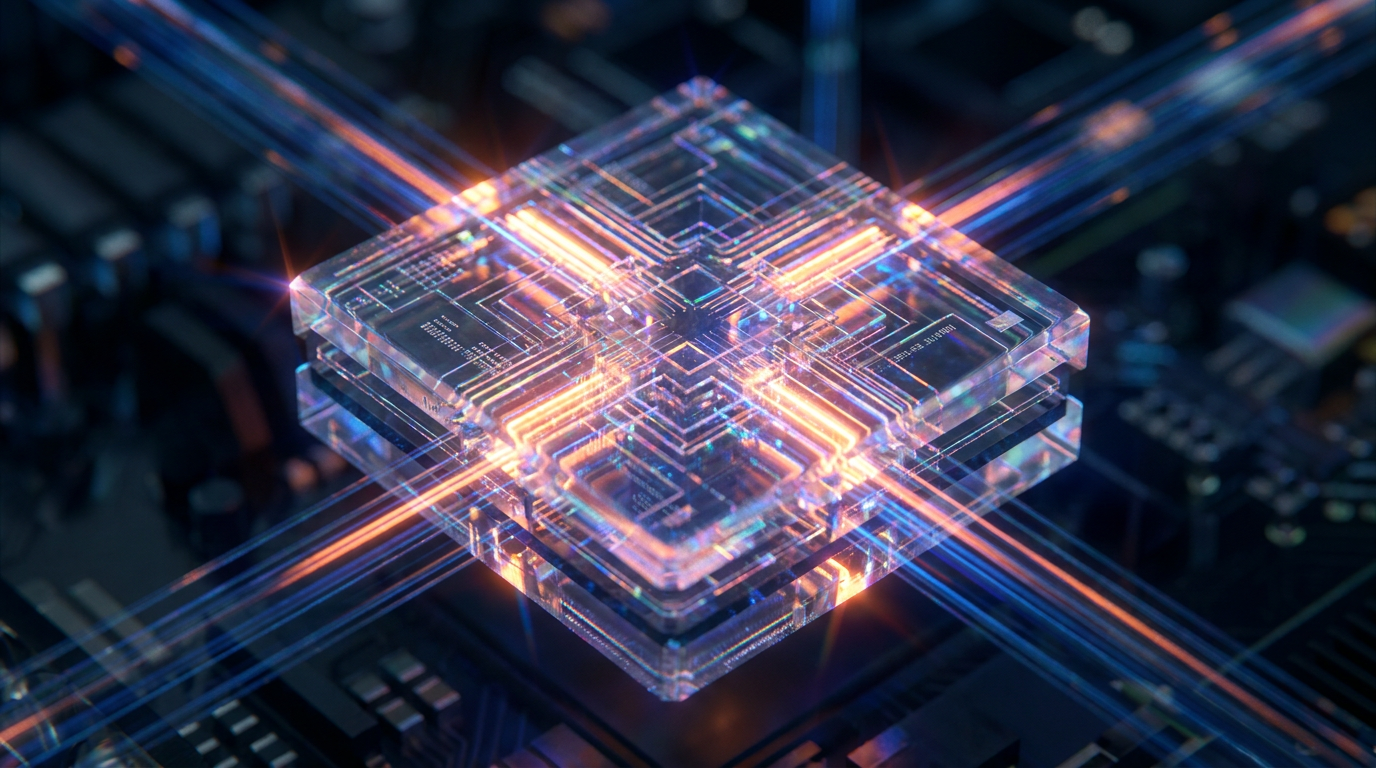
A landmark breakthrough from researchers at the University of Pennsylvania is now offering a viable path out of this energy trap. Scientists have successfully engineered a hybrid "light-matter" particle that could fundamentally replace traditional electronic computing with ultra-efficient optical technology. By harnessing photons—the fundamental particles of light—rather than electrons, the new architecture promises to dramatically accelerate AI computing speeds while using a fraction of the energy. This shift from electronics to photonics has long been a holy grail in computer science, but controlling light well enough to perform complex mathematical logic has proven notoriously difficult.[1][2]
The Penn research team, led by physicist Bo Zhen, solved this routing problem by creating a specialized quasiparticle known as an "exciton-polariton." This hybrid entity is formed when photons are strongly coupled with electrons inside an atomically thin semiconductor material. In a standard electronic chip, electrons face physical resistance as they travel, which wastes energy as heat. Photons, by contrast, travel at the speed of light with zero resistance, but they typically do not interact with one another, making them poor candidates for the signal switching required in binary computing. The exciton-polariton bridges this gap perfectly: it retains the frictionless speed of light while borrowing matter's ability to interact and switch states.[1][2][7]

There is a poetic symmetry to this development occurring at the University of Pennsylvania. Eighty years ago, researchers at the same institution developed ENIAC, the world’s first general-purpose electronic computer, which launched the modern digital age by using streams of electrons to solve complex equations. That same fundamental electronic approach still powers everything from smartphones to the massive GPU clusters driving today's AI revolution. However, as industry analysts note, 2026 is marking a transition point where brute-force scaling of traditional hardware is giving way to entirely new paradigms of infrastructure. The shift toward light-based computing represents the most significant hardware evolution since the invention of the transistor.[2][4][5]
There is a poetic symmetry to this development occurring at the University of Pennsylvania.
Beyond the sheer energy savings, photonic computing opens the door to capabilities that are physically impossible with current silicon. One of the most promising applications is the direct processing of visual data. Currently, when an autonomous vehicle or an AI-powered robot "sees" the world, its camera sensors capture light, convert it into electrical signals, process those signals through a computer chip, and then translate them into action. The Penn breakthrough could eventually allow photonic chips to process information directly from the light entering a camera lens. By eliminating the need for repeated conversions between light and electricity, systems could achieve near-zero latency, allowing machines to react to their environments instantaneously.[1][5]

For sustainability advocates, the timing of this breakthrough is critical. As the world pushes to mitigate climate change, the tech sector's growing energy consumption has become a major point of friction. Environmental reports have increasingly highlighted the need for green computing solutions that don't compromise on performance. By drastically lowering the power required to run complex neural networks, light-based chips could decouple the growth of artificial intelligence from greenhouse gas emissions. This aligns with a broader 2026 push toward climate-friendly technologies, where AI is increasingly viewed not just as a consumer of energy, but as a tool for optimizing global power grids and discovering new sustainable materials.[6]
While the exciton-polariton chip is currently a laboratory success rather than a commercial product, it provides a clear, proven roadmap for the semiconductor industry. The next major hurdle will be scaling the manufacturing of these atomically thin semiconductor materials so they can be produced reliably at a commercial scale. Tech giants and hardware startups are already heavily investing in next-generation AI infrastructure, recognizing that the first company to commercialize optical computing will hold a massive competitive advantage. As cognitive computing becomes cheaper and more ubiquitous, the hardware that powers it must evolve.[4][5]

The economic implications of scalable, low-energy AI cognition are staggering. Financial analysts and market strategists have recently warned that the global economy is vastly underprepared for the sheer volume of AI integration expected by the end of the decade. If the cost of computing drops exponentially due to photonic efficiency, high-level reasoning and data analysis will no longer be scarce resources limited to massive tech conglomerates. Instead, ultra-efficient AI could be deployed locally on low-power devices, democratizing access to advanced medical diagnostics, personalized education, and complex problem-solving tools across the developing world. The bottleneck of hardware cost would effectively vanish.[3][4]
Ultimately, the transition to photonic AI chips represents a shift from fighting the laws of physics to working alongside them. By replacing the friction and heat of electrons with the elegant speed of light, researchers are ensuring that the future of artificial intelligence remains boundless. As these hybrid light-matter systems move from the laboratory to the data center over the coming years, they promise to unlock a new era of sustainable, hyper-fast computing that will touch every sector from medical diagnostics to climate modeling.[1][3]
How we got here
1945
University of Pennsylvania researchers develop ENIAC, launching the electronic computing era.
Early 2020s
Generative AI models trigger a massive surge in data center construction and energy consumption.
2025
AI adoption reaches 88% of organizations, straining regional power grids globally.
May 2026
Penn researchers successfully demonstrate optical signal switching using exciton-polaritons, proving the viability of photonic AI chips.
Viewpoints in depth
Hardware Researchers
Focused on overcoming the physical and thermal limits of traditional silicon.
Physicists and materials scientists view the exciton-polariton as a triumph over the fundamental limits of electron-based computing. For decades, Moore's Law has been sustained by shrinking transistors, but as components approach the size of individual atoms, quantum interference and heat generation become insurmountable. By shifting the medium of computation from matter to light, researchers believe they have unlocked a new paradigm that bypasses these thermal bottlenecks entirely, paving the way for exponentially faster processing speeds.
Sustainability Advocates
Prioritizing the reduction of the technology sector's massive carbon footprint.
Environmental groups and climate scientists have grown increasingly alarmed by the energy demands of generative AI, with some data centers requiring as much electricity as small cities. Sustainability advocates see photonic computing as a critical intervention. If AI can be decoupled from massive carbon emissions, it can be safely deployed as a tool to solve climate challenges—such as optimizing power grids and discovering green materials—without exacerbating the very crisis it is trying to solve.
Industry Analysts
Evaluating how scalable, low-cost computing will disrupt the global economy.
Market strategists are focused on the economic democratization that optical computing could bring. Currently, the high cost of energy and silicon GPUs restricts advanced AI development to a handful of well-funded tech conglomerates. Analysts argue that if photonic chips dramatically lower the cost of compute, high-level artificial intelligence will become a cheap, ubiquitous utility. This would allow smaller startups and developing nations to deploy advanced AI locally, fundamentally shifting the balance of power in the tech industry.
What we don't know
- Exactly how long it will take to scale the manufacturing of atomically thin semiconductors for commercial mass production.
- Whether existing software architectures will need to be fundamentally rewritten to run on photonic hardware.
- How traditional silicon giants will pivot their supply chains to accommodate light-based chip designs.
Key terms
- Photon
- A fundamental particle of light that carries energy but has no mass, allowing it to travel at light speed without physical resistance.
- Exciton-polariton
- A hybrid quasiparticle formed by coupling a photon with an electron, combining the speed of light with the interactive properties of matter.
- Semiconductor
- A material, typically silicon, that can conduct electricity under certain conditions, forming the basis of modern computer chips.
- Latency
- The delay before a transfer of data begins following an instruction; in computing, lower latency means faster reaction times.
- Quasiparticle
- A disturbance or phenomenon in a solid material that behaves like a distinct particle, used by physicists to simplify complex quantum interactions.
Frequently asked
What is a photonic computer chip?
A computer chip that uses photons—particles of light—instead of electrons to process and transmit information. This drastically reduces the heat and energy used during computation.
What is an exciton-polariton?
It is a hybrid particle created by coupling light with matter in a semiconductor. This allows light to be controlled and switched like electrical signals, which is necessary for computing.
Why does AI use so much energy?
Training and running large AI models requires thousands of traditional processors running simultaneously. These silicon chips generate massive amounts of heat and require power-hungry cooling systems.
When will light-based AI computers be available?
While the foundational physics have been proven in the lab, commercial scaling and manufacturing of these atomically thin materials will likely take several years before they replace traditional silicon GPUs.
Sources
Source coverage
7 outlets
3 viewpoints surfaced







[1]ScienceDailyHardware Researchers
Scientists discover AI can be powered by light-matter particles
Read on ScienceDaily →[2]University of PennsylvaniaHardware Researchers
Penn Researchers Create Hybrid Light-Matter Particle for Ultra-Efficient AI Computing
Read on University of Pennsylvania →[3]Stanford University AI IndexIndustry Analysts
Artificial Intelligence Index Report 2026
Read on Stanford University AI Index →[4]FortuneIndustry Analysts
Morgan Stanley warns an AI breakthrough is coming in 2026 — and most of the world isn't ready
Read on Fortune →[5]Technogen SolutionsIndustry Analysts
AI Breakthrough 2026: New Smart Systems Set to Transform Everyday Life
Read on Technogen Solutions →[6]Good News NetworkSustainability Advocates
7 positive potentials of Artificial Intelligence
Read on Good News Network →[7]NatureHardware Researchers
Exciton-polaritons in atomically thin semiconductors for optical switching
Read on Nature →



Every angle. Every day.
Get ai stories with full source coverage and perspective breakdowns delivered to your inbox.