
How Hall Effect Joysticks Are Eradicating Controller Stick Drift
Magnetic sensor technology is replacing decades-old mechanical joysticks, offering gamers a permanent solution to the notorious hardware failure known as stick drift.
By Factlen Editorial Team
- Hardware Manufacturers
- Argue that magnetic sensors are the definitive engineering solution to mechanical wear and tear.
- Tech Reviewers
- Focus on the consumer benefits of durable hardware, evaluating the cost-to-lifespan ratio of new controller technologies.
- Competitive Players
- Prioritize absolute precision and centering, noting that frictionless sticks can sometimes feel too loose for fine aiming.
What's not represented
- · First-party console manufacturers (Sony, Microsoft, Nintendo) who still primarily use potentiometers in base models
Why this matters
For decades, gamers have treated $70 controllers as disposable items, replacing them every few months when mechanical wear inevitably ruins their accuracy. The widespread adoption of magnetic sensors is ending this cycle, saving players money and drastically reducing electronic waste.
Key points
- Stick drift is caused by the physical friction and wear of traditional potentiometer joysticks.
- Hall Effect sensors use magnets to track movement, eliminating physical contact and friction.
- Magnetic sensors can last up to 50 million cycles, compared to the 2 million cycle lifespan of older tech.
- Third-party manufacturers have made Hall Effect the new standard for controllers in 2026.
- While immune to sensor wear, magnetic sticks can still suffer from mechanical spring fatigue over time.
The universal gamer experience of "stick drift" is a quiet tragedy of modern hardware: a character creeping forward without input, a missed sniper shot, a ruined speedrun. For decades, it has been an accepted, expensive tax on the hobby.[1][5]
But in 2026, the hardware landscape is undergoing a quiet revolution. A technology called the Hall Effect is rapidly becoming the gold standard for third-party and premium controllers, promising to eradicate mechanical stick drift entirely.[3][4]
To understand the cure, one must first understand the disease. Since the late 1990s, the vast majority of console controllers—from the PlayStation 2 to the modern PS5 DualSense and Xbox Series X pads—have relied on ALPS potentiometers to translate thumb movements into digital actions.[1][6]
A potentiometer is a mechanical sensor that relies on physical contact. Inside the joystick module, a tiny metal wiper drags across a curved carbon track. As the wiper moves, it changes the electrical resistance, which the controller's processor reads as positional data.[1][6]

The fatal flaw of this design is friction. Every flick, rotation, and click of the joystick physically scrapes the carbon track. Over time, this friction wears down the material, leaving behind microscopic conductive dust.[4][5]
This degradation creates electrical "noise." The controller begins reading phantom inputs, interpreting the dust and worn grooves as intentional movement. The result is stick drift—a hardware failure that software deadzones can only temporarily mask.[1][4]
Enter the Hall Effect. Named after physicist Edwin Hall, who discovered the phenomenon in 1879, the technology measures changes in voltage caused by a magnetic field interfering with the flow of electricity in a conductor.[1][5]
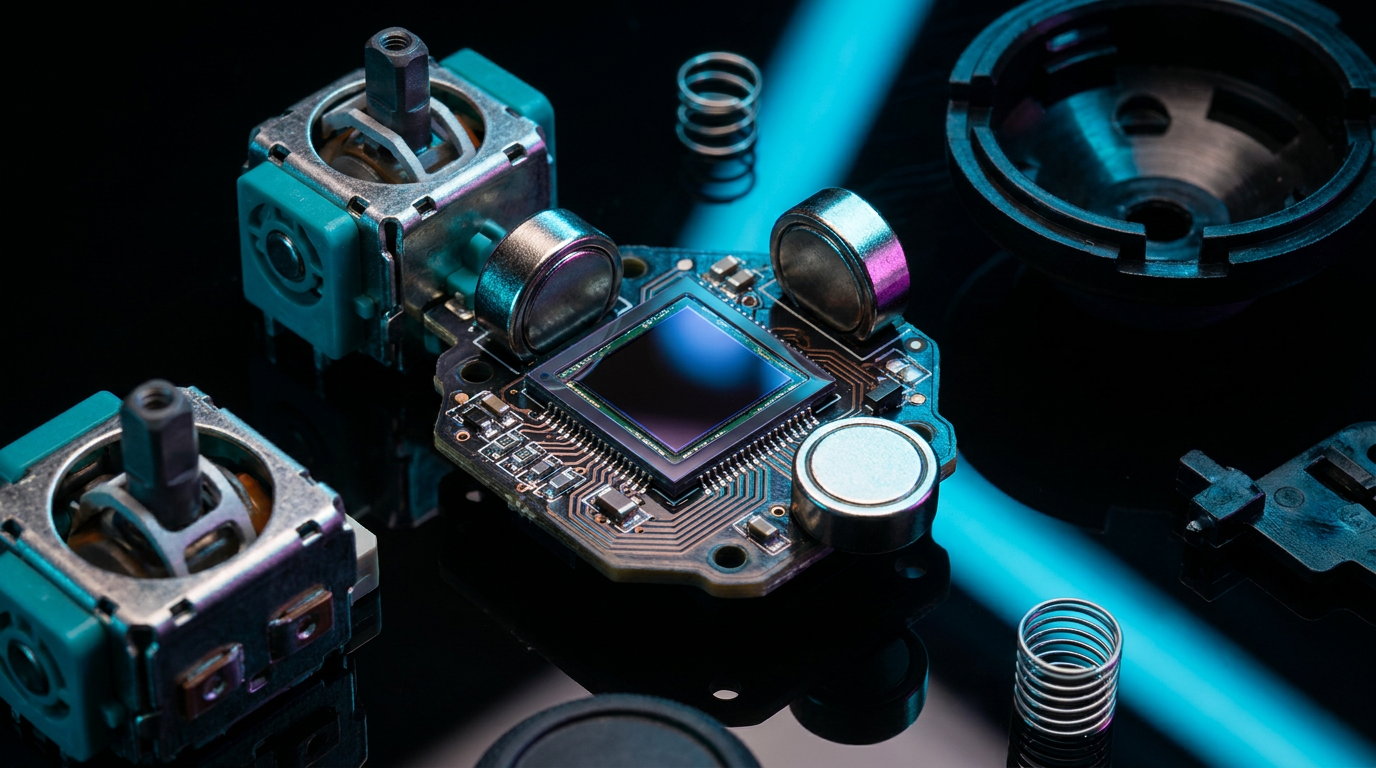
In a Hall Effect joystick, a permanent magnet is attached to the base of the thumbstick, while a stationary sensor sits nearby. As the player tilts the stick, the magnet shifts, altering the magnetic field. The sensor reads this change and translates it into precise positional data.[1][4]
In a Hall Effect joystick, a permanent magnet is attached to the base of the thumbstick, while a stationary sensor sits nearby.
The critical difference is the complete lack of physical contact. Because the magnet and the sensor never touch, there is no friction, no carbon dust, and no mechanical wear on the sensing components.[1][5]
The durability gains are staggering. While traditional potentiometers are rated for roughly two million cycles before failure, Hall Effect sensors boast a Mean Time Between Failure (MTBF) of over 50 million cycles. They effectively outlast the plastic chassis of the controller itself.[4][5]

Beyond longevity, magnetic sensors offer superior precision. Without the physical resistance of a wiper dragging across a track, the input signal is incredibly clean. Modern 12-bit Hall sensors can detect microscopic adjustments, providing a fluid, "floating" feel that competitive players prize for tracking targets.[4][7]
The market has responded aggressively. In 2026, third-party manufacturers like GameSir, 8BitDo, and Flydigi have made Hall Effect sticks the baseline for their mid-range and premium offerings. Even mobile gaming attachments are adopting the technology to survive the rigors of daily commutes.[3][4]
However, the technology is not entirely without compromises. Because Hall Effect sticks lack the natural mechanical damping of a physical wiper, some players find them too "loose" or sensitive around the center point. Manufacturers have begun implementing adjustable tension rings to artificially recreate that classic resistance.[7]
Furthermore, while the magnetic sensor itself is immune to friction, the surrounding mechanical housing is not. The plastic linkages and metal springs that physically return the joystick to its center can still stretch, fatigue, or break over years of heavy use.[2][7]

There are also edge cases involving magnetic interference. Strong external magnetic fields—such as those from a smartphone speaker placed directly against the controller—can temporarily warp the sensor's readings, though this is rare in standard gaming environments.[4][7]
A newer challenger, Tunnel Magnetoresistance (TMR), is also entering the premium space. TMR operates on similar contactless principles but measures changes in electrical resistance rather than voltage, offering even higher precision and lower power consumption for wireless devices.[2]
How we got here
1879
Physicist Edwin Hall discovers the Hall Effect, observing how magnetic fields interact with electrical currents.
1999
Sega releases the Dreamcast, featuring an early implementation of Hall Effect sensors in its controller.
2020s
Massive consumer backlash over widespread stick drift in major console controllers sparks demand for better hardware.
2026
Hall Effect and TMR sensors become the baseline standard for premium and third-party gaming controllers.
Viewpoints in depth
Hardware Manufacturers
Magnetic sensors are the definitive engineering solution to mechanical wear and tear.
For hardware engineers, the transition to Hall Effect is a long-overdue modernization. Traditional potentiometers are viewed as a relic of 1990s engineering—cheap to produce but fundamentally flawed due to their reliance on physical friction. Manufacturers argue that by removing the mechanical contact points, they have eliminated the root cause of 90% of controller failures, offering consumers a product that genuinely lasts.
Competitive Players
Absolute precision and centering are prioritized over pure longevity.
While casual players celebrate the end of stick drift, the competitive esports community approaches magnetic sensors with more nuance. Because Hall Effect sticks lack the physical friction of a carbon track, they can feel 'loose' or overly sensitive around the center point. Professional players often demand adjustable tension rings to recreate the mechanical damping they are used to, ensuring that micro-adjustments in first-person shooters remain stable.
Tech Reviewers
The shift represents a massive consumer victory and a reduction in electronic waste.
Consumer tech advocates view the widespread adoption of Hall Effect and TMR sensors as a major win for the right-to-repair and anti-ewaste movements. For years, players were forced to treat $70 controllers as disposable items, replacing them annually as potentiometers inevitably failed. Reviewers highlight that the new magnetic standard not only saves gamers money in the long run but also forces first-party console makers to rethink their hardware durability.
What we don't know
- Whether first-party console makers like Sony and Microsoft will fully abandon potentiometers in their next-generation base controllers.
- How the long-term durability of emerging TMR (Tunnel Magnetoresistance) sensors will compare to established Hall Effect modules in real-world conditions.
Key terms
- Stick Drift
- A hardware failure where a controller registers movement even when the joystick is not being touched.
- Potentiometer
- A traditional mechanical sensor that measures joystick movement by dragging a metal wiper across a resistive carbon track.
- Lorentz Force
- The physical principle behind Hall Effect sensors, where a magnetic field alters the flow of electrons in a conductor.
- Deadzone
- A software setting that ignores small joystick movements, often used to mask the symptoms of stick drift.
Frequently asked
Do Hall Effect controllers ever get stick drift?
They are immune to drift caused by sensor friction, which is the most common cause. However, the physical springs that center the stick can still wear out over years of use, potentially causing minor drift.
Are Hall Effect controllers more expensive?
Historically yes, but prices have dropped significantly. In 2026, many high-quality Hall Effect controllers are available for under $50, making them competitive with standard controllers.
What is TMR technology?
Tunnel Magnetoresistance (TMR) is an emerging alternative to Hall Effect. It also uses magnets to track movement but measures changes in electrical resistance rather than voltage, offering high precision and lower power consumption.
Sources
Source coverage
7 outlets
3 viewpoints surfaced







[1]Turtle BeachHardware Manufacturers
Hall Effect Controllers Explained: The Stick Drift Solution
Read on Turtle Beach →[2]CNETTech Reviewers
TMR vs. Hall Effect Controllers: Battle of the Magnetic Sensing Tech
Read on CNET →[3]ComicBookTech Reviewers
Best Hall Effect Controllers in 2026: Drift-Free Picks for PS5, Xbox, PC, and Mobile
Read on ComicBook →[4]GadgetHyperTech Reviewers
Why Hall Effect is the Death of Stick Drift in 2026
Read on GadgetHyper →[5]ELO GamingHardware Manufacturers
What Are Hall Effect Joysticks? The Complete Guide for Gamers
Read on ELO Gaming →[6]hlplanetTech Reviewers
Potentiometer (ALPS) vs hall effect sensor in joysticks
Read on hlplanet →[7]r/ControllerCompetitive Players
Why Hall effect is not the end all and be all for future controllers, especially for FPS players
Read on r/Controller →

Every angle. Every day.
Get gaming esports stories with full source coverage and perspective breakdowns delivered to your inbox.