
The $5 Million Agronomy Experiment Behind the 2026 World Cup
Researchers from the University of Tennessee and Michigan State University have spent eight years engineering specialized natural grass systems to standardize playing surfaces across 16 vastly different North American stadiums.
By Factlen Editorial Team
- Turf Scientists & Agronomists
- Focus on the unprecedented agricultural achievement of standardizing diverse climates.
- Player Safety Advocates
- Emphasize the necessity of natural grass to prevent lower-body injuries.
- Stadium Operators
- Highlight the logistical challenges and costs of converting venues.
- Sustainability Researchers
- Focus on the environmental footprint and water usage of the new systems.
What's not represented
- · Local sod farmers tasked with scaling the experimental grass
- · NFL teams whose home stadiums are being temporarily altered
Why this matters
This massive scientific undertaking will not only determine the safety and performance of the world's most-watched sporting event, but its breakthroughs in hybrid turf and indoor agronomy are expected to set new standards for local parks, college fields, and multipurpose stadiums worldwide.
Key points
- FIFA invested $5 million into an eight-year agronomy project led by the University of Tennessee and Michigan State University.
- Researchers conducted over 170 experiments to engineer uniform natural grass pitches for 16 vastly different North American stadiums.
- The project utilizes climate-specific grass recipes, including Bermuda grass for the South and a bluegrass-ryegrass mix for the North.
- For indoor and artificial-turf venues, scientists developed a shallow-profile hybrid system with sub-surface vacuum ventilation.
- The turf is grown at 10 specialized farms and shipped via refrigerated trucks to be installed just weeks before the tournament.
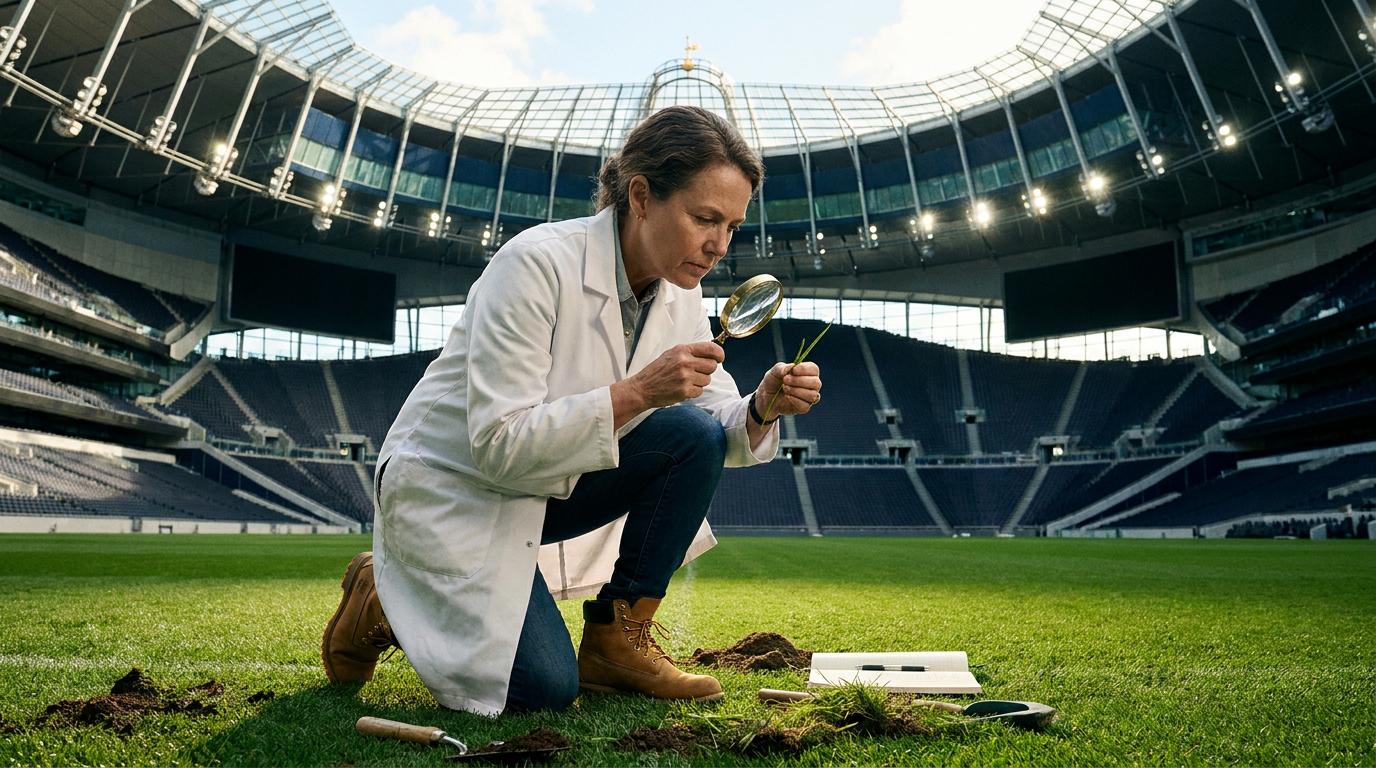
When the 2026 FIFA World Cup kicks off, more than a billion viewers worldwide will tune in to watch 104 matches spread across 16 stadiums in the United States, Canada, and Mexico. But beneath the cleats of the world's best soccer players lies one of the most complex agricultural science experiments of the decade. FIFA strictly mandates that every World Cup match must be played on natural grass, refusing to compromise on the playing surface. This presents a massive logistical and agronomic hurdle: half of the host stadiums are either fully enclosed domes or currently utilize artificial turf, and the venues span 10 vastly different climatic zones ranging from humid sea-level cities to arid high-altitude environments.[1][2][3][6]
To solve this unprecedented puzzle, FIFA initiated an eight-year, $5 million research partnership with two of the world's leading agricultural institutions: the University of Tennessee (UT) and Michigan State University (MSU). The core claim driving this extensive research is that a uniform, safe, and natural grass playing surface can be engineered and temporarily installed across diverse environments without compromising player safety or altering ball physics. The governing body recognized early on that relying on local stadium groundskeepers would not yield the identical conditions required for a fair global tournament.[1][4][6][8]
The massive research effort is led by John Sorochan, a distinguished professor of turfgrass science at UT, and John "Trey" Rogers III from MSU. Over the past five years, their dedicated teams of graduate students and agronomists have conducted more than 170 distinct experiments, rigorously testing soil depths, grass seed mixes, and the biomechanical strength of various turf systems. The ultimate goal is not just to grow healthy grass, but to manufacture an identical tactile experience for athletes traveling from the searing summer heat of Miami to the controlled, air-conditioned indoor environment of Vancouver.[2][3][4][5][7]

The evidence for their solution begins with the biological recipes themselves. The researchers quickly determined that a single grass species could not survive across all 16 venues, given the extreme variations in temperature and sunlight. Instead, they developed highly specific, climate-tailored formulations. In hot and humid southern regions, the pitches utilize Bermuda grass, a warm-season species specifically selected for its extreme heat tolerance, deep root structure, and rapid recovery from the severe wear and tear inflicted by professional athletes.[8]
Conversely, for cooler northern climates and indoor stadiums where Bermuda grass would fail, the agronomy teams engineered a precise mixture of Kentucky bluegrass and perennial ryegrass. Despite the fundamental biological differences between the southern Bermuda grass and the northern bluegrass-ryegrass mix, the researchers faced a strict mandate: they had to ensure that the leaf texture, visual appearance, and biomechanical feedback remained completely indistinguishable to the players stepping onto the pitch.[1][8]
Player safety serves as the primary metric by which these experimental surfaces are judged. Orthopedic experts and sports scientists emphasize that the turf must provide a delicate, highly engineered balance: it needs enough traction to prevent players from slipping during a sprint, but enough 'release' so that a player's cleats do not get dangerously locked into the ground during sharp, sudden cuts. Inconsistent or overly sticky surfaces are a leading cause of catastrophic non-contact knee and ankle injuries in professional sports, making the turf's shear strength a critical variable.[1][4]
Player safety serves as the primary metric by which these experimental surfaces are judged.
To replace artificial turf in venues that lack natural soil beds, the UT and MSU teams developed a highly specialized 'shallow profile' hybrid turf system. This innovative system weaves natural grass roots into a reinforced matrix of artificial fibers, providing immense structural stability without requiring deep, heavy soil beds that stadiums cannot support. The grass is grown in specialized hexagonal planters or thin, interlocking trays that can be seamlessly locked together over existing concrete stadium floors.[2][4][8]

Growing natural grass inside domed stadiums presents its own set of severe environmental challenges that push the limits of indoor agriculture. Without natural sunlight or wind to strengthen the blades, grass quickly weakens, thins out, and dies. To counteract this biological reality, the indoor venues are equipped with massive, suspended arrays of LED grow lights that meticulously simulate the solar spectrum. Below the surface, the engineering is equally intricate. The shallow profile systems feature complex in-ground irrigation networks with pop-up sprinkler heads and active vacuum ventilation systems. These sub-surface vacuums literally pull oxygen down into the root zone and rapidly drain excess moisture away from the surface, artificially mimicking the natural capillary action and drainage of a traditional deep soil field.[4][8]
The logistical execution of this ambitious agronomic plan requires a highly coordinated, continent-wide supply chain. The specialized turf is currently being cultivated at 10 dedicated, closely monitored sod farms spread across the United States, Canada, and Mexico. Because the grass must be fully mature and deeply rooted before it can withstand gameplay, it is grown off-site for months, enduring rigorous quality control checks. In the critical weeks leading up to the tournament, the mature sod will be carefully rolled up, loaded into fleets of refrigerated trucks, and transported—sometimes across hundreds of miles—to the host stadiums. Once installed, the grass must immediately acclimate and withstand the intense wear of the 104-match schedule, which effectively compresses an entire season's worth of professional play into a single, grueling month.[5][6][8]

There is historical precedent for this ambitious undertaking, though on a much smaller scale. During the 1994 World Cup, MSU's Trey Rogers successfully grew the first-ever indoor natural grass pitch for the Pontiac Silverdome in Michigan, proving that indoor agronomy was possible. However, the 2026 project scales that single-stadium success to an unprecedented, continent-wide operation, introducing a multitude of logistical and climatic variables that have never been tested simultaneously.[2][5]
Despite the rigorous testing and millions of dollars invested, transparent uncertainty remains regarding how the fields will perform in reality. The primary unknown is how the temporary grass will respond to the unique microclimates of each stadium once 80,000 screaming fans fill the seats, drastically altering the indoor humidity and ambient temperature. Furthermore, the rapid turnaround time between matches leaves a dangerously narrow window for the grass to naturally recover from divots and shear stress.[2][8]
Beyond the immediate, high-stakes demands of the World Cup, the researchers argue that their innovations will have a lasting, positive impact on global sports infrastructure. The hydroponic and sub-surface circulation systems developed specifically for the tournament have the potential to significantly reduce water usage in stadium maintenance, offering a greener path forward for facility managers. Agronomists anticipate that this extensive research will establish entirely new industry standards for safe athletic surfaces, eventually trickling down from international mega-events to NFL stadiums, collegiate fields, and even local community parks. The hybrid systems definitively prove that multipurpose venues can sustainably host natural grass events without permanently sacrificing their lucrative artificial infrastructure.[4][7][8]

Ultimately, the 2026 World Cup will serve as the most highly scrutinized agricultural showcase in human history. When the first whistle blows and the cameras pan across the pristine green pitches, the focus of a billion viewers will naturally be on the world-class athletes. But the literal foundation of the tournament—the very ground the players run, cut, and slide on—rests entirely on eight years of meticulous, peer-reviewed turf science. If the researchers at the University of Tennessee and Michigan State University succeed, the grass will be the one thing nobody notices at all.[1][5]
How we got here
1994
Michigan State University researchers successfully grow the first indoor natural grass pitch for the World Cup at the Pontiac Silverdome.
2018
FIFA approaches University of Tennessee and Michigan State University to begin standardizing turf for the 2026 tournament.
2024
Researchers finalize the climate-specific grass formulations and shallow-profile hybrid systems after more than 170 experiments.
Spring 2026
Sod farms across North America begin harvesting the mature grass and shipping it via refrigerated trucks to the 16 host stadiums.
June 2026
The turf faces its ultimate test as the expanded 104-match tournament kicks off.
Viewpoints in depth
Turf Scientists & Agronomists
Focus on the unprecedented agricultural achievement of standardizing diverse climates.
For the academic researchers at UT and MSU, the 2026 tournament is the culmination of decades of agronomic study. They view the project as a massive, highly visible proof-of-concept for modern turf science. By successfully engineering grass that can thrive under LED lights and survive in shallow, portable trays, they believe they are pushing the boundaries of what is biologically possible in controlled-environment agriculture. Their primary focus is on the data: ensuring that the biomechanical feedback of a pitch in Mexico City is statistically identical to one in Toronto.
Player Safety Advocates
Emphasize the necessity of natural grass to prevent lower-body injuries.
Sports orthopedic experts and player unions have long campaigned against artificial turf, citing higher rates of non-contact ACL and Achilles injuries. From this perspective, the millions spent on temporary natural grass is a necessary investment in athlete health. Advocates argue that natural grass provides the crucial 'release' needed when a player plants their cleat to change direction. They view the World Cup's strict natural-grass mandate as a standard that domestic leagues, such as the NFL, should be pressured to adopt permanently.
Stadium Operators
Highlight the logistical challenges and costs of converting venues.
For the management groups running the 16 host stadiums—many of which are designed strictly for artificial turf—the natural grass mandate presents a monumental logistical hurdle. Operators must coordinate the removal of existing surfaces, accommodate fleets of refrigerated sod trucks, and power massive LED grow-light rigs. While they acknowledge the prestige of hosting the tournament, they are acutely focused on the financial and operational strain of maintaining a living surface in a building designed for synthetic materials.
Sustainability Researchers
Focus on the environmental footprint and water usage of the new systems.
Environmental scientists are closely monitoring the resource consumption required to keep temporary grass alive in artificial environments. While the energy required to power indoor grow lights and transport sod across the continent is significant, researchers are optimistic about the long-term benefits. The sub-surface hydroponic and vacuum ventilation systems developed for the tournament drastically reduce the amount of water needed for irrigation, potentially offering a more sustainable blueprint for future multipurpose stadiums.
What we don't know
- How the temporary shallow-profile grass will hold up to the unprecedented wear of 104 matches compressed into a single month.
- Whether the microclimates created by 80,000 fans in enclosed stadiums will cause unexpected humidity or temperature stress on the turf.
- How many of the NFL stadiums currently using artificial turf will choose to permanently adopt these hybrid natural grass systems after the tournament.
Key terms
- Agronomy
- The science of soil management and crop production, applied in this context to the engineering of specialized sports turf.
- Hybrid Turf
- A playing surface that combines natural grass roots with a matrix of synthetic fibers to increase durability and prevent the soil from tearing.
- Shallow Profile System
- A method of growing turf in thin, portable trays rather than deep soil, allowing natural grass to be installed temporarily over concrete or artificial surfaces.
- Bermuda Grass
- A warm-season grass species utilized in southern stadiums for its extreme heat tolerance and rapid recovery from wear.
- Perennial Ryegrass
- A cool-season grass that germinates quickly and is mixed with bluegrass to provide a uniform playing surface in northern and indoor venues.
Frequently asked
Why doesn't FIFA just use artificial turf?
FIFA mandates natural grass because it provides consistent ball roll and is strongly preferred by players to reduce the risk of non-contact joint injuries and turf burns.
How do they keep grass alive inside a domed stadium?
Agronomists use a combination of massive LED grow light arrays, sub-surface vacuum ventilation to pull oxygen into the roots, and precise hydroponic irrigation.
Will the stadiums keep the grass after the World Cup?
While the grass is designed to be temporary for venues that normally use artificial turf, researchers hope the technology will encourage more stadiums to adopt permanent hybrid natural systems.
Sources
Source coverage
8 outlets
4 viewpoints surfaced








[1]The New York TimesPlayer Safety Advocates
The Scientific Quest for Perfect World Cup Pitch
Read on The New York Times →[2]Fast CompanyPlayer Safety Advocates
The design challenge behind the 2026 World Cup's turf grass
Read on Fast Company →[3]Sports Business JournalStadium Operators
Power Players: FIFA World Cup 2026 — John Sorochan, University of Tennessee
Read on Sports Business Journal →[4]University of TennesseeTurf Scientists & Agronomists
Taking on the challenge: UT experts tapped to develop the best and safest pitches
Read on University of Tennessee →[5]Michigan State UniversityTurf Scientists & Agronomists
MSU turfgrass research takes the field for FIFA World Cup 2026
Read on Michigan State University →[6]WKARStadium Operators
MSU will collaborate with FIFA and the University of Tennessee to provide natural grass playing surfaces
Read on WKAR →[7]SportsField ManagementTurf Scientists & Agronomists
Bringing UT's turfgrass expertise to FIFA World Cup 26
Read on SportsField Management →[8]Seoul Economic DailySustainability Researchers
FIFA Invests More Than $5 Million to Improve Turf Quality
Read on Seoul Economic Daily →
Every angle. Every day.
Get science stories with full source coverage and perspective breakdowns delivered to your inbox.