
The Ultimate Longevity Biomarkers: Why VO2 Max and Muscle Mass Outpredict Molecular Clocks
While molecular aging clocks capture headlines, massive longitudinal studies reveal that cardiorespiratory fitness and muscular strength remain the most powerful, modifiable predictors of human lifespan.
By Factlen Editorial Team
- Physiological Aging Researchers
- Argue that functional metrics like VO2 max and strength are the most validated, actionable biomarkers of human longevity.
- Molecular Gerontologists
- Focus on cellular hallmarks of aging, arguing that molecular interventions will eventually be needed to break through the hard limits of human lifespan.
- Preventive Medicine Advocates
- Emphasize the translation of this data into population-level guidelines, pushing for 'exercise as medicine' prescriptions.
What's not represented
- · Socioeconomic health researchers
Why this matters
Understanding the outsized impact of aerobic capacity and muscle mass shifts the focus of longevity away from unproven supplements and toward highly actionable, measurable physical interventions that anyone can begin improving today.
Key points
- Cardiorespiratory fitness is a stronger predictor of long-term survival than smoking, diabetes, or coronary artery disease.
- There is no observed 'upper limit' to the longevity benefits of aerobic fitness; elite performers have the lowest mortality rates.
- Regular muscle-strengthening activities independently reduce the risk of all-cause mortality by up to 20%.
- Physiological markers like VO2 max currently outperform molecular 'aging clocks' in predicting actual functional resilience.
The modern pursuit of longevity has spawned a multi-billion-dollar industry of supplements, cold plunges, and molecular biological clocks. Yet, when researchers analyze the largest datasets on human mortality, the most powerful predictors of a long, healthy life are not found in a pill or a genetic test. They are measured on a treadmill and a weight rack.[1][5]
A growing consensus among aging researchers and cardiologists points to two physiological metrics that consistently outpredict traditional risk factors: cardiorespiratory fitness (often measured as VO2 max) and muscular strength. Unlike chronological age, which merely tracks the passage of time, these functional biomarkers provide a highly accurate window into an individual's biological resilience and capacity to withstand disease.[1][3]
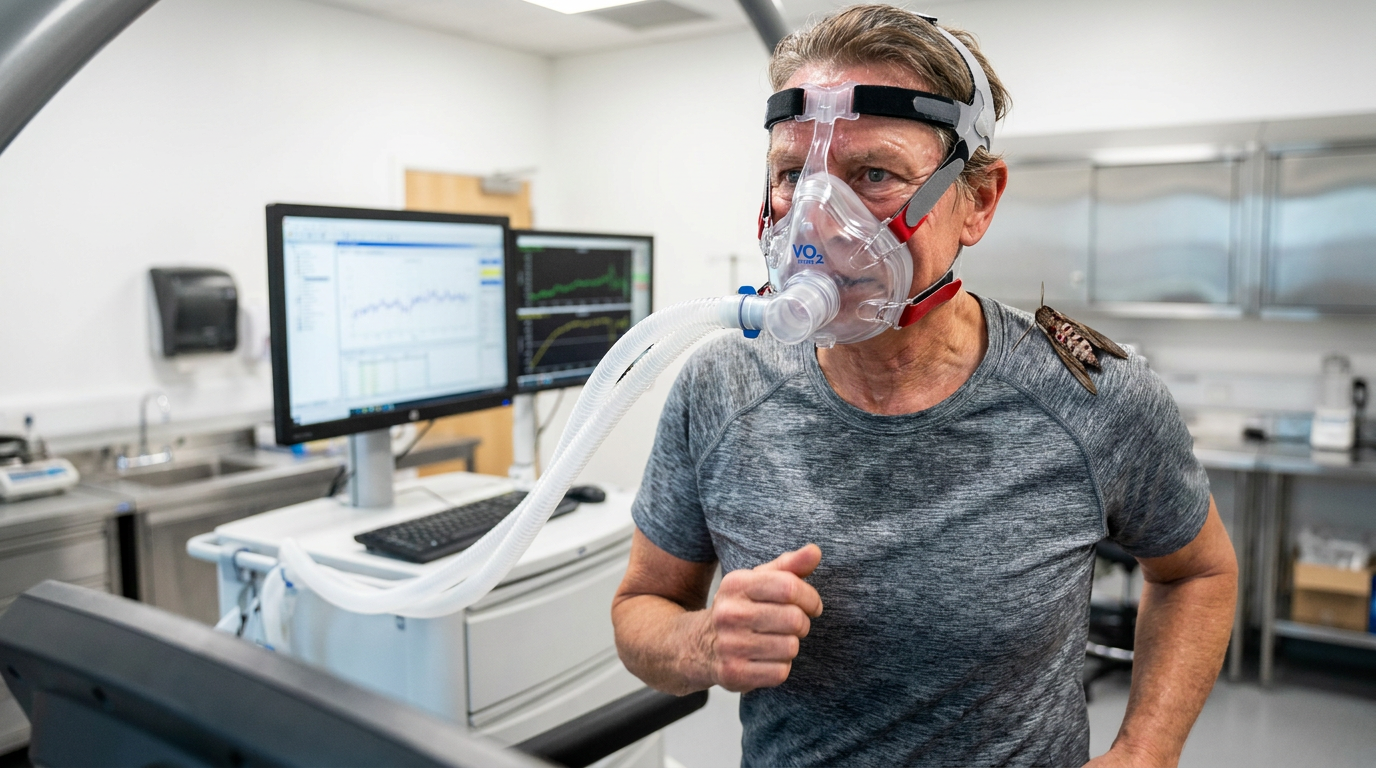
The evidence for cardiorespiratory fitness as a primary driver of longevity is anchored by a landmark study published in JAMA Network Open. Researchers at the Cleveland Clinic analyzed data from over 122,000 adults who underwent exercise treadmill testing over a 24-year period. The findings fundamentally shifted how the medical community views aerobic capacity.[2]
The study revealed that risk-adjusted all-cause mortality is inversely proportional to cardiorespiratory fitness. Individuals categorized as having "low" fitness faced a fivefold higher risk of death compared to those with "elite" fitness levels. Strikingly, the data showed that poor cardiovascular fitness is a worse predictor of long-term mortality than having coronary artery disease, being a smoker, or having diabetes.[2]

Historically, some sports cardiologists hypothesized a "U-shaped" curve for exercise, fearing that extreme levels of endurance training might eventually damage the heart and increase mortality. The JAMA data dismantled this concern. Researchers found no upper limit to the survival benefits of aerobic fitness; the "elite" performers—those in the top 2.3% of fitness for their age and sex—exhibited the lowest mortality rates of all, with no observed toxicity at the high end.[2]
The American Heart Association (AHA) has since advocated for cardiorespiratory fitness to be classified as a "clinical vital sign," arguing it should be assessed at every healthcare visit alongside blood pressure and heart rate. The AHA notes that for every 1-MET (Metabolic Equivalent of Task) increase in a patient's exercise capacity, their risk of all-cause mortality drops by 13% to 15%.[3]

The AHA notes that for every 1-MET (Metabolic Equivalent of Task) increase in a patient's exercise capacity, their risk of all-cause mortality drops by 13% to 15%.
While aerobic capacity dictates the health of the cardiovascular and respiratory systems, it represents only half of the physiological longevity equation. The other half is skeletal muscle. Often viewed purely through the lens of athletic performance or aesthetics, muscle tissue is now recognized by gerontologists as a vital endocrine organ and a primary metabolic sink for glucose.[4][5]
A comprehensive meta-analysis published in the British Journal of Sports Medicine examined the impact of muscle-strengthening activities across multiple major cohorts. The data demonstrated that regular resistance training is associated with a 15% to 20% lower risk of all-cause mortality, cardiovascular disease, and total cancer mortality, independent of aerobic exercise.[4]
The protective mechanism of muscle mass becomes critical in the later decades of life. Sarcopenia—the age-related loss of muscle mass and function—is a primary driver of frailty, falls, and subsequent loss of independence. By maintaining high levels of strength, older adults preserve their physical autonomy and drastically reduce their vulnerability to catastrophic injuries, such as hip fractures, which carry a high mortality rate in the elderly.[4][5]

The predictive power of these physiological markers is currently being weighed against the rise of molecular "aging clocks." Recent reviews in Nature Medicine highlight that while epigenetic clocks—which measure DNA methylation to estimate biological age—are powerful tools for understanding cellular aging, they sometimes fail to capture the functional improvements generated by exercise.[5]
For instance, a patient who begins a rigorous training program will rapidly improve their VO2 max, lower their resting heart rate, and increase their insulin sensitivity—all of which drastically reduce their near-term mortality risk. However, their molecular epigenetic clock may not immediately reflect these profound physiological upgrades, highlighting a gap between cellular markers and actual physical resilience.[1][5]
This discrepancy underscores why functional biomarkers remain the gold standard in clinical settings. While molecular profiling holds immense promise for the future of personalized medicine and anti-aging pharmacology, VO2 max and muscular strength offer immediate, proven, and highly modifiable targets for extending human healthspan.[1][3][5]
The synthesis of this data presents a clear, evidence-backed prescription for longevity. It requires a dual-pronged approach: high-intensity aerobic training to push the ceiling of cardiorespiratory fitness, combined with progressive resistance training to build and preserve a robust musculoskeletal system. In the hierarchy of longevity interventions, physical capability remains unmatched.[1][2][4]
How we got here
1989
The Cooper Center Longitudinal Study begins publishing early data linking treadmill performance to significantly reduced mortality.
2016
The American Heart Association publishes a scientific statement urging doctors to use cardiorespiratory fitness as a 'clinical vital sign.'
2018
JAMA Network Open publishes a landmark study of 122,000 patients, proving there is no upper limit to the longevity benefits of aerobic fitness.
2025
Nature Medicine reviews the landscape of aging biomarkers, affirming that physiological function currently outpredicts molecular clocks for mortality risk.
Viewpoints in depth
Physiological Aging Researchers
Focus on functional metrics as the ultimate ground truth for biological resilience.
This camp argues that while cellular mechanisms of aging are fascinating, the ultimate test of an organism's resilience is its physical capacity to perform work and survive stress. They point to massive epidemiological datasets proving that VO2 max and muscle mass are the most reliable, actionable, and clinically relevant biomarkers available today. For these researchers, longevity interventions should prioritize moving the needle on these functional tests before relying on experimental pharmacology.
Molecular Gerontologists
Focus on cellular hallmarks of aging and the development of molecular interventions.
Molecular gerontologists acknowledge the profound benefits of exercise but argue that physical training only optimizes the body within its current biological limits. To truly extend maximum human lifespan, they argue, science must address the root causes of aging at the cellular level—such as epigenetic degradation, telomere attrition, and cellular senescence. They view epigenetic clocks as the necessary next step for measuring the efficacy of true anti-aging drugs that exercise alone cannot replicate.
Preventive Medicine Advocates
Focus on the translation of longevity data into population-level health guidelines.
Public health officials and preventive medicine advocates view the data on VO2 max and muscle strength as a mandate to overhaul modern healthcare. They argue that the medical system is overly reliant on pharmaceutical interventions for chronic diseases that are fundamentally rooted in poor physical fitness. This camp advocates for 'exercise as medicine,' pushing for fitness assessments to become standard clinical vital signs and for structured exercise programs to be subsidized by health insurance.
What we don't know
- How exactly mechanical tension from resistance training translates into systemic anti-aging signals at the cellular level.
- Whether next-generation epigenetic clocks will eventually be calibrated to accurately reflect the rapid physiological age reversals caused by exercise.
Key terms
- VO2 Max
- The maximum rate at which the heart, lungs, and muscles can effectively use oxygen during exercise, serving as a primary indicator of aerobic fitness.
- MET (Metabolic Equivalent of Task)
- A unit used to estimate the metabolic cost of physical activity, where 1 MET equals the energy expended while sitting quietly.
- Sarcopenia
- The age-related, involuntary loss of skeletal muscle mass and strength, which is a major contributor to frailty in older adults.
- Epigenetic Clock
- A biochemical test that measures DNA methylation levels to estimate a person's biological age, which may differ from their chronological age.
Frequently asked
What is VO2 max?
VO2 max is the maximum amount of oxygen your body can utilize during intense exercise. It is considered the gold standard measurement of cardiovascular fitness and aerobic endurance.
Can you improve your VO2 max later in life?
Yes. While VO2 max naturally declines with age, structured aerobic training—particularly a mix of steady Zone 2 cardio and high-intensity interval training (HIIT)—can significantly improve aerobic capacity at any age.
Why is muscle mass important for longevity?
Muscle tissue acts as a metabolic sink that helps regulate blood sugar, while physical strength prevents frailty, reduces the risk of catastrophic falls, and helps maintain independence in old age.
Sources
Source coverage
5 outlets
3 viewpoints surfaced





[1]Factlen Editorial TeamPreventive Medicine Advocates
Synthesis by Factlen editorial team
Read on Factlen Editorial Team →[2]JAMA Network OpenPhysiological Aging Researchers
Association of Cardiorespiratory Fitness With Long-term Mortality Among Adults Undergoing Exercise Treadmill Testing
Read on JAMA Network Open →[3]American Heart AssociationPhysiological Aging Researchers
Importance of Assessing Cardiorespiratory Fitness in Clinical Practice: A Case for Fitness as a Clinical Vital Sign
Read on American Heart Association →[4]British Journal of Sports MedicinePhysiological Aging Researchers
Muscle-strengthening activities are associated with lower risk and mortality in major non-communicable diseases: a systematic review and meta-analysis of cohort studies
Read on British Journal of Sports Medicine →[5]Nature MedicineMolecular Gerontologists
Biomarkers of aging: from molecules and surrogates to physiology and function
Read on Nature Medicine →



Every angle. Every day.
Get health stories with full source coverage and perspective breakdowns delivered to your inbox.