
The Science of Sourdough: How Wild Microbes Transform Flour and Water
Recent genetic sequencing of hundreds of sourdough starters reveals the complex, symbiotic ecosystem of wild yeast and bacteria that gives the ancient bread its rise, flavor, and nutritional benefits.
By Factlen Editorial Team
- Microbial Ecologists
- Focus on the starter as a complex, evolving ecosystem shaped by environmental pressures.
- Culinary Scientists
- Focus on how microbial byproducts translate into the physical and sensory qualities of bread.
- Nutrition Researchers
- Focus on how prolonged fermentation alters the chemical composition of grains to benefit human digestion.
- Home Bakers
- Focus on the practical application, heritage, and emotional connection to the starter.
What's not represented
- · Commercial Yeast Manufacturers
- · Gluten-Free Bakers
Why this matters
Understanding the science of sourdough empowers home bakers to troubleshoot their starters and control the flavor of their bread, while highlighting how natural fermentation unlocks essential nutrients and improves the digestibility of everyday grains.
Key points
- A sourdough starter is a symbiotic ecosystem of wild yeast and lactic acid bacteria.
- Lactic acid bacteria outnumber wild yeast by 100 to 1 and produce the acids that give the bread its tangy flavor.
- The Global Sourdough Project sequenced 500 starters and found that geography does not determine a starter's microbial makeup.
- The type of flour used and the feeding schedule are the primary drivers of microbial diversity in a starter.
- Sourdough fermentation breaks down phytic acid, making the minerals in wheat more bioavailable to the human body.
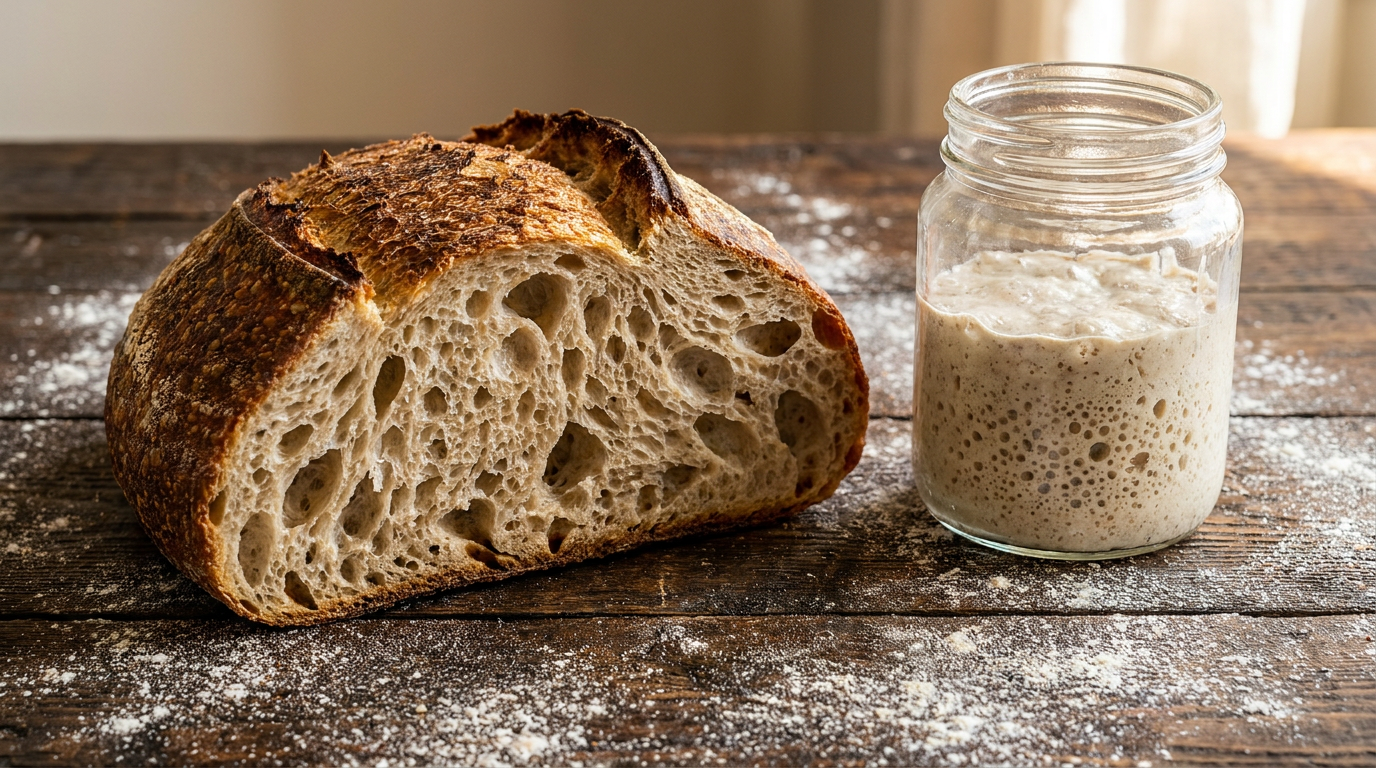
Bread is one of humanity's oldest technologies, yet the invisible mechanics that make it rise remained a mystery for millennia. Long before commercial baker's yeast was isolated in the 19th century, bakers relied on a living, bubbling mixture of flour and water known as a sourdough starter. Today, this ancient practice has captured the attention of modern microbiologists, who view the humble sourdough jar not just as a baking tool, but as a complex microscopic ecosystem.[1][2]
At its core, a sourdough starter is a symbiotic culture of wild yeast and bacteria. When a baker mixes flour and water and leaves it at room temperature, naturally occurring microbes from the grain and the surrounding environment begin to colonize the paste. Over several days of regular feeding, a microscopic turf war ensues until a stable, cooperative community emerges.[2][4]
The primary engine of leavening in this ecosystem is wild yeast. Unlike the single, highly optimized strain of Saccharomyces cerevisiae found in commercial yeast packets, a sourdough starter can host a diverse array of wild yeasts, including Kazachstania and Saccharomyces exiguus. These hardy fungi consume the complex carbohydrates present in the flour, metabolizing them into ethanol and carbon dioxide.[2][3]
As the yeast produces carbon dioxide, the gas becomes trapped in the elastic network of gluten proteins developing within the dough. This process creates the expanding air pockets that give sourdough bread its characteristic rise and open, airy crumb structure. However, the yeast does not work alone; it is vastly outnumbered by its bacterial partners.[1][4]
Lactic acid bacteria (LAB) are the unsung heroes of the sourdough microbiome. In a mature starter, these bacteria typically outnumber yeast cells by a staggering ratio of 100 to 1. The most prominent among them is Lactobacillus sanfranciscensis, a species that thrives in the carbohydrate-rich environment of fermenting dough.[1][2]

The relationship between the wild yeast and the lactic acid bacteria is a textbook example of mutualistic symbiosis. They do not compete for the exact same sugars, allowing them to coexist peacefully. More importantly, as the bacteria feed, they produce copious amounts of lactic and acetic acids. This rapidly lowers the pH of the starter to a highly acidic level, typically between 3.5 and 4.5.[2][4]
This acidic environment serves a dual purpose. First, it acts as a powerful defense mechanism, killing off harmful food-borne pathogens and mold that might otherwise spoil the dough. The wild yeasts, having evolved to tolerate high acidity, are left to thrive unbothered. Second, these organic acids are entirely responsible for the complex, tangy flavor profile that defines sourdough bread.[1][2]
First, it acts as a powerful defense mechanism, killing off harmful food-borne pathogens and mold that might otherwise spoil the dough.
The specific flavor of a loaf is dictated by the balance of these acids. Lactic acid provides a mild, creamy, yogurt-like sourness, while acetic acid delivers a sharper, more pungent vinegar note. Bakers can subtly manipulate this balance through temperature control and hydration levels, effectively steering the microbial metabolism to suit their culinary preferences.[1][5]
For decades, a pervasive myth dominated the baking world: the idea that specific geographic locations harbored unique wild yeasts that made their bread superior. The legendary "San Francisco sourdough" was widely believed to be impossible to replicate outside of Northern California due to the local coastal air.[5][7]
To test this hypothesis, an international team of researchers launched the Global Sourdough Project. They collected and genetically sequenced 500 sourdough starters from bakers across four continents, utilizing advanced metabarcoding techniques to map the microbial diversity of each sample. The results fundamentally rewrote the scientific understanding of sourdough biogeography.[1][5]
The sequencing revealed that geography plays almost no role in determining a starter's microbial makeup. A starter cultivated in Paris is virtually indistinguishable from one grown in San Francisco or Tokyo. Instead, the researchers discovered that the specific conditions within the baker's kitchen—and the choices the baker makes—are the true drivers of microbial diversity.[1][5]

The most significant factor shaping the sourdough microbiome is the type of flour used for feeding. Recent studies have demonstrated that different flours act as distinct evolutionary frameworks. Whole wheat flour, which contains more of the grain's bran and germ, introduces a different set of baseline microbes and nutrients than refined bread flour, actively selecting for different bacterial communities over time.[3][7]
Beyond flavor and leavening, this microbial ecosystem also fundamentally alters the nutritional profile of the bread. The prolonged fermentation process allows the lactic acid bacteria to produce enzymes that degrade phytic acid, an anti-nutrient naturally present in wheat that binds to essential minerals. By breaking down the phytic acid, sourdough fermentation makes minerals like iron, zinc, and magnesium significantly more bioavailable to the human body.[4][7]

Furthermore, the acidic environment and bacterial enzymes work together to partially pre-digest the gluten proteins in the flour. While sourdough is absolutely not safe for individuals with celiac disease, this enzymatic degradation can make the bread noticeably easier to digest for people with mild gluten sensitivities, reducing the bloating often associated with commercial bread.[4][7]
Ultimately, every sourdough starter is a living, breathing reflection of its environment and its caretaker. Even the microbes present on the baker's own hands can become integrated into the starter's ecosystem. Baking sourdough is not merely a culinary technique; it is a daily practice of applied microbiology, where humans and microbes collaborate to transform simple flour and water into something extraordinary.[2][7]
How we got here
2000 BC
Ancient Egyptians likely discover sourdough fermentation by accident when wild microbes colonize dough.
1849
The California Gold Rush popularizes 'San Francisco sourdough,' sparking the myth of geographically unique yeast.
2020
A pandemic-induced baking surge prompts scientists to launch citizen-science initiatives to study home starters.
Jan 2021
The Global Sourdough Project publishes genetic data proving flour and feeding habits outweigh geography.
Jan 2026
New research demonstrates that different flours actively select for distinct bacterial communities over time.
Viewpoints in depth
The Microbial Ecology View
Focuses on the starter as a complex, evolving ecosystem shaped by environmental pressures.
Ecologists view sourdough starters as a rare, accessible model for studying microbial evolution in real-time. By sequencing hundreds of starters, they have demonstrated that a starter's biodiversity is not a product of its geographic zip code, but rather the specific evolutionary pressures applied by the baker—such as the type of grain provided and the frequency of feeding.
The Culinary Science View
Focuses on how microbial byproducts translate into the physical and sensory qualities of bread.
For culinary scientists, the magic of sourdough lies in the metabolic byproducts of fermentation. They study how the specific ratio of acetic acid to lactic acid dictates the sharpness of the bread's flavor, and how the carbon dioxide produced by wild yeast interacts with the flour's gluten network to create the bread's airy crumb structure.
The Nutritional Science View
Focuses on how prolonged fermentation alters the chemical composition of grains to benefit human digestion.
Nutrition researchers emphasize the biochemical transformation that occurs during a long sourdough ferment. They highlight how lactic acid bacteria produce enzymes that degrade phytic acid—a compound in wheat that normally inhibits the absorption of minerals like iron and zinc. Furthermore, the partial breakdown of gluten proteins during fermentation can make sourdough more tolerable for individuals with mild digestive sensitivities.
What we don't know
- Exactly how the hundreds of different wild yeast strains interact with one another when multiple species colonize the same starter.
- The full extent to which the baker's own skin microbiome permanently alters the long-term genetic makeup of the starter.
- Whether specific, undiscovered strains of lactic acid bacteria could be isolated to create targeted probiotic breads.
Key terms
- Lactic Acid Bacteria (LAB)
- Beneficial bacteria that ferment carbohydrates into lactic acid, providing sourdough's signature tang and preserving the bread.
- Wild Yeast
- Naturally occurring single-celled fungi found on grains and in the environment, responsible for leavening the dough.
- Phytic Acid
- An anti-nutrient in grains that binds to minerals; it is broken down during sourdough fermentation, increasing nutritional value.
- Metabarcoding
- A genetic sequencing technique used to quickly identify all the different microbial species present in a complex sample.
- Symbiosis
- A mutually beneficial relationship between different organisms, such as the cooperation between yeast and bacteria in a starter.
Frequently asked
Can I make a sourdough starter with any flour?
Yes, but whole grain flours like rye or whole wheat contain more wild microbes and nutrients, making it easier to establish a healthy starter quickly.
Why does my starter smell like nail polish remover?
A strong acetone smell indicates that the starter is hungry and the yeast has exhausted its food supply. Feeding it fresh flour and water restores the balance.
Is sourdough bread gluten-free?
No. While fermentation breaks down some gluten proteins, making it easier to digest for those with mild sensitivities, it is not safe for people with celiac disease.
Does my city change how my sourdough tastes?
No. Recent genetic sequencing shows that the specific flour you use and how often you feed the starter matter far more than your geographic location.
Sources
Source coverage
7 outlets
4 viewpoints surfaced






[1]eLifeMicrobial Ecologists
The diversity and function of sourdough starter microbiomes
Read on eLife →[2]American Society for MicrobiologyMicrobial Ecologists
The Sourdough Microbiome
Read on American Society for Microbiology →[3]ScienceDailyCulinary Scientists
The hidden microbes that decide how sourdough tastes
Read on ScienceDaily →[4]National Institutes of HealthNutrition Researchers
Microbial Communities in Different Sourdough Starters
Read on National Institutes of Health →[5]Science FridayCulinary Scientists
Mapping Sourdough Microbes From Around The World
Read on Science Friday →[6]North Carolina State UniversityMicrobial Ecologists
The Wild Sourdough Project
Read on North Carolina State University →[7]Factlen Editorial TeamHome Bakers
Synthesis by Factlen editorial team
Read on Factlen Editorial Team →

Every angle. Every day.
Get food drink stories with full source coverage and perspective breakdowns delivered to your inbox.