
The Multimillion-Dollar Science Behind the 2026 World Cup's Perfect Pitch
To ensure player safety and consistent gameplay across 16 North American stadiums, agronomists have spent five years engineering a revolutionary hybrid turf system for the 2026 FIFA World Cup.
By Factlen Editorial Team
- Turfgrass Researchers
- Focus on the technical achievement of standardizing a biological organism across diverse microclimates.
- Player Safety Advocates
- Emphasize the critical need for natural grass to reduce non-contact lower-body injuries.
- Sports Business & Operations
- Highlight the logistical and financial challenges of retrofitting domed, artificial-turf NFL stadiums.
What's not represented
- · Environmental sustainability advocates monitoring the water and energy usage of indoor grass.
- · Local municipal parks departments awaiting the trickle-down benefits of the turf research.
Why this matters
The unprecedented effort to standardize natural grass across diverse climates will not only protect the world's top soccer players from career-altering injuries, but also revolutionize how local parks and university fields are built and maintained.
Key points
- FIFA mandates natural grass for all 2026 World Cup matches, requiring 8 artificial-turf stadiums to convert temporarily.
- Agronomists from the University of Tennessee and Michigan State spent five years developing a shallow-profile hybrid grass system.
- The hybrid system weaves natural grass into synthetic fibers, providing the stability needed for a shallow root base over concrete.
- Indoor stadiums will rely on massive LED grow lights and subsurface irrigation to keep the grass alive and uniform.
The 2026 FIFA World Cup is poised to be the largest and most logistically complex tournament in the history of global sports. Spanning three countries, four time zones, and featuring an expanded roster of 48 national teams, the sheer scale of the event is unprecedented. Yet, behind the billion-dollar broadcast deals and the sprawling infrastructure, the most critical challenge facing organizers is entirely biological: the ground the players will run on. Ensuring a flawless, uniform playing surface across 16 vastly different North American venues has sparked one of the most ambitious agronomic engineering projects ever undertaken.[5]
FIFA regulations strictly mandate that all Men's World Cup matches must be played on natural grass. This requirement presents a monumental hurdle for the 2026 host nations, as half of the 16 selected stadiums—including massive venues like AT&T Stadium in Dallas and Mercedes-Benz Stadium in Atlanta—normally utilize artificial turf. Furthermore, several of these stadiums are fully enclosed domes or feature retractable roofs that severely limit natural sunlight. Transforming these synthetic, climate-controlled environments into pristine natural grass pitches requires far more than simply rolling out sod.[3][4]
To solve this unprecedented challenge, FIFA initiated a five-year, multimillion-dollar scientific endeavor in 2021. The global soccer governing body tapped the world-renowned turfgrass science programs at the University of Tennessee and Michigan State University to lead the research. This collaborative effort was tasked with developing, testing, and ultimately delivering a standardized natural grass system that could survive and thrive in environments where grass was never meant to grow, all while withstanding the punishing wear and tear of elite international soccer.[1][5]
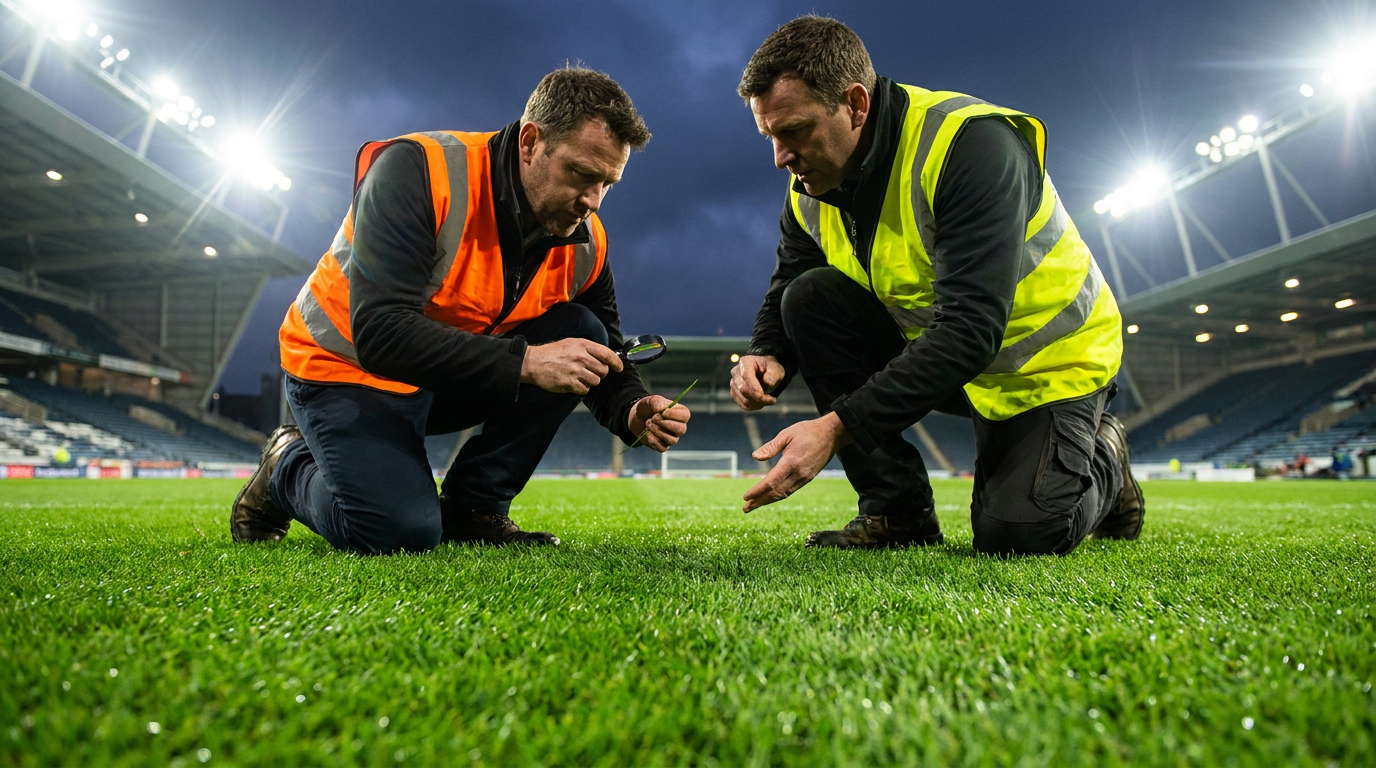
Dr. John Sorochan, a distinguished professor of turfgrass science and management at the University of Tennessee, is spearheading this monumental effort. Sorochan and his team of agronomists have spent years working to engineer a playing surface that behaves exactly the same in the humid, sea-level heat of Miami as it does in the high-altitude, arid air of Mexico City or the enclosed, air-conditioned environment of a domed NFL stadium. The goal is absolute consistency, ensuring that a ball rolls and bounces identically regardless of the geographic location.[1][2]

The core innovation driving this project is the development of a highly specialized "shallow profile system." Traditional natural grass sports fields rely on deep root zones extending several inches into the earth to provide stability and moisture retention. However, installing a traditional deep-root field temporarily over the concrete floors of NFL stadiums is structurally and logistically impossible. The shallow profile system allows the grass to grow in a much thinner layer of engineered sand, drastically reducing the weight and depth required for installation.[1]
Because a shallow root system is inherently less stable, researchers had to find a way to prevent the grass from tearing under the immense shear force generated by world-class athletes. The solution is a hybrid-reinforced natural grass system. In this setup, the natural grass is grown into a matrix of synthetic fibers that are stitched into the sand base. These synthetic fibers act as an artificial root system, anchoring the natural grass and providing immense structural integrity to the pitch, even when the biological roots are confined to a shallow profile.[1][2]
This hybrid approach is critical for player safety, which remains the primary driver behind FIFA's natural grass mandate. Elite soccer players change direction at full sprint, generating massive rotational forces on their lower bodies. Artificial turf is notorious for "locking" a player's cleat into the surface, leading to devastating non-contact injuries like torn anterior cruciate ligaments (ACLs). The hybrid-reinforced natural grass is engineered to provide exactly the right amount of rotational traction—gripping enough to prevent slipping, but giving way just enough to protect the players' joints.[4][5]
This hybrid approach is critical for player safety, which remains the primary driver behind FIFA's natural grass mandate.
Growing this highly engineered grass indoors presents another monumental hurdle for the agronomy teams. Stadiums with fixed roofs completely block the sun, while those with retractable roofs often create complex, shifting shadow patterns that prevent uniform grass growth. To counteract this, stadium operators will deploy massive arrays of specialized LED grow lights. These towering rigs will be rolled onto the pitches daily, bathing the grass in precisely calibrated wavelengths of light to simulate the sun's energy.[3][5]

The lighting systems are meticulously programmed to deliver the exact amount of photosynthetic active radiation (PAR) required by the specific grass species chosen for each venue. Agronomists have mapped the microclimates of every stadium, calculating the precise daily light integral (DLI) needed to keep the grass in a state of vigorous growth. This artificial sunlight ensures that the pitch can recover rapidly from the damage inflicted during a 90-minute match, even in the darkest enclosed stadiums.[1][5]
Moisture and temperature control are equally critical components of the shallow profile system. Because the sand base is so thin, it can dry out or overheat rapidly. To manage this, the research teams have integrated advanced subsurface irrigation and vacuum ventilation systems into the pitch design. These systems can pump water directly into the root zone from below, or use powerful vacuums to pull excess moisture out of the grass canopy during heavy rain, while simultaneously regulating the temperature of the soil down to the millimeter.[1]
At the University of Tennessee's research facility in Knoxville, scientists constructed an indoor simulator to rigorously test how different grass strains respond to the varied microclimates of the 16 host cities. Inside this controlled environment, the turf is subjected to simulated foot traffic, heavy rolling, and mechanical wear that mimics the intensity of a World Cup match. This allows the researchers to identify the most resilient grass varieties and fine-tune their maintenance protocols long before the tournament begins.[1][2]
The testing process involves highly specialized biomechanical equipment designed to replicate the exact forces exerted by a soccer player. Researchers use mechanical legs fitted with standard soccer cleats to strike and twist the turf, meticulously measuring the rotational traction and surface hardness. The data ensures that the pitch is neither too soft, which causes rapid muscle fatigue, nor too hard, which increases the risk of impact injuries and concussions when players fall.[4][5]

The behavior of the soccer ball itself is also subject to rigorous scientific standardization. A pass hit with a specific amount of force must travel the exact same distance on the pitch in Toronto as it does on the pitch in Houston. To achieve this, agronomists measure the "ball roll" and "ball rebound" using standardized ramps and drop tests. The grass canopy must be mowed to a precise millimeter height and maintained at a specific density to guarantee that the ball interacts with the surface identically across all 16 venues.[1][4]
As the tournament approaches, the logistics of the physical rollout are staggering. The specialized sod is currently being grown at highly controlled turf farms across North America. Harvesting this grass requires precise timing; it must be cut into massive rolls, transported in a fleet of climate-controlled trucks, and installed in the stadiums just weeks before the opening matches. Once laid down, the seams must seamlessly knit together to form a perfectly flat, uniform surface.[2][5]

Beyond the immediate spectacle of the 2026 World Cup, the legacy of this multimillion-dollar research project will extend far into the future of grassroots sports. The data gathered on shallow-profile systems, hybrid reinforcement, and drought-resistant grass varieties will eventually trickle down to the municipal level. The techniques pioneered for FIFA will inform the construction of safer, more sustainable, and more resilient public parks, high school fields, and university athletic facilities around the world.[1][5]
When the first whistle blows in June 2026, the eyes of billions will be on the world's greatest athletes. But beneath their cleats lies a triumph of modern science. If Dr. Sorochan and his vast team of agronomists succeed in their mission, the pitches will go entirely unnoticed by the fans—flawless, consistent, and safe, serving as the invisible foundation for the beautiful game.[5]
How we got here
2021
FIFA initiates a five-year research project with the University of Tennessee and Michigan State University to develop the perfect pitch.
2022–2024
Researchers develop and test the shallow profile hybrid grass system in controlled laboratory environments.
February 2025
FIFA President Gianni Infantino visits the UT turf project in Knoxville to review the progress of the grass testing.
Early 2026
Specialized sod farms across North America begin the final growth phase for the stadium pitches.
June 2026
The 2026 FIFA World Cup kicks off on the newly engineered natural grass surfaces.
Viewpoints in depth
Agronomists and Turf Scientists
Focus on the technical achievement of standardizing a biological organism across diverse microclimates.
For the scientific community, the 2026 World Cup represents a moonshot in agronomic engineering. Researchers emphasize that standardizing a living, biological organism across 16 vastly different microclimates—from the humidity of Miami to the altitude of Mexico City—is an unprecedented achievement. They view the development of the hybrid-reinforced shallow profile system as a breakthrough that will push the boundaries of sports field management for decades.
Player Safety Advocates
Emphasize the critical need for natural grass to reduce non-contact lower-body injuries.
Sports medicine professionals and player unions have long argued against the use of artificial turf, citing higher rates of non-contact injuries like ACL tears. This camp strongly supports FIFA's uncompromising mandate for natural grass, arguing that the multimillion-dollar investment in temporary pitches is a necessary cost to protect the health and careers of the world's top athletes during the sport's most important tournament.
Stadium Operators
Highlight the logistical and financial challenges of retrofitting domed, artificial-turf NFL stadiums.
For the management teams running massive NFL venues like AT&T Stadium or Mercedes-Benz Stadium, the natural grass mandate presents a monumental logistical and financial hurdle. These operators point out that their facilities were explicitly designed for low-maintenance artificial turf. Retrofitting them with temporary shallow-profile grass, deploying massive LED grow lights, and managing complex irrigation systems indoors requires a staggering temporary infrastructure overhaul.
What we don't know
- It remains to be seen how perfectly the temporary shallow-profile pitches will hold up during the later knockout stages of the tournament after weeks of heavy use.
- The exact environmental footprint—specifically the energy required to power the massive LED grow lights in domed stadiums—has not been fully quantified.
Key terms
- Shallow profile system
- A method of growing natural grass in a thin layer of engineered sand, designed to be installed temporarily over hard surfaces like stadium concrete.
- Hybrid-reinforced grass
- Natural grass grown into a synthetic fiber matrix, which anchors the roots and prevents the turf from tearing under the stress of athletic movements.
- Photosynthetic active radiation (PAR)
- The specific wavelengths of light that plants use for photosynthesis, which are replicated by specialized LED stadium grow lights.
- Rotational traction
- The amount of grip a playing surface provides to an athlete's cleat when they pivot or change direction, a key metric for preventing joint injuries.
Frequently asked
Why doesn't FIFA just use artificial turf?
FIFA mandates natural grass for the Men's World Cup to ensure consistent ball behavior and to significantly reduce the risk of non-contact lower-body injuries associated with synthetic surfaces.
How do they grow grass in indoor stadiums?
Agronomists use advanced LED grow lights, precise climate control, and subsurface irrigation to replicate the ideal outdoor growing conditions inside enclosed domed stadiums.
What happens to the grass after the World Cup?
While some stadiums may opt to keep the natural grass, many of the temporary shallow-profile pitches will be removed and repurposed for local parks or training facilities.
Sources
Source coverage
5 outlets
3 viewpoints surfaced





[1]University of Tennessee Institute of AgricultureTurfgrass Researchers
Tackling turfgrass: UT experts lead World Cup 26 research
Read on University of Tennessee Institute of Agriculture →[2]United States Golf AssociationTurfgrass Researchers
Creating the Perfect Pitch for the 2026 FIFA World Cup With Dr. John Sorochan
Read on United States Golf Association →[3]Sports Business JournalSports Business & Operations
Power Players: FIFA World Cup 2026 — John Sorochan, University of Tennessee
Read on Sports Business Journal →[4]The New York TimesPlayer Safety Advocates
The Scientific Quest for Perfect World Cup Pitch
Read on The New York Times →[5]Factlen Editorial TeamTurfgrass Researchers
Synthesis by Factlen editorial team
Read on Factlen Editorial Team →

Every angle. Every day.
Get science stories with full source coverage and perspective breakdowns delivered to your inbox.