
How AI is Decoding Animal Communication and Transforming Conservation
Breakthroughs in machine learning are allowing scientists to map the complex languages of whales, birds, and other species, opening a new frontier in wildlife protection.
By Factlen Editorial Team
- Bioacoustic Researchers
- Focused on the technological frontier of decoding syntax and semantics.
- Conservationists
- Focused on scaling AI as a tool for ecological monitoring and protection.
- Ethicists and Skeptics
- Focused on the philosophical limits of translation and the risks of intervention.
What's not represented
- · Indigenous communities with traditional ecological knowledge
- · Commercial shipping operators affected by noise regulations
Why this matters
By translating the complex vocalizations of wildlife, AI is providing conservationists with unprecedented tools to monitor ecosystem health, detect poaching in real time, and build a legal framework for animal rights based on proven sentience.
Key points
- AI is using unsupervised machine learning to decode the complex communication systems of animals, including sperm whales and birds.
- Project CETI has discovered that sperm whale clicks possess a highly structured 'phonetic alphabet' with distinct rhythms and dialects.
- Conservationists are using open-source AI models like Google DeepMind's Perch to monitor rainforest biodiversity in real time.
- Acoustic sensors are being deployed in the Global South to instantly detect and alert rangers to illegal logging and poaching.
- Ethicists warn that actively broadcasting AI-generated sounds into the wild could disrupt natural ecosystems and social structures.
For centuries, humans have drawn a firm line between themselves and the rest of the animal kingdom, anchored by the belief that complex language is a uniquely human trait. That boundary is now dissolving. Driven by unprecedented advances in artificial intelligence, researchers are beginning to decode the intricate vocalizations of species ranging from sperm whales to rainforest birds. This is not a parlor trick or science fiction; it is a rapidly maturing scientific discipline known as digital bioacoustics. By applying the same machine learning architectures that power modern large language models, scientists are uncovering syntax, dialects, and social context in the sounds of the wild.[1][2]
The implications extend far beyond academic curiosity. Conservationists view this technological leap as the equivalent of inventing the microscope—a tool that reveals an entirely new dimension of the natural world. As global biodiversity faces mounting pressures, the ability to listen to ecosystems at scale offers a non-invasive, highly accurate method for monitoring wildlife health. From detecting the earliest signs of habitat collapse to identifying the specific dialects of endangered pods, AI-powered bioacoustics is fundamentally reshaping how humanity interacts with and protects nature.[3][4]
The mechanism driving this revolution relies on passive acoustic monitoring (PAM) paired with unsupervised machine learning. Traditionally, scientists placed microphones in habitats to capture "sound diaries," but analyzing thousands of hours of audio manually was an insurmountable bottleneck. Today, AI models ingest these massive datasets and convert the audio into spectrograms—visual representations of sound frequencies over time.[3]
Without needing a "Rosetta Stone" or pre-labeled data, unsupervised machine learning algorithms search these spectrograms for hidden structures. They identify recurring patterns, group similar sounds, and map the relationships between different acoustic signals. This allows the AI to build a foundational understanding of an animal's communication system from the ground up, isolating distinct "words" or phrases even in noisy environments like a bustling rainforest or a stormy ocean.[1][2]

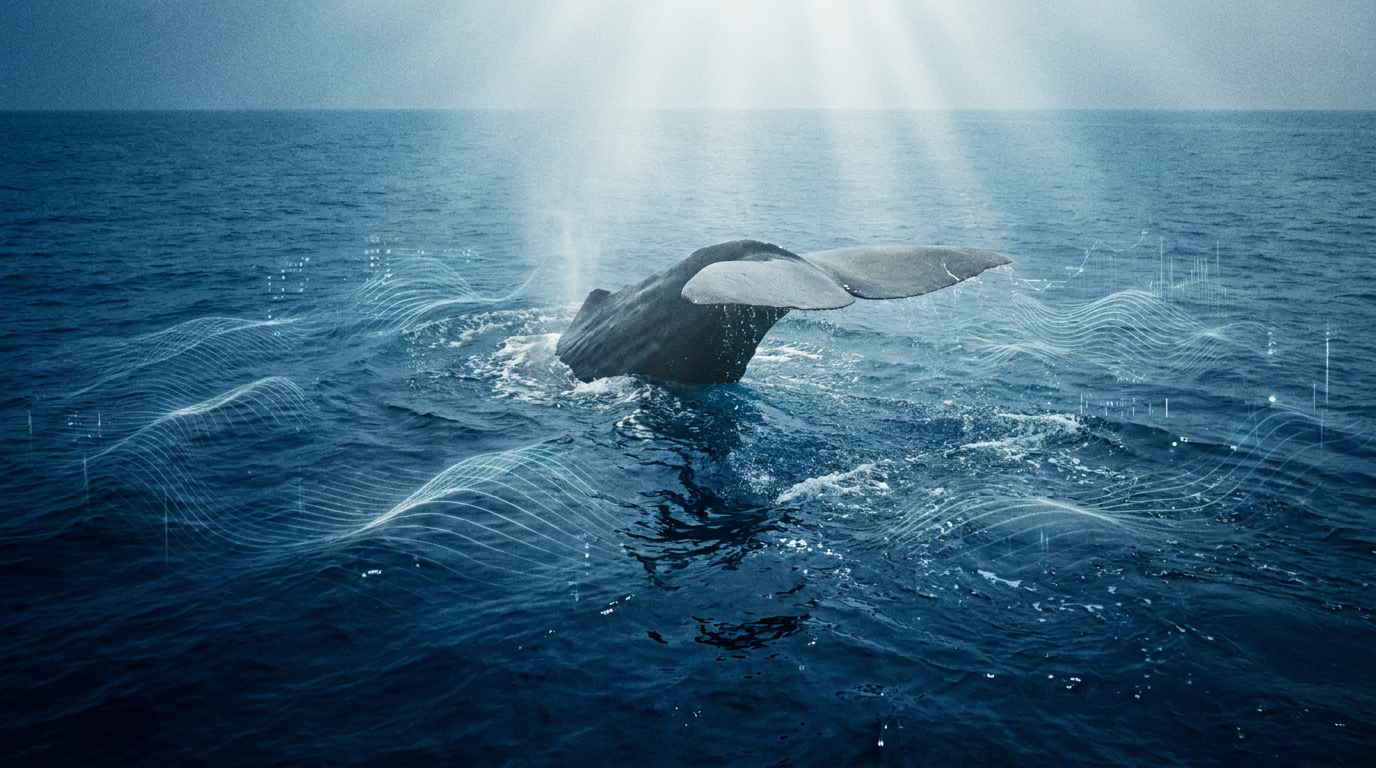
The most high-profile application of this technology is unfolding deep underwater. Project CETI (Cetacean Translation Initiative) is a multidisciplinary effort dedicated to decoding the communication of sperm whales. Sperm whales possess the largest brains on Earth, live in complex, matrilineal societies, and communicate across vast distances using rapid bursts of clicks known as codas. For decades, researchers assumed these codas functioned like a simple maritime Morse code.[1][5]
Machine learning has shattered that assumption. By feeding thousands of recorded codas into AI models, Project CETI discovered that sperm whale communication possesses a highly structured "phonetic alphabet." The whales actively vary the rhythm, tempo, and duration of their clicks, combining elements in different sequences to alter their meaning—much like humans combine sounds to form different words. The AI even identified vowel-like features within the clicks, a structural complexity previously thought to be exclusive to human speech.[1][2]
Gathering the data required to train these models is a monumental engineering challenge. To capture pristine audio and contextual behavioral data, Project CETI researchers deploy delicate, non-invasive robotics. Recently, the team developed a "tap-and-go" drone system that allows them to attach temporary, suction-cup recording tags to whales from the air. This method is significantly faster and gentler than traditional boat-based tagging, minimizing stress on the animals while yielding high-fidelity acoustic data.[5]
Gathering the data required to train these models is a monumental engineering challenge.
The analytical results have been staggering. Project CETI's deep learning techniques have achieved a 99.5% accuracy rate in isolating sperm whale clicks from background ocean noise. Furthermore, the AI can categorize dozens of distinct click patterns with 97.5% accuracy and recognize specific regional whale dialects with 95.3% accuracy. These metrics prove that AI can reliably parse the aquatic language; the next phase is mapping those parsed sounds to specific social behaviors to understand their exact meaning.[5]

While Project CETI focuses deeply on a single species, other organizations are taking a broader approach. The Earth Species Project (ESP), which recently secured $17 million in funding, is building multimodal foundation models designed to decode the languages of multiple species simultaneously. ESP operates on the premise that the fundamental architectures of machine translation can be applied universally, whether the subject is a primate, a cetacean, or a bird.[6][7]
ESP's field research involves deploying miniature "biologgers" on wild animals, such as crows. These tiny, lightweight devices capture close-range vocalizations that environmental microphones often miss, while simultaneously recording the animal's movement and social interactions. By feeding this multimodal data into AI, researchers can map specific calls to specific contexts—determining, for instance, if a crow uses a different acoustic pattern when addressing a mate versus a rival.[6]
Beyond translation, bioacoustic AI is being deployed as a real-time planetary alarm system. Google DeepMind recently released Perch, an open-source AI model designed to help conservationists analyze audio and interpret bioacoustic data at unprecedented speeds. Perch is particularly adept at handling the chaotic, overlapping symphony of tropical rainforests, isolating the calls of rare and elusive species from the deafening hum of insects.[3]
This capability arrives at a critical moment. With an estimated 61% of global bird populations currently in decline, traditional visual surveys are too slow and labor-intensive to track the crisis effectively. Perch allows a handful of researchers to monitor hundreds of square miles of canopy simultaneously, providing real-time data on population densities and migration shifts. Because the model is open-source, it is freely available to underfunded conservation groups worldwide.[3]

The integration of AI and bioacoustics is also actively fighting environmental crime. The Cornell Lab of Ornithology recently received a $1.8 million grant from the Bezos Earth Fund to deploy AI-powered acoustic sensors in the Global South, including Guatemala's Maya Biosphere Reserve and Brazil's Pantanal wetland. These systems do more than count birds; they are trained to recognize the acoustic signatures of illegal logging chainsaws, gunshots, and unauthorized vehicle engines.[4]
When a threat is detected, the AI can instantly transmit an alert to local park rangers, transforming passive monitoring into active, real-time defense. This represents the first biome-wide ecosystem health assessment conducted via acoustics in the Global South, shifting conservation from a reactive science to a proactive one.[4]
Despite these profound breakthroughs, significant uncertainties remain. The most profound philosophical hurdle is the "umwelt" problem—the reality that an animal's subjective experience of the world is fundamentally different from a human's. Even if an AI perfectly maps the syntax of a whale's coda, human researchers may struggle to comprehend a concept that relies on echolocation or deep-sea pressure dynamics. Translating the structure of a language does not guarantee an understanding of its meaning.[1][2]
There are also mounting ethical questions regarding how this technology should be used. As AI models become capable of generating synthetic animal calls, researchers face the temptation of "talking back." Some conservationists are already playing synthesized sounds in degraded coral reefs to attract fish and encourage ecosystem recovery. However, ethicists warn that actively injecting AI-generated language into wild populations could disrupt natural social structures or introduce unforeseen behavioral consequences.[7]
Ultimately, the most powerful outcome of decoding animal communication may not be what we say to them, but how listening changes us. Proponents argue that proving the existence of complex animal languages could force a global paradigm shift in environmental law. If species like sperm whales are recognized as possessing culture, dialects, and language, it dramatically strengthens the legal and moral arguments for granting them fundamental rights and protecting their acoustic habitats from human noise pollution.[1]
How we got here
March 2020
Project CETI is founded to apply advanced machine learning to the acoustic codas of sperm whales.
Late 2023
The Earth Species Project begins deploying miniature biologgers on wild animals to map vocalizations to social contexts.
October 2025
The Bezos Earth Fund awards a $1.8 million grant to the Cornell Lab of Ornithology to scale real-time AI bioacoustics in the Global South.
December 2025
Google DeepMind releases Perch, an open-source AI model designed to help conservationists analyze complex rainforest audio.
Viewpoints in depth
Bioacoustic Researchers
Focused on the technological frontier of decoding syntax and semantics.
For computer scientists and marine biologists leading initiatives like Project CETI and the Earth Species Project, the primary focus is on the data. They view animal communication as a complex cryptographic puzzle that unsupervised machine learning is uniquely equipped to solve. By treating vocalizations as massive datasets, these researchers argue that AI can bypass human cognitive biases, identifying structural nuances—like rhythm, tempo, and vowels—that the human ear simply cannot process. Their ultimate goal is a foundational model capable of translating the core mechanics of interspecies communication.
Conservationists
Focused on scaling AI as a tool for ecological monitoring and protection.
Ecologists and wildlife managers view bioacoustic AI through a highly pragmatic lens: it is a force multiplier for protecting endangered ecosystems. Rather than focusing on the philosophical implications of 'talking' to animals, this camp prioritizes the technology's ability to process thousands of hours of audio to track population health, map migration shifts, and detect immediate threats. For conservationists, an AI that can instantly alert rangers to the sound of a poacher's gunshot or a logger's chainsaw is the most urgent and valuable application of the technology.
Ethicists and Skeptics
Focused on the philosophical limits of translation and the risks of intervention.
While acknowledging the technological leaps, ethicists and behavioral ecologists caution against unchecked enthusiasm. They highlight the 'umwelt' problem, arguing that because animals experience the world through entirely different sensory and environmental realities, true semantic translation may be impossible. Furthermore, they raise significant concerns about the next phase of bioacoustics: generating synthetic animal calls. Skeptics warn that broadcasting AI-generated sounds into wild habitats—even for conservation purposes—could disrupt delicate social structures, confuse mating patterns, and introduce unforeseen ecological consequences.
What we don't know
- Whether AI can translate the actual meaning of animal sounds, or merely map their structural syntax.
- How animals will react if humans begin broadcasting AI-generated, species-specific vocalizations back into their habitats.
- Whether the discovery of complex animal languages will be enough to legally redefine the rights of species like whales.
Key terms
- Bioacoustics
- The cross-disciplinary science that combines biology and acoustics to study how animals produce and perceive sound.
- Codas
- Rapid sequences of rhythmic clicks used by sperm whales to communicate with one another.
- Spectrogram
- A visual representation of the spectrum of frequencies of a sound as it varies with time, allowing AI to "see" audio patterns.
- Unsupervised Machine Learning
- A type of AI that looks for previously undetected patterns in a dataset with no pre-existing labels and minimum human supervision.
- Umwelt
- The unique, subjective sensory world that a particular organism inhabits and experiences, which may differ vastly from human perception.
Frequently asked
Can we actually talk to animals now?
Not yet. AI is currently mapping the structure, syntax, and dialects of animal sounds, but translating the exact meaning—and holding a two-way conversation—remains a future goal.
Why focus on sperm whales?
Sperm whales have the largest brains on Earth, live in complex, multi-generational family structures, and communicate using highly structured acoustic clicks that are ideal for AI analysis.
How does this help conservation?
Beyond translation, bioacoustic AI can monitor ecosystem health, track endangered populations, and alert rangers to illegal logging or poaching in real time by recognizing the sounds of chainsaws or gunshots.
Sources
Source coverage
7 outlets
3 viewpoints surfaced







[1]Inside Climate NewsEthicists and Skeptics
AI Is Decoding Whales' Communications. Could That Be a Turning Point in the Push for Their Rights?
Read on Inside Climate News →[2]WHYYEthicists and Skeptics
How AI and machine learning led to 'mind blowing' progress in understanding animal communication
Read on WHYY →[3]The University TimesConservationists
How AI is Transforming Conservationism with Bioacoustics
Read on The University Times →[4]Cornell ChronicleConservationists
Bezos grant to fund AI innovations to monitor and protect wildlife
Read on Cornell Chronicle →[5]Project CETIBioacoustic Researchers
Project CETI Research & Data
Read on Project CETI →[6]Earth Species ProjectBioacoustic Researchers
Earth Species Project: Decoding Animal Communication
Read on Earth Species Project →[7]Sentient FuturesBioacoustic Researchers
AI for Animals: Interspecies communication
Read on Sentient Futures →
Every angle. Every day.
Get environment stories with full source coverage and perspective breakdowns delivered to your inbox.