
Ukraine and Moldova Start First Phase of EU Membership Negotiations After Hungary Lifts Veto
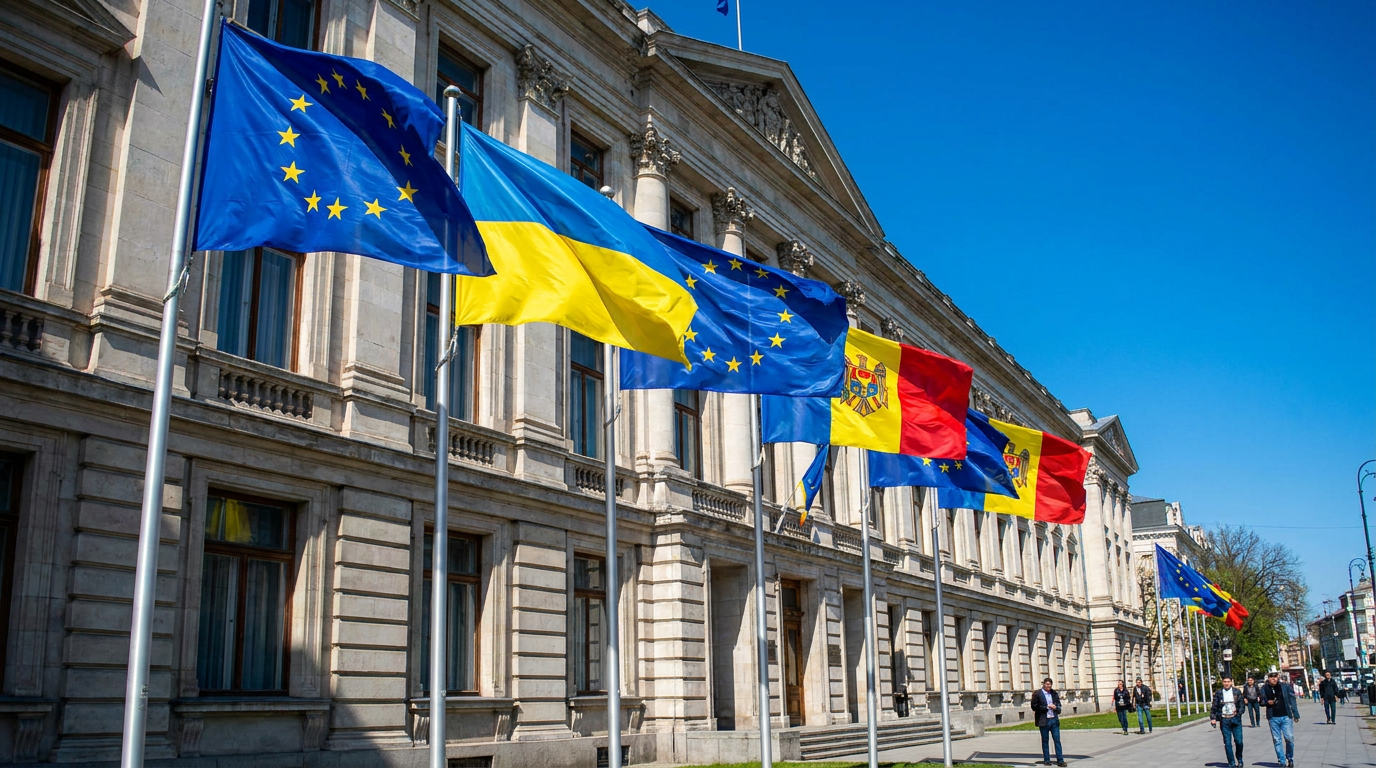
The European Union has officially opened the first substantive negotiating cluster with Kyiv and Chisinau, moving the accession process from symbolic solidarity into rigorous bureaucratic integration.
By Factlen Editorial Team
- Strategic Expansionists
- Argue that rapidly integrating Ukraine and Moldova is a geopolitical imperative to secure Europe's eastern flank.
- Institutional Purists
- Maintain that accession must remain a strict, merit-based process requiring deep anti-corruption and judicial reforms.
- Economic Realists
- Warn that absorbing a massive agricultural economy will require painful overhauls to the EU budget.
What's not represented
- · Ukrainian soldiers on the frontlines fighting for European integration.
- · European farmers who fear being undercut by Ukrainian agricultural imports.
Why this matters
Expanding the European Union to include Ukraine and Moldova represents a generational shift in Europe's geopolitical borders. The move anchors the two nations in the West but will require massive, controversial overhauls to the EU's budget and agricultural subsidies that will affect every current member state.
Key points
- Ukraine and Moldova are officially opening the first substantive phase of EU membership negotiations on June 15, 2026.
- The breakthrough follows the election of a new Hungarian government, which lifted Budapest's long-standing veto on the talks.
- Negotiations begin with the 'Fundamentals' cluster, covering the rule of law, anti-corruption, and democratic institutions.
- The Fundamentals cluster is the first to open and the last to close, dictating the pace of the entire accession process.
- Integrating Ukraine will require massive reforms to the EU's budget, agricultural subsidies, and cohesion funds.
Ukraine and Moldova are taking a historic step on Monday, June 15, by officially opening the first substantive phase of European Union membership negotiations at an intergovernmental conference in Luxembourg.[1][2]
After years of ceremonial milestones and political declarations following Russia's 2022 invasion, the accession process is now shifting from symbolic solidarity into the grueling, highly technical bureaucratic machinery of EU integration.[1][4]
This breakthrough was made possible by a major political shift in Budapest. For two years, Hungary's previous government under Viktor Orbán had repeatedly blocked the opening of formal negotiating clusters, citing concerns over corruption and minority rights.[1][3]
The April 2026 election of a new Hungarian government under Prime Minister Péter Magyar fundamentally altered the diplomatic dynamic. Following bilateral meetings between Ukrainian and Hungarian experts regarding the rights of the ethnic Hungarian minority in western Ukraine, Budapest officially rescinded its veto.[3][6]
The diplomatic thaw was also reportedly linked to broader discussions between the new Hungarian leadership and Brussels regarding the potential release of €16.4 billion in frozen EU funds. With Hungary's objections cleared, EU member states unanimously agreed to finalize the negotiating framework.[3][6]
Joining the European Union is not a single political decision but a massive legislative overhaul. Candidate countries must adopt the "EU acquis"—the complete body of European law, obligations, and standards, which spans tens of thousands of pages.[4]
To manage this monumental task, the European Commission divides the acquis into 33 distinct negotiating chapters, which are further grouped into six broad thematic clusters.[4][5]

The first cluster being opened in Luxembourg is known as "Fundamentals." It serves as the bedrock of the entire accession process, covering the rule of law, judicial independence, fundamental rights, democratic institutions, and anti-corruption measures.[3][5]
Under the EU's revised enlargement methodology, the Fundamentals cluster is the first to be opened and the very last to be closed. Progress in this area dictates the pace of all other negotiations; if a candidate country backslides on democracy or the rule of law, talks in all other clusters can be frozen.[5]
Under the EU's revised enlargement methodology, the Fundamentals cluster is the first to be opened and the very last to be closed.
For Ukraine, the stakes of the Fundamentals cluster are exceptionally high. Kyiv must demonstrate to skeptical member states that it can root out systemic corruption, tackle money laundering, and build resilient, independent courts while simultaneously fighting a war of national survival.[4][5]
Moldova is moving on a parallel track. While it does not face a full-scale military invasion, Chisinau is battling intense Russian hybrid warfare, disinformation campaigns, and the unresolved frozen conflict in the breakaway region of Transnistria, making institutional alignment with Europe a critical security imperative.[1][4]
Beyond the legal alignment of the candidate countries, the prospect of Ukrainian membership forces the European Union to confront its own internal architecture. Ukraine is a demographic heavyweight and an agricultural superpower.[3]
Integrating Ukraine's vast, highly competitive agricultural sector into the EU's Common Agricultural Policy (CAP) will require fundamental reforms to how the bloc distributes subsidies, potentially reducing payouts to current member states.[3]

Similarly, the EU's cohesion funds—designed to lift up the bloc's poorer regions—would inevitably see a massive redirection toward rebuilding a war-torn Ukraine, a reality that current net beneficiaries are quietly viewing with trepidation.[3]
The timeline for accession remains the great unknown. While Ukrainian officials have expressed ambitions to close negotiating chapters rapidly and aim for an accession treaty by 2027, European diplomats privately view this schedule as highly improbable.[5]
The historical precedent for EU enlargement is sobering. Countries in the Western Balkans have been trapped in the accession waiting room for over a decade, and the complete process requires unanimous approval from all 27 member states at multiple stages.[3][4]

Furthermore, the ongoing war introduces an unprecedented variable. The European Union contains a mutual defense clause, and integrating a nation with active frontlines and partially occupied territory presents profound legal and security dilemmas that the bloc has yet to resolve.[3]
How we got here
Feb 2022
Ukraine applies for EU membership days after Russia's full-scale invasion.
Jun 2022
The European Council officially grants candidate status to Ukraine and Moldova.
Dec 2023
EU leaders agree in principle to open accession negotiations with Ukraine.
Jun 2024
Formal accession talks are ceremonially initiated, but substantive progress is stalled by Hungarian vetoes.
Apr 2026
A new Hungarian government is elected, shifting Budapest's stance on Ukraine's accession.
Jun 15, 2026
The first substantive negotiating cluster officially opens in Luxembourg.
Viewpoints in depth
Strategic Expansionists
Argue that rapidly integrating Ukraine and Moldova is a geopolitical imperative to secure Europe's eastern flank.
Proponents of rapid accession view the expansion of the European Union as a fundamental security guarantee against Russian aggression. For this camp, the bureaucratic hurdles of the EU acquis should be streamlined to reflect the existential nature of the war. They argue that leaving Ukraine and Moldova in a prolonged 'waiting room' creates a dangerous gray zone that invites further destabilization from Moscow, and that the EU must act as a geopolitical actor rather than just an economic bloc.
Institutional Purists
Maintain that accession must remain a strict, merit-based process requiring deep anti-corruption and judicial reforms.
This perspective emphasizes that the European Union is fundamentally a community of law. Institutional purists argue that fast-tracking membership without ensuring strict adherence to the Copenhagen Criteria would fatally undermine the bloc's democratic foundations. They point to the ongoing struggles with rule-of-law backsliding in existing member states as proof that the EU cannot afford to absorb new countries until their judicial independence and anti-corruption frameworks are completely bulletproof, regardless of wartime sympathies.
Economic Realists
Warn that absorbing a massive agricultural economy will require painful overhauls to the EU budget.
For economic realists, the debate over Ukraine's accession is ultimately a question of mathematics. Ukraine's agricultural sector is vast and highly competitive, meaning its entry into the EU's Common Agricultural Policy would trigger a seismic shift in how subsidies are distributed. This camp warns that current member states who are net beneficiaries of EU cohesion funds will face significant financial losses, requiring a complete renegotiation of the bloc's budget before Kyiv can be fully integrated.
What we don't know
- How the European Union will legally handle the accession of a country with active frontlines and partially occupied territory.
- Whether current member states will agree to the massive budget reforms required to absorb Ukraine's agricultural sector.
- The exact timeline for closing the 33 negotiating chapters, which historically takes candidate countries a decade or more.
Key terms
- EU Acquis
- The accumulated body of European Union law, obligations, and standards that candidate countries must adopt into their national legislation.
- Negotiating Cluster
- A grouping of related policy chapters—such as 'Fundamentals' or 'Internal Market'—that are negotiated together during the EU accession process.
- Intergovernmental Conference
- A formal meeting between EU member states and a candidate country where accession negotiations are officially opened or closed.
- Copenhagen Criteria
- The essential rules that define whether a country is eligible to join the EU, requiring stable democratic institutions, a functioning market economy, and the ability to implement EU laws.
Frequently asked
Does this mean Ukraine and Moldova are now in the EU?
No. Opening negotiations is just the first step in a rigorous process that typically takes many years, requiring sweeping domestic reforms before full membership is granted.
Why did Hungary drop its veto?
Following a change in government in April 2026, the new Hungarian administration lifted its veto after reaching agreements regarding the rights of the Hungarian minority in western Ukraine and discussing the release of frozen EU funds.
What is the 'Fundamentals' cluster?
It is the first of six negotiating clusters, covering essential democratic principles like the rule of law, judicial independence, and anti-corruption measures. It is the first to open and the last to close.
Can a country join the EU while at war?
There is no explicit rule against it, but the practical realities of integrating a nation with contested borders and active conflict present unprecedented legal and security challenges for the bloc.
Sources
Source coverage
6 outlets
3 viewpoints surfaced






[1]The GuardianStrategic Expansionists
Ukraine and Moldova start first phase of EU membership negotiations
Read on The Guardian →[2]PoliticoInstitutional Purists
Ukraine can start EU membership negotiations on June 15
Read on Politico →[3]EuractivEconomic Realists
EU to Open Accession Talks with Ukraine and Moldova in June
Read on Euractiv →[4]European CommissionStrategic Expansionists
Ukraine's path towards EU accession
Read on European Commission →[5]TVP WorldEconomic Realists
EU to open first accession cluster with Ukraine and Moldova
Read on TVP World →[6]Ukrainska PravdaInstitutional Purists
EU prepares to open first negotiating cluster with Ukraine and Moldova on 15 June
Read on Ukrainska Pravda →
More in news politics
See all 8 stories →Digital Provenance
How 'Digital Provenance' is Replacing Traditional Fact-Checking in the Deepfake Era
0 sources

US-Iran Relations
Anticipated US-Iran Peace Deal Complicated by Israeli Strikes on Beirut
0 sources
US-Iran Relations
US and Iran Near Peace Deal as Israeli Strikes on Beirut Threaten Ceasefire
0 sources

US-Iran Relations
Trump's US-Iran Peace Deal Nears Signing as Israel Strikes Beirut
0 sources
Every angle. Every day.
Get news politics stories with full source coverage and perspective breakdowns delivered to your inbox.