
How the Internet is Rebuilding Trust: The Tech Behind AI Watermarking in 2026
As AI-generated media becomes indistinguishable from reality, a new global infrastructure of cryptographic labels and imperceptible watermarks is quietly becoming the standard for digital authenticity.
By Factlen Editorial Team
- Technology Standards Bodies
- Advocate for a multi-layered, interoperable approach combining metadata (C2PA) and watermarking (SynthID) to ensure durability.
- Regulatory & Compliance Experts
- View provenance as a mandatory legal safeguard to enforce the EU AI Act and protect consumers from synthetic fraud.
- Open-Source Advocates
- Support transparency but warn that enforcing watermarks on locally run, decentralized AI models remains technically unfeasible.
- Enterprise Creators
- Embrace provenance tools to protect brand safety, prove copyright, and maintain trust in commercial and ecommerce settings.
What's not represented
- · Independent digital artists concerned about the burden of proving their human-made art is not synthetic.
- · Consumers who may suffer from 'warning fatigue' if every piece of digital media carries complex provenance labels.
Why this matters
With the EU AI Act enforcing strict transparency rules in August 2026, the ability to prove whether an image, video, or text is human-made or AI-generated is no longer just an ethical debate—it is a legal and commercial requirement that will reshape how we consume media.
Key points
- The tech industry is deploying a two-layered defense to identify AI content: C2PA metadata and SynthID watermarking.
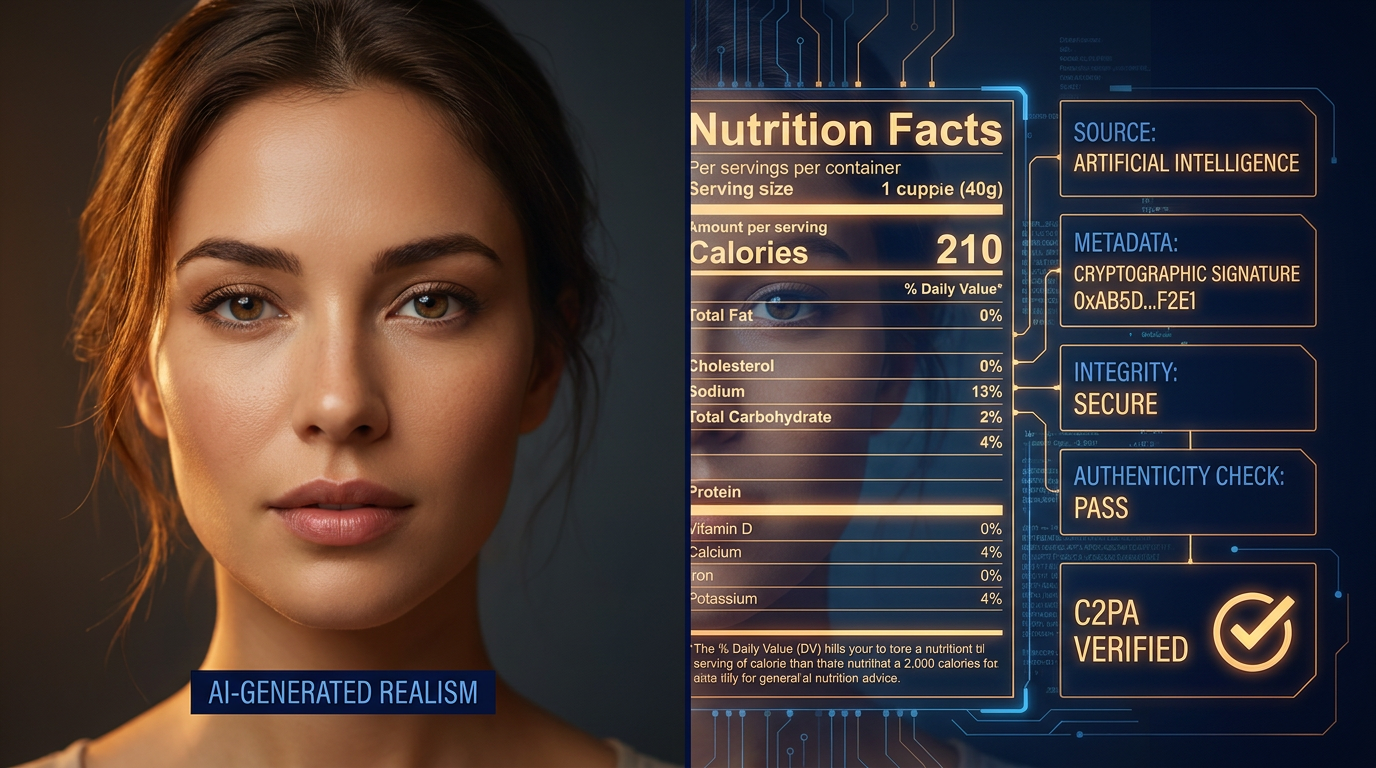
- C2PA acts as a digital nutrition label, providing a cryptographically signed history of how media was created and edited.
- SynthID embeds an imperceptible signal directly into pixels or audio, surviving screenshots and compression that destroy metadata.
- Strict regulatory deadlines in 2026, including the EU AI Act and California's SB 942, are forcing rapid enterprise adoption.
- Major AI providers like OpenAI and Google are now combining both standards to ensure maximum durability and transparency.
The era of trusting our own eyes is officially over. As generative AI models reach the point where they can effortlessly produce photorealistic video, clone human voices, and draft flawless prose, the "eye test" has become obsolete. For years, this reality fueled anxiety about a looming post-truth dystopia. But in 2026, the narrative has shifted from philosophical panic to practical engineering. The technology industry is quietly rolling out a global, standardized infrastructure designed to rebuild digital trust from the ground up.[8]
This shift is not entirely voluntary; it is being driven by a ticking regulatory clock. In the United States, California's SB 942 (the AI Transparency Act) took effect in January 2026, mandating machine-detectable watermarks for AI systems used by state residents. Globally, the stakes are even higher: the European Union's AI Act will begin strictly enforcing its Article 50 transparency obligations in August 2026. Companies that fail to label synthetic content face penalties starting at €7.5 million or 1.5% of their global turnover.[4][7]
Faced with these mandates, the tech ecosystem has converged on a "layered defense" strategy to prove content provenance. Rather than relying on a single silver bullet, the industry is weaving together two distinct technologies: cryptographic metadata manifests and imperceptible pixel-level watermarks. Together, they form a robust system that can tell users exactly where a piece of media came from and how it was altered.[2][8]

The first layer of this defense is the Coalition for Content Provenance and Authenticity (C2PA). Often described as a "nutrition label" for digital media, C2PA is an open technical standard backed by a massive consortium including Adobe, Microsoft, Google, and OpenAI. When a camera takes a photo or an AI generates an image, C2PA embeds a cryptographically signed manifest directly into the file's header.[1][8]
This manifest acts as a tamper-evident historical record. It logs the tool used to create the content, any subsequent edits made in software like Photoshop, and the identity of the signing organization. In 2025, C2PA matured from an industry initiative into a formal international standard (ISO/IEC 22144). This graduation gave the standard immense legal and procurement weight, allowing governments and enterprise compliance teams to mandate its use without locking into a specific vendor.[1][7]
However, metadata has a well-known Achilles' heel: it is inherently fragile. Because C2PA data lives in the file header rather than the image itself, it can be easily lost. If a user takes a screenshot of an AI-generated image, strips the EXIF data using a free online tool, or uploads the file to a social media platform that aggressively compresses media, the cryptographic "nutrition label" is destroyed, leaving the image untethered from its history.[2][5]

To solve the fragility problem, the industry relies on the second layer of defense: imperceptible watermarking. The undisputed leader in this space is SynthID, developed by Google DeepMind. Unlike C2PA, which attaches a label to the outside of the file, SynthID weaves a statistical "ghost signal" directly into the fabric of the content itself—the pixels of an image or the waveform of an audio clip.[3][5]
To solve the fragility problem, the industry relies on the second layer of defense: imperceptible watermarking.
SynthID is designed for extreme survivability. DeepMind's engineers built the watermark to withstand the exact transformations that destroy metadata. An image watermarked with SynthID can be heavily compressed, color-graded, cropped, or screenshotted, and a specialized detector can still read the statistical noise to confirm it was generated by an AI model. It does not provide the rich editing history of C2PA, but it answers the most critical binary question: "Is this synthetic?"[4][5]
The scale of SynthID's deployment is staggering. By May 2026, Google reported that the technology had been used to watermark over 100 billion images and videos, alongside 60,000 years of generated audio. It is now the default output behavior for Google's Gemini, Imagen, and Veo models, embedding provenance into the media before the user even sees it.[3][5]
Watermarking text, however, presents a unique mathematical challenge. You cannot hide a signal in the "pixels" of a sentence. To solve this, Google open-sourced SynthID Text. This technology acts as a "logits processor" during the AI's generation phase. As the Large Language Model predicts the next word (token) in a sentence, SynthID subtly alters the probability distribution of those choices. The resulting text reads naturally to a human, but a detector can recognize the specific mathematical pattern of word choices to identify it as AI-generated.[3][5]

Recognizing that neither C2PA nor SynthID is perfect in isolation, the industry's major players are now combining them. In June 2026, OpenAI announced its support for the European Commission's Code of Practice, confirming a multi-layered approach for its models. Images generated by DALL-E and ChatGPT now include both C2PA metadata for rich, auditable context, and SynthID watermarks to ensure the synthetic signal survives if the metadata is stripped.[2][8]
This infrastructure is rapidly moving beyond consumer chatbots and into enterprise operations. For companies in regulated sectors like finance, healthcare, and ecommerce, digital provenance is becoming a baseline requirement for doing business. Brands using AI to generate lifestyle product imagery, for instance, are utilizing C2PA to prove to consumers—and to search engine algorithms—that they are being transparent about their synthetic marketing materials.[6][8]
Despite this massive technical mobilization, the system is not entirely foolproof. The most significant loophole remains open-source AI models. When a developer downloads a model weights file and runs it locally on their own hardware, they can often bypass or disable the watermarking modules entirely. Enforcing provenance on decentralized, locally hosted AI remains a deeply unresolved technical and regulatory challenge.[5][8]
Additionally, physical workarounds like the "analog hole" still exist. If a user displays a watermarked, C2PA-signed AI image on a high-resolution monitor and takes a photograph of the screen with a physical camera, the resulting file is technically a "real" photograph of a synthetic subject, often defeating both the metadata and the pixel-level watermark.[8]

Yet, cybersecurity experts stress that the goal of content provenance was never to build an impenetrable fortress. The objective is to raise the cost and complexity of deception. By making cryptographic authenticity the default state of the internet—supported by major browsers, social networks, and operating systems—the tech industry is successfully rebuilding the web's immune system, ensuring that while we may not be able to trust our eyes, we can finally trust the data.[6][8]
How we got here
August 2023
Google DeepMind launches the first version of SynthID for Imagen-generated images.
2025
C2PA Content Credentials officially graduate to an international ISO standard (ISO/IEC 22144).
January 2026
California's SB 942 takes effect, requiring large AI providers to embed disclosures in AI-generated content.
May 2026
Google announces SynthID has watermarked over 100 billion media items and expands its detection API.
June 2026
OpenAI formally adopts a multi-layered provenance approach, combining C2PA and SynthID.
August 2026
The EU AI Act's Article 50 transparency obligations become strictly enforceable with heavy financial penalties.
Viewpoints in depth
Regulatory & Compliance Experts
View provenance as a mandatory legal safeguard to enforce the EU AI Act and protect consumers from synthetic fraud.
For legal and compliance professionals, the debate over AI ethics ended the moment the EU AI Act and California's SB 942 were signed into law. This camp views C2PA and SynthID not as optional features, but as critical enterprise infrastructure required to avoid massive fines. They emphasize that under new regulations, companies deploying AI are legally responsible for the outputs. Without a machine-readable, auditable chain of custody, organizations cannot prove they are operating within the bounds of the law, making digital provenance a matter of corporate survival.
Technology Standards Bodies
Advocate for a multi-layered, interoperable approach combining metadata (C2PA) and watermarking (SynthID) to ensure durability.
Engineers and standards coalitions argue that there is no single silver bullet for identifying synthetic media. They champion a 'defense in depth' strategy. C2PA is championed for its ability to carry rich, contextual data—who made the image, what tool was used, and how it was edited. However, acknowledging the fragility of metadata, this camp insists on pairing it with 'hard binding' technologies like SynthID. By weaving an imperceptible signal into the actual pixels or audio waveform, they ensure that even if bad actors strip the metadata, the core synthetic identifier survives.
Open-Source Advocates
Support transparency but warn that enforcing watermarks on locally run, decentralized AI models remains technically unfeasible.
While generally supportive of combating misinformation, the open-source community points out a massive structural loophole in the current provenance framework. When users download open-weight models and run them locally on their own hardware, they have full control over the code. This camp warns that motivated actors can easily disable logits processors or bypass watermarking modules entirely. They caution regulators against assuming that centralized tools like SynthID can effectively police the decentralized, open-source AI ecosystem.
What we don't know
- How effectively regulators will be able to enforce watermarking mandates on decentralized, open-source AI models run locally by users.
- Whether consumers will actually change their behavior or trust levels when presented with C2PA 'nutrition labels' on social media feeds.
- How quickly adversarial AI tools will be developed specifically to scrub or spoof pixel-level watermarks like SynthID.
Key terms
- C2PA (Content Credentials)
- An open technical standard that embeds cryptographically signed metadata into digital files to prove their origin and edit history.
- SynthID
- A technology developed by Google DeepMind that embeds imperceptible, statistical watermarks directly into AI-generated images, audio, video, and text.
- Metadata Manifest
- The hidden data attached to a file (like a digital receipt) that logs how, when, and by whom the content was created or altered.
- Logits Processor
- A mechanism used in AI text generation that adjusts the probability of which word the AI will choose next; used by SynthID to embed text watermarks.
- Analog Hole
- A vulnerability in digital security where a user bypasses digital protections by capturing the output physically, such as taking a photograph of a computer monitor.
Frequently asked
What is the difference between C2PA and SynthID?
C2PA is a metadata standard that attaches a secure 'nutrition label' to a file's header, showing its edit history. SynthID is an imperceptible watermark embedded directly into the pixels or audio waveform, designed to survive if the metadata is stripped.
Can SynthID watermarks be removed?
SynthID is highly robust against casual manipulation like cropping, color filters, and screenshots. However, it is not entirely immune to highly motivated, sophisticated adversarial attacks or the 'analog hole' (taking a photo of a screen).
Does this apply to text generated by AI?
Yes. Google has open-sourced SynthID Text, which subtly alters the mathematical probability of word choices during generation, creating a detectable pattern without changing the meaning of the text.
Why is 2026 a critical year for AI watermarking?
Major regulations are taking effect. California's SB 942 mandated watermarking starting in January 2026, and the EU AI Act begins strictly enforcing its transparency and labeling requirements in August 2026.
Sources
Source coverage
8 outlets
4 viewpoints surfaced








[1]C2PATechnology Standards Bodies
Advancing digital content transparency and authenticity
Read on C2PA →[2]OpenAITechnology Standards Bodies
Supporting Europe's work in ensuring a trustworthy AI ecosystem
Read on OpenAI →[3]Google DeepMindTechnology Standards Bodies
Expanding SynthID to more AI-generated content
Read on Google DeepMind →[4]Tech Plus TrendsRegulatory & Compliance Experts
AI Watermarking & The EU AI Act: 2026 Compliance Guide
Read on Tech Plus Trends →[5]FindSkill AIOpen-Source Advocates
Google's Invisible AI Watermark Explained (2026)
Read on FindSkill AI →[6]DevoteamRegulatory & Compliance Experts
Implementing Digital Provenance: Tools and Technical Standards
Read on Devoteam →[7]C2PA.aiRegulatory & Compliance Experts
The EU AI Act Enforcement Clock: August 2026
Read on C2PA.ai →[8]Factlen Editorial TeamEnterprise Creators
Synthesis by Factlen editorial team
Read on Factlen Editorial Team →

More in ai
See all 5 stories →


Every angle. Every day.
Get ai stories with full source coverage and perspective breakdowns delivered to your inbox.