
SpaceX Completes Record $75 Billion IPO, Valuation Tops $2 Trillion on First Day of Trading
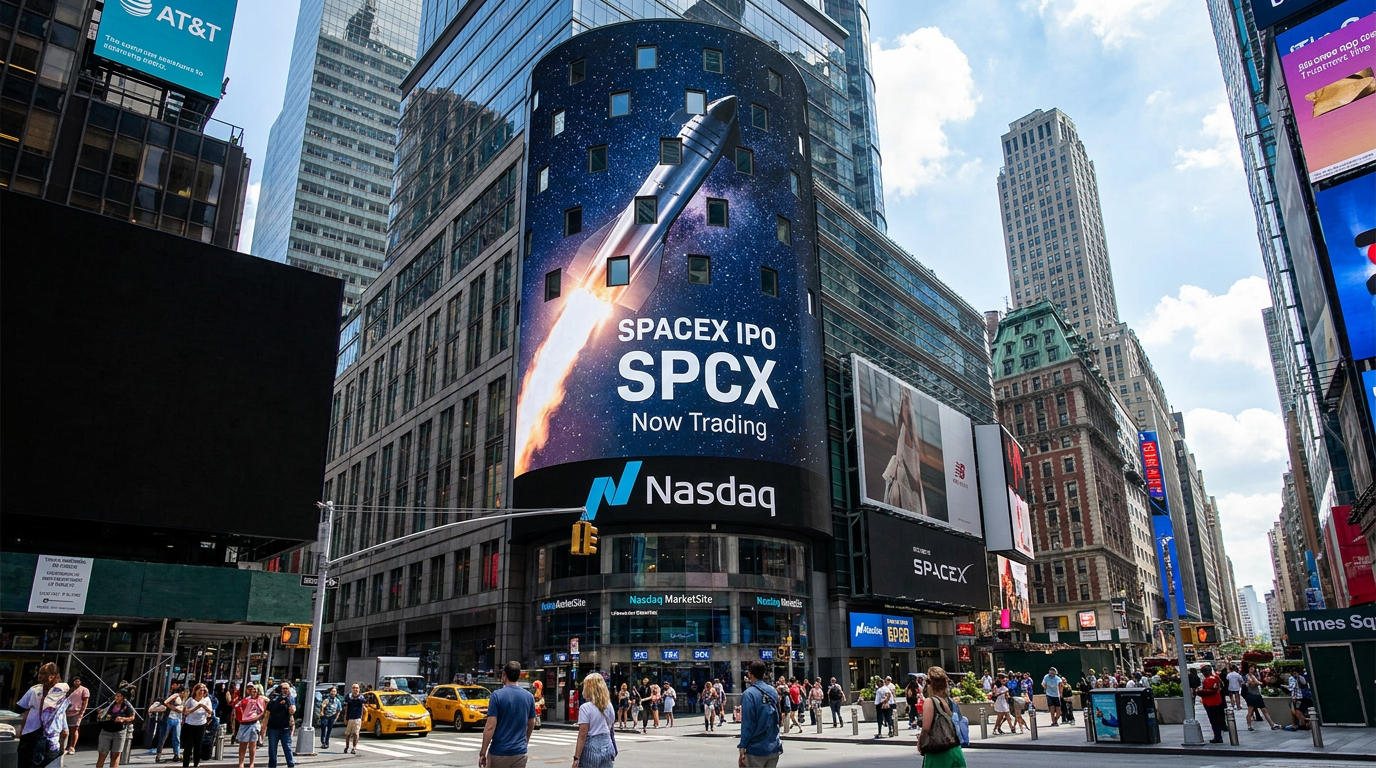
SpaceX has made the largest stock market debut in history, raising $75 billion and seeing its shares surge 19% to reach a $2.1 trillion valuation. The historic listing opens the commercial space economy to public investors and propels founder Elon Musk's net worth past $1 trillion.
By Factlen Editorial Team
- Bullish Investors & Retail Traders
- View the IPO as a generational opportunity to invest in the dominant force in space and satellite internet.
- Value Analysts & Skeptics
- Warn that a $2.1 trillion valuation prices in flawless execution and ignores heavy capital burn.
- Aerospace Industry Observers
- Focus on the operational milestone, noting SpaceX's transition to an institutional aerospace monopoly.
What's not represented
- · Legacy aerospace competitors facing a newly capitalized rival
- · Astronomers concerned about the rapid expansion of the Starlink constellation
Why this matters
SpaceX's record-breaking $75 billion IPO opens the commercial space economy to everyday investors for the first time. The listing not only creates a new $2.1 trillion anchor for the public equities market, but also provides the massive capital runway needed to accelerate global satellite internet coverage and fund next-generation aerospace and AI infrastructure.
Key points
- SpaceX completed the largest IPO in history, raising $75 billion and reaching a $2.1 trillion valuation on its first day of trading.
- The stock surged 19.2% above its $135 initial offering price, closing at $160.95 per share.
- The massive valuation surge propelled founder Elon Musk's net worth past $1 trillion, making him the world's first trillionaire.
- SpaceX allocated an unusually high 20% of its offering to retail investors, democratizing access to the commercial space sector.
- The company's Starlink division generated $11.4 billion in revenue in 2025 and surpassed 10 million subscribers in early 2026.
- Despite the hype, analysts warn that the company's 100x revenue multiple and $4.9 billion consolidated net loss pose significant long-term risks.
After twenty-four years operating as a closely guarded private aerospace startup, SpaceX has officially completed the largest initial public offering in stock market history, raising a staggering $75 billion and fundamentally reshaping the public equities landscape. The long-awaited debut on the Nasdaq exchange marks the culmination of a two-decade journey from a scrappy, often-doubted rocket builder to a global space and telecommunications monopoly. For years, the broader financial markets could only watch from the sidelines as the company achieved historic milestones in reusable rocketry and satellite broadband. Now, by opening its doors to public investment, SpaceX has transitioned from a Silicon Valley unicorn into a foundational pillar of the global economy, signaling that the commercial space sector has fully matured into a mainstream, investable asset class.[1][2]
Trading under the highly anticipated ticker symbol SPCX, the stock was initially priced at $135 per share late Thursday evening, but it opened Friday at $150 amid overwhelming institutional and retail demand. By the time the closing bell rang in New York, shares had surged 19.2% to settle at $160.95. This massive first-day pop pushed SpaceX's total market valuation to approximately $2.1 trillion, instantly making it the sixth-largest public company in the world, leapfrogging established legacy giants like Meta Platforms and Saudi Aramco. The sheer volume of trading activity was unprecedented, with more than $80 billion worth of shares changing hands during the session. The successful pricing and subsequent rally demonstrated an immense appetite for artificial intelligence infrastructure and next-generation aerospace technology, defying broader market anxieties.[2][3][5]
The historic listing also triggered what is likely the largest single-day wealth-creation event in corporate history. The immediate surge in the company's share price propelled founder and CEO Elon Musk's personal net worth past the $1 trillion mark, officially making him the world's first trillionaire. Because Musk retained a massive equity stake through the transition to public markets, the day-one pop cemented his position at the absolute pinnacle of global wealth. Beyond the executive suite, the IPO served as a massive financial windfall for the company's workforce. The public offering minted thousands of new millionaires among current and former SpaceX employees, engineers, and technicians who had accumulated equity over the company's two-decade private run, rewarding those who built the Falcon and Starship programs from the ground up.[1][2][7]

The celebration on Wall Street was perfectly punctuated by the company's ongoing core business operations, ensuring the focus remained on the hardware. Just an hour before SpaceX executives stepped up to ring the Nasdaq opening bell—accompanied by the fitting soundtrack of Elton John's "Rocket Man" echoing across the trading floor—a Falcon 9 rocket lifted off from the Cape Canaveral Space Force Station in Florida. The morning launch successfully delivered 29 Starlink broadband satellites into low-Earth orbit, marking the 650th flight of the company's workhorse reusable rocket. The split-screen moment of a flawless orbital launch occurring simultaneously with the largest financial debut in history served as a powerful visual reminder to investors of the company's unmatched operational cadence and its ability to execute complex engineering feats on a routine basis.[2][7]
Unlike many recent mega-IPOs that cater almost exclusively to large institutional investors and sovereign wealth funds, SpaceX deliberately structured its offering to include an unprecedented retail allocation. Recognizing the massive public enthusiasm for space exploration, the company initially reserved up to 30% of the offering directly for retail investors—a figure that ultimately settled closer to 20% due to the sheer scale of the oversubscription. This structural decision allowed millions of ordinary savers, retail traders, and space enthusiasts to gain direct financial exposure to the commercial space economy for the first time. Market analysts noted that drawing millions of retail investors into the fold could help smooth out the often choppy post-IPO trading waters, creating a dedicated base of shareholders who are philosophically aligned with the company's long-term interplanetary mission.[3][5]
While the rockets capture the public's imagination, the true financial engine driving Wall Street's euphoric enthusiasm is Starlink, SpaceX's rapidly expanding satellite internet constellation. The mandatory public disclosures required for the IPO offered the first transparent look at the company's internal finances, revealing that the connectivity segment generated an impressive $11.4 billion in revenue in 2025. This accounted for roughly 61% of the company's total sales, proving that telecommunications is now the core business. More importantly, Starlink is highly profitable on a standalone basis, posting roughly $4.4 billion in operating income with a robust 39% operating margin. For investors evaluating the $2.1 trillion price tag, Starlink provides the recurring, high-margin subscription revenue necessary to anchor the valuation and fund the company's more speculative, capital-intensive research and development projects.[6]
This accounted for roughly 61% of the company's total sales, proving that telecommunications is now the core business.
Starlink's growth trajectory has been remarkably steep, outpacing even the most optimistic early projections. The broadband service ended 2023 with approximately 2.3 million active subscribers, but that figure climbed dramatically to 8.9 million by the end of 2025, and officially surpassed the 10 million user milestone in the first quarter of 2026. With recent strategic price increases—including a $10 monthly hike implemented in May—and expanding global coverage that now reaches remote enterprise clients and maritime operators, the revenue ceiling continues to rise. Financial analysts view the telecom division as the primary justification for the company's astronomical valuation, noting that SpaceX has effectively built a global telecommunications monopoly in low-Earth orbit that traditional terrestrial internet service providers simply cannot compete with on a global scale.[6]

On the traditional aerospace side of the ledger, SpaceX maintains a level of dominance rarely seen in any modern industrial sector. The company's launch vehicles currently account for the vast majority of global payload mass delivered to orbit, effectively cornering the market for commercial and government spaceflight. The unprecedented $75 billion raised in the IPO is explicitly earmarked to expand this flagship rocket business and accelerate the development of the next-generation Starship vehicle, which is critical for the company's Mars ambitions. Furthermore, SEC filings revealed that a significant portion of the capital will fund a heavy strategic pivot toward artificial intelligence. Following the integration of the xAI venture earlier in the year, SpaceX is positioning itself not just as an aerospace company, but as a foundational AI infrastructure provider.[6][7]
The financial ripple effects of the historic IPO extended far beyond the United States, generating massive returns for early international backers. In Saudi Arabia, Prince Alwaleed bin Talal's investment firm, Kingdom Holding Company, saw its shares jump 5% at the open of the Riyadh market after the value of its 42.4 million SpaceX shares swelled to nearly $7 billion. The Saudi royal had first aligned with the company's leadership during the 2022 acquisition of Twitter, rolling over equity that has now yielded astronomical returns. Regional investment funds across the Middle East, including the $1 trillion Public Investment Fund, are increasingly viewing SpaceX as a core pillar of their broader artificial intelligence and technology portfolios, utilizing the company's growth to diversify their national economies away from traditional oil dependence.[4][8]
Despite the euphoric debut and the record-breaking capital raise, some financial analysts are urging caution, pointing to the underlying math of the offering. At a staggering $2.1 trillion valuation, SpaceX is trading at well over 100 times its 2025 revenue—a premium multiple typically reserved for early-stage software startups in hyper-growth mode, not capital-intensive aerospace and hardware manufacturing firms. Furthermore, the newly public financial disclosures revealed that on a consolidated basis, which includes the heavy cash burn of the newly acquired xAI division, the overall company posted a net loss of $4.9 billion in 2025. Skeptics warn that the artificial intelligence segment is currently consuming all of Starlink's profits and then some, meaning the current share price relies heavily on the assumption of flawless future execution across multiple unproven technological frontiers.[5][6]

Market observers note that the stock's near-term performance will be severely tested as early lock-up periods begin to expire later this summer. The company's relatively small initial public float—combined with the massive retail allocation—helped artificially constrain supply and drive Friday's aggressive price action. However, as pre-IPO holders, venture capital backers, and early employees gain the ability to sell their shares, the market could be flooded with new supply that dwarfs the volume sold during the IPO. Sustaining a multi-trillion-dollar market capitalization in the face of this incoming liquidity event will require SpaceX to consistently beat quarterly earnings expectations and demonstrate tangible progress on both its Starship development milestones and its ambitious artificial intelligence integration plans.[5]
Regardless of the inevitable future price volatility and the debates over revenue multiples, the successful listing represents a permanent watershed moment for the commercial space industry. By successfully transitioning from a closely guarded private enterprise into a cornerstone of the public equities market, SpaceX has validated the space economy as a mature, highly investable sector. The sheer scale of the $75 billion capital raise ensures that the company has the financial runway to pursue its most ambitious interplanetary goals without relying on the constraints of private funding rounds. Ultimately, the IPO sets a new benchmark for technological ambition, proving that public markets are willing to finance generational engineering challenges when backed by a proven track record of execution.[2][3]
How we got here
April 2026
SpaceX confidentially submits a draft registration statement to the SEC, signaling its intent to go public.
May 20, 2026
The company publicly files its S-1 prospectus, revealing its internal finances and a massive retail allocation plan.
June 11, 2026
SpaceX officially prices its initial public offering at $135 per share, targeting a record $75 billion capital raise.
June 12, 2026
Shares begin trading on the Nasdaq under the ticker SPCX, surging 19% and pushing the company's valuation past $2 trillion.
Viewpoints in depth
Retail and Growth Investors
Viewing the IPO as a generational opportunity to invest in a tech monopoly.
For retail traders and growth-focused institutional funds, SpaceX represents a singular asset with no true public market equivalent. They argue that the company's near-monopoly on orbital launch capabilities and its rapidly expanding Starlink telecom network justify the premium valuation. From this perspective, the $2.1 trillion market cap is not a reflection of current revenues, but a forward-looking premium on the company's ability to dominate the future space economy and successfully integrate artificial intelligence into its hardware ecosystem.
Value Analysts
Warning that the astronomical valuation is detached from current financial fundamentals.
Traditional value investors and financial skeptics point to the underlying math as a major red flag. Trading at over 100 times its 2025 revenue, SpaceX's valuation leaves absolutely no room for error. Analysts in this camp highlight the consolidated $4.9 billion net loss posted in 2025, driven largely by the capital-intensive development of the Starship rocket and the massive cash burn of the newly integrated xAI division. They warn that once the initial hype fades and early lock-up periods expire, the stock could face severe downward pressure if the company fails to hit aggressive growth targets.
Aerospace Industry Observers
Focusing on the operational shift from a disruptive startup to an institutional giant.
For veterans of the aerospace sector, the IPO is less about the stock price and more about the maturation of the industry. They note that by going public, SpaceX has permanently shed its status as a nimble, rule-breaking startup. As a publicly traded entity, the company will now face relentless quarterly earnings pressure and stringent SEC oversight, which could fundamentally alter its famously high-risk, iterative engineering culture. However, they also acknowledge that the $75 billion capital injection provides the financial security needed to pursue multi-decade projects like Mars colonization without relying on the whims of private venture capital.
What we don't know
- How the stock will perform later this summer when early lock-up periods expire and pre-IPO holders are allowed to sell their shares.
- Whether the highly profitable Starlink division can generate enough cash to offset the massive capital burn of the Starship and xAI programs.
- How the transition to a publicly traded company with quarterly earnings pressure will affect SpaceX's famously high-risk engineering culture.
Key terms
- Initial Public Offering (IPO)
- The process by which a private company offers shares to the public in a new stock issuance, transitioning to a publicly traded entity.
- Starlink
- SpaceX's satellite internet constellation, which provides broadband coverage globally and serves as the company's primary revenue engine.
- Market Capitalization
- The total value of a publicly traded company's outstanding shares of stock, calculated by multiplying the share price by the total number of shares.
- Lock-up Period
- A predetermined window after an IPO during which early investors and company insiders are restricted from selling their shares to prevent market flooding.
- Public Float
- The portion of a corporation's outstanding shares that is in the hands of public investors and available for trading on the open market.
Frequently asked
What is SpaceX's stock ticker symbol?
SpaceX trades on the Nasdaq Global Select Market under the ticker symbol SPCX.
How much money did SpaceX raise in its IPO?
The company raised $75 billion by selling 555.6 million shares at $135 each, making it the largest initial public offering in history.
Is SpaceX a profitable company?
Its Starlink division is highly profitable, generating $4.4 billion in operating income in 2025. However, the consolidated company posted a net loss of $4.9 billion due to heavy investments in Starship and AI.
Can retail investors buy SpaceX stock?
Yes, the stock is now publicly traded. Furthermore, the company allocated an unusually high percentage (around 20%) of its initial offering directly to retail investors.
How did the IPO affect Elon Musk's net worth?
The massive first-day surge in SpaceX's share price propelled Musk's personal net worth past the $1 trillion mark, making him the world's first trillionaire.
Sources
Source coverage
8 outlets
3 viewpoints surfaced








[1]ForbesAerospace Industry Observers
SpaceX Finalizes IPO Price At $135, Cementing Largest Offering In History
Read on Forbes →[2]The GuardianBullish Investors & Retail Traders
SpaceX makes biggest stock market debut in history
Read on The Guardian →[3]Financial TimesBullish Investors & Retail Traders
SpaceX shares soar 20% in historic $2tn market debut
Read on Financial Times →[4]BloombergAerospace Industry Observers
SpaceX Surge Further Boosts Saudi Billionaire Prince’s Fortune
Read on Bloomberg →[5]MorningstarValue Analysts & Skeptics
SpaceX Stock Jumps 19% After Largest IPO in History
Read on Morningstar →[6]The Motley FoolValue Analysts & Skeptics
SpaceX IPO: Should Investors Buy After the 19% Pop?
Read on The Motley Fool →[7]NPRAerospace Industry Observers
SpaceX's newly listed stock leaps on first day of trading
Read on NPR →[8]Business StandardAerospace Industry Observers
SpaceX surge further boosts this Saudi billionaire prince's fortune
Read on Business Standard →

Every angle. Every day.
Get business stories with full source coverage and perspective breakdowns delivered to your inbox.