
2026 Rivian R2 vs. Tesla Model Y: The Midsize Electric SUV Showdown
Rivian's rugged new R2 challenges the heavily updated Tesla Model Y 'Juniper' in a battle for the mainstream electric SUV market.
By Factlen Editorial Team
- Efficiency & Tech Loyalists
- Prioritize aerodynamics, software integration, highway range, and a quiet cabin.
- Adventure-Focused Buyers
- Value ground clearance, cargo volume, off-road capability, and a rugged aesthetic.
- Value-Conscious Families
- Focus on the lowest starting price, proven reliability, and immediate availability.
What's not represented
- · Legacy Automakers losing market share to pure-EV brands
- · Urban apartment dwellers who rely entirely on public charging infrastructure
Why this matters
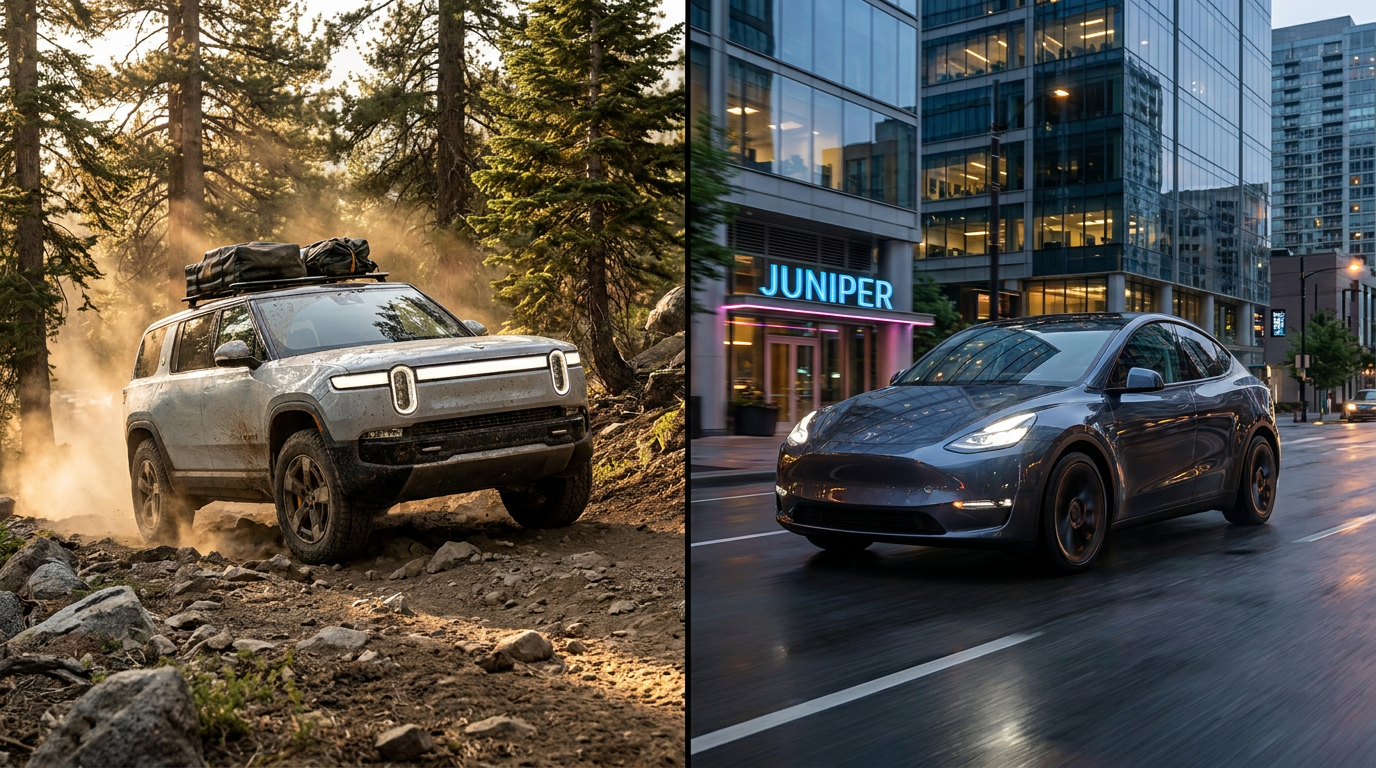
For the first time since the EV revolution began, buyers in the crucial $40,000 to $60,000 midsize SUV segment have two distinct, highly capable options. Choosing between the Model Y and the R2 dictates whether your family vehicle is optimized for hyper-efficient, whisper-quiet highway commuting or rugged, high-capacity outdoor adventure.
Key points
- The 2026 Tesla Model Y Juniper refresh drastically improves ride comfort and reduces cabin noise by 22 percent.
- The Rivian R2 offers a rugged alternative with 9.6 inches of ground clearance and superior cargo space.
- Both vehicles now utilize the NACS charging port, granting the Rivian R2 seamless access to Tesla Superchargers.
- The Model Y maintains an advantage in aerodynamic efficiency and immediate entry-level pricing.
- Rivian's $45,000 base model will not arrive until 2027, leaving early adopters to purchase the $59,485 Performance Launch Edition.
For years, the electric midsize SUV segment has been a one-horse race, defined entirely by the ubiquitous Tesla Model Y. But in 2026, the landscape has fundamentally shifted. Rivian has officially launched the R2, a rugged, boxy alternative aimed directly at the heart of the mainstream market. Simultaneously, Tesla has rolled out its highly anticipated "Juniper" refresh for the Model Y, addressing years of consumer feedback with a sweeping overhaul of its suspension and interior. The result is a genuine showdown between two highly capable, similarly sized vehicles that take radically different approaches to the family EV.[8]
The stakes for both automakers are immense. The Model Y is defending its title as the world's best-selling vehicle, relying on its proven charging network, software maturity, and aerodynamic efficiency. Rivian, meanwhile, is using the R2 to transition from a niche luxury truck manufacturer into a volume automaker. By offering a starting price that will eventually match Tesla's, Rivian is banking on the appeal of off-road adventure branding and traditional SUV utility to win over buyers who might otherwise default to a Tesla.[8]
The case for the 2026 Tesla Model Y is built entirely on its dramatic leap in daily driving refinement. With the Juniper update, Tesla transformed what was once a stiff, occasionally noisy crossover into a genuinely premium commuter. The evidence for this upgrade is found in the vehicle's new frequency-dependent dampers, which adapt instantly to road conditions to smooth out city potholes while remaining composed in corners. Furthermore, the integration of 360-degree acoustic glass has yielded a 22 percent reduction in cabin noise, creating an eerily quiet environment that rivals European luxury brands.[6]

However, the argument against the Model Y centers on its inherent limitations as a utility vehicle. Despite its SUV classification, the Model Y remains a pavement-bound crossover. With a maximum ground clearance of just 6.6 inches and a sloping, aerodynamic roofline, it sacrifices traditional cargo flexibility and off-road capability in the name of efficiency. Its minimalist interior, while upgraded with ventilated seats and an 8.0-inch rear touchscreen, still forces drivers to rely almost entirely on the central display, a design choice that continues to alienate some traditional car buyers.[4][6]
Conversely, the case for the Rivian R2 is rooted in its uncompromising commitment to traditional, rugged utility. Rivian has managed to shrink the aesthetic of its flagship R1S into a more manageable footprint without losing the brand's signature go-anywhere capability. The evidence lies in the R2's physical architecture: it boasts a towering 9.6 inches of ground clearance, a 25-degree approach angle, and a 26-degree departure angle. This makes the R2 genuinely trail-capable, allowing it to easily navigate craggy rocks, shallow water crossings, and rutted two-track trails that would leave a Model Y stranded.[2][4][7]

Conversely, the case for the Rivian R2 is rooted in its uncompromising commitment to traditional, rugged utility.
The R2 also leverages its boxy silhouette to maximize interior volume, providing a crucial advantage for families hauling gear. With the seats folded, the R2 offers 90.1 cubic feet of total storage—including a spacious front trunk—which is roughly 19 percent more than the Model Y's 75.5 cubic feet. Inside, the R2 retains physical controls for essential functions like wipers and gear selection, and the cabin features premium materials like real wood trim. The dual-motor Performance trim is also staggeringly quick, utilizing 656 horsepower to accelerate from zero to 60 mph in just 3.6 seconds.[1][2][4]
Despite its rugged appearance, the R2 delivers a surprisingly composed experience on the pavement. Rivian opted for a traditional coil suspension over electronic dampers, omitting the complex air suspension found in its larger vehicles. The result is a flat, even-keeled ride that neatly rounds off road imperfections rather than transmitting them into the cabin. While the steering is tuned more for stability than sports-car precision, the progressive ramp-up of electric torque makes the R2 incredibly smooth and easy to modulate in stop-and-go traffic.[1][2][7]

The argument against the Rivian R2 primarily involves its initial cost of entry and charging speeds. While Rivian promises a $45,000 base model, that version will not arrive until 2027. Early adopters in 2026 are restricted to the Performance Launch Edition, which starts at $59,485, or the $55,485 Premium trim. Additionally, the R2's peak DC fast-charging rate is capped at 210 kilowatts. While it can charge from 10 to 80 percent in a respectable 29 minutes, it trails behind some competitors' 400-kilowatt architectures, making highway road trips slightly more time-consuming.[2][5]
When it comes to charging infrastructure, the historic gap between the two brands has finally closed. The 2026 Rivian R2 features a native North American Charging Standard (NACS) port, granting it seamless, adapter-free access to Tesla's sprawling Supercharger network. This eliminates the primary anxiety that previously kept buyers tethered to Tesla. Both vehicles now offer over 300 miles of range in their upper trims—the Model Y Premium Rear-Wheel Drive reaches 357 miles, while the R2 Long Range targets 345 miles—ensuring that range anxiety is largely a non-issue for either choice.[2][5][8]

Ultimately, the decision between these two electric SUVs comes down to a strict trade-off analysis of lifestyle needs. The Tesla Model Y fits well when a buyer prioritizes immediate budget flexibility, maximum aerodynamic efficiency, and a whisper-quiet highway commute. It is the ideal choice for families who treat their vehicle as a high-tech daily appliance and have no intention of leaving paved roads. It does not fit when a buyer needs to haul bulky, awkwardly shaped cargo or desires a vehicle with a commanding, truck-like driving position.[4][6][8]
On the other hand, the Rivian R2 fits well when an owner wants a true adventure vehicle that seamlessly blends blistering electric performance with genuine off-road capability. It is perfect for buyers who need massive cargo volume for camping gear, dogs, or outdoor equipment, and who prefer the aesthetic of a classic, squared-off SUV. It does not fit when a buyer requires the absolute lowest monthly payment today, or when their driving profile is strictly limited to high-speed interstate commuting where the R2's boxy shape creates more aerodynamic drag.[1][4][7]

For the first time in the electric vehicle era, mainstream buyers are not forced to compromise on their preferred automotive identity. Whether opting for the sleek, hyper-refined efficiency of the Model Y or the rugged, trail-ready utility of the R2, consumers in 2026 finally have access to two distinct, uncompromising visions of the electric future.[8]
How we got here
2020
Tesla launches the Model Y, which quickly becomes the world's best-selling electric vehicle.
Early 2024
Rivian unveils the R2 prototype, signaling its intent to enter the mainstream midsize SUV market.
2025
Tesla introduces the 'Juniper' refresh for the Model Y, overhauling the suspension and interior acoustics.
Spring 2026
The Rivian R2 officially hits the market with the dual-motor Performance Launch Edition.
2027
Rivian plans to release the $45,000 base model of the R2 to compete directly with Tesla's entry-level pricing.
Viewpoints in depth
Efficiency & Tech Loyalists
Prioritize aerodynamics, software integration, highway range, and a quiet cabin.
For this camp, the Tesla Model Y remains the undisputed king. They point to the Juniper update's 22 percent reduction in cabin noise and the vehicle's superior aerodynamic efficiency as proof that Tesla is refining the ultimate daily commuter. To them, the Rivian R2's boxy shape and off-road hardware are unnecessary compromises that drag down highway efficiency and increase charging costs for capabilities most drivers will never use.
Adventure-Focused Buyers
Value ground clearance, cargo volume, off-road capability, and a rugged aesthetic.
This group views the Rivian R2 as the first true electric utility vehicle for the masses. They argue that the Model Y is simply a tall hatchback that cannot support an active, outdoor lifestyle. By highlighting the R2's 9.6 inches of ground clearance, massive 90.1 cubic feet of cargo space, and flat-folding seats, they believe Rivian has successfully translated the traditional SUV experience into the EV era without sacrificing performance.
Value-Conscious Families
Focus on the lowest starting price, proven reliability, and immediate availability.
For budget-focused buyers, the conversation begins and ends with the current price tag. While they appreciate the R2's design, they note that Rivian's $45,000 base model won't arrive until 2027. In the meantime, the Model Y offers an immediate, proven entry point at $41,630. This camp values Tesla's established manufacturing scale, predictable software updates, and the financial security of buying the world's best-selling car over the promise of future off-road adventures.
What we don't know
- Exactly when Rivian will scale production enough to deliver the promised $45,000 base model in 2027.
- How the Rivian R2's long-term reliability will compare to the highly mature manufacturing process of the Tesla Model Y.
Key terms
- NACS (North American Charging Standard)
- The charging plug design originally developed by Tesla, now adopted by Rivian to allow seamless access to Superchargers.
- Frequency-Dependent Dampers
- A suspension technology that automatically adjusts stiffness based on road conditions, offering a soft ride over bumps and firm control in corners.
- Frunk
- A front trunk located where a traditional gas engine would be, providing additional enclosed cargo space.
- Approach Angle
- The maximum angle of a ramp or obstacle a vehicle can climb from a flat surface without the front bumper hitting the ground.
Frequently asked
Do I need an adapter to charge the Rivian R2 at a Tesla Supercharger?
No, the 2026 Rivian R2 comes equipped with a native NACS port, allowing you to plug directly into Tesla Superchargers without an adapter.
Which SUV has more cargo space?
The Rivian R2 offers 90.1 cubic feet of total storage when the seats are folded, which is about 19 percent more than the Model Y's 75.5 cubic feet.
Is the Tesla Model Y Juniper quieter than older models?
Yes, the 2026 Juniper refresh features 360-degree acoustic glass, reducing overall cabin noise by roughly 22 percent compared to previous versions.
Can the Rivian R2 handle serious off-roading?
Yes, with 9.6 inches of ground clearance and dedicated off-road driving modes, the R2 is highly capable on trails, though it lacks the adjustable air suspension of the larger R1S.
Sources
Source coverage
8 outlets
3 viewpoints surfaced








[1]Top GearAdventure-Focused Buyers
Rivian R2 (US) review
Read on Top Gear →[2]EdmundsAdventure-Focused Buyers
2027 Rivian R2 First Drive Review
Read on Edmunds →[3]Car and DriverAdventure-Focused Buyers
2027 Rivian R2 First Drive: From Normal, Is Normal
Read on Car and Driver →[4]ElectrekValue-Conscious Families
Rivian R2 vs Tesla Model Y spotted side-by-side: Detailed size comparison
Read on Electrek →[5]InsideEVsEfficiency & Tech Loyalists
Rivian R2 Vs. Tesla Model Y Price Comparison
Read on InsideEVs →[6]CarmotocarEfficiency & Tech Loyalists
2026 Tesla Model Y Juniper Review
Read on Carmotocar →[7]Road & TrackAdventure-Focused Buyers
Rivian R2 Review
Read on Road & Track →[8]TechieBuzzValue-Conscious Families
Tesla Model Y vs Rivian R2 are set for a major showdown in 2026
Read on TechieBuzz →
Every angle. Every day.
Get automotive stories with full source coverage and perspective breakdowns delivered to your inbox.