
Sodium-Ion Batteries Enter Mass Production, Reshaping the EV Market
A major breakthrough in battery chemistry is hitting the roads in 2026 as automakers launch the first electric vehicles powered by abundant, low-cost sodium instead of lithium.
By Factlen Editorial Team
- Battery Manufacturers
- Manufacturers see sodium-ion as the key to unlocking the mass market for affordable EVs by bypassing the lithium supply chain.
- Market Analysts
- Analysts view sodium as a complementary technology that will dominate budget cars and grid storage, while lithium keeps the premium sector.
- Grid Storage Developers
- Utility developers value the technology for its superior safety profile, lack of thermal runaway risk, and low cost for stationary applications.
What's not represented
- · Lithium Mining Industry
- · Western Automakers
Why this matters
By replacing expensive, scarce lithium with cheap, abundant sodium, this technology promises to drastically lower the sticker price of entry-level EVs while solving the notorious problem of battery drain in freezing winter temperatures.
Key points
- CATL and Changan are launching the world's first mass-produced sodium-ion passenger EV in mid-2026.
- Sodium-ion batteries are projected to be up to 30% cheaper than standard lithium-ion cells.
- The chemistry retains over 90% of its capacity in freezing -20°C temperatures.
- Due to lower energy density, sodium will complement rather than replace lithium in premium EVs.
For years, the electric vehicle industry has been locked in a high-stakes race for lithium. But in 2026, the most significant breakthrough in battery technology isn't a better way to mine lithium—it's a way to bypass it entirely.[3]
Sodium-ion batteries, long relegated to university laboratories and theoretical roadmaps, have officially entered mass production. Led by Chinese battery giant CATL, these cells are rolling off assembly lines and into consumer vehicles, marking a fundamental shift in how the world stores energy.[4][5]
The commercial proof point arrives mid-2026 with the Changan Nevo A06, the world's first mass-produced passenger EV powered by a sodium-ion pack. Alongside Changan, automakers like BAIC and BYD are rapidly integrating the chemistry into their entry-level fleets, moving the technology from pilot lines to public roads.[1][5]
To understand the shift, one must look at the periodic table. Sodium sits just below lithium, sharing similar chemical properties but boasting a crucial difference: abundance. Sodium is roughly 500 to 1,000 times more plentiful in the Earth's crust than lithium, extractable from simple sea salt rather than complex mining operations.[5]

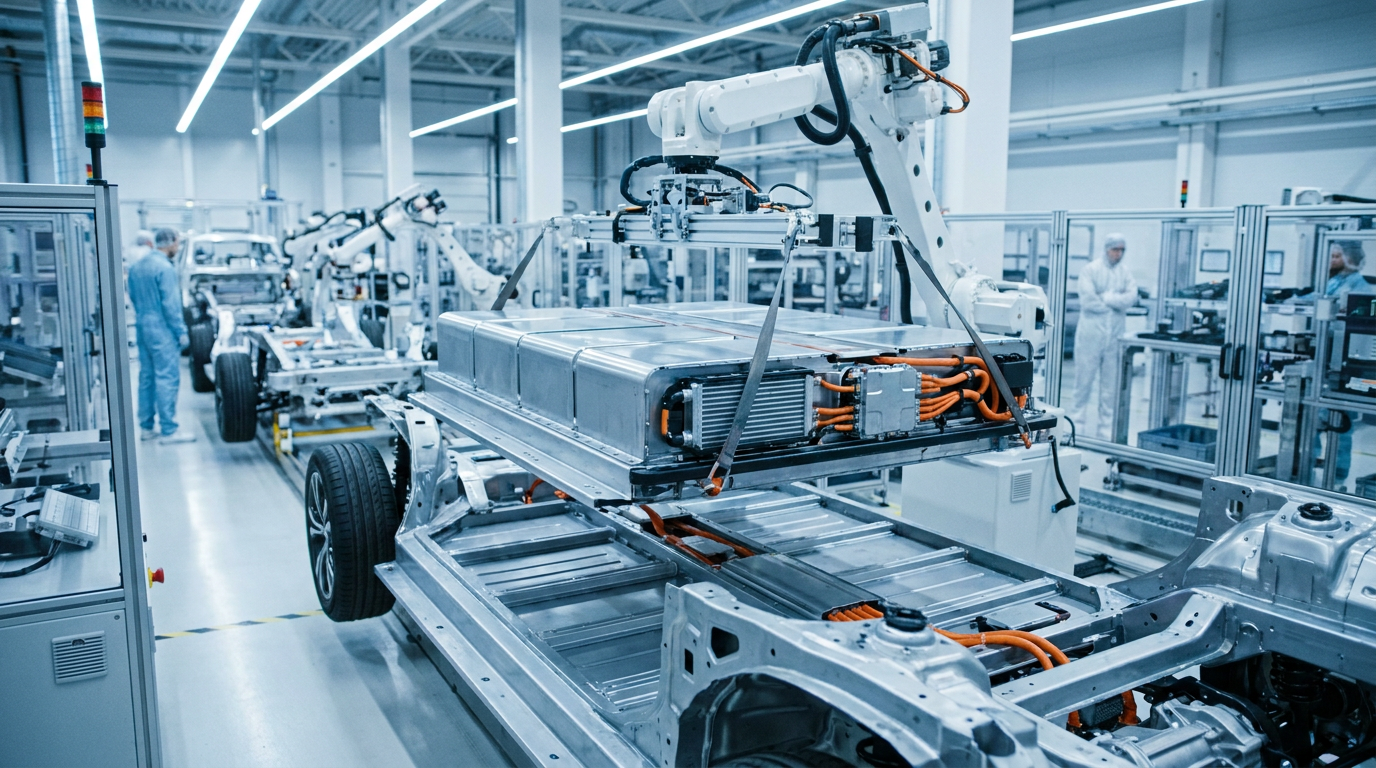
In a sodium-ion cell, sodium ions replace lithium ions as the charge carriers, shuttling between the anode and cathode. The fundamental architecture is so similar that manufacturers can repurpose 70% to 80% of existing lithium-ion production equipment, drastically lowering the capital required to scale up manufacturing facilities.[2]
This abundance translates directly to the sticker price. Because sodium-ion cells eliminate the need for expensive, geopolitically constrained metals like cobalt and nickel, they are projected to be up to 30% cheaper to produce than lithium iron phosphate (LFP) batteries.[5]
Industry analysts project that by late 2026, sodium-ion cells will reach absolute cost parity with LFP, fundamentally altering the economics of budget EVs. This cost floor enables automakers to build profitable, sub-$20,000 electric vehicles without compromising on basic utility.[2]

But sodium's true killer application isn't just price—it's thermal resilience. Traditional lithium-ion batteries are notoriously sluggish in freezing temperatures, losing significant range and charging speed. Sodium-ion cells rewrite this rulebook entirely.[1][3]
But sodium's true killer application isn't just price—it's thermal resilience.
CATL's Naxtra sodium-ion battery maintains an energy retention rate of over 90% at -20°C (-4°F) and remains operational down to a staggering -40°C. Furthermore, the cells can accept a charge even when frozen solid, a game-changer for drivers in Nordic countries, Canada, and the northern United States.[1][5]

Beyond cold weather, the larger sodium ions actually facilitate rapid charging architectures. BAIC's recent prototype demonstrated 4C ultra-fast charging capabilities, allowing the battery to fully recharge in approximately 11 minutes—a metric that rivals the time spent at a traditional gas pump.[1]
However, the physics of sodium come with a strict trade-off: weight. A sodium ion is roughly 25% larger and three times heavier than a lithium ion. Consequently, sodium-ion batteries cannot pack as much energy into the same physical footprint.[6]
Current mass-produced sodium cells achieve an energy density of roughly 170 to 175 watt-hours per kilogram (Wh/kg). While this places them on par with early-generation LFP batteries, it falls significantly short of the 250 to 350 Wh/kg achieved by premium nickel-manganese-cobalt (NMC) lithium cells.[1][5][6]
In practical terms, this limits early sodium-ion EVs to a driving range of roughly 400 to 450 kilometers (250 to 280 miles) on the generous Chinese CLTC testing cycle. They are not designed for cross-country road trips, but rather for daily urban commuting and regional fleets.[1][5]
Because weight and size are irrelevant for stationary applications, sodium-ion is rapidly becoming the chemistry of choice for grid-scale energy storage. Utilities are deploying massive sodium battery banks to store solar and wind energy, prioritizing safety and cycle life over compactness.[3][6]

Safety is another critical factor driving utility adoption. Sodium-ion batteries exhibit superior thermal stability compared to lithium-ion, drastically reducing the risk of thermal runaway and battery fires. They can also be safely transported at a 0% state of charge, simplifying global logistics.[3][6]
Analysts at CRU Group caution against viewing sodium as a total lithium killer. Instead, the market is bifurcating. Lithium will remain the undisputed king of premium, long-range EVs and consumer electronics, while sodium will dominate the entry-level automotive tier and stationary storage.[6]
The rapid industrialization of sodium-ion technology also cements a geopolitical reality: China's continued dominance of the battery supply chain. By moving aggressively into sodium, Chinese manufacturers are insulating themselves against future lithium shortages while capturing the low end of the global market.[2][6]
As 2026 progresses, the focus shifts from proving the chemistry to optimizing the manufacturing scale. With targets set to push energy density toward 200 Wh/kg and ranges up to 600 kilometers in the coming years, the sodium-ion era has officially arrived, promising a cheaper, more resilient electric future.[4][5]
How we got here
Pre-2024
Sodium-ion technology remains largely confined to academic research and small-scale pilot projects due to low energy density.
2025
CATL launches its Naxtra sodium-ion product line, signaling the beginning of commercial viability.
February 2026
CATL and Changan unveil the Changan Nevo A06, the first mass-produced passenger EV with a sodium-ion pack.
May 2026
CATL confirms that key manufacturing bottlenecks have been resolved, initiating full-scale mass production.
Mid-2026
The first sodium-powered passenger vehicles officially hit the consumer market.
Viewpoints in depth
Battery Manufacturers' View
Manufacturers see sodium-ion as the key to unlocking the mass market for affordable EVs.
Companies like CATL and BYD argue that the EV market's growth is bottlenecked by the high cost and volatile supply chain of lithium. By pivoting to sodium, they can utilize 80% of their existing manufacturing infrastructure while drastically cutting material costs. Their ultimate goal is to push sodium's energy density high enough to achieve 600-kilometer ranges, making it a viable competitor not just for city cars, but for the mainstream automotive sector.
Market Analysts' View
Analysts view sodium as a complementary technology that will bifurcate the battery market.
Research firms like CRU Group caution against the narrative that sodium will "kill" lithium. Because sodium ions are physically heavier and larger, they cannot match the energy density required for premium, long-range vehicles or lightweight consumer electronics. Instead, analysts predict a dual-chemistry future: lithium will remain the premium standard for high-performance applications, while sodium will quietly take over the high-volume, cost-sensitive sectors like budget EVs, e-bikes, and grid storage.
Cold-Climate Consumers' View
Drivers in extreme climates view sodium-ion as the solution to winter range anxiety.
For consumers in Nordic countries, Canada, and the northern US, the primary barrier to EV adoption hasn't just been price—it's the severe degradation of lithium-ion batteries in freezing temperatures. Sodium-ion's ability to retain over 90% of its capacity at -20°C and accept a charge when completely frozen removes the biggest operational hurdle for winter driving, opening up entirely new geographic markets for electrification.
What we don't know
- Whether Western automakers will adopt sodium-ion technology or concede the budget EV market to Chinese manufacturers.
- How quickly the global supply chain for battery-grade sodium precursors can scale to meet projected demand.
- If future iterations of sodium-ion cells can successfully reach the 600-kilometer range target set by manufacturers.
Key terms
- Sodium-ion battery
- A type of rechargeable battery that uses sodium ions as its charge carriers, offering a cheaper and more abundant alternative to lithium.
- Energy density
- The amount of energy a battery can store relative to its weight or size, typically measured in watt-hours per kilogram (Wh/kg).
- Lithium iron phosphate (LFP)
- A popular, lower-cost lithium-ion battery chemistry widely used in standard-range electric vehicles.
- Thermal runaway
- A dangerous chain reaction within a battery cell that causes rapid overheating, potentially leading to fires or explosions.
- State of charge
- The current level of energy remaining in a battery, expressed as a percentage of its total capacity.
Frequently asked
Will sodium-ion batteries replace lithium-ion?
No. Sodium-ion will dominate budget EVs and grid storage, while lithium-ion will remain the standard for long-range, premium vehicles due to its higher energy density.
How much cheaper are sodium batteries?
Because they use abundant sodium and eliminate expensive metals like cobalt, they are projected to be up to 30% cheaper to produce than standard lithium batteries.
Do sodium batteries work better in the winter?
Yes. Sodium-ion cells maintain over 90% of their energy capacity at -20°C (-4°F) and can even be charged when frozen solid.
Can existing factories make sodium batteries?
Yes. Manufacturers can repurpose roughly 70% to 80% of their existing lithium-ion production equipment to build sodium-ion cells.
Sources
Source coverage
6 outlets
3 viewpoints surfaced






[1]ElectrekBattery Manufacturers
Sodium-ion EV battery breakthrough delivers 11-min charging and 450 km range
Read on Electrek →[2]CarNewsChinaBattery Manufacturers
CATL will launch a series of mass-produced sodium-ion battery products this year
Read on CarNewsChina →[3]TechTargetGrid Storage Developers
MIT Technology Review named sodium-ion batteries a breakthrough technology of 2026
Read on TechTarget →[4]Battery-TechBattery Manufacturers
CATL will mass-produce sodium-ion batteries in 2026
Read on Battery-Tech →[5]AutoNocionBattery Manufacturers
CATL confirmed sodium-ion cells will hit mass production in 2026
Read on AutoNocion →[6]CRU GroupMarket Analysts
Sodium-ion battery technology gains traction in 2026
Read on CRU Group →
Every angle. Every day.
Get automotive stories with full source coverage and perspective breakdowns delivered to your inbox.