
How Solid-State Batteries Are Finally Moving From the Lab to the Road
After decades of research, solid-state batteries are entering pilot production in 2026, promising to double EV ranges, slash charging times, and eliminate fire risks. Here is how the technology works and what hurdles remain before it reaches the mass market.
By Factlen Editorial Team
- Next-Gen Battery Developers
- Startups and tech firms pushing for rapid commercialization of solid-state cells.
- Incumbent Automakers
- Legacy manufacturers balancing the new technology with existing production lines.
- Scientific & Financial Pragmatists
- Analysts and engineers focused on the mechanical hurdles and massive capital costs of scaling.
Why this matters
Solid-state batteries promise to eliminate the two biggest hurdles to electric vehicle adoption: range anxiety and long charging times. By replacing flammable liquids with stable solid materials, this technology will make future EVs drastically safer, lighter, and capable of traveling over 700 miles on a single 10-minute charge.
For a decade, solid-state batteries have been the "holy grail" of electric vehicles—perpetually promised but seemingly always five years away. But in early 2026, the technology finally crossed the threshold from laboratory experiment to factory floor.[1][2]
In San Jose, California, QuantumScape inaugurated its "Eagle Line," a highly automated pilot facility designed to crank out solid-state cells for automotive testing. Halfway across the world, Chinese manufacturer Greater Bay Technology (GBT) rolled its first "A-sample" solid-state cells off the production line, while Toyota continues quietly accumulating test miles on its own prototypes.[1][2][3]
The stakes for this transition are monumental. If successfully scaled, solid-state architectures promise to fundamentally rewrite the rules of electric mobility—doubling driving ranges, slashing charging times to the length of a gas station visit, and virtually eliminating the risk of battery fires.[5][7]
To understand why this shift is so revolutionary, one must look inside the conventional lithium-ion batteries powering today's EVs. Current cells rely on a liquid organic solvent to act as the "electrolyte"—the medium through which lithium ions swim back and forth between the anode and cathode during charging and discharging.[5]

That liquid electrolyte is the source of modern EVs' greatest limitations. It is heavy, it degrades over time, and crucially, it is highly flammable. If a conventional battery is punctured in a crash or overheats due to a short circuit, the liquid can ignite, triggering a dangerous chain reaction known as thermal runaway.[5]
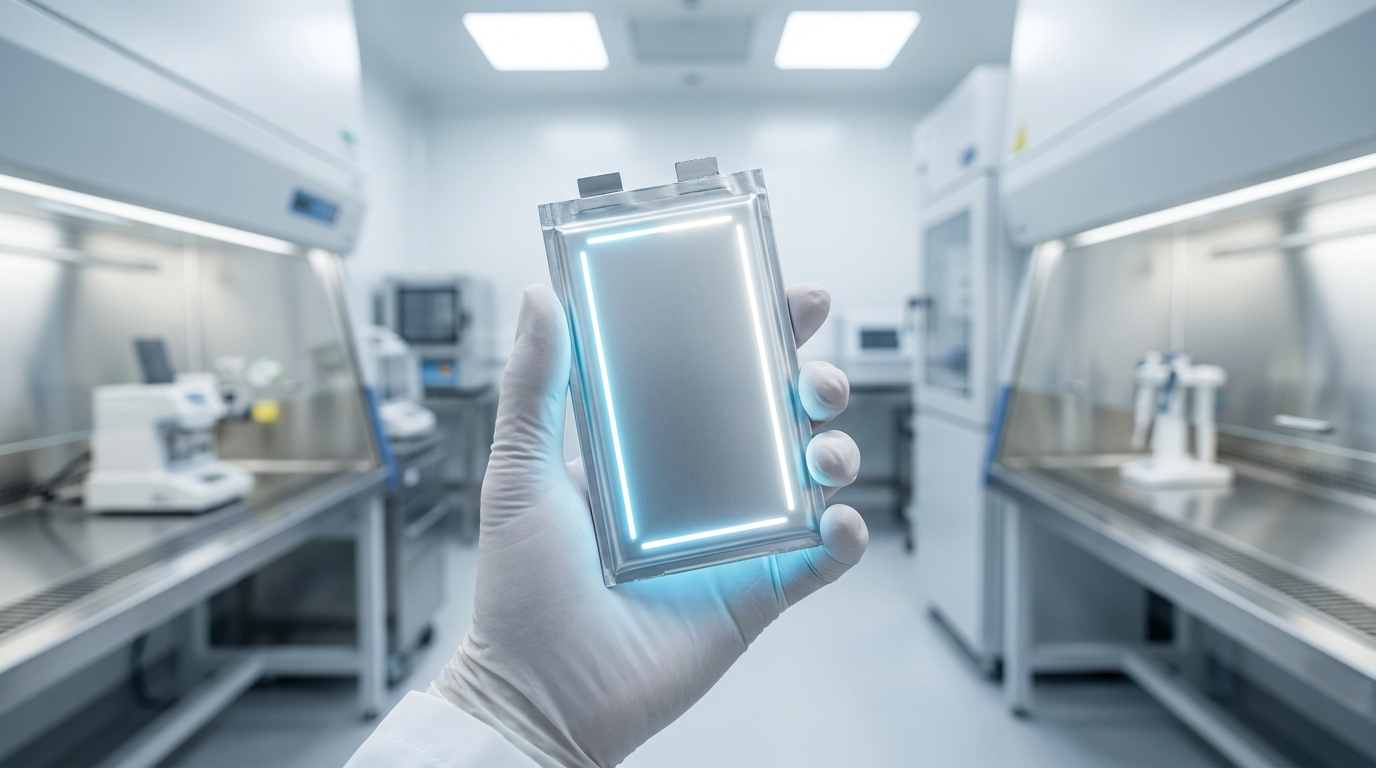
Solid-state batteries eliminate this vulnerability by replacing the liquid soup with a solid, non-flammable material—typically a specialized ceramic, glass, or sulfide compound. Because there is no combustible fluid, the risk of catastrophic fires plummets. These solid cells can operate safely at temperatures up to 80°C (176°F), whereas traditional lithium-ion cells begin to degrade rapidly and risk failure once internal temperatures cross 50°C.[5]
But safety is only the baseline. The true prize of the solid electrolyte is what it allows engineers to do with the rest of the battery. Because the solid separator is so robust, manufacturers can replace the bulky graphite anode used in today's batteries with pure lithium metal.[6]

The true prize of the solid electrolyte is what it allows engineers to do with the rest of the battery.
Lithium metal is the ultimate anode material. It is incredibly light and can store vastly more energy in the same physical footprint. Today's best lithium-ion batteries max out at an energy density of roughly 250 to 300 watt-hours per kilogram (Wh/kg). The solid-state cells entering pilot production in 2026 are targeting 400 to 500 Wh/kg.[2][6]
For the driver, that density translates directly into freedom. Toyota claims its early solid-state vehicles will deliver ranges of 621 to 745 miles (1,000 to 1,200 kilometers) on a single charge. A driver could theoretically travel from New York to Chicago without ever plugging in.[3][7]
When they do need to plug in, the experience will be drastically different. Because solid electrolytes are highly resistant to heat and can handle massive influxes of current without degrading, charging times are expected to plummet. Toyota and QuantumScape both project that their solid-state packs will be capable of charging from 10% to 80% in roughly 10 minutes.[1][3]

Despite these staggering numbers, the road to mass adoption remains fraught with immense engineering hurdles. Replacing a liquid with a solid trades one set of chemical problems for a stubborn set of physical ones.[6]
The most significant challenge is the "breathing" problem. As lithium ions move in and out of the electrodes during charging and discharging, the battery materials physically expand and contract. In a liquid battery, the fluid simply flows around these changing shapes. But in a solid-state battery, the rigid solid electrolyte must maintain perfect, microscopic contact with the expanding and contracting electrodes.[6]
If that intimate contact degrades over thousands of cycles, electrical resistance spikes, and the battery dies. Engineers are currently forced to design complex, heavy mechanical compression systems to squeeze the battery layers together, which eats into the weight savings the technology is supposed to provide.[6]
Cost and manufacturing scale present the final bottlenecks. Building solid-state cells requires entirely new factory equipment, pristine clean-room environments, and novel manufacturing techniques like QuantumScape's "Cobra" separator process. Financial analysts note that while the technology is proven, the capital required to reach gigawatt-hour scale is staggering, leaving early-stage companies with significant execution risk.[1][4]

Because of these costs, the first solid-state batteries will not appear in affordable commuter cars. Industry roadmaps suggest they will debut in premium luxury vehicles, high-performance sports cars, and potentially hybrid models where smaller battery packs can keep costs manageable.[3]
True mass-market availability—where solid-state tech replaces standard lithium-ion in the average family crossover—is widely projected to arrive between 2030 and 2032. But with pilot lines now spinning up in California and China, the countdown to the next era of electric transportation has officially begun.[1][2][3]
Viewpoints in depth
The Innovators' View
Startups and battery developers focused on the immediate performance leaps.
Companies like QuantumScape and Greater Bay Technology argue that the fundamental science of solid-state lithium-metal is now solved. Their focus has shifted entirely to industrialization—proving that these cells can be manufactured rapidly and consistently. They view the 2026 pilot lines as the 'Kitty Hawk moment' that proves the technology is ready to leave the lab and enter the real world.
The Automakers' View
Legacy car manufacturers balancing the new tech with existing supply chains.
Automakers like Toyota acknowledge the revolutionary potential of solid-state cells but are taking a measured approach to deployment. Because the initial cost of these batteries will be astronomical, legacy brands plan to introduce them slowly, beginning with premium luxury models or hybrids. They must also protect their massive existing investments in traditional lithium-ion factories, ensuring a gradual transition rather than an overnight disruption.
The Pragmatists' View
Engineers and analysts focused on the physical limitations of solid electrolytes.
While the chemistry is sound, materials scientists point out that replacing a liquid with a solid introduces severe mechanical challenges. The 'breathing' problem—where electrodes expand and contract during charging—can cause the solid electrolyte to lose contact, killing the battery. Researchers emphasize that while pilot lines are running, perfecting the mechanical compression needed to keep these cells alive over hundreds of thousands of miles remains a formidable hurdle.
What we don't know
- How quickly manufacturing costs can be driven down to make solid-state batteries affordable for entry-level vehicles.
- Whether the mechanical 'breathing' problem can be solved without adding heavy compression systems that negate the battery's weight advantages.
- Which specific solid material—ceramics, sulfides, or polymers—will ultimately become the industry standard.
Sources
Source coverage
7 outlets
3 viewpoints surfaced







[1]InsideEVsNext-Gen Battery Developers
QuantumScape Kicks Off Pilot Production For Solid-State EV Batteries
Read on InsideEVs →[2]ElectrekNext-Gen Battery Developers
China ramps up solid-state EV battery production with GBT
Read on Electrek →[3]Car and DriverIncumbent Automakers
Toyota Lays Out Its EV Battery Road Map, Including a Solid-State Battery
Read on Car and Driver →[4]Simply Wall StScientific & Financial Pragmatists
QuantumScape Stock Reassessed As Solid State Deals Revive Valuation Debate
Read on Simply Wall St →[5]EV Infrastructure NewsScientific & Financial Pragmatists
Technology fundamentals explained: Solid-state batteries
Read on EV Infrastructure News →[6]MediumScientific & Financial Pragmatists
The physics problem hiding in solid-state batteries
Read on Medium →[7]TopSpeedIncumbent Automakers
Toyota's Solid-State Batteries Revealed
Read on TopSpeed →
Every angle. Every day.
Get automotive stories with full source coverage and perspective breakdowns delivered to your inbox.