
UK Forces Seize Russian Shadow Fleet Oil Tanker in English Channel
British Royal Marines and law enforcement officers boarded and seized a sanctioned Russian oil tanker in the English Channel, marking the UK's first direct interception of a shadow fleet vessel.
By Factlen Editorial Team
- UK Government
- Views the seizure as a necessary enforcement action to choke off funding for Russia's war machine.
- Ukrainian Officials
- Advocates for moving beyond detentions to the outright confiscation of Russian oil cargoes.
- Maritime Industry Monitors
- Focuses on the legal mechanics of stateless vessels and the environmental risks of the shadow fleet.
What's not represented
- · Russian Government
- · Indian Oil Importers
- · Chinese Vessel Owners
Why this matters
The interception represents a significant escalation in Western enforcement of sanctions against Russia's war economy. By physically seizing a vessel rather than merely sanctioning it, the UK is establishing a new precedent for maritime interdiction that could disrupt the covert logistics network funding Moscow's military operations.
Key points
- British Royal Marines and the National Crime Agency boarded the Russian shadow fleet tanker Smyrtos in the English Channel.
- The six-hour operation marks the first time the UK has directly seized a sanctioned vessel.
- The unflagged tanker was carrying over 100,000 tonnes of Russian Urals crude destined for India.
- The UK Ministry of Defence estimates the shadow fleet transports 75% of Russia's sanctioned oil.
- The vessel is currently anchored off the coast of Dorset for environmental and safety monitoring.
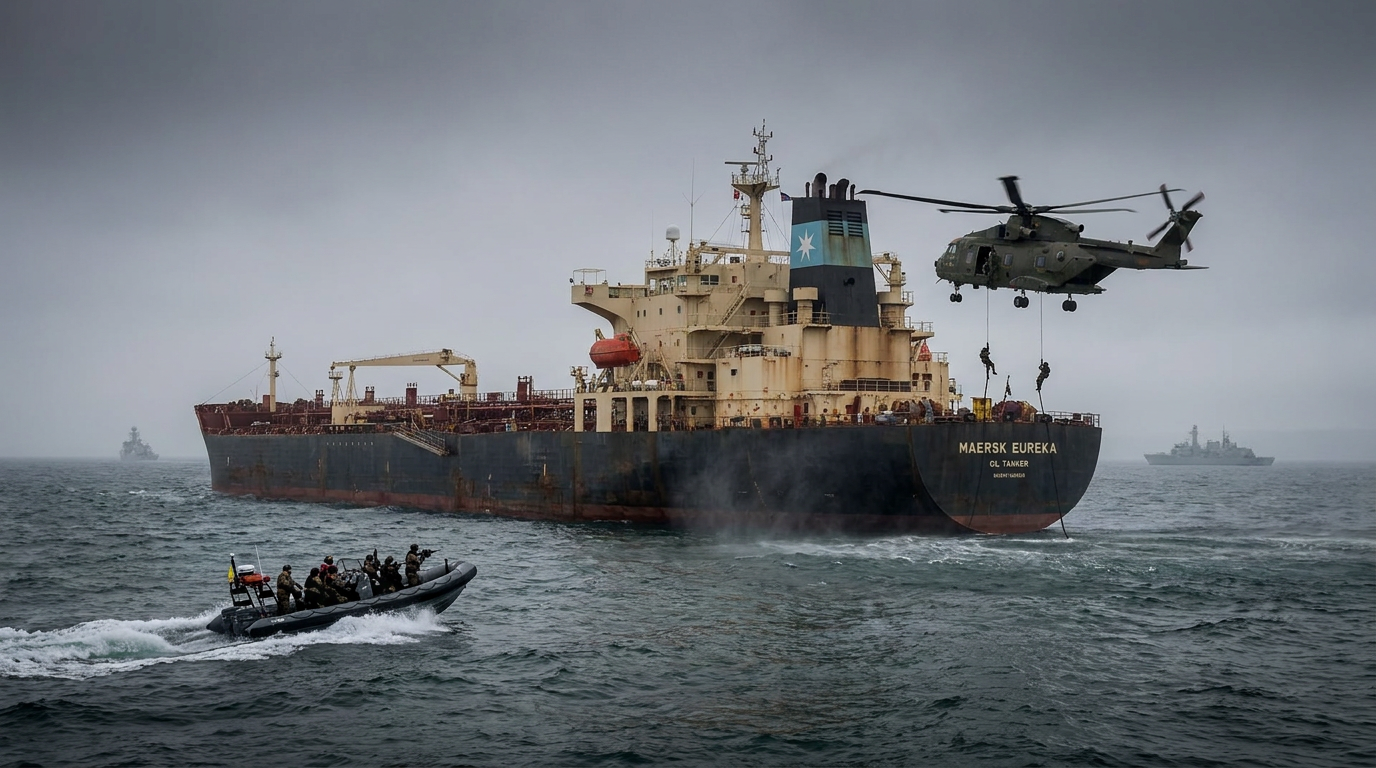
British armed forces executed a complex, six-hour maritime operation early Sunday morning to board and seize a sanctioned Russian oil tanker in the English Channel. The interception of the Smyrtos, an Aframax-class tanker carrying over 100,000 tonnes of Russian Urals crude, marks a significant escalation in Western enforcement efforts and the first time the United Kingdom has directly commandeered a vessel belonging to Moscow's so-called "shadow fleet." The operation signals a shift from passive monitoring and financial blacklisting to physical interdiction, directly challenging the covert logistics network that sustains the Russian war economy.[1][2][5]
Operating under the cover of darkness, Royal Marine Commandos and specially trained law enforcement officers from the National Crime Agency boarded the massive vessel. The interdiction was supported by a formidable military umbrella designed to ensure total control of the airspace and sea lanes surrounding the tanker. Aircraft from the Maritime Air Group, including Chinook, Merlin Mk4, and Wildcat helicopters, hovered above the deck, while a Royal Air Force P-8 Poseidon maritime patrol aircraft provided overwatch. On the water, the Type 23 frigate HMS Sutherland and the mine countermeasures vessel HMS Ledbury flanked the Smyrtos, effectively neutralizing any potential resistance or evasion attempts by the tanker's crew.[1][7]
Following the successful boarding and securing of the ship, British authorities diverted the Smyrtos to an anchorage off the coast of Dorset, near Weymouth in southern England. The Ministry of Defence confirmed that the aging vessel will be held in UK territorial waters and closely monitored for severe environmental and safety risks while comprehensive investigations proceed. The presence of a heavily laden, poorly maintained oil tanker in one of the world's busiest shipping lanes presents a distinct ecological hazard, prompting authorities to prioritize securing the vessel's integrity before determining its ultimate legal fate.[2][5][8]

The Smyrtos departed from Russia's Ust-Luga oil terminal in the Baltic Sea on June 4, with its cargo destined for the port of Sikka in India. Although the vessel had previously sailed under the flag of Cameroon, maritime intelligence indicates that the African nation recently deregistered the ship, alongside dozens of others, following intense diplomatic pressure from the European Union. Stripped of its flag, the Smyrtos entered the English Channel as a stateless vessel. This critical detail provided the legal justification under Article 110 of the United Nations Convention on the Law of the Sea (UNCLOS), which permits warships to intercept and board a ship if there are reasonable grounds to suspect it is operating without a nationality.[5][7]
Prime Minister Keir Starmer, who authorized the military to board shadow fleet vessels passing through British waters earlier this year, confirmed that he personally directed Sunday's operation. "This successful operation delivers yet another blow to Russia and reminds those fueling Putin's war in Ukraine that we will not let them hide," Starmer stated. The Prime Minister emphasized that the enforcement action was carried out in strict accordance with both domestic and international law, framing the seizure as a necessary step to protect European security and uphold the integrity of global sanctions.[2][8]

"This successful operation delivers yet another blow to Russia and reminds those fueling Putin's war in Ukraine that we will not let them hide," Starmer stated.
Defence Secretary Dan Jarvis praised the skill, professionalism, and courage of the armed forces personnel involved in the high-stakes boarding. Jarvis noted that the interdiction directly targets the financial arteries sustaining the Russian military, declaring that the operation "delivers a blow to Putin's illegal war." The UK's unilateral action builds upon recent collaborative efforts with European allies; British forces had previously provided surveillance and logistical support to the French Navy, which intercepted a suspected shadow fleet tanker in the Atlantic Ocean in late May.[1][3]
Russia relies heavily on a covert network of more than 700 aging, opaquely owned, and inadequately insured tankers to bypass Western price caps and embargoes. According to the UK Ministry of Defence, this "shadow fleet" is responsible for transporting roughly 75 percent of Russia's sanctioned oil. By utilizing complex corporate structures, frequently changing vessel names, and hopping between obscure flag registries, the fleet generates critical revenue that funds the Kremlin's procurement of ballistic missiles, drones, and artillery used in the ongoing invasion of Ukraine.[1][4]

The UK government has aggressively targeted this illicit maritime network, sanctioning nearly 600 vessels to date and banning them from accessing British ports, insurance markets, and maritime services. British officials estimate that these enforcement measures are steadily biting into Moscow's war chest. Government data indicates a 24 to 27 percent year-over-year decline in Russian oil and gas revenues, suggesting that the combination of financial blacklisting and the increased operational costs of running a clandestine shipping network is degrading the profitability of Russia's primary export.[1][6]
The physical seizure of the Smyrtos drew immediate praise from Kyiv, where officials have long argued that Western sanctions are too porous. Ukrainian President Volodymyr Zelenskyy welcomed the interdiction, expressing gratitude to the UK while urging European allies to take far more aggressive legislative steps. Zelenskyy argued that Western nations must move beyond merely detaining tankers and begin legally confiscating the sanctioned oil they carry. Liquidating these seized assets and redirecting the funds to Ukraine's defense and reconstruction, Kyiv contends, is the only way to permanently dismantle the shadow fleet's lucrative business model.[4]
The capture of the Smyrtos establishes a muscular new precedent for maritime enforcement in European waters, signaling that the era of unimpeded transit for stateless Russian tankers may be closing. As the vessel remains anchored off the English coast, the long-term legal and logistical fate of the ship—and its massive cargo of crude oil—remains to be determined. The UK government now faces the complex challenge of navigating international asset forfeiture proceedings, managing the environmental risks of a detained tanker, and bracing for potential diplomatic or asymmetric retaliation from Moscow.[5][7]
How we got here
March 2026
Prime Minister Keir Starmer authorizes British armed forces to board and detain shadow fleet vessels in UK waters.
May 31, 2026
The French Navy, with UK support, intercepts a Russian shadow fleet tanker in the Atlantic Ocean.
June 4, 2026
The Smyrtos departs the Russian port of Ust-Luga loaded with Urals crude.
Early June 2026
Cameroon deregisters the Smyrtos following European diplomatic pressure, rendering the vessel stateless.
June 14, 2026
British forces board and seize the Smyrtos in the English Channel.
Viewpoints in depth
UK & Allied Governments
Viewing the shadow fleet as a critical vulnerability in Russia's war machine.
British and European officials argue that the shadow fleet is not merely a sanctions-evasion tool, but a direct funding mechanism for the Russian military. By physically intercepting stateless vessels like the Smyrtos, allied governments aim to establish a deterrent that increases the operational and financial risks for the opaque network of owners and insurers facilitating Moscow's oil trade. They emphasize that such actions are legally grounded in international maritime law regarding unflagged ships.
Ukrainian Leadership
Pushing for asset confiscation rather than just detention.
While welcoming the physical interception of tankers, Kyiv argues that detention alone is insufficient to cripple the Russian war economy. Ukrainian officials, including President Zelenskyy, are lobbying Western allies to implement legal frameworks that allow for the outright confiscation and sale of the intercepted oil. They contend that liquidating these assets and redirecting the funds to Ukraine's defense and reconstruction is the only way to permanently dismantle the shadow fleet's business model.
Maritime & Environmental Monitors
Highlighting the severe ecological risks posed by the shadow fleet.
Independent maritime analysts and environmental watchdogs point out that the shadow fleet consists largely of aging vessels—often over 15 years old—operating without standard industry insurance or rigorous safety inspections. The Smyrtos itself has a history of changing names and flags to obscure its origins. Experts warn that an accident involving one of these poorly maintained, heavily loaded tankers in crowded waterways like the English Channel could trigger a catastrophic oil spill with no clear entity to hold financially accountable.
What we don't know
- It remains unclear what the UK government ultimately plans to do with the Smyrtos and its cargo of over 100,000 tonnes of crude oil.
- It is unknown how Russia will retaliate against the physical seizure of a vessel carrying its state-backed exports.
- The exact ownership structure of the Smyrtos remains opaque, complicating potential legal forfeiture proceedings.
Key terms
- Shadow Fleet
- A covert network of aging, opaquely owned tankers used to transport sanctioned oil and evade international price caps.
- Aframax
- A medium-sized oil tanker with a deadweight tonnage between 80,000 and 120,000, commonly used for short- to medium-haul crude transport.
- UNCLOS
- The United Nations Convention on the Law of the Sea, an international treaty that establishes guidelines for businesses, the environment, and the management of marine natural resources.
- Urals Crude
- The primary reference oil brand used as a basis for pricing the Russian export oil mixture.
Frequently asked
Why was the UK legally allowed to board the ship?
Under the UN Convention on the Law of the Sea (UNCLOS), warships have the right to board a vessel if there are reasonable grounds to suspect it is without nationality. Because the Smyrtos had recently been deregistered by Cameroon, it was operating as a stateless vessel.
Where was the oil going?
The Smyrtos had loaded its cargo at the Russian port of Ust-Luga and was en route to Sikka, India.
What happens to the oil now?
The vessel is currently anchored off the southern coast of England. The UK government has not yet announced whether it will attempt to legally confiscate and sell the oil, or simply hold the vessel indefinitely.
Sources
Source coverage
8 outlets
3 viewpoints surfaced






[1]UK Ministry of DefenceUK Government
British forces this morning boarded a sanctioned shadow fleet oil tanker in the Channel in the latest blow to Russia's war economy
Read on UK Ministry of Defence →[2]The GuardianUK Government
Keir Starmer says operation involving UK armed forces has delivered 'yet another blow' to Russia and Putin
Read on The Guardian →[3]Al JazeeraMaritime Industry Monitors
UK forces seize Russian shadow-fleet oil tanker in English Channel
Read on Al Jazeera →[4]Kyiv IndependentUkrainian Officials
Britain detains Russian shadow fleet tanker in English Channel
Read on Kyiv Independent →[5]Lloyd's ListMaritime Industry Monitors
UK forces boarded and seized the unflagged Russian tanker Smyrtos in the English Channel
Read on Lloyd's List →[6]The Moscow TimesMaritime Industry Monitors
U.K. Intercepts Russian Shadow Fleet Vessel in English Channel
Read on The Moscow Times →[7]The AviationistMaritime Industry Monitors
UK Seizes Russian 'Shadow Fleet' Tanker In English Channel
Read on The Aviationist →[8]The Washington PostUK Government
Britain detains sanctioned oil tanker believed to be linked to Russia's shadow fleet
Read on The Washington Post →
More in news politics
See all 8 stories →Digital Provenance
How 'Digital Provenance' is Replacing Traditional Fact-Checking in the Deepfake Era
0 sources

US-Iran Relations
Anticipated US-Iran Peace Deal Complicated by Israeli Strikes on Beirut
0 sources
US-Iran Relations
US and Iran Near Peace Deal as Israeli Strikes on Beirut Threaten Ceasefire
0 sources
US-Iran Relations
Trump's US-Iran Peace Deal Nears Signing as Israel Strikes Beirut
0 sources
Every angle. Every day.
Get news politics stories with full source coverage and perspective breakdowns delivered to your inbox.