
How Electromagnetic Resistance is Reshaping Home Strength Training
A new generation of smart home gyms is replacing traditional iron plates with digital algorithms, bringing elite sports-science techniques to the living room.
By Factlen Editorial Team
- Sports Scientists & Biomechanists
- Focus on the biomechanical advantages of constant tension and the ability to safely overload the eccentric phase.
- Home Fitness Advocates
- Value the safety, space efficiency, and AI-driven spotting that makes heavy lifting accessible to solo users.
- Traditional Strength Purists
- Maintain that balancing physical free weights is essential for developing stabilizer muscles and real-world functional strength.
What's not represented
- · Commercial gym owners facing competition from high-end home setups.
- · Physical therapists evaluating the long-term joint impact of constant-tension training.
Why this matters
Digital weight technology is democratizing elite sports-science techniques, allowing solo users to safely lift heavier and build muscle faster at home without the need for a human spotter or bulky iron plates.
Key points
- Digital weight uses electromagnetic motors instead of gravity to create resistance.
- The technology eliminates momentum, keeping muscles under constant tension throughout the entire lift.
- AI spotting automatically lowers the weight if a user struggles, making solo lifting safer.
- Eccentric overload modes add weight during the lowering phase, a proven trigger for muscle growth.
- Studies show machine-based training builds muscle just as effectively as traditional free weights.
For over a century, the fundamental physics of strength training remained unchanged: lifting a heavy piece of iron against the downward pull of gravity. But a quiet revolution is replacing cast iron with algorithms. "Digital weight"—a system that uses electromagnetic resistance instead of physical mass—has emerged as one of the most significant advancements in home fitness. By swapping metal plates for frameless motors, these systems are democratizing advanced strength-training techniques that once required a team of spotters and a commercial gym facility.[7]
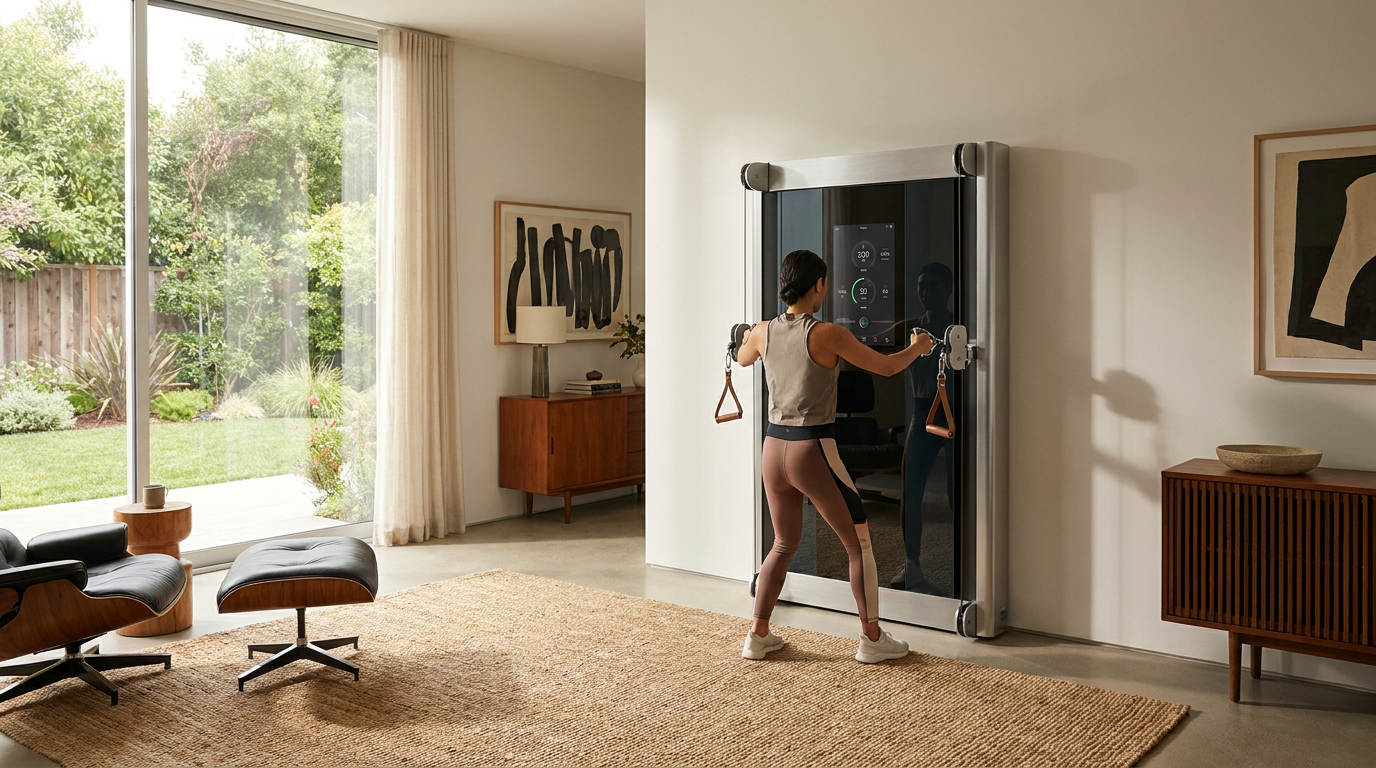
The core mechanism behind digital weight relies on brushless direct current (BLDC) motors, similar to those found in electric vehicles but optimized for torque rather than speed. Instead of gravity pulling a weight downward, these motors generate an electromagnetic field that pulls against a cable. Because the resistance is generated digitally, a sleek machine weighing less than 50 pounds can simulate up to 440 pounds of physical drag.[3][5]
This shift from mass to magnetic torque solves a fundamental biomechanical flaw in traditional free weights: the momentum curve. When a lifter explosively pushes a 50-pound dumbbell upward, the initial acceleration requires significant force. However, as the weight gains momentum, it effectively becomes "lighter" near the top of the movement, robbing the muscle of tension.[7]

Digital weight eliminates this momentum cheat. The internal computers in systems like Tonal and Vitruvian monitor the cable's position up to 1,000 times per second, adjusting the electromagnetic current instantly to strip away inertia. This creates a perfectly flat resistance curve, ensuring that 50 pounds of digital weight demands exactly 50 pounds of muscular force at every millimeter of the repetition, regardless of how fast the user moves.[1][2]
This constant tension unlocks a training modality known as isokinetic exercise, where the speed of the movement is controlled, and the resistance dynamically matches the user's force output. Historically, isokinetic machines were massive, prohibitively expensive devices confined to elite sports rehabilitation clinics. Now, that same precise muscular loading is available in wall-mounted screens and portable floor platforms.[1][7]
Beyond smoothing out momentum, the true breakthrough of digital weight lies in its ability to manipulate the "eccentric" phase of a lift. Every strength exercise has two halves: the concentric phase (lifting the weight, like pushing a barbell off the chest) and the eccentric phase (lowering the weight back down).[2]

Decades of sports science research have demonstrated that muscles are naturally stronger during the eccentric phase—capable of handling roughly 20 to 30 percent more load than they can lift concentrically. Furthermore, loading the eccentric phase heavily is one of the most effective known triggers for muscle hypertrophy (growth) and power development.[2][4][6]
Furthermore, loading the eccentric phase heavily is one of the most effective known triggers for muscle hypertrophy (growth) and power development.
The problem with traditional iron is that you cannot safely overload the eccentric phase alone. If a lifter puts 250 pounds on a barbell to maximize their lowering strength, they will be physically unable to push it back up without two human spotters physically lifting the bar for them. As a result, almost all traditional strength training is bottlenecked by the user's weaker concentric strength.[2][7]
Digital weight machines solve this elegantly through "eccentric overload" modes. Because the resistance is just an algorithm, the machine can seamlessly add 25 percent more weight the millisecond the user begins to lower the handles, and instantly strip that extra weight away the moment they begin to push back up. This allows a solo lifter in their living room to safely push their muscles to absolute failure in both directions.[1][2][3]

Safety is another major factor driving the adoption of electromagnetic resistance. Lifting heavy free weights alone carries an inherent risk of getting pinned under a barbell. Digital systems act as an active AI spotter. If the machine's sensors detect that the cable's velocity has stalled and the user is struggling to complete a repetition, it automatically reduces the resistance in real-time, allowing the user to finish the set safely.[1][2]
But does this high-tech approach actually build muscle as effectively as traditional iron? A longstanding bias in the fitness industry has favored free weights, under the assumption that balancing a barbell recruits more stabilizer muscles. However, recent meta-analyses comparing free weights to machine-based training have challenged this assumption.[4][6]
Comprehensive reviews published by the National Institutes of Health and sports science journals show no significant difference in muscle hypertrophy between free-weight and machine-based training when the effort and volume are matched. Both modalities are highly effective at stimulating muscle growth, provided the user trains close to muscular failure.[4][6]

Where free weights still hold an advantage is in specific power development and absolute maximal strength for powerlifting. If an athlete's goal is to compete in barbell squats, they must train with a barbell to master the specific neurological coordination required to balance that mass. But for general fitness, longevity, and aesthetic muscle growth, digital resistance is proving to be an equal, if not superior, tool due to its increased time-under-tension.[1][4][7]
The primary barrier to entry remains cost. These smart gyms require a significant upfront investment—often ranging from $3,000 to $4,000—plus ongoing monthly subscription fees to access the software and AI features that make the hardware truly effective. For budget-conscious consumers, a simple set of adjustable dumbbells remains the most cost-effective path to fitness.[1][7]
Despite the cost, the integration of robotics into home fitness represents a permanent shift in how we approach physical health. By removing the logistical hurdles of spotters, plate math, and momentum, digital weight allows users to focus entirely on the quality of their muscular contraction. As the technology scales and becomes more affordable, the era of the "dumb iron" home gym may eventually become a thing of the past.[1][7]
How we got here
1960s
Isokinetic machines are introduced in elite sports rehabilitation clinics.
2018
Tonal launches the first consumer wall-mounted digital weight system.
2020
Vitruvian launches a portable floor-based digital resistance platform.
2023
Meta-analyses confirm machine-based training yields similar hypertrophy to free weights.
Viewpoints in depth
Sports Scientists & Biomechanists
Focus on how digital weight unlocks precise muscular loading previously confined to labs.
For decades, sports scientists have known that isokinetic and eccentric-overload training produce superior muscular adaptations. However, these modalities required massive, specialized equipment that was impractical for daily use. Biomechanists view digital weight as a breakthrough because it allows for the precise measurement of force output and velocity on every single repetition, turning a standard workout into a data-rich clinical assessment.
Traditional Strength Purists
Argue that balancing physical iron is essential for developing true functional strength.
Many traditional strength coaches maintain that while digital weight is excellent for isolating muscles, it cannot fully replace a barbell. Balancing a 300-pound physical weight on your back requires intense neurological coordination, core stabilization, and micro-adjustments that a guided cable simply cannot replicate. For athletes training for powerlifting or contact sports, purists argue that moving physical mass through space remains a non-negotiable requirement.
Home Fitness Advocates
Value the removal of friction, allowing for safer and more efficient solo workouts.
For the average consumer, the biggest barriers to strength training are safety, space, and time. Home fitness advocates champion digital weight because it eliminates the need for a dedicated room full of iron plates and the necessity of a human spotter. The ability to change resistance with the push of a button and rely on AI to catch a failed lift makes heavy strength training accessible to demographics that previously avoided the weight room.
What we don't know
- Whether long-term reliance on digital weight alters the neurological adaptations required for real-world heavy lifting.
- How the durability of these internal BLDC motors will hold up over decades of heavy daily use compared to indestructible cast iron.
- If the subscription-based business model of smart gyms will remain viable in a tightening consumer economy.
Key terms
- Digital Weight
- Electromagnetic resistance generated by motors rather than physical mass.
- Concentric Phase
- The lifting portion of an exercise where the muscle shortens.
- Eccentric Phase
- The lowering portion of an exercise where the muscle lengthens under tension.
- Isokinetic Training
- Exercise where the speed of movement is kept constant by dynamically adjusting resistance.
- Hypertrophy
- The enlargement of muscle tissue from exercise.
Frequently asked
Can digital weight build as much muscle as free weights?
Yes. Meta-analyses show that when effort and volume are matched, machine-based resistance and free weights produce similar muscle growth.
What happens if I fail a rep on a digital weight machine?
The machine acts as an AI spotter. If it detects the cable velocity stalling, it automatically reduces the resistance so you can finish the movement safely.
Do I need a spotter for heavy lifting?
No. Because the resistance is algorithmic, you can safely push to muscular failure alone; the machine will disengage the weight if you cannot complete the lift.
Are these machines safe for beginners?
Yes. They often include built-in form guidance, start at very low resistance (as low as 1 pound), and eliminate the risk of dropping heavy iron plates.
Sources
Source coverage
7 outlets
3 viewpoints surfaced






[1]GearJunkieTraditional Strength Purists
Digital Coaching, Dynamic Resistance: Tonal Is the Fitness 'Gimmick' I Wanted to Hate but Didn't
Read on GearJunkie →[2]TonalHome Fitness Advocates
Reap the strength, power, and hypertrophy benefits of eccentric training from home
Read on Tonal →[3]VitruvianHome Fitness Advocates
The power of eccentric training without a spotter
Read on Vitruvian →[4]National Institutes of HealthSports Scientists & Biomechanists
Free-weights vs. machines: A meta-analysis of strength and hypertrophy
Read on National Institutes of Health →[5]Lin EngineeringSports Scientists & Biomechanists
Utilizing Frameless BLDC Motors for Electromagnetic Resistance
Read on Lin Engineering →[6]SportsmithSports Scientists & Biomechanists
Free weights vs machine based training: Is the bias justified?
Read on Sportsmith →[7]Factlen Editorial TeamHome Fitness Advocates
Synthesis by Factlen editorial team
Read on Factlen Editorial Team →


Every angle. Every day.
Get fitness stories with full source coverage and perspective breakdowns delivered to your inbox.